
On this page
Start here
Quick answer
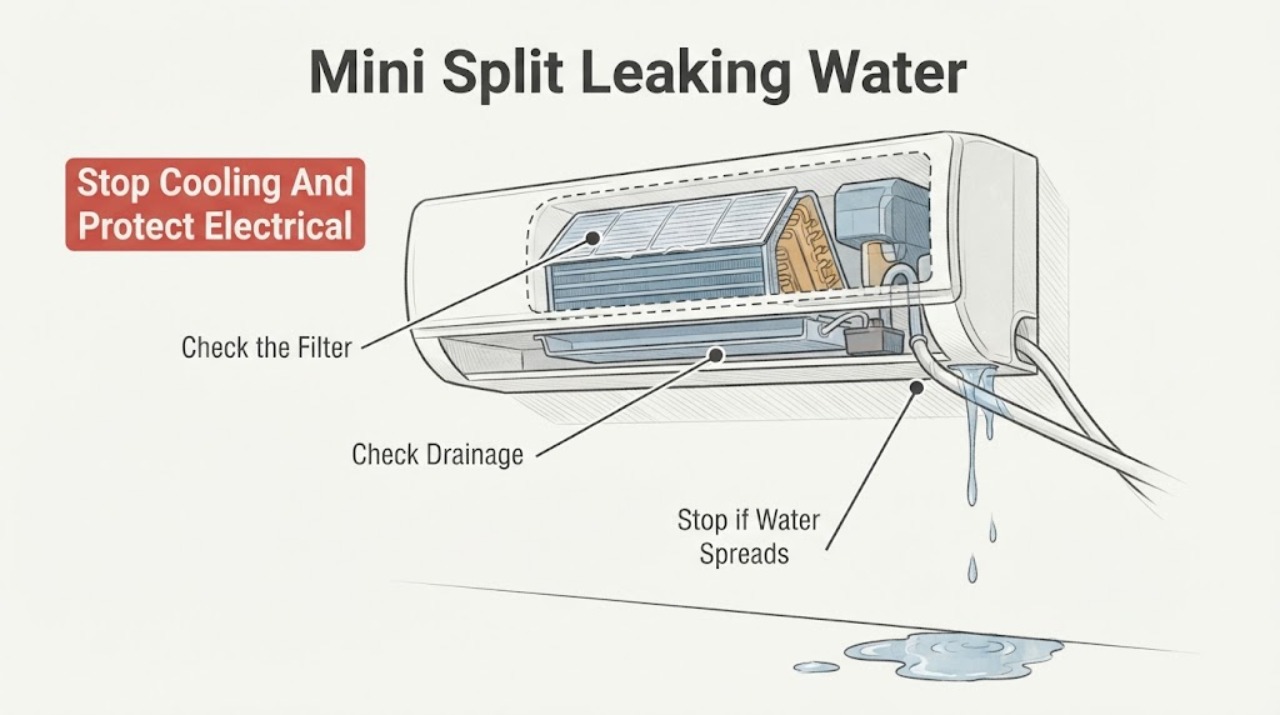
A Fujitsu mini split that is leaking water usually has condensate that is not leaving the indoor unit correctly, excess frost melting after restricted airflow, or an installation or component problem. Stop cooling from the remote, protect the wall and floor, and keep clear of water near electrical parts. Check and clean the accessible air filters as the Fujitsu model manual directs, look for ice or water at the indoor unit, and inspect only the visible end and routing of the condensate drain for kinks or an obvious blockage. Do not open the indoor unit, disturb refrigerant tubing, pour chemicals into the drain, or adjust the unit's mounting. If water returns, the drain or pan is hidden, the coil is icing, cooling is weak, or electrical parts are wet, leave the system off and arrange qualified HVAC service.
Work through in order
Diagnostic checks
Use only checks that match the exact appliance or system and its official guide.
-
Check 1
Stop the Fujitsu mini split from its remote or normal control and place a towel or shallow container below the indoor unit. If water is near the power cord, outlet, disconnect, or wiring, do not touch the wet area; isolate power only from a dry, safe position or arrange electrical help. Keep people away from a slippery wall or floor.
Expected result: Water stops when cooling stops, continues while the unit is off, is coming from the indoor unit, or has reached electrical components or building materials.
Next step: Leave the system off and continue only with dry, external checks. Arrange HVAC service for an active or unexplained leak, and use an electrician for an unsafe wet electrical connection.
Stop if: Do not operate the mini split with water entering the electrical compartment, remove the cover, or reach behind the unit while standing on a wet surface.
Why this matters
Why: Water that stops with operation is consistent with a condensate, frost-melt, or drain-path symptom. Continued dripping can be stored water in the pan or a separate leak. Wet electrical parts or soaked wall/ceiling materials are a safety and damage boundary, not a routine cleaning task.
-
Check 2
With the system off, open only the normal filter access described in the Fujitsu owner's manual. Inspect the washable or user-serviceable filter for dust and confirm that it is seated correctly; clean and dry it exactly as the manual directs. Do not remove the coil, blower, drain pan, or electrical cover.
Expected result: The filter is heavily dirty, the filter is missing or mis-seated, airflow was weak, the filter is clean, or ice is visible behind the filter area.
Next step: After the filter is fully dry and installed, leave the system off until any ice has cleared and only test if there is no electrical or active-leak hazard. If ice returns, airflow remains weak, or water returns, arrange qualified HVAC service.
Stop if: Do not run the unit without its filter, scrape ice from the coil, use a heat gun or open flame, or spray cleaner into the indoor cabinet.
Why this matters
Why: A restricted filter can reduce airflow across the evaporator coil and contribute to freezing, with melt water later overflowing the pan. A clean, correctly installed filter makes a blocked drain, pan, pump, mounting, or refrigerant issue more likely. Visible ice means continued cooling can add water when it melts.
-
Check 3
From a dry, safe position, follow the visible condensate drain hose from the indoor unit as far as it can be seen. Look for a sharp kink, crushed section, disconnected end, upward loop, or loose debris at the outlet; do not detach the hose or open the unit. If the model has a drain pump, note any pump alarm or water that remains at the indoor unit.
Expected result: The hose is kinked, disconnected, visibly blocked, routed so water cannot flow away, the outlet is dry while the indoor pan leaks, or the visible route appears clear.
Next step: Correct only a loose external hose position if the model instructions clearly permit it and no tools or disassembly are required. Otherwise leave the unit off and arrange service to clear or test the drain and pump safely.
Stop if: Do not blow compressed air into the line, pour bleach or drain chemicals into it, disconnect a concealed hose, or force water into the indoor cabinet.
Why this matters
Why: A damaged or poorly draining visible hose can back water into the pan. A clear visible end does not rule out a blockage inside the hose, a pump fault, a hidden pan restriction, or a drain connection problem.
-
Check 4
Without moving the unit or removing panels, look at the lower edge, visible drain-pan area, wall bracket, and nearby refrigerant-line insulation for an obvious tilt, sag, crack, wet insulation, or gap at the wall penetration. Compare the leaking side with the side where the drain outlet should route according to the model manual.
Expected result: The indoor unit appears tilted, water collects on one side, the pan or casing is cracked, insulation is wet, the wall penetration is open, or the visible mounting and casing look normal.
Next step: Leave mounting, pan, insulation, and line-set repairs to qualified HVAC service. Keep the unit off if water continues or reaches the wall, ceiling, or electrical area, and provide photos and the model number to the technician.
Stop if: Do not loosen mounting hardware, level the indoor unit by force, remove line insulation, open the sealed refrigeration circuit, or drill into the wall near hidden piping.
Why this matters
Why: A mounting or drain-pan defect can keep condensate from reaching the outlet and can send it through the air outlet or wall side. Wet refrigerant-line insulation or repeated icing points toward a system condition that cannot be identified by exterior appearance alone.
-
Check 5
Record whether the leak appears only in Cooling or Dry mode, after long operation, during high humidity, after the system cycles off, or together with weak airflow, poor cooling, hissing, or repeated ice. Note whether the outdoor unit runs and whether other indoor units in a multi-zone system are affected, without opening any unit.
Expected result: The leak follows heavy cooling or humidity, ice repeatedly forms, cooling is weak, an unusual sound is present, the leak recurs after the drain is externally clear, or the problem affects one or several indoor units.
Next step: Keep the affected system off and arrange qualified HVAC service for recurring water, ice, weak cooling, unusual sounds, suspected refrigerant issues, or multi-zone symptoms. Give the technician the mode, timing, visible water path, and model information.
Stop if: Do not adjust refrigerant, connect gauges, release refrigerant, reset a protection device repeatedly, or keep running the unit to reproduce a leak.
Why this matters
Why: A mode- or humidity-related event can involve normal condensation that is not draining, a restricted filter, or frost melt. Repeated ice with weak cooling raises a refrigerant, airflow, or coil problem; a multi-zone pattern or recurring leak makes system-level or shared drainage diagnosis more likely.
Use your observations
Decision map
Find the observation that best matches what you see, then follow the next safe action.
-
PATH 01Next step
What you see
The filter is dirty or mis-seated, airflow is weak, and ice forms on or behind the indoor filter area before water appears.
Do this next
Clean and dry the filter according to the Fujitsu manual, leave the system off while ice melts, and arrange service if ice or leaking returns or the coil is not accessible through normal maintenance.
Why this path and its safety boundary
Why it matters: Restricted airflow and subsequent frost melt are more likely than a simple external hose issue, although a restricted drain can also be present.
-
PATH 02Next step
What you see
Water leaks from the indoor unit during cooling, the visible drain outlet is dry, or water remains at the pan while the visible hose is kinked, disconnected, or unclear.
Do this next
Leave the system off and have qualified service test the drain pan, hose, pump, and outlet. Correct only a clearly accessible loose hose position allowed by the model instructions.
Why this path and its safety boundary
Why it matters: A blocked, poorly routed, disconnected, or pump-assisted condensate path is more likely; a visible outlet cannot prove the hidden pan and hose are clear.
-
PATH 03Next step
What you see
The indoor unit is visibly tilted, water collects on one side, the pan or casing is damaged, or refrigerant-line insulation is wet.
Do this next
Keep the unit off and arrange HVAC service for mounting, pan, insulation, or concealed line work. Do not loosen the bracket or disturb refrigerant piping.
Why this path and its safety boundary
Why it matters: A drainage slope, pan, mounting, or line-insulation defect can direct condensation where it should not go and generally needs trained repair.
-
PATH 04Next step
What you see
Ice returns with a clean filter, cooling is weak, water continues after the drain path is externally clear, unusual sounds occur, or multiple indoor units show the problem.
Do this next
Stop operating the affected system and arrange qualified HVAC service for leak testing, coil and airflow checks, drain testing, and refrigerant diagnosis.
Why this path and its safety boundary
Why it matters: A refrigerant, coil, fan, control, shared drain, or other system fault is more likely and cannot be diagnosed safely from homeowner observations alone.
Helpful context
Understand the symptom
Find where the water starts
A wall-mounted Fujitsu indoor unit collects condensation in a pan and sends it through a drain hose or line. Water dripping from the lower edge or running down the wall often means the pan is overflowing or the drain path is restricted, but a dirty filter can also reduce airflow, freeze the coil, and create extra water when the ice melts. Water near the outdoor unit may be normal condensate in some operating modes, so trace the first abnormal wet location before assuming a drain failure.
Use the exact Fujitsu model manual for access
Fujitsu AIRSTAGE systems use several indoor-unit styles and may have different drain routing or a pump. A visible drain outlet can be checked without opening the cabinet, but a pan, pump, coil, or concealed hose may require service. Record the indoor-unit model before attempting anything beyond filter care and an external visual check.
Only after diagnosis
Potential parts
- Fujitsu condensate drain hose or drain pan component
Only consider this category after diagnosis confirms a damaged, disconnected, or restricted drain path or pan rather than a filter, mounting, or refrigerant cause.
Drain routing and pan design vary by indoor-unit model; confirm the model and have concealed or pan work performed by qualified service. - Fujitsu condensate drain pump component
Only consider this category when the specific indoor unit uses a pump and service diagnosis confirms that the pump or its control is not moving condensate.
Pump fit and control wiring are model-specific; do not select a pump from a leak symptom alone or open the electrical compartment.
When checks do not resolve it
Need a professional?
Arrange qualified HVAC service when water returns after filter care and an external visual check; the drain, pan, or pump is hidden or requires disassembly; the indoor unit is tilted or damaged; the coil ices; cooling is weak; refrigerant or line insulation is suspected; a multi-zone system is affected; or water reaches electrical parts, a wall, ceiling, or floor. Keep the system off for an active leak, do not open the sealed refrigeration circuit, and do not use compressed air, chemicals, improvised heat, or mounting adjustments to force a repair.
Common questions
FAQ
Why is my Fujitsu mini split leaking water indoors?
The common paths are condensate that cannot leave through the drain, frost that melts after restricted airflow, a damaged or poorly routed pan or hose, or an installation or refrigerant problem. Check the accessible filter and visible drain route only; recurring water or hidden components need qualified HVAC service.
Can a dirty Fujitsu mini split filter cause water to leak?
Yes. Fujitsu's operating guidance notes that the heat exchanger can freeze under some cooling or dry conditions and then cause water leakage. A dirty filter can restrict airflow, so clean and dry the user-serviceable filter according to the exact model manual. Repeated ice, weak cooling, or continued leaking needs service.
Can I unclog the Fujitsu mini split drain hose myself?
Only perform an external visual check or a simple hose-position correction when the exact model instructions allow it and no disassembly is required. Do not use compressed air, chemicals, or force water into the indoor unit. A hidden hose, pan, pump, or recurring leak should be tested by qualified HVAC service.
What should I do if the mini split is leaking near electrical parts?
Stop the system and keep away from the wet outlet, disconnect, cord, or wiring. Do not reach through water to disconnect power. Isolate power only from a dry, safe position or get electrical help, then arrange HVAC service to identify and correct the leak.
Read the exact guide
Official sources
- INSTALLATION INSTRUCTIONSFujitsu General United States & Canada · Fujitsu condensate drain-pan and drain-line routing, slope, fittings, insulation, drain testing, and service-access requirements
- OPERATION MANUALFujitsu General United States & Canada · Fujitsu mini-split drain hose operation, user safety, filter care, and authorized-service boundary
- What is a Mini-Split?Fujitsu General United States & Canada · Fujitsu mini-split system components, indoor evaporator unit, and condensation drain line
- OPERATION MANUALFujitsu General United States & Canada · Fujitsu mini-split operating limits, filter maintenance, coil freezing, condensation, and water-leak safety guidance
Community feedback
Share a repair observation
Share a plain-text repair observation. Accepted observations are published automatically; this page may take a moment to update.