
On this page
Start here
Quick answer
Turn the LG mini split off when water is entering the room, protect nearby furniture and electrical equipment, and do not touch wet wiring or open the indoor unit. Identify whether water is coming from the indoor head, the drain-hose route, insulated piping, or the outdoor unit. A disconnected, torn, kinked, upward-routed, or submerged drain hose can return condensate to the indoor unit; a dirty filter or evaporator can also contribute to drainage and airflow problems. Clear only loose external obstructions and replace an accessible filter as directed by the model manual. Stop for water near electrical parts, heavy ice, a concealed drain, a persistent error, or a leak that remains after a safe hose check, and call qualified LG HVAC service.
Before you begin
Safety first
- Owner checks are limited to turning the unit off, protecting the room, safe external observation, accessible filter replacement or cleaning as directed, removing loose external obstructions, visible drain-hose route observation, model identification, and documentation. A qualified technician must handle cabinet removal, concealed drain work, drain-pan or pump service, electrical inspection, refrigerant, coil, sensor, control, and indoor-unit access.
Work through in order
Diagnostic checks
Use only checks that match the exact appliance or system and its official guide.
-
Check 1
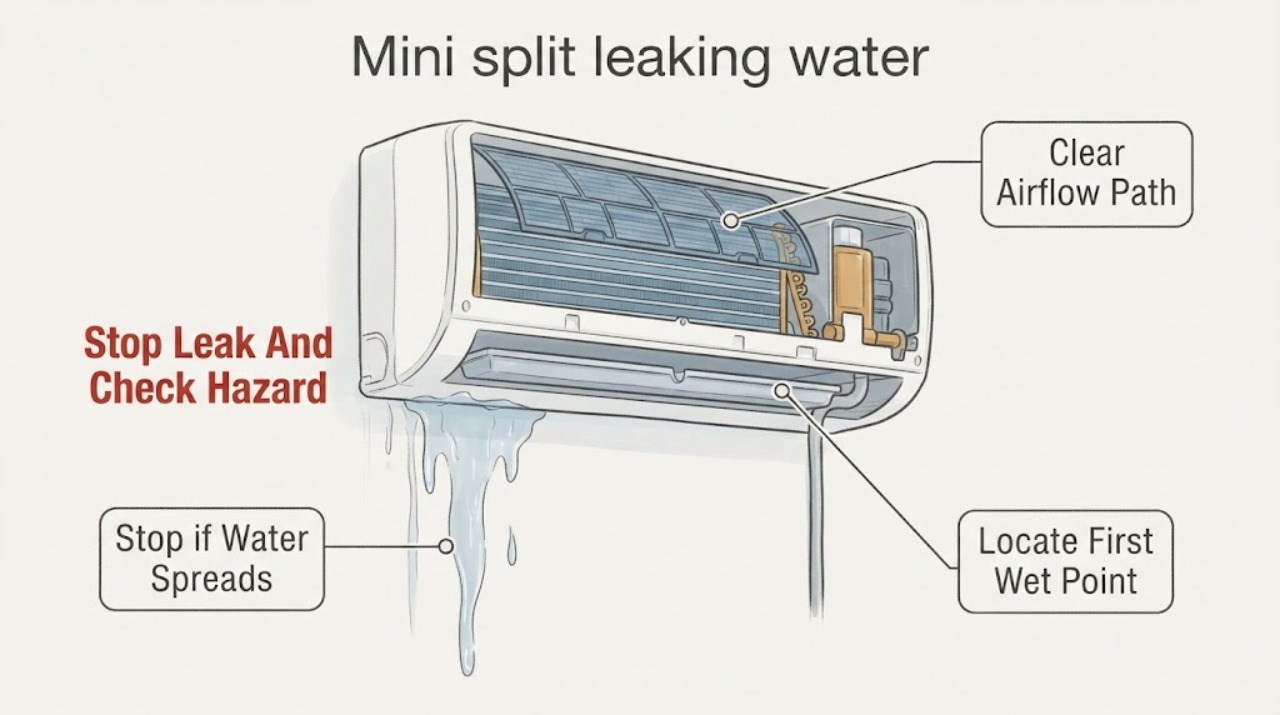
Turn the LG mini split off at the remote or normal user control when water is entering the room. Move belongings away, place a shallow container under a safe drip, and look from a dry position for water near outlets, cords, the indoor head, or the outdoor unit. Do not touch wet wiring or stand in pooled water.
Expected result: The leak is a small indoor drip; water is near electrical equipment; the outdoor unit has been flooded; water is fast or spreading; or no active leak is visible.
Next step: Keep the system off. If electrical equipment is wet, the outdoor unit was flooded above its pipe connections, or water is spreading, leave it alone and call qualified HVAC or electrical service; do not restart it to test.
Stop if: Stop immediately for wet electrical parts, standing water, smoke, burning odor, exposed conductors, active flooding, or an unsafe path to the disconnect.
Why this matters
Why: A small isolated condensate drip can be observed after shutdown, but water near electrical components or a fast leak can create shock and property hazards. No visible drip does not rule out a concealed drain or intermittent ice-melt leak.
-
Check 2
With the system off and surfaces dry enough to observe safely, use separate dry towels to identify the first wet point: the bottom of the indoor head, the drain-hose exit, the insulated line set or wall penetration, the outdoor pipe connection, or the outdoor base. Do not remove the cover or insulation to chase water.
Expected result: Water begins at the indoor head or hose exit; follows the wall or line-set insulation; appears only at an outdoor cold pipe; or comes from the outdoor cabinet or base.
Next step: Photograph the first wet point and keep the system off. Continue only with external hose and filter observations; arrange service for a wall penetration, line-set insulation failure, cabinet leak, or source that cannot be identified.
Stop if: Stop for water inside the wall, wet insulation that must be removed, refrigerant-pipe damage, a fast leak, or any need to open the indoor or outdoor cabinet.
Why this matters
Why: An indoor head or hose-exit leak keeps condensate drainage, pan overflow, filter or evaporator dirt, and hose routing in consideration. Outdoor pipe moisture can be condensation, while cabinet flooding or a concealed wall route needs professional inspection.
-
Check 3
After the unit is off, inspect the accessible air filter and intake area according to the model manual. Replace or clean the filter only by the model-approved method and only after it can be handled without touching sharp metal or wet electrical areas; do not wipe the evaporator coil or spray cleaner inside the head.
Expected result: The filter is visibly loaded; the intake is blocked by curtains or objects; the filter is clean and the intake is open; or water or ice is visible behind the filter.
Next step: Correct only an obvious external intake obstruction and replace the filter as specified. If water or ice remains behind it, the filter is clean but leakage continues, or cleaning would require opening the head, call qualified service.
Stop if: Stop for ice, sharp metal, mold or heavy contamination, water near controls, a wet filter that cannot be removed safely, or any need to open panels or spray into the evaporator.
Why this matters
Why: LG links excessive dust in the filter or evaporator with abnormal water discharge, and restricted intake can reduce airflow. Water or ice behind the filter means the issue exceeds a simple filter change and may involve the coil, drain pan, airflow, or refrigerant system.
-
Check 4
From outside the unit, inspect the visible indoor drain hose and its outlet without disconnecting it. Look for a loose or torn section, severe bend, upward loop, horizontal sag that holds water, a submerged end, or an outlet that no longer slopes away from the indoor unit. Do not pull a concealed hose or force a wall connection.
Expected result: The hose is straight and slopes down; its end is submerged; a bend or upward section is visible; a connection is loose or torn; or the route is concealed or inaccessible.
Next step: If the visible outlet can be repositioned without tools, restore a clear downward route and keep the end above any water; otherwise leave the system off and arrange service. Do not tape over a damaged hose as a permanent repair or pour chemicals into it.
Stop if: Stop for a concealed route, loose wall penetration, torn hose, water inside the wall, severe kink that will not move easily, ladder or roof access, or any need to disconnect piping.
Why this matters
Why: LG states that a disconnected or torn hose, submerged outlet, severe bend, or upward route can cause water to flow back or leak indoors. A concealed route or damaged connection needs the installer or technician because forcing it can detach the indoor drain or wall penetration.
-
Check 5
Record whether the leak occurs in cooling, dry, or heating mode, whether it follows a shutdown or defrost event, and any LG display code or blinking lamp. Compare the code with the exact model manual or LG support page; do not repeatedly power-cycle a wet unit or treat a code as proof of a failed part.
Expected result: A drainage-related code appears; the leak occurs only during cooling or humid weather; it follows ice or defrost; the outdoor pipe merely sweats; or the code returns after a permitted user reset.
Next step: Keep the unit off for persistent leakage, ice, or a recurring code and arrange LG-qualified service. Provide the model, mode, code, first wet point, filter state, and hose-route photos.
Stop if: Stop for heavy ice, water near electricity, repeated fault codes, an outdoor unit that has been flooded, or any need to test refrigerant, pressure, sensors, wiring, or controls.
Why this matters
Why: A drainage code supports a condensate-path problem, while outdoor pipe sweating can be normal condensation. Ice-related water can indicate airflow, refrigerant, or defrost trouble; a recurring code needs service rather than repeated resets.
-
Check 6
Gather the LG model and serial information from paperwork or a safely visible label, the first wet point, operating mode, filter and intake condition, drain-hose route, display code, recent installation or relocation, and photos taken without opening the unit. Keep the mini split off if it leaks again.
Expected result: The leak stops after an external route correction; it returns; the source is concealed; the indoor coil or pan is iced; or the unit has electrical or physical damage.
Next step: Give the record to LG support, the installer, or a qualified mini-split technician. Do not remove the cover, evacuate or recharge refrigerant, open wiring, or dismantle the drain pan as a homeowner escalation.
Stop if: Stop owner troubleshooting when the next step requires cabinet removal, electrical testing, refrigerant work, coil or pan access, concealed drain repair, or lifting the indoor head.
Why this matters
Why: A route correction can explain backflow from a visible drain hose, but recurrence suggests a blockage, pan, pump, installation, airflow, frost, refrigerant, or control issue. Concealed, iced, or damaged conditions require model-specific service.
Use your observations
Decision map
Find the observation that best matches what you see, then follow the next safe action.
-
PATH 01Next step
What you see
The indoor leak begins at the head or hose exit and the visible drain hose is kinked, rises, sags with accumulated water, has a submerged outlet, or is loose.
Do this next
Keep the system off. Correct only a loose, accessible route without force so it slopes away and the outlet stays above water; have an installer or technician repair a torn, concealed, or wall-connected hose.
Why this path and its safety boundary
Why it matters: Drain backflow or a failed hose connection is more likely than outdoor pipe condensation.
-
PATH 02Next step
What you see
The filter is heavily dirty, airflow is weak, or ice and water are visible behind the indoor grille.
Do this next
Replace or clean only the accessible filter as directed and leave the unit off if ice or water remains. Call qualified service for coil, pan, refrigerant, or internal drainage diagnosis.
Why this path and its safety boundary
Why it matters: Restricted airflow, evaporator contamination, condensate pan overflow, refrigerant, or another coil issue is more likely.
-
PATH 03Next step
What you see
The indoor unit and drain route are dry, but moisture appears only on a cold outdoor pipe or service-valve area during cooling and humid weather.
Do this next
Keep water away from electrical equipment and observe without touching the pipe. Arrange service if water enters the cabinet, insulation is damaged, the amount is abnormal, or the source cannot be separated safely.
Why this path and its safety boundary
Why it matters: Surface condensation may be normal, although a damaged insulation jacket or unusual quantity of water can still need inspection.
-
PATH 04Next step
What you see
A drainage code returns, the hose is concealed or disconnected inside the wall, the leak began after installation or relocation, or water appears at the wall penetration.
Do this next
Leave the mini split off and call the installer or qualified LG HVAC service. Do not open the wall, pull the hose, or run a chemical cleaner through the condensate path.
Why this path and its safety boundary
Why it matters: A concealed drain, installation slope, connection, pump, or indoor drain fault is more likely and cannot be confirmed by external checks.
-
PATH 05Next step
What you see
Water reaches electrical parts, the outdoor unit has been flooded above its pipe connections, the unit is spraying, or smoke, burning odor, or repeated electrical faults are present.
Do this next
Keep clear and do not power the unit. If safe without touching wet equipment or standing in water, isolate power using the normal labeled means; otherwise leave it alone and obtain qualified HVAC or electrical inspection.
Why this path and its safety boundary
Why it matters: The equipment may present a shock, fire, or hidden-component hazard beyond safe owner troubleshooting.
Helpful context
Understand the symptom
Protect the room and the electrical system first
Turn the mini split off at its normal control when water is entering the room. Keep water away from outlets, power cords, and the outdoor disconnect; do not touch wet equipment, stand in water, or open the indoor head. Catch a small drip without blocking the unit's airflow and arrange service for an active or unsafe leak.
Drain routing matters more than the puddle location
Condensate from a wall-mounted indoor unit must leave through its drain hose. LG guidance calls for a straight route that slopes downward; bends, upward sections, accumulated water, a submerged outlet, or a loose connection can let water flow back or leak at the indoor unit. A concealed or inaccessible route is not a safe owner repair.
Separate condensate from frost and pipe sweating
Water from the indoor head during cooling points toward the pan, hose, filter, airflow, or ice melt. Moisture on a cold outdoor pipe can be normal condensation in humid weather, while water entering a flooded outdoor unit creates an electrical hazard. Trace the first wet point from a dry, safe position rather than assuming every drip is a blocked drain.
Mini split models and displays differ
LG states that its general guides cover many models and that images or details may differ. A drain code or repeated leak should therefore be matched to the exact model manual; do not add a universal hose, pump, cleaner, or electrical reset procedure based on the LG name alone.
Safety boundary
Stop conditions
- Turn the mini split off when water enters the room and keep water away from outlets, cords, controls, and the outdoor disconnect; never touch wet electrical equipment or stand in pooled water.
- Do not open the indoor or outdoor cabinet, remove the coil or drain pan, test wiring, handle refrigerant, alter pressure, bypass a sensor or safety, or lift the wall unit.
- Do not pull a concealed drain hose, force a wall connection, use chemical drain cleaner, or treat tape as a permanent repair for a torn hose.
- Stop for heavy ice, a recurring drainage code, water inside the wall, a flooded outdoor unit, smoke, burning odor, exposed conductors, or a fast leak.
- Call qualified LG HVAC service when a safe external route correction does not stop the leak, the filter is clean but water returns, the source is concealed, or the next step requires internal drainage, coil, pump, electrical, or refrigerant work.
Only after diagnosis
Potential parts
- LG mini split air filter
Consider this only when the accessible filter is visibly loaded and the model manual identifies the correct filter service procedure; a clean filter does not explain recurring leakage by itself.
Confirm the exact LG model, filter dimensions, orientation, and cleaning or replacement method before ordering or fitting. - LG mini split condensate drain hose
Consider this only when inspection confirms a torn, incorrectly connected, or model-specific drain hose and the technician rules out concealed blockage, pan, and installation causes.
Confirm the exact LG model, hose connection, routing, insulation, and local installation requirements; do not use a generic hose as a concealed repair. - condensate drain pump
Consider this only when the specific LG installation uses a pump and a qualified diagnosis confirms pump failure rather than a hose, pan, blockage, or control problem.
Verify that the exact model includes a pump and match its electrical, connection, and lift specifications through qualified service. - refrigerant-pipe insulation
Consider this only when moisture is traced to an exposed cold pipe or failed insulation rather than the condensate drain.
Confirm the pipe size, insulation material, weather exposure, and model installation requirements; refrigerant piping work belongs with a qualified technician.
When checks do not resolve it
Need a professional?
Call a qualified LG HVAC technician or the installer when the visible drain hose is torn, concealed, disconnected inside the wall, severely kinked, or still leaks after a safe external route check; when water or ice is behind the indoor grille; when an LG drainage code returns; when the leak began after installation or relocation; or when a coil, pan, pump, refrigerant circuit, wiring, or outdoor cabinet needs inspection. Call urgently for water near electrical equipment, a flooded outdoor unit, smoke, burning odor, exposed conductors, active spraying, or rapid property damage.
Safety scope: Owner checks are limited to turning the unit off, protecting the room, safe external observation, accessible filter replacement or cleaning as directed, removing loose external obstructions, visible drain-hose route observation, model identification, and documentation. A qualified technician must handle cabinet removal, concealed drain work, drain-pan or pump service, electrical inspection, refrigerant, coil, sensor, control, and indoor-unit access.
Common questions
FAQ
Why is my LG mini split leaking water indoors?
Common possibilities include a drain hose that is loose, torn, kinked, submerged, or routed upward; a dirty filter or evaporator; pan or pump trouble; ice melt; or a concealed installation problem. Turn it off and identify the first wet point without opening the head.
Should I keep running an LG mini split that is leaking?
Turn it off when water enters the room, especially near electrical equipment. Do not restart it to test if the unit, cord, controls, or outdoor cabinet is wet.
Can a kinked LG mini split drain hose cause a leak?
Yes. LG says bends or an upward route can prevent drainage and let water flow back into the unit. Correct only a loose, accessible route without force; concealed or damaged hose work needs service.
Should the LG mini split drain hose slope downward?
LG installation guidance routes the indoor drain hose higher at the indoor unit and lower toward the outside so gravity carries condensate away. Follow the exact model and local requirements rather than imposing a generic route.
Can a dirty filter cause water to come from an LG mini split?
LG links heavy dust in the filter or evaporator with abnormal water discharge, and restricted airflow can contribute to coil and drainage problems. Clean or replace only the accessible filter as the model manual directs.
Why is my LG mini split leaking only in cooling mode?
Cooling creates condensate, so a cooling-only leak keeps the drain pan, hose, filter, airflow, ice melt, or pipe condensation in consideration. Water from the indoor head is not the same as normal moisture on a cold outdoor pipe.
Is water on the outdoor pipe of an LG mini split normal?
Moisture can form on a cold outdoor pipe during cooling and humid weather. If water enters the outdoor cabinet, insulation is damaged, the amount is abnormal, or electrical parts are wet, keep the unit off and request inspection.
What does an LG mini split drainage code mean?
On models that use it, LG identifies a drainage code as condensate that is not leaving the indoor unit or as a drainage fault. Match the code to the exact model and request service if it returns after a permitted user reset.
Can I pour cleaner into the LG mini split drain hose?
Do not use chemical drain cleaner or force liquid through an unknown or concealed hose. A blocked, damaged, or improperly routed drain needs model-specific diagnosis and can leak into the wall or indoor unit.
When does an LG mini split water leak need a technician?
Call when the leak returns after a safe external hose or filter check, the route is concealed, ice or water is behind the grille, a drainage code returns, installation changed recently, or the next step involves the pan, pump, coil, wiring, refrigerant, or cabinet.
Read the exact guide
Official sources
- [LG Air Conditioner] Perform a Pre-Summer Check to Stay CoolLG Electronics USA · LG official support guidance used for visible drain-hose inspection and model variability; the examples cover LG air conditioners broadly and are not a universal mini-split repair procedure.
- Single Zone Extended Piping Wall Mounted Installation ManualLG Electronics U.S.A., Inc. · LG official installation manual used for mini-split-specific drain routing, downward slope, connection, hose insulation, and concealed-wall limitations; exact model and local code requirements still govern.
- [LG Air Conditioner] Guide to Error CodesLG Electronics USA · LG official support page used for drainage-code interpretation and recurring-code service boundaries; code meanings and reset procedures vary by product type and model.
- [LG Air Conditioner Water Leakage] There is black water coming out of the hoseLG Electronics USA · LG official support guidance used to connect excessive dust in the filter or evaporator with abnormal water discharged through the drain hose; it does not authorize opening or cleaning an indoor mini-split coil.
- What to do if water gets into the outdoor unitLG Electronics USA · LG official support guidance used for wet outdoor-unit safety, no-touch and no-disassembly warnings, and professional inspection when water reaches electrical areas.
- [LG Air Conditioner Leakage] During cooling, there is water dripping from the outdoor unitLG Electronics USA · LG official support guidance used to distinguish normal moisture on cold outdoor pipes during cooling or humid weather from an indoor drainage leak; the page is broad and model-specific conditions still apply.
Community feedback
Share a repair observation
Share a plain-text repair observation. Accepted observations are published automatically; this page may take a moment to update.