
On this page
Start here
Quick answer
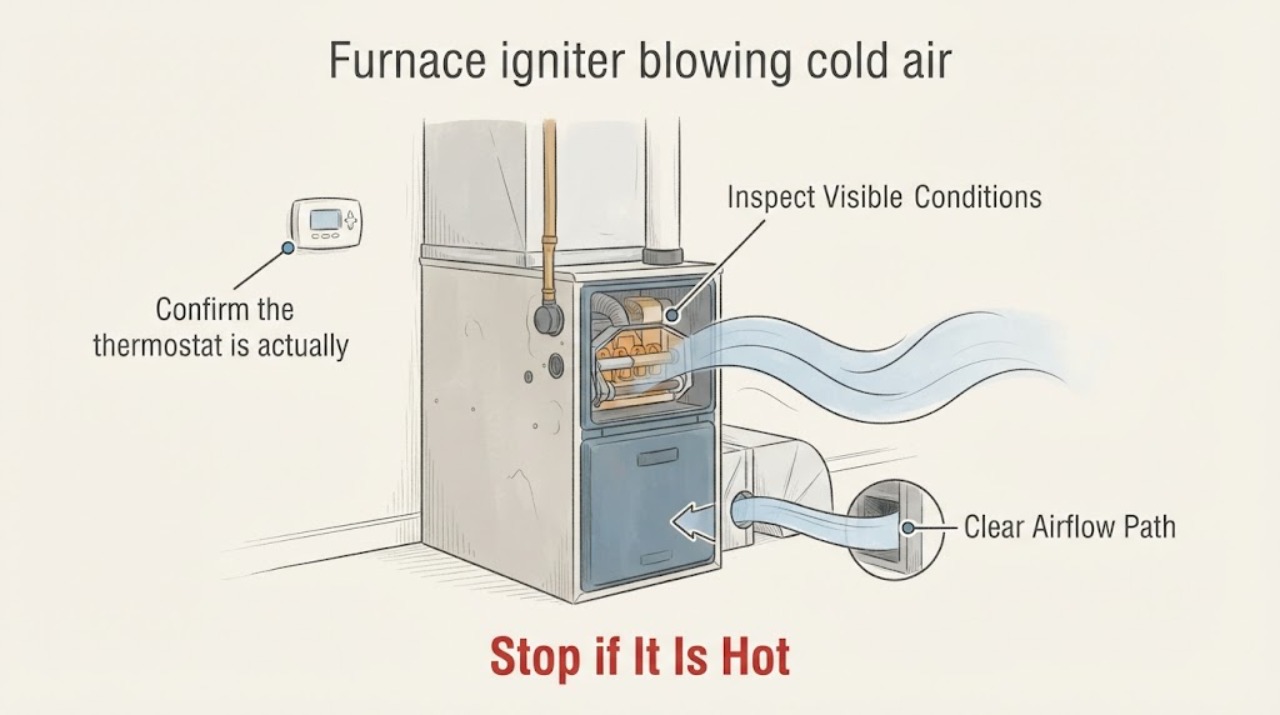
If a gas furnace blows cold air and the igniter is suspected, do not open the burner compartment, touch the igniter, test live voltage, clean a flame sensor, or replace a gas or flame component. From outside the cabinet, confirm a heat call, note whether the blower runs before any warm air, check the accessible filter and supply registers, and record any status light pattern or unusual sound. Trane and Carrier both identify ignition and flame-proving faults as professional HVAC work; shut the system down and leave for fresh air if you smell gas or a carbon-monoxide alarm sounds.
Work through in order
Diagnostic checks
Use only checks that match the exact appliance or system and its official guide.
-
Confirm the thermostat is actually calling for heat
Read the thermostat without removing its cover: note the mode, requested temperature, room temperature, and fan setting. If the fan is set to run continuously, return it to the normal automatic setting only if the thermostat instructions make that a straightforward user control; do not change wiring or schedules you do not understand.
Expected result: The thermostat is not in heat mode, the setpoint is not above room temperature, the fan is running continuously, or a valid heat call is present while cold air continues.
Next step: After one normal heating cycle, record whether warm air begins and whether the blower stops or continues. If the heat call is valid and air remains cold, proceed with external observations and request HVAC service.
Stop if: Stop if the thermostat or wiring is damaged, the unit behaves erratically, or any gas, smoke, alarm, or combustion warning is present.
Why this matters
Why: A wrong mode or continuous fan can circulate unheated room air. A valid heat call with cold air means the furnace sequence still needs attention and does not identify the igniter without professional testing.
-
Observe the startup sequence without opening the furnace
From outside the cabinet and at a safe distance, listen during one ordinary call for heat. Note whether an inducer or startup sound occurs, whether the blower starts immediately, whether you hear repeated clicking, and whether warm air ever arrives. Do not remove a panel, look into the burner compartment, or repeat cycles to force a fault.
Expected result: The blower runs with no ignition sounds, clicking occurs with no warm air, the furnace starts then stops quickly, or the sequence is not safely observable.
Next step: Write down the order and approximate timing of sounds, then give that record to the HVAC technician. Do not interpret a glow or flame by opening the cabinet.
Stop if: Stop immediately for gas odor, a bang or delayed-ignition sound, flame rollout, smoke, a carbon-monoxide alarm, or any panel that is loose or damaged.
Why this matters
Why: A blower-before-heat pattern can be a normal delay or a response to an ignition or safety shutdown. Clicking without sustained heat can be consistent with an ignition problem, but only a technician can distinguish igniter, gas, flame-proving, venting, and control causes.
-
Check airflow items a homeowner can reach
With the furnace off at the thermostat, inspect only the readily accessible air filter and room supply registers. Note whether the filter is visibly loaded with dust, whether registers are blocked, and whether return airflow is obstructed; do not open the furnace or reach toward burners, wiring, igniter, or flame sensor.
Expected result: The filter is clean, visibly loaded, missing, the wrong size, or the registers and return path are blocked or open.
Next step: If the filter replacement is a clearly documented user task, use only the exact size and type specified for the system; otherwise leave it in place and tell the technician. Restore unobstructed registers without entering the cabinet, then request service if cold air persists.
Stop if: Stop if the filter is wet, moldy, damaged, inaccessible without tools, or if the furnace has exposed wiring, a damaged cabinet, or any combustion warning.
Why this matters
Why: Trane lists a dirty filter among causes of ignition trouble, and restricted airflow can trigger protective shutdowns. A filter observation can explain poor heat delivery but cannot confirm or rule out an igniter fault.
-
Record external status indicators
Use the owner manual or the visible exterior label to identify any normal status-light location. Without removing covers, record the light color, blink count, display message, and when it occurs during the cold-air cycle. Do not reset repeatedly, bypass a switch, or infer a code from a different model.
Expected result: No indicator is visible, a steady normal status is shown, a repeatable fault pattern appears, or the display is unreadable or inconsistent.
Next step: Photograph the indicator only if that can be done safely and provide the model information from the exterior rating label plus the exact pattern to the HVAC provider.
Stop if: Stop if accessing the indicator requires removing a panel, touching wiring, resetting a tripped breaker repeatedly, or approaching flame, gas, smoke, or a hot surface.
Why this matters
Why: Modern furnaces may report ignition or control faults through a diagnostic light, but codes are model-specific. Carrier notes that code reading is part of professional igniter diagnosis; the pattern is evidence for the service call, not a repair instruction.
-
Prepare the HVAC service handoff
Compile thermostat settings, filter and register observations, startup sound order, duration of cold air, status-light pattern, model and fuel type from the exterior label, recent maintenance, and any gas odor or alarm event. State that the burner compartment, igniter, flame sensor, wiring, and live electrical measurements were not disturbed.
Expected result: The record shows a valid heat call with no warm air, a likely airflow issue, a repeated ignition-like sequence, a safety alarm, or an unclear sequence.
Next step: Request high-priority HVAC diagnosis and tell the provider whether the furnace is currently off, locked out, or still blowing cold air. Keep occupants warm by safe temporary means and never use an oven or outdoor combustion appliance indoors.
Stop if: Do not remove panels, clean or replace the igniter or flame sensor, test voltage or resistance, adjust gas pressure, relight, jumper controls, or bypass safeties.
Why this matters
Why: The technician can select safe tests for the igniter, flame proving, gas delivery, venting, controls, and airflow instead of replacing a part based on a symptom. DOE guidance also emphasizes combustion-safety testing by a qualified person for applicable combustion appliances.
Use your observations
Decision map
Find the observation that best matches what you see, then follow the next safe action.
-
PATH 01Safety boundary
What you see
Gas odor, carbon-monoxide alarm, smoke, flame outside the normal area, or a combustion bang is present.
Do this next
Leave immediately, keep others out, and contact emergency or gas utility service from a safe location; arrange HVAC service after the hazard is cleared.
Why this path and its safety boundary
Safety stop: Do not operate switches, relight, open the furnace, or re-enter until the appropriate responders say it is safe.
-
PATH 02Safety boundary
What you see
Thermostat calls for heat and the furnace runs, but no warm air arrives or the blower repeatedly runs cold.
Do this next
Keep the combustion compartment closed, record the startup sequence and any code, and request high-priority HVAC diagnosis of ignition, flame proving, airflow, gas, venting, and controls.
Why this path and its safety boundary
Safety stop: Do not identify or replace the igniter from appearance or sound alone.
-
PATH 03Safety boundary
What you see
The fan is set to continuous operation, the thermostat is not calling for heat, the filter is visibly loaded, or registers are blocked.
Do this next
Correct only the clearly user-accessible thermostat setting or register obstruction and follow the documented filter specification; if cold air remains, arrange HVAC service.
Why this path and its safety boundary
Safety stop: Do not open the furnace or continue if the filter is wet, damaged, inaccessible, or the unit shows a safety warning.
-
PATH 04Safety boundary
What you see
The sequence is unclear, the furnace locks out repeatedly, a breaker trips, or the status code cannot be identified safely.
Do this next
Turn the system off using the normal user control if safe, record the symptom, and request professional service rather than repeated resets.
Why this path and its safety boundary
Safety stop: Do not reset a tripped breaker repeatedly, bypass a door switch, jumper controls, or attempt live testing.
Helpful context
Understand the symptom
An igniter lights the fuel in a gas furnace. If it fails to light, the control system can stop the gas and leave the blower moving room-temperature air. The same symptom can also come from thermostat settings, a dirty filter, a flame-proving issue, airflow protection, gas supply, or controls, so cold air does not prove that the igniter itself is bad.
Keep this diagnosis at the homeowner-observation level. Trane says the furnace igniter and flame sensor should be troubleshot by an HVAC professional, while Carrier describes the igniter as delicate and warns against homeowner handling. A status light or sound can help a technician, but it cannot authorize opening the combustion area or bypassing a safety control.
Stop first for gas or combustion danger
If you smell gas, hear an unusual combustion noise, see flame outside the normal viewing area, or a carbon-monoxide alarm sounds, do not operate switches or keep troubleshooting. Leave the building, keep others out, and contact the appropriate emergency or gas utility service from a safe location. If there is no immediate danger, use only the external checks below and arrange HVAC service for a suspected igniter or flame fault.
Only after diagnosis
Potential parts
- furnace flame sensor
A flame sensor is only a conditional category because a cold-air symptom can have many causes and Trane says cleaning or replacement should be left to HVAC professionals.
Match the exact furnace model and approved component through the service technician; do not clean, bend, remove, or substitute the sensor from this guide. - furnace igniter
An igniter may be involved when a furnace fails to light, but appearance and sound cannot establish its electrical or model compatibility.
Use the exact manufacturer-approved part selected after professional diagnosis; do not touch the element or test it live. - furnace air filter
A filter is relevant only when the existing filter is loaded or due for replacement and the owner information identifies the correct size and type.
Follow the furnace or filter documentation and airflow direction; a filter cannot repair ignition, gas, flame-proving, venting, or control faults.
When checks do not resolve it
Need a professional?
Request high-priority HVAC service for cold air during a valid heat call, repeated ignition attempts, a lockout, a suspected igniter or flame-sensor fault, a repeated diagnostic code, or a breaker that trips. Treat gas odor, carbon-monoxide alarm, smoke, flame rollout, or a combustion bang as an immediate safety emergency.
Common questions
FAQ
Can I replace the furnace igniter myself?
Do not use this guide for igniter replacement. The part is fragile and sits in a gas-and-electric ignition system; Carrier and Trane direct homeowners to professional diagnosis and service.
Does clicking mean the igniter is bad?
Clicking without sustained heat is a useful observation, not a diagnosis. It can involve the igniter, gas delivery, flame proving, venting, or controls, so record it and call an HVAC professional.
Can a dirty filter make a furnace blow cold air?
It can restrict airflow and contribute to protective shutdown or poor heat delivery. Check only the accessible filter as directed by the owner information; do not open the combustion compartment, and request service if the symptom continues.
Should I keep resetting the furnace until it lights?
No. Repeated lockouts or a tripped breaker indicate a fault that needs diagnosis. Stop after safe external observations and arrange HVAC service; never bypass a safety control.
What should I do if I smell gas while checking the furnace?
Do not operate switches or continue checking. Leave the building, keep others out, and contact the appropriate emergency or gas utility service from a safe location.
Read the exact guide
Official sources
- Furnace Not Igniting? Find Out Why and What to DoTrane · Supports external checks for thermostat, power, filter, and the distinction that igniter and flame-sensor faults need professional service.
- What is a Furnace Ignitor? Repair & Replacement GuideCarrier · Supports explaining the igniter's role, observable failure clues, professional testing, and the risks of homeowner handling.
- HVAC CAZ Testing OverviewU.S. Department of Energy Building Science Education · Supports the boundary that combustion safety and venting verification require a certified professional rather than a homeowner opening or modifying the furnace.
Community feedback
Share a repair observation
Share a plain-text repair observation. Accepted observations are published automatically; this page may take a moment to update.