
On this page
Start here
Quick answer
When a gas furnace is not heating and the burner may not be igniting, first confirm the thermostat is calling for heat, the furnace switch has power, and the filter is not visibly blocked. If the furnace has a safe viewing window, note whether the inducer or blower starts, ignition clicks or glows, a burner flame appears, and the flame stays on; do not remove access panels or touch the igniter, flame sensor, burner, gas valve, or wiring. A dirty filter, loss of power, gas-supply issue, failed igniter, flame-sensor safety shutdown, control fault, or dirty burner can produce a no-heat symptom, but the sequence alone does not identify the part. If you smell gas, hear hissing or a loud ignition, see abnormal flame, the furnace repeatedly locks out, or a carbon-monoxide alarm sounds, leave the area and call emergency or HVAC help from a safe location. Do not repeatedly relight, bypass a safety, or order an igniter by appearance.
Before you begin
Safety first
- The HVAC professional should verify the model-specific thermostat, power, airflow, ignition, flame sensing, burner, gas valve, control, vent, and safety sequence before selecting a part or restoring operation.
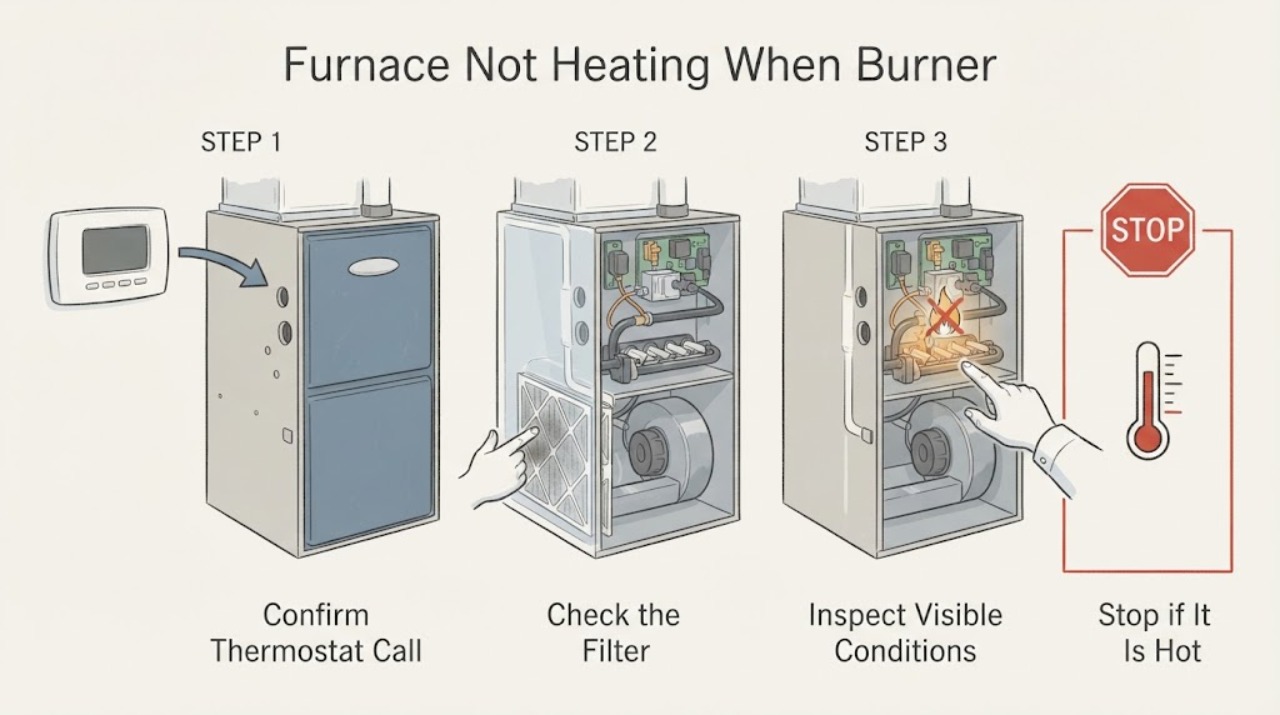
Work through in order
Diagnostic checks
Use only checks that match the exact appliance or system and its official guide.
-
Check 1
Check the thermostat from a normal indoor position: confirm Heat mode, a set temperature above the room temperature, and a fan setting appropriate to the system; do not repeatedly change settings to force a cycle.
Expected result: The thermostat is not calling for heat, the display is blank, the fan runs without heat, or a normal heat call is present.
Next step: Correct only an obvious setting or battery issue described by the thermostat manual. If a normal heat call produces no heat, continue with external checks and arrange HVAC service for an unexplained control issue.
Stop if: Do not open the thermostat, alter low-voltage wiring, or continue cycling a furnace that smells of gas, makes a loud ignition, or shows another hazard.
Why this matters
Why: An incorrect mode, missing thermostat power, or fan-only operation can mimic a burner ignition failure. A normal heat call shifts attention to furnace power, airflow, ignition, flame sensing, gas supply, and controls.
-
Check 2
From outside the furnace, check that the nearby service switch is on and the labeled furnace breaker has not tripped; with the furnace off, inspect the accessible filter and replace it only with the specified type if visibly dirty.
Expected result: The switch is off, the breaker is tripped, the filter is visibly blocked, the power indicators are normal, or the furnace area cannot be accessed safely.
Next step: Restore only an obviously switched-off service switch and replace a dirty filter according to the manual. Do not reset a breaker repeatedly; arrange HVAC or electrical service if it trips again or the furnace remains without heat.
Stop if: Do not remove furnace panels, reset a repeatedly tripping breaker, operate the furnace without a filter, or work around wet, scorched, or damaged equipment.
Why this matters
Why: Loss of electrical power prevents the blower, controls, and electronic ignition from operating. A blocked filter can restrict airflow and contribute to a safety shutdown, while normal power and airflow shift attention toward the ignition sequence or internal components.
-
Check 3
If the model has a manufacturer-provided viewing window and there is no gas odor or other hazard, observe one normal startup from outside the closed furnace: note inducer or blower activity, ignition click or glow, burner flame, and whether the flame stays on.
Expected result: There is no startup activity, repeated clicking without flame, an igniter glow without burner ignition, a flame that starts then drops out, or a stable flame but no warm supply air.
Next step: Record the sequence and stop the test. Leave the furnace off for repeated attempts, failed ignition, unstable flame, or a lockout and arrange qualified HVAC service.
Stop if: Do not remove the access door, touch the igniter or flame sensor, clean burners, relight a pilot, or repeat ignition cycles to obtain a clearer view.
Why this matters
Why: No activity can keep thermostat, power, control, or safety-switch issues in focus. Clicking or glow without flame can involve ignition or gas delivery; a flame that drops out can involve flame sensing or a safety shutdown; a stable flame with cool air shifts attention to airflow or blower operation.
-
Check 4
Without touching a gas valve, connector, burner, or vent, note from a safe position whether there is a gas odor, hissing, a loud bang at ignition, unusual flame color or movement visible through the approved window, soot, or a carbon-monoxide alarm.
Expected result: A gas odor, hissing, loud delayed ignition, unstable flame, soot, unusual exhaust, illness, or a carbon-monoxide alarm is present, or none of these signs is present.
Next step: For current gas odor or a carbon-monoxide alarm, leave immediately and call 911 or the gas utility from outside. Otherwise keep the furnace off and arrange qualified HVAC service for any abnormal flame, noise, soot, or exhaust.
Stop if: Do not light a match, use a flame, operate electrical switches in a gas odor, adjust the gas valve, block a vent, or remain inside after an alarm or suspected leak.
Why this matters
Why: These symptoms can indicate a gas leak, delayed combustion, combustion or venting problem, or unsafe furnace operation and cannot be cleared by changing a filter or resetting the thermostat. Absence of a warning sign does not prove that ignition is safe.
-
Check 5
Photograph the furnace model label, thermostat display, filter condition, external switch and breaker status, viewing-window sequence, and any visible status light or code without opening the furnace cabinet.
Expected result: The exact model and code are available, only the furnace brand or style is known, the furnace repeatedly locks out, or the ignition sequence remains unclear.
Next step: Leave the furnace off after repeated or unexplained failed ignition and provide the record to a qualified HVAC professional; do not select a part from a code or appearance without model confirmation.
Stop if: Do not remove the furnace cabinet, probe terminals, measure live electrical values, bypass a safety switch, or keep resetting a lockout.
Why this matters
Why: Model information and a sequence record let a technician match the ignition system and interpret a model-specific status code. An unclear sequence or repeated lockout means an igniter, flame sensor, burner, gas valve, control, vent, or safety switch remains possible.
-
Check 6
Arrange qualified HVAC diagnosis when the igniter does not glow or spark, burners do not light, flame drops out, the furnace locks out, or no heat remains after the safe thermostat, power, and filter checks.
Expected result: The technician confirms an igniter, flame sensor, burner, gas valve, control, vent, airflow, or wiring issue, or the furnace passes component checks but still fails to heat.
Next step: Keep the furnace out of service until diagnosis and repair are complete, and follow the technician's instructions for temporary heat and carbon-monoxide protection.
Stop if: Do not install an igniter or gas valve, clean burners or flame sensors, relight repeatedly, or bypass controls as a substitute for service.
Why this matters
Why: Ignition failure is a system sequence problem rather than proof that one visible part is bad. A technician must verify the model-specific safety sequence and combustion before replacing a component.
Use your observations
Decision map
Find the observation that best matches what you see, then follow the next safe action.
-
PATH 01Next step
What you see
The thermostat is calling for heat, but the furnace has no inducer, ignition, blower, or visible startup activity and power checks are inconclusive.
Do this next
Leave the furnace off if the cause is not obvious and arrange HVAC service; do not open the cabinet or reset a repeatedly tripping breaker.
Why this path and its safety boundary
Why it matters: Thermostat, service switch, breaker, control board, safety switch, or power-supply issues are more likely than a burner-only fault.
-
PATH 02Next step
What you see
A safe viewing window shows clicking or igniter glow, but no burner flame appears.
Do this next
Stop the cycle and arrange qualified HVAC diagnosis. Do not adjust the gas valve, clean the burner, or attempt repeated relighting.
Why this path and its safety boundary
Why it matters: An igniter, gas-supply or gas-valve, burner, pressure, control, or safety-sequence fault is more likely; the observation does not identify which part is defective.
-
PATH 03Next step
What you see
The burner lights briefly and then shuts off, or the furnace repeatedly attempts ignition and locks out.
Do this next
Leave the furnace off after the repeated attempt and arrange professional service; do not clean or replace the flame sensor as a home experiment.
Why this path and its safety boundary
Why it matters: A flame-sensor signal, airflow or limit condition, gas valve, control, vent, or other safety shutdown is more likely than a simple thermostat setting.
-
PATH 04Next step
What you see
A stable burner flame is visible, but supply air remains cool or airflow is weak after the furnace runs.
Do this next
Check only that the filter is present and not visibly blocked and that accessible registers are open; arrange HVAC service for persistent cool air, weak airflow, or any abnormal noise or odor.
Why this path and its safety boundary
Why it matters: The issue may be airflow, filter, blower, duct, fan-control, or heat-transfer related rather than initial burner ignition.
-
PATH 05Next step
What you see
Gas odor, hissing, loud delayed ignition, yellow or unstable flame, soot, unusual exhaust, illness, or a carbon-monoxide alarm is present.
Do this next
Leave immediately for gas odor or a carbon-monoxide alarm and call 911 or the gas utility from a safe location. Keep the furnace off and obtain qualified HVAC service before returning to operation.
Why this path and its safety boundary
Why it matters: A gas leak or combustion and venting hazard may be present, and no further homeowner ignition check is appropriate.
Helpful context
Understand the symptom
Confirm the call for heat before interpreting ignition sounds
A furnace can appear to have an ignition failure when the thermostat is not calling for heat, the furnace switch is off, or the blower is circulating room-temperature air. Check settings and accessible power indicators without opening the furnace. A visibly dirty filter can restrict airflow and contribute to a shutdown, but changing a filter does not clear a gas or ignition fault.
Use the startup sequence as a clue, not a DIY repair guide
If the furnace has a manufacturer-provided viewing window, note the sequence from outside: a call for heat, inducer or blower activity, ignition attempt, burner flame, and whether the flame remains. No click or glow, repeated clicking without flame, a flame that starts and drops out, and a loud delayed ignition point to different professional checks. Do not remove the access door or reach inside to clean or test those parts.
Gas and combustion symptoms raise the service boundary
A gas odor, hissing, yellow or unstable flame, loud bang, soot, unusual exhaust, or a carbon-monoxide alarm is not a routine filter check. Leave the home for a current gas odor or alarm and contact emergency services or the gas utility from a safe location. For a furnace that repeatedly attempts ignition or locks out without those emergency signs, leave it off and arrange qualified HVAC diagnosis.
Safety boundary
Stop conditions
- If you smell gas, hear hissing or loud delayed ignition, see an abnormal flame, or a carbon-monoxide alarm sounds, leave immediately and call 911 or the gas utility from a safe location.
- Do not remove furnace access panels, touch an igniter, flame sensor, burner, gas valve, wiring, or vent, and do not perform live electrical or gas testing.
- Do not repeatedly relight, reset a lockout, adjust a gas valve, clean burners or flame sensors, bypass a safety switch, or operate the furnace without its filter.
- Do not order an igniter, flame sensor, gas valve, control, or burner by appearance or symptom alone; model, fuel, and safety-sequence compatibility must be confirmed by a qualified professional.
- Arrange qualified HVAC service for failed ignition, a repeated lockout, abnormal flame or noise, persistent no heat, a tripping breaker, or any condition that cannot be checked safely.
Only after diagnosis
Potential parts
- furnace igniter
Consider this part only after a qualified HVAC technician confirms that the ignition sequence and model-specific tests identify the igniter as failed rather than the gas valve, flame sensor, burner, control, airflow, or safety system.
Confirm the exact furnace model, fuel type, ignition technology, mounting, and manufacturer fit information; do not handle or select an igniter by appearance.
When checks do not resolve it
Need a professional?
Use prompt HVAC service for failed burner ignition, repeated clicking, flame dropout, lockout, abnormal flame, or persistent no heat. Treat gas odor, hissing, loud ignition, carbon-monoxide alarm, smoke, or suspected combustion or venting trouble as urgent.
Safety scope: The HVAC professional should verify the model-specific thermostat, power, airflow, ignition, flame sensing, burner, gas valve, control, vent, and safety sequence before selecting a part or restoring operation.
Have this ready
- Furnace model, fuel type, thermostat setting, and photos of the model label and external control indicators
- Whether the inducer or blower starts, the igniter clicks or glows, a burner flame appears, and whether it remains on
- Filter condition, nearby service-switch and breaker status, and whether a breaker or safety lockout repeated
- Any visible status light or code read without opening the cabinet and the exact sequence observed through the approved viewing window
- Any gas odor, hissing, delayed ignition, abnormal flame, soot, unusual exhaust, carbon-monoxide alarm, or prior repair
Common questions
FAQ
Why is my furnace not heating when the burner may not ignite?
Possible paths include thermostat or power loss, a blocked filter, gas-supply trouble, failed igniter, flame-sensor shutdown, dirty burner, gas valve, control, vent, or safety-switch issue. Use only safe external checks and a manufacturer viewing window; the startup sequence does not identify a part by itself.
What does clicking without a furnace flame mean?
Clicking or an igniter glow without a burner flame can keep the igniter, gas delivery, gas valve, burner, control, or safety sequence in focus. Stop the cycle and arrange HVAC service rather than cleaning or replacing a part as a guess.
Can I clean the furnace flame sensor or burner myself?
Do not treat flame-sensor or burner cleaning as a routine homeowner repair. Trane specifically directs those issues to HVAC professionals because the parts are part of a gas and safety sequence; keep the furnace off and arrange service.
Should I relight the furnace pilot if it is out?
Only a model-specific owner manual and a qualified professional should determine whether a standing pilot can be relit. Never relight when you smell gas, hear hissing, see an abnormal condition, or are unsure of the procedure; leave and call for help instead.
What if the furnace flame starts and then goes out?
A flame that drops out can involve flame sensing, airflow or limit protection, gas valve, control, venting, or another safety shutdown. Leave the furnace off after repeated attempts and have a qualified HVAC technician diagnose the sequence.
When should I call for furnace ignition service?
Call when the igniter clicks or glows without flame, burners do not light, flame drops out, the furnace locks out, or no heat remains after safe thermostat, power, and filter checks. Leave immediately for gas odor or a carbon-monoxide alarm and call 911 or the gas utility from outside.
Read the exact guide
Official sources
- What Is a Furnace Gas Valve? | Expert Guide & TroubleshootingCarrier · The opened Carrier manufacturer guide describes gas-valve and ignition relationships, gas-odor escalation, model and fuel fitment, and technician-only testing.
- Furnace Troubleshooting Guide | Fix a Furnace Not WorkingCarrier · The opened Carrier manufacturer guide lists basic thermostat, filter, power, pilot, gas-supply, and airflow checks and sends loud ignition and gas-odor conditions to professionals.
- Furnace Not Igniting? Find Out Why and What to DoTrane · The opened Trane manufacturer troubleshooting page covers thermostat, power, filter, gas supply, igniter, flame sensor, pilot, and burner paths for a furnace that will not ignite.
- Furnace Troubleshooting: Gas Furnace SolutionsTrane · The opened Trane manufacturer guide describes safe external checks, warns about gas leaks and carbon monoxide, and sets a professional boundary for ignition and flame issues.
- What is a Furnace Ignitor? | Repair & Replacement GuideCarrier · The opened Carrier manufacturer guide explains how igniters light burners, identifies no glow and repeated clicking as failure clues, and reserves electrical testing and replacement for professionals.
Community feedback
Share a repair observation
Share a plain-text repair observation. Accepted observations are published automatically; this page may take a moment to update.