
On this page
Start here
Quick answer
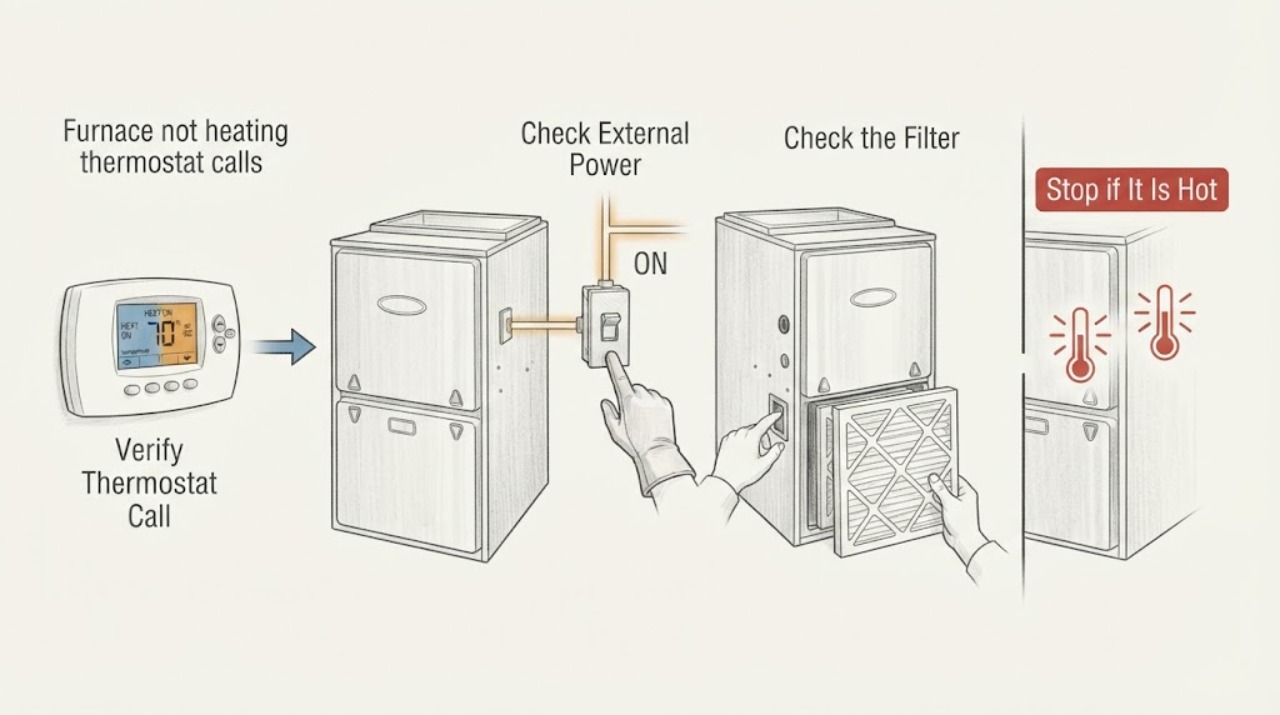
If the thermostat is calling for heat but the furnace is not heating, first confirm the display, Heat mode, setpoint, and fan setting, then check only the accessible furnace switch, breaker, filter, and open supply and return vents. A furnace can receive the call yet fail because of lost power, restricted airflow, a limit or condensate safety shutdown, fuel or ignition trouble, a blower fault, or a control problem. Observe the sequence from a safe position and use any external status light or code only as information. Do not adjust a gas valve, bypass a safety switch, open a burner compartment, touch wiring or an igniter, or relight a pilot unless the exact owner manual and local rules expressly make that procedure a safe user task. Stop and obtain professional help for gas odor, smoke, flame irregularity, repeated breaker trips, or a furnace that still will not heat after the external checks.
Work through in order
Diagnostic checks
Use only checks that match the exact appliance or system and its official guide.
-
Check 1
Read the thermostat without opening it: confirm Heat mode, a setpoint above the room temperature, and Fan set to Auto unless continuous fan is intentionally desired. Note any low-battery, delay, lockout, blank-display, or error message.
Expected result: Record a stable Heat call with no warning, a wrong mode or setpoint, Fan On, a low-battery or blank display, a normal delay message, or a call that disappears before the furnace responds.
Next step: Correct only an obvious user setting or battery issue and allow one normal startup delay. If the stable call still produces no heat, continue with the external furnace checks and do not alter thermostat wiring.
Stop if: Stop if the thermostat is hot, damaged, wet, sparking, shows exposed wiring, or the system behaves unpredictably after a recent wiring change.
Why this matters
Why: A wrong mode, setpoint, fan selection, dead battery, schedule, or normal delay can make the system appear not to heat. A stable call with no response sends the investigation toward furnace power, airflow, safety, ignition, blower, or controls rather than proving the thermostat is at fault.
-
Check 2
From a dry, safe position, check that the furnace service switch is on and that the labeled furnace or heat breaker is not visibly tripped. Reset a clearly tripped breaker no more than once; do not remove an electrical-panel cover.
Expected result: Record normal switch and breaker position, a single known trip that stays on after reset, an immediate repeat trip, buzzing, scorch marks, warmth, moisture, or no accessible switch or breaker identification.
Next step: If power is clearly restored and no hazard is present, observe one ordinary call. Leave the breaker off and request HVAC or electrical service for a repeat trip or any visible electrical warning.
Stop if: Do not open the panel, touch exposed conductors, bypass protection, or reset a breaker again after it trips immediately.
Why this matters
Why: A switched-off furnace or tripped breaker can prevent the heat call from reaching the equipment. A repeat trip, heat, odor, buzzing, or damage indicates an electrical or equipment fault; it is not a reason to keep resetting protection.
-
Check 3
Turn the furnace off and inspect the filter through its normal user access. Check that supply registers and return grilles are open and not covered by furniture, rugs, or drapes; do not remove the blower door or reach into the return.
Expected result: Record a clean, correctly seated filter and clear grilles; a visibly loaded or damaged filter; a backwards or missing filter; blocked supply or return airflow; or a filter location that requires tools or cabinet access.
Next step: If the filter is clearly due and replacement is an ordinary user-access task, install the manufacturer-specified size in the marked airflow direction, restore the access cover, and observe one cycle. If the furnace still does not heat, stop and call for service.
Stop if: Never operate without the specified filter. Do not force a panel, substitute an unknown filter size, clean a burner, or reach into the blower compartment.
Why this matters
Why: A dirty filter or blocked airflow can reduce heat delivery, strain the blower, and cause overheating that triggers a safety shutdown. A missing filter, inaccessible compartment, or persistent weak airflow needs professional assessment rather than operation without filtration.
-
Check 4
With panels closed and from a safe position, observe one heat call after the thermostat and external checks: note whether the furnace is silent, a fan runs, the inducer or ignition sequence begins, warm air arrives, or the system starts and stops.
Expected result: Record no response, blower-only cool air, a brief startup followed by shutdown, a normal warm-air cycle that ends too soon, an external diagnostic light or code, or a sound or smell that is abnormal.
Next step: Record the sequence and turn the furnace off for absent heat, repeated cycling, abnormal sound, or any warning. Request qualified HVAC diagnosis rather than opening a burner or control compartment.
Stop if: Stop immediately for gas odor, smoke, burning odor, yellow or unstable flame visible through an approved sight window, loud ignition, severe vibration, or water near electrical equipment.
Why this matters
Why: Silence makes power, control, thermostat signal, or lockout relevant. A blower without heat makes ignition, flame-sensing, fuel, limit, condensate, or control causes relevant. Starts-then-stops behavior can reflect restricted airflow or a safety response. An external code is useful to report but does not authorize internal repair.
-
Check 5
Without touching gas or oil components, note whether other fuel appliances have normal supply, whether a propane or oil tank gauge appears empty if one is already visible, and whether the furnace has an external status light or message. Do not turn a gas valve, press a rollout reset, relight a pilot, or remove a cover to inspect flame parts.
Expected result: Record no fuel concern and no code; an empty or low fuel indication; a furnace lockout or fault code; a pilot or flame that is absent, yellow, or unstable when visible through the designed viewing area; or a gas odor.
Next step: Leave the furnace off and arrange HVAC service for a code, absent or abnormal flame, no fuel, or any ignition symptom. If gas is smelled, leave immediately without operating switches and contact the gas utility or emergency services from a safe location.
Stop if: Do not adjust gas supply, open a burner panel, clean or replace an igniter or flame sensor, bypass a limit or rollout switch, or repeatedly reset a lockout.
Why this matters
Why: A fuel interruption, ignition failure, flame-sensor issue, or safety lockout can leave a thermostat calling while the furnace produces no heat. A code or visual flame observation narrows the service handoff but cannot identify a part or justify gas adjustment.
-
Check 6
Prepare the HVAC service request with the furnace model if safely visible, fuel type if known, thermostat state, power and breaker observations, filter and vent condition, response sequence, airflow and temperature change, status code, and any odor or moisture. Keep panels closed and components undisturbed.
Expected result: Confirm that the record contains external observations only and that no wiring, gas valve, burner, igniter, flame sensor, limit switch, capacitor, or blower component was touched.
Next step: Request qualified HVAC diagnosis when the stable thermostat call does not produce heat after the safe checks. Tell the technician whether the furnace was silent, blew cool air, ignited briefly, cycled off, or displayed a code.
Stop if: Stop all homeowner troubleshooting when the next step requires cabinet access, electrical measurements, flame or combustion testing, gas work, or internal component removal.
Why this matters
Why: A clear sequence distinguishes a missing call or power path from restricted airflow, a blower-only response, ignition or flame-sensing failure, fuel interruption, condensate or limit safety action, or a control fault without a hazardous homeowner diagnosis.
Use your observations
Decision map
Find the observation that best matches what you see, then follow the next safe action.
-
PATH 01Next step
What you see
The thermostat is not actually maintaining a Heat call, shows a battery or display problem, is in the wrong mode, or the fan is set to On rather than Auto.
Do this next
Correct only the obvious setting or battery issue and allow one normal delay. If the call still disappears or wiring appears damaged, stop and request HVAC or electrical service.
Why this path and its safety boundary
Why it matters: The problem may be in the user control or its settings rather than the furnace's heat-producing sequence; a stable call must be established before interpreting furnace silence.
-
PATH 02Next step
What you see
The thermostat shows a stable heat call, but the furnace is silent and the external switch or breaker is off, tripped, or repeatedly trips.
Do this next
Restore an obvious switched-off control or reset a clearly tripped breaker once only if safe. Leave it off and call qualified service for a repeat trip, heat, odor, buzzing, or no response.
Why this path and its safety boundary
Why it matters: Power delivery, a safety lockout, or a control fault is more likely than a filter-only problem; repeated protection trips may indicate an electrical hazard.
-
PATH 03Next step
What you see
The furnace starts or the blower runs, but airflow is weak, the filter is loaded, returns or registers are blocked, or the furnace repeatedly stops before heating the home.
Do this next
Correct only an obvious filter or grille issue with the furnace off, then observe one cycle. If heat or airflow does not return, leave the furnace off and arrange HVAC diagnosis; never bypass a limit or rollout device.
Why this path and its safety boundary
Why it matters: Restricted airflow and a protective limit response are more likely, although a blower, coil, duct, control, or safety fault can produce the same pattern.
-
PATH 04Next step
What you see
The blower runs and air moves, but the air remains cool or the furnace never completes ignition, with the filter and vents clear.
Do this next
Stop the furnace and call a qualified HVAC technician. Do not clean or replace an igniter or flame sensor, adjust gas, or open the burner compartment.
Why this path and its safety boundary
Why it matters: Ignition, flame sensing, fuel, condensate safety, limit, or control issues become more likely; the thermostat call and blower operation do not prove that gas combustion is safe or complete.
-
PATH 05Next step
What you see
There is gas odor, smoke, burning odor, a yellow or unstable flame, loud ignition, severe vibration, water near electrical equipment, or a repeated lockout.
Do this next
Stop using the furnace and leave the area as appropriate. For gas odor, do not operate switches and contact the gas utility or emergency services from a safe location; use qualified HVAC service for other warnings.
Why this path and its safety boundary
Why it matters: A combustion, electrical, overheating, or safety fault may be present, and continued operation or homeowner reset attempts could increase risk.
Helpful context
Understand the symptom
A heat call is a request, not proof that the furnace completed its cycle
The thermostat can show Heat On while the furnace has no power, has a safety lockout, cannot establish ignition, or cannot move air. Start by separating three observations: is the furnace completely silent, does a fan run without warm air, or does it start and then stop? Trane notes that a thermostat display does not rule out a dirty filter, power switch, breaker, gas supply, blower, or ignitor problem.
Airflow restrictions can prevent useful heat and trigger protection
A loaded filter or blocked return can restrict circulation and cause a furnace to overheat, after which a safety control may stop the burners while the fan continues or the system locks out. Check the filter through its normal access and keep supply and return grilles clear. Never run the furnace without its specified filter; if airflow remains weak after a correct filter change, the blower, coil, ductwork, control, or safety path needs professional diagnosis.
Ignition and flame symptoms are a service boundary
If the blower runs but no warm air arrives, the furnace may not be igniting or may be shutting the gas off after a flame-sensing check. A high-efficiency furnace can also stop ignition when a condensate safety condition is present. These are not confirmed by a thermostat display, and cleaning a burner, changing an igniter, adjusting gas, or bypassing a limit or rollout safety is not a general homeowner step. Record the timing and any external code, leave the equipment safe, and call an HVAC professional.
Safety boundary
Stop conditions
- Gas or flame components, burner, igniter, flame sensor, gas valve, limit or rollout switch, and combustion testing are professional-only work; never bypass a safety or adjust fuel delivery.
- Do not open the furnace cabinet, touch wiring or a capacitor, reach into the blower, relight a pilot without exact model-specific safe instructions, or repeatedly reset a breaker or lockout.
- Stop immediately for gas odor, smoke, burning odor, abnormal flame, loud ignition, severe vibration, water near electrical equipment, or an electrical enclosure that is hot, buzzing, or damaged.
Only after diagnosis
Potential parts
- furnace air filter
Consider a replacement only when the existing filter is visibly loaded or damaged and the exact filter size and type are confirmed from the furnace or owner manual; a filter will not fix an ignition or control fault.
Match the exact size, airflow direction, and manufacturer requirements; never operate the furnace without the specified filter. - furnace igniter
Consider this only if a qualified technician confirms an igniter failure in the furnace's ignition sequence; a no-heat symptom alone cannot identify the igniter.
Confirm the exact furnace model, ignition system, electrical rating, mounting, and approved replacement with the technician. - furnace flame sensor
Consider this only when a qualified technician confirms that flame sensing is failing after checking ignition, fuel, burner, airflow, and safety causes.
Match the exact furnace model, sensor shape, mounting, and manufacturer-approved specification; do not bypass the sensor or alter the burner sequence.
When checks do not resolve it
Need a professional?
Call a qualified HVAC technician when the thermostat maintains a heat call but the furnace remains silent, blows cool air, starts and stops, shows a fault code, or does not restore heat after the accessible setting, power, filter, and vent checks. Escalate immediately for gas odor, smoke, burning odor, yellow or unstable flame, loud ignition, severe vibration, water near electrical equipment, or a repeated breaker trip or lockout.
Have this ready
- Provide the furnace model if safely visible, fuel type if known, thermostat mode and setpoint, switch and breaker observations, filter and vent condition, response sequence, airflow and temperature change, status code, cycle timing, and any odor, flame, moisture, or lockout observation. State that no internal or gas component was disturbed.
Common questions
FAQ
Why does my thermostat say Heat On but the furnace is not heating?
The thermostat call may be stable while the furnace has no power, restricted airflow, a safety shutdown, fuel or ignition problem, a blower fault, or a control issue. Check only the thermostat, external switch and breaker, accessible filter, and open vents before arranging HVAC diagnosis.
What if the furnace blower runs but the air is cold?
A blower-only response can involve ignition, flame sensing, fuel, condensate, limit, or control problems. Do not open the burner compartment or adjust gas; stop the furnace and have a qualified technician diagnose the sequence.
Can a dirty furnace filter cause no heat?
Yes. A loaded filter can restrict airflow, reduce heat delivery, and contribute to overheating and a protective shutdown. Replace it only through ordinary user access with the specified type and direction; if heat does not return, call for service.
Should I reset the furnace if it is not heating?
Do not repeatedly reset it. You may correct an obvious thermostat setting or reset a clearly tripped breaker once if there is no hazard, but a repeat trip, lockout, abnormal flame, gas odor, or continued no-heat condition requires professional diagnosis.
Can I clean or replace the furnace igniter or flame sensor myself?
Do not treat an igniter or flame sensor as a general homeowner repair. These components are part of the ignition and safety sequence; a qualified HVAC technician should verify the failure and the exact model-specific replacement without bypassing protection.
Read the exact guide
Official sources
- Furnace Troubleshooting: Gas Furnace SolutionsTrane · Trane gas-furnace guidance used for safe external checks and combustion escalation; no gas or flame procedure is generalized to an unbranded furnace.
- Furnace Not Blowing Hot AirTrane · Trane gas-furnace troubleshooting used for general symptom interpretation; gas and model-specific work remains professional.
- Thermostat Says Heat On but Furnace Not RunningTrane · Trane thermostat troubleshooting used for general control-versus-furnace distinction; exact thermostat wiring and model instructions govern.
- Furnace Not Turning On? Troubleshooting & Repair GuideCarrier · Carrier residential furnace troubleshooting used for general external checks and escalation, not model-specific repair instructions.
- Furnace Blower Not Working: Causes and SolutionsTrane · Trane gas-furnace blower guidance used for general sequence and professional boundary; exact equipment design controls.
Community feedback
Share a repair observation
Share a plain-text repair observation. Accepted observations are published automatically; this page may take a moment to update.