
On this page
Start here
Quick answer
If a furnace is not heating, first check only the thermostat display and mode, room registers and return airflow, and any filter indicator or filter that is accessible without opening the furnace cabinet. Record whether the blower runs, whether warm air ever appears, and any visible diagnostic light pattern without repeatedly resetting or cycling the unit. Do not open panels, relight a pilot, adjust a gas valve, test electrical parts, bypass a safety switch, inspect burners or flame components, or continue operation if there is a gas smell, carbon-monoxide alarm, smoke, soot, burning odor, unusual combustion noise, or illness symptoms. Leave the area for a gas/CO or smoke warning and call emergency help from a safe location; otherwise arrange high-priority HVAC service and provide the safe observations.
Before you begin
Safety first
- Do not open panels, relight pilots, adjust gas valves, bypass safety switches, touch electrical components, inspect burners or flame sensors, repeatedly reset or cycle the furnace, or continue operation after a gas, CO, smoke, soot, burning, or combustion warning.
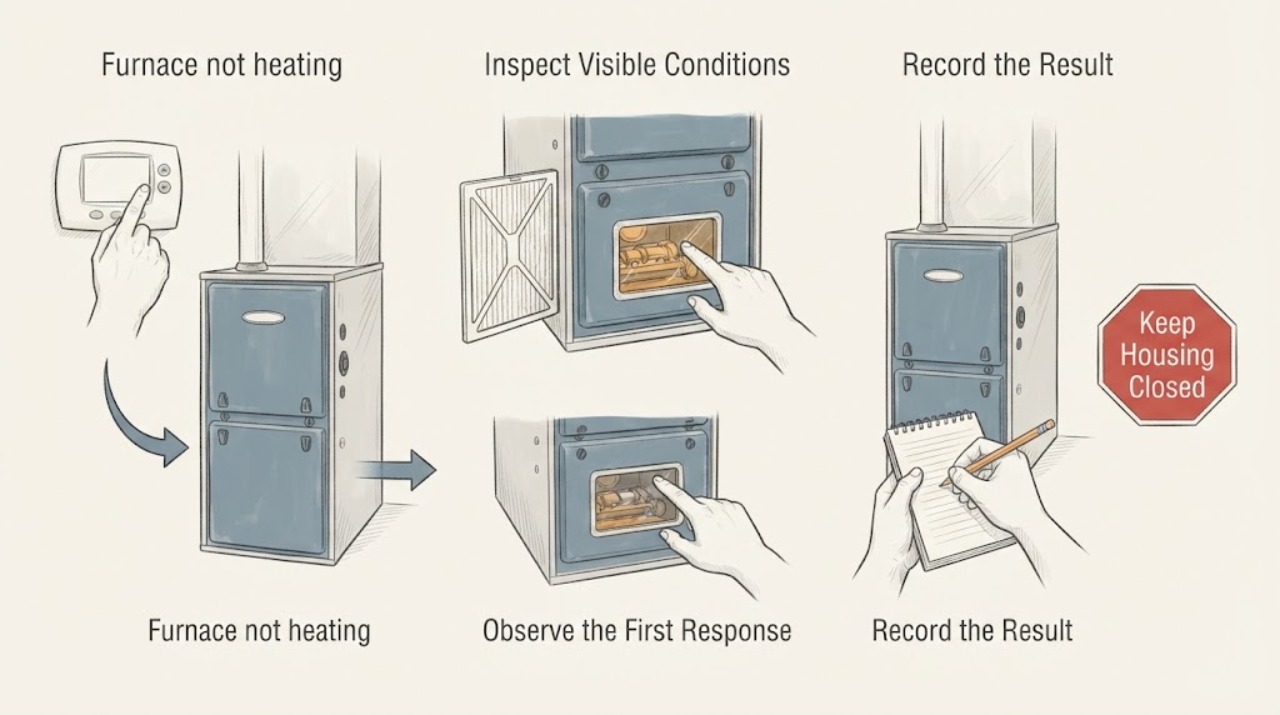
Work through in order
Diagnostic checks
Use only checks that match the exact appliance or system and its official guide.
-
Check 1
From the thermostat, observe whether the display is on, the mode reads Heat, the setpoint is above the room temperature, and the fan setting is Auto or another intentional setting; do not open the thermostat or change wiring.
Expected result: The display is off, the system is in Cool or Off, the setpoint is not calling for heat, the fan is set to On, or the controls appear appropriate but the furnace remains cold.
Next step: Record the exact display and settings and, if there is no hazard, use the normal thermostat control once as intended; if the display is appropriate and heat does not respond, arrange HVAC service without repeated cycles.
Stop if: Stop if the thermostat is damaged, wet, sparking, unusually hot, or changing settings would require opening it or handling wires.
Why this matters
Why: A control state can explain no heat or cool air from the fan, while an appropriate heat demand shifts attention to airflow or professional furnace diagnosis.
-
Check 2
From a clear, safe location, observe whether several supply registers are open and whether the main return grille is visibly blocked by furniture, clothing, or debris; feel the air only at a normal accessible register without approaching the furnace cabinet.
Expected result: Airflow is absent, weak, cool, warm, or uneven, and a register or return path is visibly blocked or unobstructed.
Next step: Clear only movable items that can be removed safely from the room side, record the airflow pattern, and call HVAC service if heat does not return; do not alter ductwork or open the furnace.
Stop if: Stop if air smells of gas, smoke, burning, or exhaust, if a register is hot enough to burn, or if inspection requires entering a mechanical hazard area.
Why this matters
Why: Restricted or uneven airflow can make the furnace overheat or limit heat delivery, while cool air with a running blower can indicate that heat production is not occurring.
-
Check 3
If the air filter is designed to be accessed without opening the furnace cabinet or touching electrical or fuel components, observe its indicator or visible dust loading; otherwise record that it was not safely accessible and do not remove panels.
Expected result: The accessible filter appears clean, visibly loaded with dust, missing, or cannot be inspected safely.
Next step: Report the filter state and use the model's documented filter specification or a professional service visit; do not operate a fuel-burning furnace without its required filter or open the cabinet to reach it.
Stop if: Stop if the filter is hot, wet, damaged, near exposed wiring, or accessible only by removing a panel.
Why this matters
Why: A loaded or missing filter can restrict airflow and contribute to overheating or a safety shutdown, but the filter observation does not diagnose ignition, flame, limit, or gas conditions.
-
Check 4
From outside the furnace cabinet and away from vents or flue openings, record the last normal response: no sound, a blower without heat, a brief start attempt, repeated cycling, unusual banging, or another distinct sound; do not restart the unit to reproduce it.
Expected result: The blower runs with cool air, the unit is silent, it starts and stops quickly, or an unusual combustion, electrical, or mechanical sound is present.
Next step: Write down the sequence and arrange HVAC service; if the sound is a bang, boom, scraping, electrical buzz, or combustion-like noise, stop operation and use urgent service.
Stop if: Stop immediately for smoke, flame, gas smell, burning odor, carbon-monoxide alarm, a bang or boom at ignition, or symptoms such as headache, dizziness, nausea, or confusion.
Why this matters
Why: The response helps a technician distinguish a demand or airflow symptom from an ignition, limit, condensate, motor, or combustion fault, but sound alone cannot identify a safe repair.
-
Check 5
From a safe location, observe only any exterior status light, display code, CO alarm, smoke alarm, visible soot, moisture, or exhaust concern; do not remove a cover or infer a blink code that is not documented for the model.
Expected result: No warning is visible, a documented code or light is present, or a gas/CO/smoke/soot/combustion warning appears.
Next step: For a warning, leave the area and call emergency help or the fuel utility from a safe location; otherwise record the code and request high-priority HVAC service.
Stop if: Stop and leave immediately for a CO alarm, gas odor, smoke, soot, burning or exhaust odor, visible flame outside its normal enclosure, or illness symptoms.
Why this matters
Why: A documented status can help route professional diagnosis, while gas, CO, smoke, soot, or combustion warnings make continued operation unsafe.
Use your observations
Decision map
Find the observation that best matches what you see, then follow the next safe action.
-
PATH 01Safety boundary
What you see
The thermostat is not calling for heat or the fan is intentionally set to run without heat.
Do this next
Record the control state and make only the normal thermostat adjustment if the room and equipment are safe; arrange service if the display or control does not respond normally.
Why this path and its safety boundary
Safety stop: Do not open the thermostat, touch wires, or continue if there is an odor, smoke, CO alarm, or electrical warning.
-
PATH 02Safety boundary
What you see
The thermostat calls for heat, but the blower delivers cool air or airflow is weak and the accessible filter is loaded.
Do this next
Report the filter and airflow observations and request HVAC evaluation; keep the unit off if it overheats, cycles repeatedly, or produces an abnormal odor.
Why this path and its safety boundary
Safety stop: Do not run without a required filter, open the furnace, or bypass a limit or other safety switch.
-
PATH 03Safety boundary
What you see
The furnace is silent, makes a brief start attempt, or repeatedly cycles without producing heat.
Do this next
Arrange high-priority professional HVAC diagnosis for controls, ignition, condensate, limit, blower, or fuel-related causes.
Why this path and its safety boundary
Safety stop: Do not relight, reset repeatedly, inspect flame parts, adjust gas, or test electrical components.
-
PATH 04Safety boundary
What you see
A gas smell, CO alarm, smoke, soot, burning or exhaust odor, unusual combustion noise, or illness symptom is present.
Do this next
Leave immediately, get people and pets to fresh air, and call emergency help or the fuel utility from outside or another safe location.
Why this path and its safety boundary
Safety stop: Do not operate switches, use a flame, re-enter to inspect, or restart the furnace until qualified responders declare it safe.
-
PATH 05Safety boundary
What you see
No hazard is visible, but the furnace still does not heat after safe observations.
Do this next
Keep the furnace out of repeated test cycles and schedule high-priority HVAC service with the observation timeline and model information.
Why this path and its safety boundary
Safety stop: Do not open panels, access burners or ignition parts, change gas settings, bypass safety controls, or substitute a part based only on symptoms.
Helpful context
Understand the symptom
Separate a control issue from a furnace fault
A thermostat set to the wrong mode, a fan set to run continuously, restricted airflow, or an accessible clogged filter can make a home feel cold without identifying a failed furnace component. A furnace that runs but delivers cool air can also have a professional-only ignition, flame-safety, condensate, or limit condition. The outside symptoms do not justify opening the cabinet or adjusting gas or electrical parts.
Keep fuel-burning equipment observation-only
Look at the thermostat, registers, return path, and any exterior display or indicator from a safe location. Do not relight a pilot, inspect a flame, remove the furnace door, touch wiring, adjust a gas valve, bypass a safety switch, or repeatedly reset the unit. If the equipment smells like gas or combustion, or a CO alarm sounds, leave and call for emergency help.
What to tell the HVAC technician
Provide the furnace type if known, thermostat mode and displayed temperature, whether the blower runs, whether any register feels warm, the filter or airflow observation, any visible code or light pattern, recent power or weather changes, and the exact time and character of any odor or sound. State clearly that no panel, burner, gas, or electrical work was attempted.
Only after diagnosis
Potential parts
- furnace air filter
Consider only if the accessible filter is visibly loaded or missing and the furnace documentation or an HVAC professional confirms the correct replacement specification.
Confirm the exact size, type, airflow rating, and installation direction; do not operate the furnace without its required filter. - furnace igniter
Consider only after a qualified technician confirms an ignition-component failure rather than thermostat, airflow, condensate, limit, fuel, or control issues.
Confirm the furnace model, ignition system, electrical specification, and manufacturer fit; ignition work is professional-only. - furnace flame sensor
Consider only after professional diagnosis confirms a failed flame-sensing component; a cold-air symptom alone does not identify the sensor.
Confirm the furnace model, sensor shape, mounting, and manufacturer compatibility; do not access or clean flame components as a home observation.
When checks do not resolve it
Need a professional?
Arrange high-priority HVAC service when the furnace does not heat after safe thermostat, airflow, filter-access, and symptom observations. Use emergency help for gas odor, CO or smoke alarm, soot, burning or exhaust odor, unusual combustion noise, visible flame outside the normal enclosure, or illness symptoms.
Safety scope: Do not open panels, relight pilots, adjust gas valves, bypass safety switches, touch electrical components, inspect burners or flame sensors, repeatedly reset or cycle the furnace, or continue operation after a gas, CO, smoke, soot, burning, or combustion warning.
Common questions
FAQ
What should I check first when the furnace is not heating?
Observe the thermostat mode and setpoint, room-side airflow, and any filter that is safely accessible without opening the furnace. Then arrange service if heat does not return.
Can I relight the furnace pilot myself?
Not in this workflow. Do not open the furnace, relight a pilot, adjust gas, or access flame components; use the model documentation and qualified HVAC service.
What if the furnace blows cold air?
Record whether the blower runs, check thermostat mode and safe room-side airflow, and note the filter condition if accessible. Ignition, limit, condensate, flame, and fuel issues require professional diagnosis.
When is a furnace problem an emergency?
Leave immediately for a gas odor, CO or smoke alarm, soot, burning or exhaust smell, unusual combustion noise, visible flame outside its normal enclosure, or symptoms such as headache, dizziness, nausea, or confusion.
Read the exact guide
Official sources
- Furnace Not Blowing Hot Air? Get Help NowTrane · Supports distinguishing thermostat, airflow, filter, blower, ignition, condensate, and flame-safety symptom paths while routing combustion work to HVAC professionals.
- Furnace Safety Fact SheetCenters for Disease Control and Prevention · Supports treating fuel-burning furnace CO risk as invisible and odorless, maintaining CO detectors, and using qualified service.
- Furnace Troubleshooting GuideCarrier · Supports the low-risk observations of thermostat state, filter condition, room airflow, and urgent escalation for gas odor or complex furnace faults.
Community feedback
Share a repair observation
Share a plain-text repair observation. Accepted observations are published automatically; this page may take a moment to update.