
On this page
Start here
Quick answer
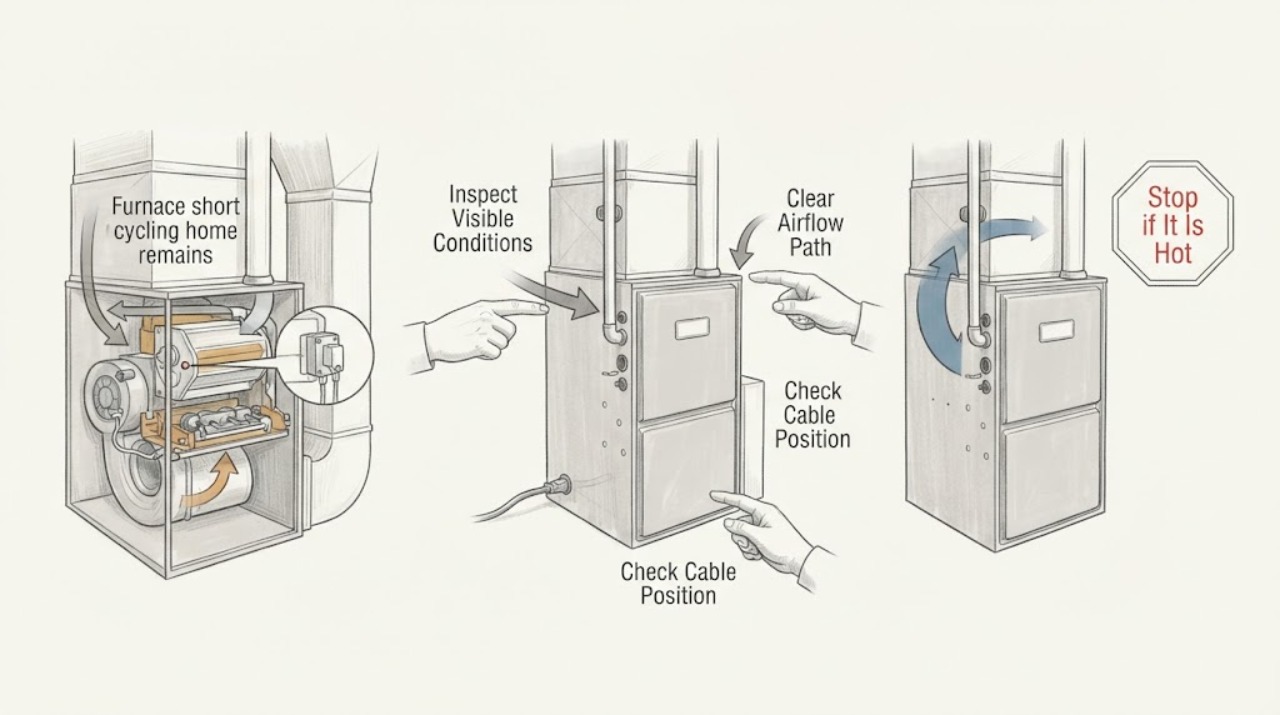
A furnace is short cycling when it starts and stops repeatedly before the home reaches the thermostat setting. A dirty filter, blocked return or supply air, thermostat error, vent restriction, limit-control problem, ignition or flame-sensing fault, or incorrect furnace sizing can all produce this pattern. Check the thermostat mode and placement, replace a visibly dirty filter with the exact specified type while the furnace is off, and make sure accessible registers and return grilles are open. Record whether the burners or blower stop first, whether the cycle repeats, and whether airflow or heat output changes. Do not bypass a limit switch, relight or adjust gas equipment, open the cabinet, or keep forcing cycles. A carbon-monoxide alarm, gas odor, unusual flame, smoke, overheating, repeated lockout, or short cycling that persists after the safe airflow checks requires the furnace to stay off and qualified HVAC service.
Before you begin
Safety first
- Combustion, gas, venting, heat-exchanger, blower, limit-control, ignition, electrical, sizing, and duct diagnosis require a qualified HVAC professional. The user can document cycle timing and inspect only the accessible filter, thermostat, vents, and external terminations as the manual permits.
Work through in order
Diagnostic checks
Use only checks that match the exact appliance or system and its official guide.
-
Check 1
For several heating calls, note when the furnace starts and stops relative to the thermostat setting, whether the home remains below the setting, and whether the blower continues after the burners stop; observe from the thermostat and room vents only.
Expected result: The furnace reaches the thermostat setting before stopping, stops early and restarts soon, runs continuously without warming the home, or the blower and burners stop in different sequences.
Next step: Record the sequence and keep the furnace on normal settings. If it repeatedly stops before warming the home, arrange HVAC diagnosis rather than forcing longer cycles.
Why this matters
Why: Stopping after the setting is reached may be normal control behavior. Early repeated starts support short cycling, while continuous operation with a cold home suggests inadequate heat delivery or a capacity or equipment problem. Burner-first versus blower-first shutdown can help a technician but does not identify a failed part by itself.
-
Check 2
With the furnace completely off, inspect the accessible filter, return grille, and supply registers; replace a visibly dirty disposable filter with the exact type specified by the manual and clear furniture or coverings from air paths.
Expected result: The filter is dirty, a return or register is blocked or closed, airflow is weak, or the accessible airflow path is clear.
Next step: Never run the furnace without its filter. If short cycling or cold rooms continue after the safe airflow check, turn the system off and arrange qualified HVAC service.
Why this matters
Why: Restricted airflow can cause heat to build up and trigger a safety shutdown before the cycle ends. A clear filter and open air paths make this cause less likely but do not rule out internal blower, duct, limit-control, or heat-exchanger problems.
-
Check 3
Verify that the thermostat is in Heat, has adequate battery power if applicable, is not directly affected by sunlight or a heat-producing appliance, and is not immediately beside a supply vent; do not open the thermostat or alter wiring.
Expected result: The mode or battery is wrong, the thermostat is exposed to a local heat source or airflow, the display behaves unexpectedly, or the thermostat appears correctly set and placed.
Next step: Correct only the normal setting or battery condition allowed by the manual. If the display is blank, the call ends early, or short cycling persists, arrange HVAC service and do not jumper thermostat terminals.
Why this matters
Why: A setting, battery, placement, or thermostat fault can end a heat call while the rest of the home remains cold. A correctly set and placed thermostat shifts attention toward airflow, safety shutdown, ignition, equipment sizing, or internal faults.
-
Check 4
From ground level and without removing covers, look for an obviously blocked outdoor exhaust or intake termination, snow, leaves, nests, or other obstruction, and note whether the furnace room's required air openings are covered; do not climb or reach into the vent.
Expected result: An intake or exhaust appears blocked, furnace-room air openings are obstructed, or no external blockage is visible.
Next step: Do not dismantle or clear an unsafe vent from a ladder or enter the furnace cabinet. Keep the furnace off and arrange qualified HVAC service for any suspected vent restriction, repeated shutdown, or combustion concern.
Why this matters
Why: A blocked vent or inadequate combustion and ventilation air can activate a safety shutdown and can create a carbon-monoxide risk. A clear visible termination does not prove the vent, pressure switch, or heat exchanger is safe.
-
Check 5
Record whether short cycling began immediately after installation, after insulation or duct changes, or only recently, and whether all rooms remain cold or only some zones; do not attempt to resize, rewire, or retune the furnace.
Expected result: The problem existed from the beginning, followed a home or duct change, appeared after years of normal operation, or is limited to certain rooms.
Next step: Give the timeline and room pattern to an HVAC professional for sizing, duct, temperature-rise, safety, and equipment diagnosis. Do not let the furnace run repeatedly while the home remains cold.
Why this matters
Why: A since-installation pattern can make sizing, thermostat location, or duct design more likely. A recent onset keeps filter, airflow, control, ignition, blower, and safety faults in consideration. Zone-specific cold can involve distribution or duct restrictions rather than only furnace capacity.
-
Check 6
Check from a safe location for gas odor, a carbon-monoxide alarm, smoke, unusual flame appearance if visible without opening the furnace, severe heat, sparking, water, or repeated safety lockout; do not rely on smell or attempt to inspect the burner.
Expected result: A gas odor, carbon-monoxide alarm, smoke, abnormal flame, severe heat, spark, water, or lockout is present.
Next step: Leave immediately for a carbon-monoxide alarm, strong gas odor, smoke, fire, or active sparking and seek emergency or gas-utility help from a safe location. Keep the furnace off and arrange qualified HVAC service for other safety symptoms.
Why this matters
Why: The furnace may have a fuel, combustion, venting, electrical, or overheating hazard that is beyond homeowner troubleshooting. A lack of odor cannot exclude carbon monoxide.
Use your observations
Decision map
Find the observation that best matches what you see, then follow the next safe action.
-
PATH 01Next step
What you see
The furnace reaches the thermostat setting and stops, or cycles normally without early shutdown while the home is still near the requested temperature.
Do this next
Confirm room temperature with a reliable room-level observation and check accessible registers and returns. Arrange an HVAC assessment if the thermostat claims satisfaction while rooms remain substantially cold.
Why this path and its safety boundary
Why it matters: Normal thermostat satisfaction is more likely than short cycling; the cold-home complaint may involve insulation, distribution, or a different comfort issue.
-
PATH 02Next step
What you see
The furnace starts, stops before the thermostat setting is reached, and restarts soon, especially with a dirty filter, blocked return, weak airflow, or closed registers.
Do this next
Turn the furnace off, correct only the accessible filter or air-path issue allowed by the manual, and monitor one normal call. If the pattern persists, arrange service and do not bypass the limit control.
Why this path and its safety boundary
Why it matters: Restricted airflow and an overheating limit shutdown are more likely than an oversized furnace alone.
-
PATH 03Next step
What you see
The filter and accessible airflow paths are clear, the thermostat is correctly set and placed, but the furnace still short cycles or shows a flame, vent, ignition, or lockout symptom.
Do this next
Keep the furnace off and arrange qualified HVAC diagnosis. Do not adjust gas controls, relight a pilot, open the cabinet, or repeatedly reset a lockout.
Why this path and its safety boundary
Why it matters: A limit switch, flame-sensing or ignition fault, vent restriction, blower problem, heat-exchanger issue, or other internal safety condition is more likely.
-
PATH 04Next step
What you see
Short cycling has existed since installation or began after major insulation, duct, zoning, or thermostat changes, without a dirty filter or obvious airflow blockage.
Do this next
Have an HVAC professional evaluate the equipment sizing, duct design, thermostat, airflow, and heat cycle. Do not alter the furnace capacity or controls yourself.
Why this path and its safety boundary
Why it matters: Improper sizing, thermostat location or setup, duct distribution, or a changed building load is more likely than a simple filter issue.
-
PATH 05Next step
What you see
There is a carbon-monoxide alarm, strong gas odor, smoke, fire, active sparking, severe overheating, water on electrical parts, an abnormal flame, or repeated safety lockout.
Do this next
Leave for gas odor, smoke, fire, active sparking, or a carbon-monoxide alarm and use emergency or gas-utility assistance from a safe location. Keep the furnace off and do not re-enter or restart it until cleared by qualified help.
Why this path and its safety boundary
Why it matters: An immediate fuel, combustion, electrical, or fire hazard may exist, regardless of why the home is cold.
Helpful context
Understand the symptom
Confirm that the furnace is actually short cycling
Short cycling is not simply a furnace turning off after it reaches the thermostat setting. The useful pattern is a heating call that ends early, followed by another start while the home remains cold. Note whether the burners stop while the blower continues, whether the whole system stops, and how soon it tries again. The sequence helps a technician distinguish airflow or safety shutdown from a thermostat call that is being satisfied incorrectly.
Start with airflow and the thermostat
A dirty filter, covered return, closed register, or blocked airflow path can make a furnace overheat and stop before the heating cycle finishes. A thermostat near sunlight, a heat source, an air vent, or a faulty battery or setting can also end a call too soon. Correct only accessible, model-approved settings and filter conditions; do not close more registers or remove furnace doors to change airflow.
A cold home means the root cause matters
Repeated short cycles increase wear and can leave rooms below the requested temperature. If the behavior has existed since installation, equipment sizing or duct design may be involved. If it began recently, a filter, thermostat, venting, ignition, limit control, blower, or heat-exchanger problem is more plausible. Sizing and internal safety diagnosis require HVAC instruments and a qualified technician.
Do not use a bypass or repeated reset as a workaround
The limit control and other furnace safeties exist to stop unsafe operation. Bypassing them, resetting a lockout repeatedly, adjusting gas controls, or running the furnace with panels removed can create fire, shock, combustion, or carbon-monoxide hazards. Absence of a gas smell does not rule out carbon monoxide; leave immediately for a carbon-monoxide alarm or strong gas odor.
Safety boundary
Stop conditions
- Do not bypass a limit switch or other safety control, jumper thermostat wires, adjust gas pressure or burners, relight a pilot without the exact qualified procedure, open the furnace cabinet, or run the furnace with access panels removed.
- Keep the furnace off and arrange qualified HVAC service when short cycling continues after the safe filter, vent, and thermostat checks, the home remains cold, ignition or lockout occurs, or equipment sizing or duct capacity is in question.
- If there is a carbon-monoxide alarm, strong gas odor, smoke, fire, active sparking, severe overheating, abnormal flame, or water near electrical components, leave the area and use emergency or gas-utility assistance from a safe location.
When checks do not resolve it
Need a professional?
Safety scope: Combustion, gas, venting, heat-exchanger, blower, limit-control, ignition, electrical, sizing, and duct diagnosis require a qualified HVAC professional. The user can document cycle timing and inspect only the accessible filter, thermostat, vents, and external terminations as the manual permits.
Common questions
FAQ
What does furnace short cycling look like?
It starts and stops repeatedly before the thermostat setting is reached, then restarts while the home remains cold. Note whether the burners stop before the blower, whether the entire system stops, and how soon it restarts; the pattern helps a technician investigate without guessing at a part.
Can a dirty filter make a furnace short cycle?
Yes. A dirty filter can restrict airflow, allow heat to build up, and trigger a safety limit shutdown before the heating cycle finishes. With the furnace off, replace a visibly dirty filter with the exact specified type and arrange service if cycling continues.
Why is the house cold if the furnace keeps running?
Short cycles may end before enough heat reaches the rooms. Restricted airflow, thermostat error, venting or ignition problems, duct distribution, equipment sizing, or an internal safety shutdown can all contribute. Do not bypass the safety controls; have the system diagnosed if safe airflow and thermostat checks do not help.
Could the thermostat cause short cycling?
Yes. Incorrect mode, weak batteries, faulty wiring, poor placement near sunlight or a heat source, or calibration issues can end a call while other rooms remain cold. Correct only normal settings or batteries allowed by the manual and leave wiring to a professional.
When should I stop running a short-cycling furnace?
Stop and arrange service when short cycling persists after the safe filter, airflow, and thermostat checks, or when there is a lockout, abnormal flame, ignition issue, vent concern, overheating, smoke, sparking, water, or unusual noise. Leave immediately for a carbon-monoxide alarm or strong gas odor.
Read the exact guide
Official sources
- Furnace Troubleshooting: Gas Furnace SolutionsTrane · Trane residential gas-furnace troubleshooting guide; fuel and ignition procedures vary by model
- Furnace Short Cycling: Causes and SolutionsTrane · Trane residential gas-furnace guidance; exact cycle behavior and service procedures vary by model
- What Is Furnace Short Cycling? Causes and SolutionsCarrier · Carrier residential furnace guidance; exact equipment and controls vary by model
- Safety Section – Gas FurnacesTrane · Trane gas-furnace safety manual; exact installation and service requirements are model-specific
Community feedback
Share a repair observation
Share a plain-text repair observation. Accepted observations are published automatically; this page may take a moment to update.