
On this page
Start here
Quick answer
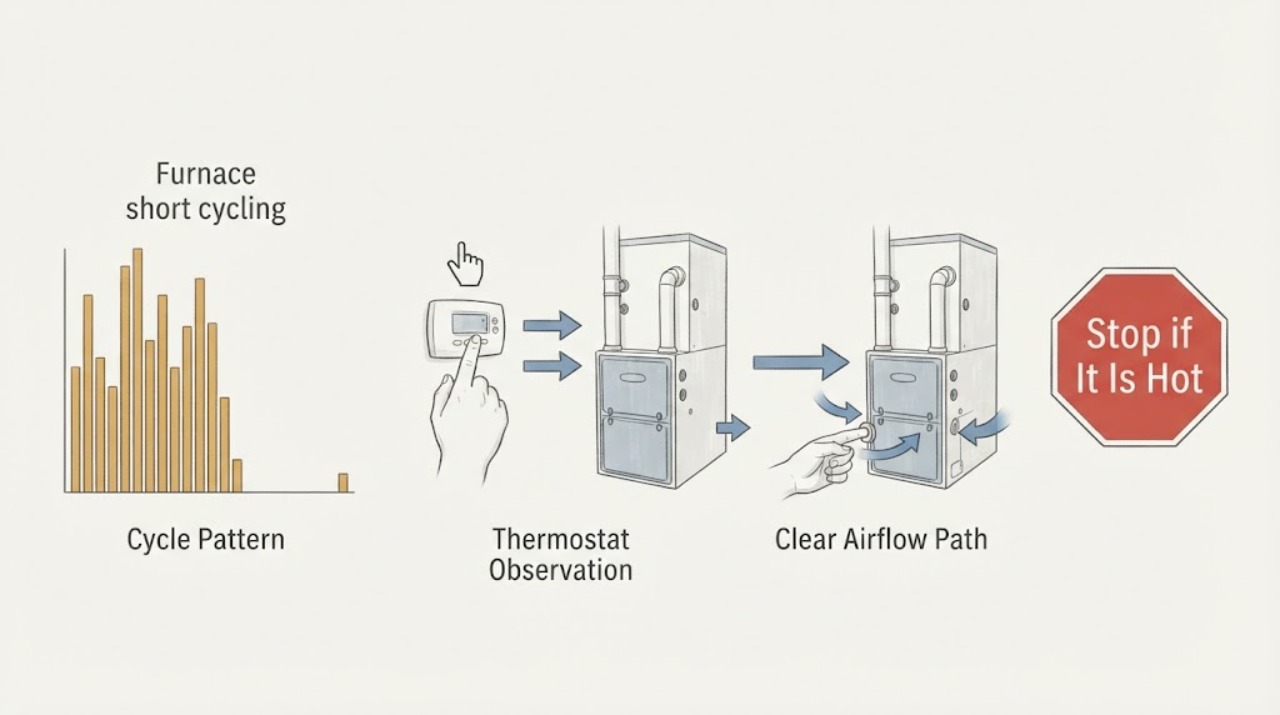
A furnace that starts and stops repeatedly before the home reaches the thermostat setting is short cycling. Restricted airflow, thermostat sensing or placement, system sizing, and internal safety or combustion faults can all look similar. Use only external, user-controlled observations: log cycle timing, check the thermostat display and surroundings, look at accessible airflow and filter conditions, and observe outdoor intake or exhaust openings from a safe distance. Do not remove furnace panels, touch gas or ignition parts, test electrical components, or repeatedly reset the system. Stop using it and arrange qualified HVAC service immediately for gas odor, carbon-monoxide alarm, smoke, burning odor, explosive ignition, or repeated breaker trips.
Work through in order
Diagnostic checks
Use only checks that match the exact appliance or system and its official guide.
-
Check 1
From a normal living area, record when the thermostat calls for heat, when the furnace starts, when it stops, and whether it restarts before the room reaches the selected setting.
Expected result: Note repeated short runs, a pattern that appears only in unusually cold weather, uneven room temperatures, or a system that runs continuously without satisfying the thermostat.
Next step: Keep the log for the technician and avoid repeated calls for heat or manual resets to force a longer cycle.
Stop if: Stop using the furnace immediately for gas odor, smoke, burning odor, loud explosive ignition, carbon-monoxide alarm, or repeated breaker trips.
Why this matters
Why: Repeated stops before comfort is reached support a short-cycling service request, while weather-dependent or thermostat-satisfied cycles may point to different control or sizing questions.
-
Check 2
Observe the thermostat from its normal location without opening it or changing wiring, noting the mode, fan setting, displayed room temperature, selected setting, battery or fault indication, and nearby heat or sunlight sources.
Expected result: Record whether the display is blank or erratic, the thermostat is close to a register or heat-producing appliance, or the furnace stops while the displayed room temperature is still below the selected setting.
Next step: Photograph the display if useful and give the settings and location history to the HVAC professional; do not open the thermostat or change control wiring.
Stop if: Stop if the thermostat is warm, scorched, sparking, smells burned, or changing it would expose wiring.
Why this matters
Why: A display or location anomaly can cause premature calls to stop or restart, but it does not prove the thermostat is faulty; persistent behavior needs qualified diagnosis.
-
Check 3
From accessible room locations, observe whether supply registers and return grilles are open and unobstructed, and look only at an externally accessible filter edge or indicator without opening the furnace cabinet.
Expected result: Note weak or uneven airflow, a visibly loaded filter, blocked furniture or drapes, unusual duct noise, or a normal-looking airflow pattern across rooms.
Next step: Clear only ordinary furniture or drapes from registers if this is safe, follow the equipment manual for an accessible filter change if no panel or electrical work is involved, and call a professional if cycling continues.
Stop if: Stop if the filter requires panel removal, the cabinet is hot, there is smoke or a burning odor, or the check would expose moving, gas, or electrical components.
Why this matters
Why: Restricted airflow can contribute to overheating and a safety shutdown, but a clean filter does not rule out duct, blower, sizing, or internal faults.
-
Check 4
From ground level and clear footing, observe any visible furnace intake or exhaust termination from a distance without touching it, moving debris, climbing, or approaching a roof or wall opening.
Expected result: Record visible blockage, frost, nesting material, unusual exhaust appearance, or a normal unobstructed view, and note whether the problem began after snow, wind, or construction.
Next step: Keep clear and report the observation to the HVAC professional; do not remove a cover, probe an opening, or operate the furnace to test a suspected vent problem.
Stop if: Stop for gas odor, soot, exhaust entering the home, smoke, ice falling from above, unsafe weather, or any need for a ladder or roof access.
Why this matters
Why: A visible obstruction can affect safe furnace operation, but the absence of an obvious obstruction does not clear the venting or combustion system.
-
Check 5
Review recent maintenance and installation history from a safe location, and note any soot, unusual flame or ignition sound heard from outside the cabinet, burning odor, carbon-monoxide alarm, or repeated breaker trip.
Expected result: Separate a new short-cycling pattern from a condition present since installation and distinguish ordinary airflow noise from banging, boom, smoke, or a combustion smell.
Next step: Record the history and arrange qualified HVAC service; do not remove panels, reset a breaker repeatedly, or attempt a combustion or electrical test.
Stop if: Stop and leave the area if gas odor, smoke, burning odor, explosive ignition, a carbon-monoxide alarm, or electrical arcing is present; contact appropriate emergency or utility services.
Why this matters
Why: A long-standing pattern can raise sizing or control questions, while combustion, electrical, or heat-exchanger warning signs require immediate professional handling.
Use your observations
Decision map
Find the observation that best matches what you see, then follow the next safe action.
-
PATH 01Next step
What you see
The furnace repeats short runs while the thermostat still shows that the home is below the selected setting.
Do this next
Keep a cycle log and schedule prompt HVAC service; persistent short cycling should not be treated as a normal operating pattern.
-
PATH 02Next step
What you see
The thermostat display or location appears abnormal, but there are no gas, smoke, or electrical warning signs.
Do this next
Provide the display and placement observations to a technician and do not open or rewire the thermostat.
-
PATH 03Next step
What you see
Airflow is weak or uneven, a filter looks loaded, or registers or returns are blocked.
Do this next
Address only an ordinary accessible obstruction or a filter change allowed by the manual without cabinet access; call an HVAC professional if cycling persists or access is not clearly safe.
-
PATH 04Next step
What you see
An intake or exhaust opening appears blocked, or the observation requires elevated access.
Do this next
Stop the check and arrange professional venting assessment; do not touch, clear, climb, or keep operating the furnace to test it.
-
PATH 05Next step
What you see
Gas odor, carbon-monoxide alarm, smoke, burning odor, explosive ignition, soot, or repeated breaker trips occur.
Do this next
Stop using the furnace, leave the area as appropriate, and contact emergency, gas-utility, electrical, or HVAC professionals; do not reset or restart it.
Helpful context
Understand the symptom
What short cycling tells you
Short cycling is a pattern, not a diagnosis. A furnace can stop because the thermostat believes the target has been reached, because airflow is restricted and a safety control responds, because the system is incorrectly sized, or because a gas, combustion, electrical, or heat-exchanger problem needs professional testing. A cold-weather change or a single unusual cycle is less informative than a repeatable pattern that leaves rooms cold.
Keep gas and electrical work professional
Do not remove access panels, bypass a safety control, inspect burners or wiring, test a capacitor or limit switch, adjust gas pressure, relight or alter ignition parts, or keep restarting a furnace that is shutting down. External observations are enough to prepare a service call. Keep combustion and electrical equipment out of the user's troubleshooting scope.
Information to give the HVAC technician
Provide the furnace and thermostat make and model if known, cycle times and room temperature pattern, thermostat settings, filter and register observations, any visible outdoor vent obstruction, recent maintenance or installation history, and every warning sign. Do not delay an urgent call to collect a close-up or an error code from inside the cabinet.
Only after diagnosis
Potential parts
- furnace air filter
Only consider a filter after an accessible visual check shows it is loaded and the equipment manual identifies a user-serviceable filter location; a filter will not correct an internal or combustion fault.
Confirm the exact system size, filter dimensions, airflow direction, and manufacturer's requirements before ordering. - furnace thermostat
Only consider a thermostat after professional or documented control diagnosis shows the thermostat is causing premature calls or incorrect temperature sensing.
Confirm heating system type, wiring, control requirements, and manufacturer compatibility before purchase or installation. - furnace limit switch
Only consider a limit switch after a qualified HVAC technician confirms the control is defective; restricted airflow or overheating must not be masked by replacing a safety component alone.
This is a professional diagnostic and replacement item; confirm the exact furnace model, switch specifications, and safety setup.
When checks do not resolve it
Need a professional?
Call a qualified HVAC professional when short cycling repeats, the home never reaches the setting, airflow observations do not explain the pattern, or the issue began after installation or maintenance. Stop and seek urgent assistance for gas odor, carbon-monoxide alarm, smoke, burning odor, explosive ignition, soot, or repeated breaker trips.
Have this ready
- Share the furnace and thermostat identities, cycle log, thermostat display and placement, filter and register observations, outdoor vent view, maintenance history, weather context, and every safety warning.
Common questions
FAQ
What counts as furnace short cycling?
It is a repeated pattern in which the furnace starts and stops before the home reaches the thermostat setting, often leaving uneven or insufficient heat. The exact normal cycle varies by equipment and conditions, so log the behavior rather than relying on a universal time threshold.
Can a dirty filter cause short cycling?
Restricted airflow can contribute to overheating and a safety shutdown, but a filter is only one possibility. Check an accessible filter without opening the furnace; if cycling continues, arrange professional diagnosis.
Should I replace the limit switch myself?
No. A limit switch is a safety control, and replacing or bypassing it without finding the cause can create a dangerous condition. Leave internal gas and electrical diagnosis to a qualified HVAC professional.
What should I do if the furnace smells like gas or burning?
Stop using it, leave the area as appropriate, and contact emergency, gas-utility, or qualified HVAC help. Do not operate switches near a gas odor, reset the system, or continue troubleshooting.
Read the exact guide
Official sources
- Furnace Short Cycling: What It Is and How to Stop ItTrane · Official furnace guidance used for mechanism context and to distinguish external observations from professional internal diagnosis.
- Gas Furnace Repair Services & Troubleshooting TipsCarrier · Official manufacturer safety guidance used to set stop conditions for gas odor, soot, burning odor, short cycling, and electrical or combustion concerns.
- Understanding Furnace Short CyclingCarrier · Official manufacturer guidance used for the observable cycle pattern and service escalation; model-specific instructions still control.
Community feedback
Share a repair observation
Share a plain-text repair observation. Accepted observations are published automatically; this page may take a moment to update.