
On this page
Start here
Quick answer
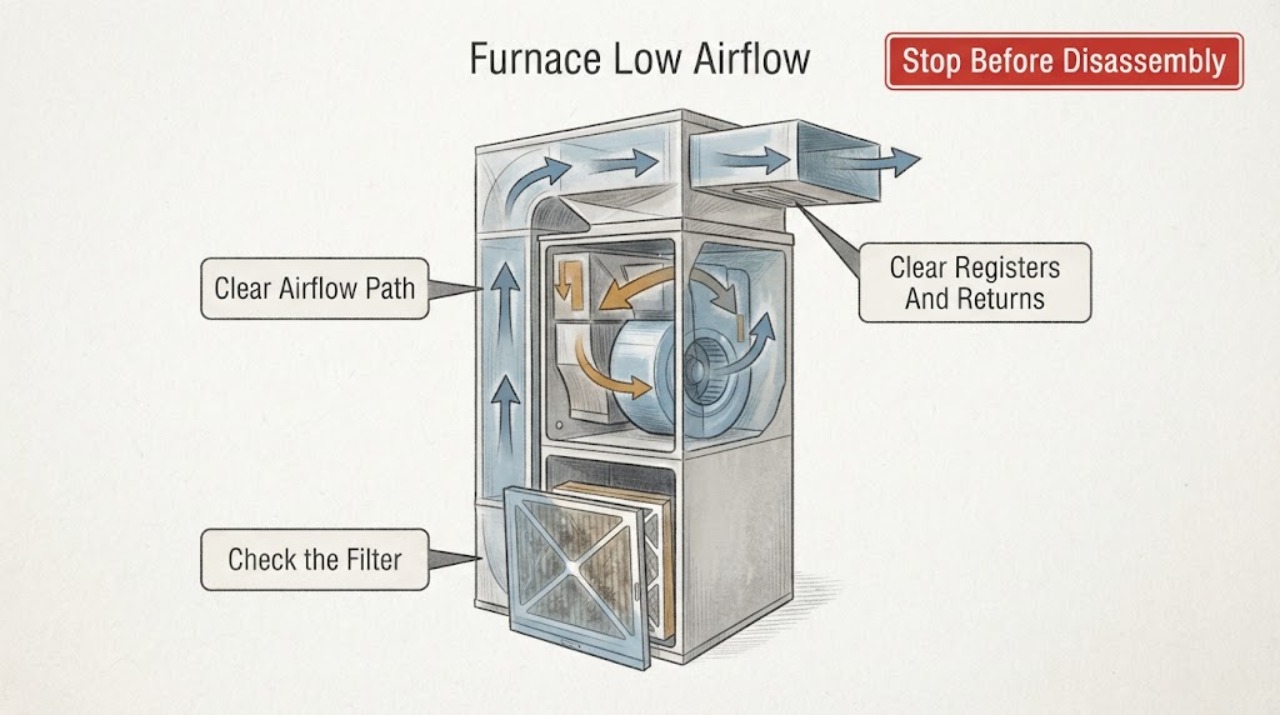
Low airflow from a furnace should be traced through the filter, return grilles, and supply registers before assuming a blower or duct fault. Turn the system off, inspect or replace a visibly dirty filter in the correct airflow direction, remove furniture or other obstructions from returns and registers, and compare whether the weak flow affects one room or the whole home. If airflow stays low, the blower stops or cycles abnormally, the furnace overheats, a breaker trips again, or you smell gas or burning, stop and call a qualified HVAC professional; do not open burner, electrical, or heat-exchanger compartments.
Work through in order
Diagnostic checks
Use only checks that match the exact appliance or system and its official guide.
-
Check 1
With the furnace operating normally, compare the airflow at several supply registers and note whether the reduction is in one room, on one branch, or throughout the home. Look at each register and return grille without removing duct covers.
Expected result: Only one register is weak, several nearby registers are weak, or airflow is weak at nearly every supply register.
Next step: Use the location of the symptom to choose the register/return inspection or whole-system filter and blower-behavior branch. Do not infer a specific failed part from airflow alone.
Stop if: Stop if a grille, duct, cabinet, or wiring looks damaged, wet, scorched, or contaminated, or if the furnace is producing smoke or a gas odor.
Why this matters
Why: A single weak register supports a local obstruction or duct branch problem; weak airflow everywhere makes a filter, return-air restriction, blower problem, or furnace safety response more plausible.
-
Check 2
Check that supply registers are open and not covered by furniture, rugs, boxes, or curtains. Check return grilles for furniture, dust buildup, or other objects blocking their face; clear only what can be moved safely without opening the ductwork.
Expected result: A register or return was blocked, or all visible openings were already clear.
Next step: Run the furnace again and compare the same registers. If clearing openings changes the flow, keep them clear and monitor the next heating cycle; if nothing changes, inspect the filter.
Stop if: Stop if removing an obstruction would require moving a gas appliance, entering an unsafe crawlspace or attic, or opening sealed duct or furnace panels.
Why this matters
Why: Closed or blocked supply and return openings increase resistance and can reduce circulation; Carrier and Trane also associate restricted airflow with overheating or repeated shutdown behavior.
-
Check 3
Set the thermostat to stop heating, turn off the furnace power using the normal user control, and follow the owner manual to access the air filter. If it is gray, visibly loaded with dust, damaged, or installed backward, replace or clean it only with the size and type specified for the system; match the airflow arrow when refitting it and close the panel securely.
Expected result: The filter is visibly clogged or backward, or it is clean, undamaged, and correctly oriented.
Next step: Restore normal operation and compare airflow after the filter change. If the new filter makes little difference, do not install a more restrictive filter or remove the filter to force airflow; continue to the return and blower-behavior checks.
Stop if: Stop if the filter cannot be accessed without opening a burner or electrical compartment, the panel will not close, or there are signs of fire, melted material, wet insulation, or damaged wiring.
Why this matters
Why: A dirty or incorrectly installed filter can sharply restrict airflow and make the furnace run longer or overheat. A clean, correctly installed filter shifts suspicion toward the return path, blower, ductwork, or a control/safety issue.
-
Check 4
After the visible openings and filter are addressed, observe one normal call for heat from outside the furnace cabinet: note whether the blower starts, maintains a steady run, turns on and off repeatedly, or continues running after the heating call ends. Do not remove the blower door or test a component electrically.
Expected result: The blower does not start, starts and stops before the cycle finishes, runs continuously with the thermostat off, or runs normally but airflow remains weak everywhere.
Next step: If the blower behavior is abnormal or a safety switch may be operating, stop and arrange HVAC diagnosis. If it appears normal, continue only with visible return/duct observations and document which registers are weak.
Stop if: Stop immediately for repeated short cycling, an overheating cabinet, smoke, burning odor, unusual electrical noise, or a breaker that trips again.
Why this matters
Why: Abnormal blower behavior can involve the thermostat, safety switch, blower motor, control board, or another internal component. Normal blower timing with low flow keeps a duct or return restriction in consideration but still does not prove a part failure.
-
Check 5
Check the thermostat mode and set point, and visually confirm that the furnace service switch and breaker appear on. If a breaker has tripped, reset it only according to the equipment instructions and only when there is no odor, smoke, water, or visible damage; then observe whether it trips again.
Expected result: The thermostat was not calling for heat, the switch or breaker was off, the system resumes normally, or the breaker trips again or the furnace remains abnormal.
Next step: Correct only the harmless setting or switch issue and recheck airflow once. For a repeat trip, no-start condition, or any odor, leave the system off and call a qualified technician; if gas is suspected, leave the area and contact the gas utility from a safe location.
Stop if: Do not touch switches if you smell gas. Leave immediately for a gas odor, and stop for smoke, burning odor, exposed wiring, water near electrics, or any repeated breaker trip.
Why this matters
Why: A setting or one-time power interruption can mimic a circulation fault. A repeated trip or continued abnormal operation is an electrical or equipment fault, not a reason to keep resetting power.
Use your observations
Decision map
Find the observation that best matches what you see, then follow the next safe action.
-
PATH 01Next step
What you see
Only one register or one small area has weak flow while the others are normal.
Do this next
Clear the register and nearby return, then arrange a technician to inspect that visible duct branch if the imbalance remains; do not open sealed ductwork.
-
PATH 02Next step
What you see
Airflow is weak throughout the home and the filter is dirty, backward, damaged, or overdue for replacement.
Do this next
Install or clean the correct filter according to the equipment instructions, close the access panel, and compare airflow on the next normal cycle.
-
PATH 03Next step
What you see
Furniture, boxes, rugs, or other movable objects block a return or supply opening.
Do this next
Clear the opening and retest. If airflow or cycling improves, keep the path clear; if not, continue to professional diagnosis.
-
PATH 04Next step
What you see
The blower does not start, repeatedly starts and stops, or runs continuously with the heat call off.
Do this next
Stop troubleshooting inside the cabinet and book HVAC service for the blower, controls, and safety system.
-
PATH 05Next step
What you see
The filter is correct and clean, visible openings are clear, but whole-home airflow remains low.
Do this next
Do not remove the filter or choose a more restrictive substitute. Have a technician assess return sizing, duct restrictions or leaks, blower operation, and safety controls.
-
PATH 06Next step
What you see
There is a gas odor, smoke, burning smell, exposed or melted wiring, water near electrical parts, abnormal cabinet heat, or a breaker trips again.
Do this next
Leave the area for a gas odor and contact the gas utility from a safe location; otherwise stop the furnace and arrange qualified HVAC service. Do not operate switches or open the cabinet while unsafe conditions remain.
Helpful context
Understand the symptom
Airflow is a whole path: room air must enter through return grilles, pass through the filter and furnace, and leave through supply registers. A restriction anywhere in that path can make the heat feel weak or cause the furnace to run longer. The location of the symptom matters—one weak register suggests a local grille or duct issue, while weak flow everywhere points upstream toward the filter, return path, blower, or a system safety response.
The checks below stay on the homeowner side of the boundary: visual inspection, ordinary thermostat observations, and a filter change that follows the appliance instructions. They do not identify a failed motor, capacitor, limit switch, gas component, or heat exchanger. Those parts require a qualified HVAC technician.
When checks do not resolve it
Need a professional?
Request qualified HVAC service for persistent low airflow or abnormal furnace operation. Provide the technician with the filter condition, which registers are weak, whether returns were blocked, the blower behavior, any displayed fault, and whether the breaker or heating cycle changed; do not order a motor, capacitor, switch, or control part from airflow symptoms alone.
Common questions
FAQ
Can a dirty furnace filter cause low airflow?
Yes. Official HVAC guidance identifies a dirty or clogged filter as a restriction that can reduce airflow, increase furnace run time, and contribute to overheating. Turn the system off, follow the owner manual, and replace or clean an accessible filter with the correct size and airflow direction. If airflow remains low, the filter was not the whole diagnosis.
Why is airflow weak in only one room?
A local supply register, return path, or duct branch may be obstructed or restricted. Clear only movable objects from the register and return and compare nearby rooms. If the imbalance persists, have a technician inspect the duct branch rather than opening sealed ductwork yourself.
Should I replace the blower motor for low airflow?
Not from low airflow alone. A dirty filter, blocked return, closed register, duct restriction, thermostat issue, safety switch, blower motor, or control problem can produce similar symptoms. If the basic visual checks do not help or the blower behaves abnormally, professional testing is required.
Read the exact guide
Official sources
- Furnace Troubleshooting Guide | Fix a Furnace Not WorkingCarrier · Furnace filter, thermostat, airflow, vent, overheating, gas-odor, and professional escalation guidance
- Furnace Filter Replacement: The How & Why of Changing Furnace FiltersCarrier · Safe homeowner filter inspection and replacement procedure, airflow direction, and filter restriction symptoms
- HVAC Proper Installation of FiltersU.S. Department of Energy Building Science Education · HVAC filter placement and the effect of dirty or clogged filters on airflow and furnace operation
- Furnace Blower Not Working: Causes and SolutionsTrane · Furnace blower behavior, blocked return air, filter restriction, short cycling, and HVAC-service boundary
Community feedback
Share a repair observation
Share a plain-text repair observation. Accepted observations are published automatically; this page may take a moment to update.