
On this page
Start here
Quick answer
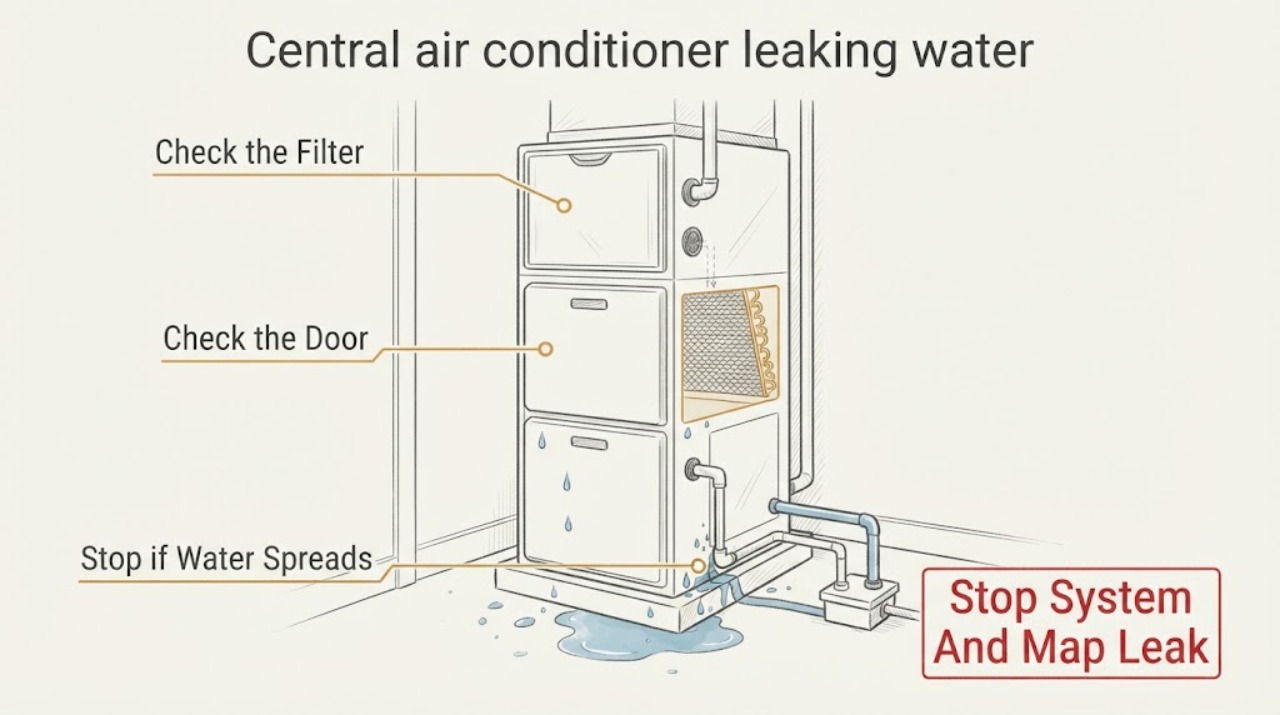
A Goodman central air conditioner leaking water usually has condensate that is not reaching its drain, a drain pan or line problem, or an evaporator coil that froze and is now thawing. A dirty filter, blocked return path, dirty coil, blower issue, refrigerant problem, pump, or installation condition can cause or worsen the symptom. Switch cooling off at the thermostat, protect the floor or ceiling, and inspect only the accessible filter, return grilles, visible drain outlet, thermostat, and outside of the indoor unit. Replace a dirty accessible filter with the exact Goodman-documented type, but do not open the air handler, handle refrigerant, scrape ice, cut or pressure-flush an unknown pipe, or restart while ice or active overflow remains. Arrange qualified HVAC service for a full or damaged pan, recurring leak, weak cooling, suspected frozen coil, concealed drain, water near electrical equipment, or any source you cannot identify.
Work through in order
Diagnostic checks
Use only checks that match the exact appliance or system and its official guide.
-
Check 1
Switch the thermostat from COOL to OFF when water is dripping or pooling around the indoor unit, and from a safe dry position note whether the leak occurs while cooling runs, after shutdown, near a ceiling, or near electrical equipment; do not keep running the system to reproduce the leak.
Expected result: Water is actively pooling, appears only after shutdown, stains a ceiling or wall, reaches wiring or controls, or has no visible source.
Next step: Leave cooling off, protect the area without touching wet equipment, and arrange prompt HVAC service for active pooling, building damage, electrical proximity, or an unknown source. Continue only with external checks when the area is safe.
Why this matters
Why: Active pooling, building damage, water near electrical equipment, or an unknown source is an urgent stop condition. Post-shutdown water can be thawing ice from the evaporator coil, while a leak during operation keeps a drain, pan, pump, or installation fault in question.
-
Check 2
With the system off and only if the filter is accessible without opening an equipment panel, inspect it for loading, collapse, wrong fit, or an unclear airflow direction; do not reach into the air handler or operate the system without its filter.
Expected result: The filter is visibly dirty or damaged, it is an uncertain size or type, it is missing, or it looks clean and correctly seated.
Next step: Install the exact documented replacement with the marked airflow direction when safely accessible. Leave the system off and arrange service if the filter is uncertain, the leak continues, or icing is suspected.
Why this matters
Why: A dirty or poorly fitted filter can reduce airflow and contribute to coil icing and subsequent meltwater. A clean correctly fitted filter makes a drain, coil, blower, thermostat, or refrigeration issue more likely; an inaccessible filter cannot be safely judged as a homeowner check.
-
Check 3
Look at accessible return grilles and the outside unit's surrounding space for furniture, dust, leaves, or other obstructions while cooling remains off; do not remove coil guards, bend fins, or open equipment panels.
Expected result: A return is blocked, the outdoor unit is surrounded by debris, airflow was weak before the leak, or visible airflow paths are clear.
Next step: Restore clear room-side returns and safe exterior clearance without dismantling equipment. If water or icing returns with airflow paths clear, stop external troubleshooting and arrange HVAC diagnosis.
Why this matters
Why: Blocked return or outdoor airflow can reduce system performance and leave an airflow-related coil or condensate problem unresolved. Clear external furniture or loose debris only; a clear path does not rule out a dirty indoor coil, blower fault, drain restriction, or refrigerant issue.
-
Check 4
From a safe external position, inspect the visible condensate outlet and accessible pan edge for standing water, overflow, a disconnected pipe, or visible damage; do not remove the pan, cut the drain, pressure-flush an unknown pipe, or open the air handler.
Expected result: The pan is full, water is on the floor, the outlet or pipe looks disconnected, a crack or corrosion is visible, or the visible drain and pan look normal.
Next step: Keep cooling off and arrange service for a full or damaged pan, concealed drain, pump, or continued water. Do not force a chemical or pressure treatment through a line whose route and material are not confirmed.
Why this matters
Why: A full pan, overflow, disconnected drain, or visible damage supports a condensate collection or drainage fault. A normal-looking outlet does not clear a concealed obstruction, pump, slope, trap, or intermittent blockage.
-
Check 5
Without opening the cabinet, look for visible frost or ice on accessible lines or the indoor unit and record whether water increases as the system remains off; do not scrape ice, apply a heat source, or touch refrigerant lines.
Expected result: Ice is visible, water increases after shutdown, cooling was weak, the unit ran continuously, or no ice is visible and the leak is independent of thawing.
Next step: Leave cooling off until the coil has thawed and water is controlled. Arrange HVAC service for any icing, weak cooling, recurrence, or inaccessible coil instead of restarting to test it.
Why this matters
Why: Ice followed by meltwater supports a frozen-coil path, often linked to restricted airflow or a refrigeration problem. No visible ice does not rule out a drain or pan fault, and an inaccessible coil cannot be diagnosed by appearance alone.
-
Check 6
Record the thermostat mode, setpoint, alerts, fan setting, runtime, and whether the water returns after the exact documented filter check and complete thaw; do not bypass a control, reset a safety switch repeatedly, or call for cooling while ice or overflow remains.
Expected result: The unit ran continuously, an alert or safety shutdown appeared, water appeared after shutdown, the leak recurs, or the system remains dry and cools normally after the external correction.
Next step: Leave the system off for recurrence, weak cooling, or alerts and provide the record to a technician. If it remains stable, monitor for renewed water or icing and follow the model's maintenance guidance.
Why this matters
Why: Continuous runtime, safety shutdown, or recurring water suggests an unresolved drain, airflow, coil, blower, control, pump, or refrigeration problem. A dry stable cycle after a known filter restriction is encouraging but does not justify opening the equipment or sealed circuit.
Use your observations
Decision map
Find the observation that best matches what you see, then follow the next safe action.
-
PATH 01Next step
What you see
Do this next
Keep cooling off and arrange qualified service to inspect the pan, drain, pump, and any float protection. Protect the area and do not dismantle or pressure-flush an unidentified line.
-
PATH 02Next step
What you see
Do this next
Leave the system off through the thaw, check only the accessible filter and returns, and arrange service for recurrence or weak cooling. Do not scrape ice or restart while ice or overflow remains.
-
PATH 03Next step
What you see
Do this next
Monitor for water, ice, weak cooling, or long runtime. If any returns, arrange service to assess the concealed coil, blower, drain, and refrigeration circuit rather than repeating filter changes alone.
-
PATH 04Next step
What you see
Do this next
Keep cooling off and arrange qualified HVAC diagnosis. Do not remove panels or order an internal part from the leak symptom alone.
-
PATH 05Next step
What you see
Do this next
Keep clear, switch the system off from a safe dry location, protect people and property without touching wet equipment, and arrange qualified HVAC or electrical service; use emergency help for active smoke or fire.
Helpful context
Understand the symptom
Where the water normally goes
During cooling, warm indoor air crosses the cold indoor evaporator coil and moisture becomes condensate. The pan collects that water and the drain routes it away from the equipment. A puddle around the indoor unit, water on a ceiling, or an overflowing pan means that this path may be blocked, damaged, disconnected, poorly supported, or receiving meltwater from a frozen coil.
A filter can be part of a water leak
A loaded filter or obstructed return path can reduce airflow over the evaporator coil. The coil may then become too cold and freeze; when the ice melts, the extra water can overflow or expose a drain problem. A filter check is useful, but a clean filter does not prove that the concealed coil, blower, drain, or refrigeration circuit is healthy.
Keep external checks separate from service work
Turn cooling off, contain accessible water, and keep water away from electrical components. External checks can document the filter, grilles, thermostat, visible drain, and timing of the leak. Coil cleaning, pan removal, blower or wiring work, drain-line access, and refrigerant diagnosis require equipment-specific procedures and qualified HVAC service.
Only after diagnosis
Potential parts
- air conditioner air filter
Consider a replacement filter only when the accessible filter is visibly loaded or damaged and the exact Goodman equipment documentation identifies its size and type.
Match the documented fit, filter type, airflow direction, and equipment requirements; a generic filter is not automatically suitable. - condensate drain pan
Consider a drain-pan repair or replacement only after qualified inspection confirms a crack, corrosion, poor fit, or overflow condition and the exact drain arrangement is known.
Drain pans are equipment-, orientation-, and coil-specific and may involve air-handler access; confirm the exact model and use qualified service. - condensate pump or float component
Consider this category only when a system with a pump or float protection is professionally diagnosed with failed pumping, overflow, or nuisance shutdown after the drain path is assessed.
Confirm the exact air-handler and pump arrangement; do not bypass a float switch or install an unverified component. - evaporator coil or airflow component
Consider an evaporator coil, blower, or related airflow repair only after qualified testing confirms a dirty, damaged, or failed component as the cause of recurring water or icing.
Internal parts are model-specific and may involve electrical or refrigerant work; do not order or install one from a water leak symptom alone.
When checks do not resolve it
Need a professional?
Arrange qualified HVAC service if the water source is concealed or uncertain, the pan is full or damaged, the drain or pump is abnormal, the leak returns, ice forms, cooling is weak, the filter and accessible returns are normal, or water reaches the floor, ceiling, or equipment. Stop immediately for active pooling, ceiling damage, water near wiring, smoke, burning odor, exposed or wet electrical equipment, or an uncontrollable leak; shut the system off from a safe dry location and do not open panels.
Common questions
FAQ
Why is my Goodman central air conditioner leaking water indoors?
The condensate drain or pan may be blocked, disconnected, damaged, or overflowing, or a frozen evaporator coil may be melting. A dirty filter, blocked return, coil, blower, pump, installation, or refrigeration problem can contribute. Turn cooling off and check only accessible external items before arranging service.
Can I run my Goodman AC while it is leaking water?
It is safer to leave cooling off while water is leaking. Continued operation can add condensate, worsen an overflow, or keep a frozen coil under load. Protect the area and arrange service before restarting when the source, ice, or active water has not been resolved.
Can a dirty Goodman AC filter cause a water leak?
Yes. Goodman explains that dirty filters block airflow, and restricted airflow can contribute to coil or system problems. Replace an accessible filter only with the exact documented type and direction after turning the system off. If water or ice returns, the filter was not the whole diagnosis.
Why does my Goodman AC leak water after it turns off?
Ice on the evaporator coil can melt after cooling stops, or water already in a restricted drain path can continue to overflow. Look for visible ice without opening the cabinet, leave cooling off, and arrange service if water continues, the pan is full, or the source is unclear.
When is a Goodman AC water leak an emergency?
Treat active pooling, ceiling or drywall damage, water near electrical equipment, a full or damaged pan, recurring ice, an unknown source, smoke, burning odor, or a leak that cannot be contained as urgent. Keep the system off, stay clear of wet equipment, and arrange qualified service; use emergency help for smoke or fire.
Read the exact guide
Official sources
- HVAC Learning Center | HVAC 101 | GoodmanGoodman · Goodman HVAC 101 educational guidance; use exact model instructions for service and access.
- AC Maintenance Tips| Air Conditioner |GoodmanGoodman · Goodman residential air-conditioner maintenance guidance; exact equipment documentation and licensed service control repairs.
- HVAC GlossaryGoodman · Goodman HVAC terminology and system-mechanics guidance; installation details vary by model.
- HVAC Learning Center | Heating and Cooling | GoodmanGoodman · Goodman residential HVAC learning material; exact equipment and installation documentation control.
Community feedback
Share a repair observation
Share a plain-text repair observation. Accepted observations are published automatically; this page may take a moment to update.