
On this page
Start here
Quick answer
A Goodman central air conditioner that starts and stops unusually often may be responding to a thermostat or control signal, restricted airflow, a frozen or dirty coil, outdoor-unit or electrical protection, low refrigerant or another sealed-system fault, duct problems, or an incorrectly sized system. First record how long each run lasts and whether the indoor temperature reaches the setpoint; confirm the thermostat is in cooling mode, inspect only the accessible filter and grilles, and look for ice, weak airflow, water, or abnormal outdoor-unit behavior from a safe distance. Replace a filter only when its type and size are specified for your equipment. Do not open electrical covers, handle capacitors, attach gauges, add refrigerant, bypass a safety control, or keep restarting a unit that is tripping, icing, overheating, or making an electrical or burning odor. If short cycling continues after the accessible checks, arrange qualified HVAC service to test thermostat operation, airflow, coil condition, refrigerant circuit, electrical controls, ductwork, and system sizing.
Before you begin
Safety first
- A qualified technician should test thermostat and control signals, airflow and duct restrictions, coil and drain condition, blower and condenser-fan operation, electrical controls, compressor protection, refrigerant charge and leaks, and capacity or staging. Homeowner checks should remain limited to settings, batteries where documented, an accessible filter, clear grilles, safe visual observations, and documentation.
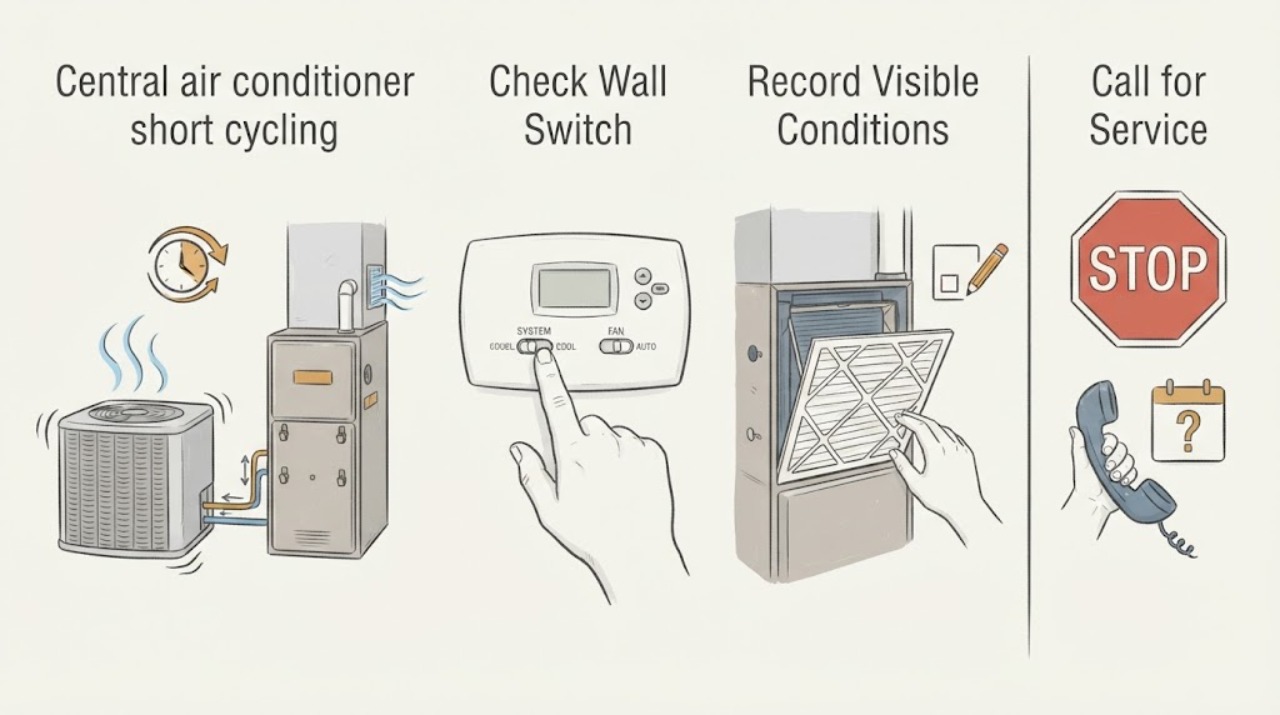
Work through in order
Diagnostic checks
Use only checks that match the exact appliance or system and its official guide.
-
Check 1
Stop trying to reproduce the fault and switch the thermostat out of cooling if the Goodman unit is repeatedly starting and stopping, tripping a breaker, showing ice, producing water, or making a burning or electrical odor; keep clear of wet or energized equipment.
Expected result: The system is only cycling frequently with no ice, water, odor, breaker event, or unusual noise, or one of those warning signs is present.
Next step: For any warning sign, leave cooling off and arrange prompt qualified HVAC or electrical help as appropriate. If no warning sign is present, continue only with the thermostat, filter, grille, and visual outdoor checks below; do not keep restarting to obtain more data.
Why this matters
Why: A repeatable short-cycle pattern needs diagnosis, while ice, water, electrical symptoms, or a protective shutdown can worsen equipment damage or create a shock or fire hazard if operation continues.
-
Check 2
Use a clock or phone to record several start and stop times, whether the indoor blower and outdoor unit stop together, the thermostat's cooling-call status, the room temperature, and whether the setpoint is actually reached.
Expected result: The thermostat ends the call at the setpoint, the call remains active when equipment stops, or the unit stops after a similarly brief interval without satisfying the setpoint.
Next step: Save the log and thermostat model or settings for the technician. Do not change installer-only cycle parameters or bypass a compressor time delay; use the log to determine which later checks are safe and useful.
Why this matters
Why: Stopping at the setpoint makes thermostat location, temperature reading, differential, and system sizing more relevant. Stopping while a call remains active points more toward equipment protection, airflow, coil, electrical-control, or communication trouble. A consistent brief run can also fit an oversized or otherwise mismatched installation, but timing alone cannot prove it.
-
Check 3
Confirm the thermostat is in cooling mode with a reasonable setpoint, is not exposed to direct sun, a draft, a doorway, or a heat-producing appliance, and has the display or batteries behaving normally; do not remove wiring or open the thermostat base.
Expected result: The thermostat is mis-set, its temperature reading seems inconsistent with the room, it is in a draft or sun, its display is weak, or the settings and location appear normal.
Next step: Correct only an obvious user setting or replace batteries when the thermostat documentation calls for it, then observe without repeatedly forcing cycles. If the call still ends early or the thermostat disagrees with a nearby room reading, arrange HVAC service for thermostat and control testing.
Why this matters
Why: A wrong mode, unstable power, or misleading temperature at the thermostat can end a cooling call early. A normal display and location make an equipment, airflow, sizing, or sealed-system cause more likely, but do not rule out a thermostat fault.
-
Check 4
Inspect the return-air filter and accessible supply and return grilles with the system stopped; replace a loaded or damaged filter only with the exact type and size specified for the Goodman equipment, and remove furniture or loose debris blocking grilles.
Expected result: The filter is loaded, missing, wet, or incorrect; grilles are blocked; airflow is weak or uneven; or the filter and accessible grilles look normal.
Next step: After a correctly specified filter change, allow the system to operate only if there is no ice, water, odor, or repeated protective shutdown. If airflow remains weak, short cycling continues, or any ice appears, stop cooling and arrange professional diagnosis; do not remove an air-handler panel.
Why this matters
Why: A restricted filter or return path can reduce airflow, contribute to coil icing, and alter system operation. A normal accessible filter does not rule out a dirty indoor coil, blower problem, closed damper, duct restriction, or low refrigerant.
-
Check 5
From a safe distance, inspect the outdoor Goodman cabinet for leaves, vegetation, or other loose debris restricting the exterior air path, and note whether the fan starts, stops, or makes abnormal noise during an observed call; do not remove panels or touch the disconnect, wiring, fan, or capacitor.
Expected result: The exterior is obstructed, the outdoor fan does not run or stops while there is a cooling call, the unit is noisy or repeatedly restarts, or the cabinet is clear and operation appears steady.
Next step: Remove only loose debris that is safely outside the cabinet and cannot contact moving or electrical parts. If the fan behavior is abnormal, the unit is hot, or cycling continues, leave cooling off and arrange qualified HVAC service; never test live voltage or replace an electrical part by guesswork.
Why this matters
Why: An obstructed condenser or an outdoor fan/control symptom can raise operating stress or trigger protection, but a visual observation cannot distinguish a motor, capacitor, control, compressor, or refrigerant problem. A clear cabinet makes indoor airflow, controls, sizing, and sealed-system causes relatively more important.
-
Check 6
Look through accessible viewing areas and around the indoor unit, refrigerant lines, and ducts for frost or ice, water, heavy condensation, or unusually weak airflow; do not open the cabinet, scrape ice, apply direct heat, or probe the coil.
Expected result: Ice or frost is visible, cooling is weak with little airflow, water appears as ice thaws, or the accessible surfaces are dry and airflow feels normal.
Next step: Turn cooling off and allow safe thawing without trying to accelerate it; arrange qualified service before restarting. Ask the technician to check airflow, coil and drain condition, refrigerant circuit, and controls rather than simply adding refrigerant.
Why this matters
Why: Ice or weak airflow supports restricted airflow, dirty coil, blower, refrigerant, metering, or control trouble and can make the compressor stop on protection. Water after ice thaws is a consequence, not proof of a blocked drain. A dry accessible area does not rule out a hidden coil or sealed-system fault.
-
Check 7
Gather the Goodman model and serial information from existing paperwork or an exterior nameplate, system age if known, recent installation or duct changes, maintenance history, thermostat log, filter details, and photos of any ice, water, or outdoor symptoms.
Expected result: The short cycling began after installation or a duct or thermostat change, occurs mainly in mild weather or at low load, has appeared as the system aged, or has no clear trigger.
Next step: Give the record to a qualified HVAC technician and request a diagnosis of thermostat/control behavior, airflow and ducts, coil and drain, refrigerant circuit, electrical controls, and sizing or staging. Do not order a compressor, capacitor, control board, or refrigerant based only on the symptom.
Why this matters
Why: A post-installation or low-load pattern keeps sizing, staging, thermostat configuration, duct design, and installation compatibility in consideration. A new pattern on an older system keeps airflow, coil, refrigerant leak, electrical-control wear, and compressor-protection causes in consideration. The history narrows the service inspection but does not identify a part alone.
Use your observations
Decision map
Find the observation that best matches what you see, then follow the next safe action.
-
PATH 01Next step
What you see
The thermostat stops calling at or near the setpoint, the system restarts after a small temperature change, and the pattern is strongest in mild weather or soon after an installation or control change.
Do this next
Keep settings reasonable and do not alter installer parameters. Have a qualified HVAC professional verify thermostat placement and operation, staging, load and system sizing, and duct distribution before considering a component replacement.
Why this path and its safety boundary
Why it matters: Thermostat location or differential, staging/configuration, low cooling load, or an oversized or mismatched system is more likely than an immediately failing compressor, although the control and equipment still need testing.
-
PATH 02Next step
What you see
The thermostat continues to call for cooling while the indoor blower or outdoor unit stops, or the unit repeatedly starts again after a protective-looking pause.
Do this next
Leave cooling off if the pattern repeats, especially with heat, ice, noise, or a breaker event, and arrange qualified HVAC diagnosis. Do not bypass a time delay or safety control and do not test live electrical parts.
Why this path and its safety boundary
Why it matters: An airflow restriction, frozen coil, electrical control, compressor or fan protection, communication issue, or another equipment fault is more likely than a normal satisfied call.
-
PATH 03Next step
What you see
The filter or return path is restricted, airflow is weak, or frost or ice appears before the unit stops.
Do this next
Replace only the correctly specified accessible filter, leave cooling off while ice thaws, and arrange professional testing of airflow, coil, drain, blower, and refrigerant circuit. Do not chip ice or add refrigerant.
Why this path and its safety boundary
Why it matters: Restricted airflow, a dirty coil or blower, a duct restriction, or a refrigerant or metering problem is more likely; the short cycle may be a protection response rather than a thermostat decision.
-
PATH 04Next step
What you see
The outdoor cabinet is blocked, the condenser fan does not run normally, or the outdoor unit is unusually hot or noisy when a cooling call is active.
Do this next
Clear only loose exterior debris without touching the cabinet or electrical parts. Stop cooling and arrange qualified service for electrical and refrigeration diagnosis if the fan or compressor behavior is abnormal or the cycling returns.
Why this path and its safety boundary
Why it matters: Outdoor airflow, fan motor or capacitor, contactor or other electrical control, compressor protection, or sealed-system trouble is more likely than a simple thermostat setting.
-
PATH 05Next step
What you see
Short cycling continues after a correctly specified filter and obvious thermostat or grille issues are addressed, or the home remains humid or warm despite repeated starts.
Do this next
Schedule qualified HVAC service and provide the cycle log, model information, filter details, recent work, and photos. Request diagnosis of the whole system and leak repair if refrigerant loss is found, rather than an unexplained top-off or trial-and-error part swap.
Why this path and its safety boundary
Why it matters: An unresolved coil, blower, duct, refrigerant, electrical-control, compressor-protection, staging, or sizing issue remains possible. Repeated operation can increase wear without restoring comfort.
Helpful context
Understand the symptom
What short cycling means on a Goodman central AC
A normal central air conditioner cycles off after the thermostat is satisfied and starts again as the indoor temperature rises. Short cycling is a pattern of unusually brief or repeated starts that ends before the home is comfortable, or repeated starts and stops that do not match the thermostat call. A single stop can be normal, especially with a multi-stage or variable-capacity system; the useful clue is the repeatable timing and whether the setpoint is reached. Frequent cycling can increase wear and leave humidity high. The symptom does not identify one failed Goodman part by itself.
Separate a thermostat decision from a unit shutdown
Note whether the thermostat stops calling for cooling when the system stops, or whether the thermostat continues calling while the indoor blower or outdoor unit stops. A clean stop at the setpoint makes the thermostat reading, differential, location, and system sizing more relevant. A shutdown during an active call makes airflow, coil freeze, electrical controls, compressor protection, or another equipment fault more relevant. Do not defeat a delay or safety control to force another start.
Accessible checks can narrow the path
Homeowner checks can safely cover the thermostat display and mode, an accessible air filter, unobstructed return and supply grilles, visible ice or water, and the outdoor unit's exterior clearance. They cannot prove refrigerant charge, capacitor condition, compressor health, coil cleanliness inside a cabinet, duct leakage, or correct system capacity. Goodman and ENERGY STAR place those deeper checks with an HVAC professional.
The repair should be verified under the original symptom
A filter change or thermostat adjustment may change the symptom without correcting a frozen coil, control fault, refrigerant leak, duct restriction, or sizing problem. After service, the technician should confirm the thermostat call, airflow, coil and drain condition, electrical operation, refrigerant circuit, and any applicable safety controls. Observe several normal cooling calls from safe locations; a system that merely restarts once is not proof that recurring short cycling is resolved.
Safety boundary
Stop conditions
- Turn cooling off and arrange prompt qualified service for ice or repeated freezing, water near electrical equipment, a tripped breaker, burning or electrical odor, loud abnormal noise, an outdoor fan that does not run, or a unit that repeatedly stops and restarts while the thermostat is still calling.
- Do not open indoor or outdoor equipment panels, test live voltage, handle capacitors or contactors, attach gauges, add or release refrigerant, chip ice, apply direct heat to a coil, bypass a float or compressor-protection control, or change installer-only settings by guesswork.
- If the system is not keeping the home comfortable, is short cycling after basic accessible checks, or shows high humidity, ask a qualified HVAC technician to check airflow, coils, ducts, thermostat and controls, refrigerant circuit, electrical components, and system sizing or staging.
- If water or suspected mold contamination is present, stop cooling when it can spread moisture, protect the area from a dry location, and arrange appropriate HVAC or moisture assessment; do not conceal wet insulation or continue operating an overflowing or frozen system.
Only after diagnosis
Potential parts
- air conditioner air filter
Consider this only when the accessible filter is loaded, damaged, missing, or the Goodman documentation specifies replacement; a filter cannot correct a control, coil, refrigerant, duct, or sizing fault.
Confirm the exact Goodman equipment, filter dimensions, airflow direction, and documented filter type before replacement. - thermostat or temperature sensor
Consider this only after a technician confirms the thermostat is misreading, ending the call incorrectly, or incompatible with the system's staging or communication requirements.
Match the complete indoor and outdoor Goodman system, staging or communicating controls, wiring, and manufacturer-approved setup; do not select by appearance alone. - blower motor or indoor airflow component
Consider this only when professional airflow and electrical tests confirm a failed blower or approved airflow component after filter, grille, duct, and coil causes are assessed.
Verify the indoor unit model, motor type, control method, rotation and airflow requirements, and approved installation procedure. - condenser fan motor or electrical control
Consider this only when a qualified technician identifies an electrical control, fan motor, capacitor, or related part as failed; short cycling alone cannot distinguish among them.
Match the exact outdoor-unit model, electrical ratings, refrigerant system, wiring, and safety requirements; this is not a homeowner live-electrical repair. - evaporator coil or metering-device assembly
Consider this only after sealed-system testing confirms a leaking or damaged coil or metering-device fault and airflow causes have been addressed.
Confirm the complete Goodman indoor and outdoor combination, refrigerant designation, coil orientation, metering device, and manufacturer fit information before sealed-system work.
When checks do not resolve it
Need a professional?
Safety scope: A qualified technician should test thermostat and control signals, airflow and duct restrictions, coil and drain condition, blower and condenser-fan operation, electrical controls, compressor protection, refrigerant charge and leaks, and capacity or staging. Homeowner checks should remain limited to settings, batteries where documented, an accessible filter, clear grilles, safe visual observations, and documentation.
Common questions
FAQ
Why does my Goodman central air conditioner keep turning on and off?
The pattern can come from a thermostat or control decision, restricted airflow, a frozen or dirty coil, outdoor-unit or electrical protection, a refrigerant or sealed-system issue, duct restrictions, or an oversized or mismatched installation. Record whether the thermostat ends the call, inspect only the accessible filter and grilles, and arrange HVAC diagnosis if the pattern repeats or cooling remains poor.
Is it normal for a Goodman AC to cycle off?
Yes. A properly sized central air conditioner cycles off after the thermostat is satisfied and restarts as the indoor temperature rises. The concern is unusually brief or frequent starts, stopping before the setpoint is reached, or stopping while the thermostat still calls for cooling. A single normal stop is not the same as a recurring short-cycle pattern.
Can a dirty filter cause Goodman AC short cycling?
A loaded filter or blocked return path can reduce airflow and contribute to coil icing or abnormal operation, so it is a useful accessible check. Replace only the exact documented filter, and stop cooling if ice, water, weak airflow, or repeated shutdown remains. A clean filter does not rule out a dirty internal coil, blower, duct, refrigerant, or control fault.
Should I adjust the Goodman thermostat cycle settings?
Do not change installer-only cycle, staging, differential, or compressor-protection settings by guesswork. First record whether the thermostat ends the call at the setpoint and check its mode, location, and documented batteries. If the call ends early or short cycling continues, have a qualified technician verify thermostat compatibility, controls, staging, system sizing, and equipment operation.
Can low refrigerant make a Goodman AC short cycle?
Refrigerant or a leak can be among the possible causes of poor cooling, coil icing, or protective shutdown, but short cycling does not prove low charge. Do not attach gauges or add refrigerant. Have an appropriately qualified technician test the sealed system, locate and repair a leak when present, and charge it using the equipment and regulatory requirements.
When should I stop running a Goodman AC that short cycles?
Stop cooling for ice or repeated freezing, water near electrical equipment, a tripped breaker, burning or electrical odor, loud abnormal noise, an outdoor fan that does not run, or repeated stops while the thermostat is still calling. Also arrange service when the symptom continues after the accessible filter, grille, and obvious thermostat checks, or when the home remains warm or humid.
Read the exact guide
Official sources
- Homeowners and Consumers: Frequently Asked QuestionsU.S. Environmental Protection Agency · EPA says refrigerant work requires the appropriate Section 608-certified technician, homeowners should request leak location and repair rather than topping off a leaking system, and refrigerant should not be intentionally released.
- 10 Common Air Conditioner Myths – BUSTED!Goodman Manufacturing · Goodman explains normal cycling, the effect of oversized equipment and improper installation on frequent cycling and humidity removal, and why thermostat location matters.
- Energy Saver 101: Everything You Need to Know About Home CoolingU.S. Department of Energy · DOE lists thermostat, dirty-filter, ductwork, refrigerant, drainage, and electrical-control symptoms and directs homeowners to trained professionals for leak, recharge, duct, and electrical work.
- HVAC Learning Center: MaintenanceGoodman Manufacturing · Goodman identifies thermostat, electrical controls, condensate drainage, filters, and ductwork as service considerations and advises homeowners to provide model information without opening equipment.
- Maintenance ChecklistENERGY STAR · ENERGY STAR calls for safe control and starting-cycle checks, filter maintenance, coil and refrigerant checks, blower or airflow service, and condensate-drain inspection.
Community feedback
Share a repair observation
Share a plain-text repair observation. Accepted observations are published automatically; this page may take a moment to update.