
On this page
Start here
Quick answer
A Goodman furnace can blow cool air when the thermostat is not actually calling for heat, the fan is set to run independently, or the blower is completing a normal start-up or post-cycle period. If a valid heat call produces no warmth at all, or the air becomes warm and then turns cold, the furnace may be stopping its heating sequence because of an airflow, venting, condensate, ignition, flame-sensing, control, or other equipment problem. Confirm the thermostat call, identify whether the system is a gas furnace or a Goodman heat-pump air handler, and check only the accessible filter, registers, and visible intake or exhaust. Do not open the furnace, touch burners or wiring, relight a pilot, bypass a safety, or adjust gas or electrical controls. Stop using it and get qualified HVAC help for gas odor, a carbon-monoxide alarm, smoke, soot, abnormal flame, a blocked vent, water near equipment, repeated failed starts, or cold air throughout a heat call.
Before you begin
Safety first
- This article supports front-panel thermostat observation, ordinary-access filter and grille checks, and safe external observation of visible terminations only. It does not authorize panel removal, combustion or gas work, live electrical testing, control bypass, vent disassembly, or internal part replacement.
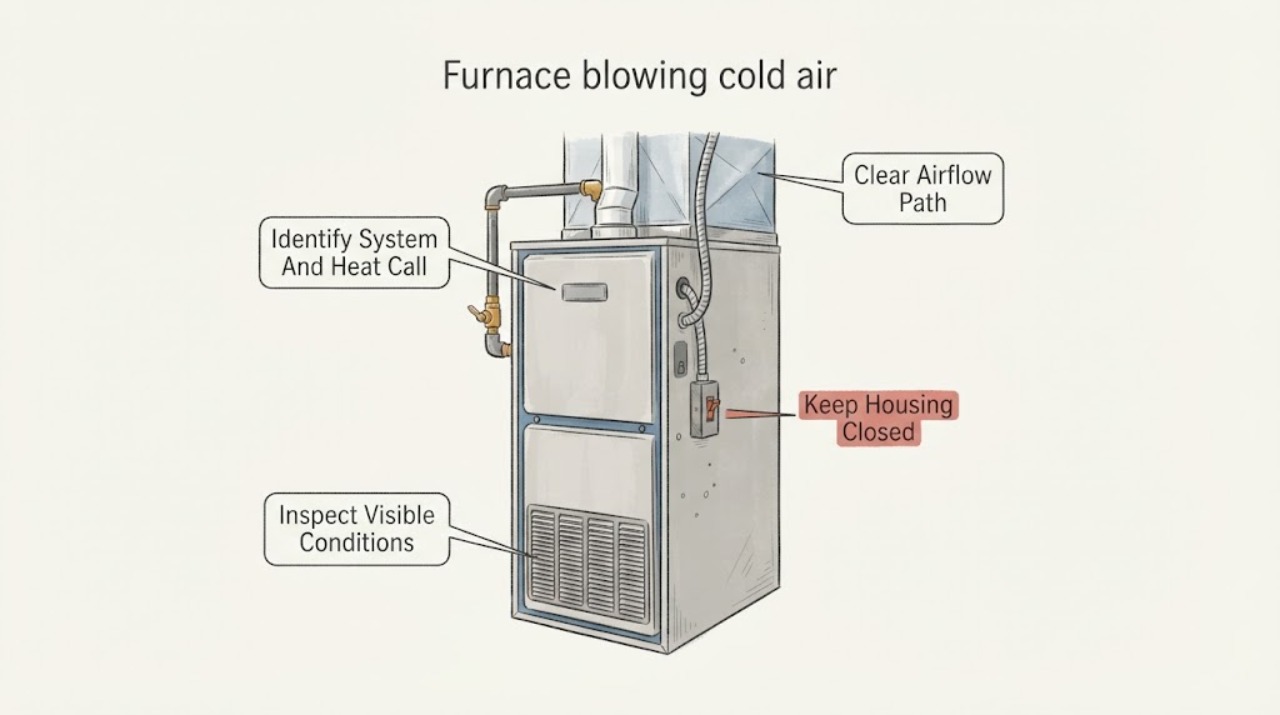
Work through in order
Diagnostic checks
Use only checks that match the exact appliance or system and its official guide.
-
Check 1
Read the thermostat from the front without removing its cover or touching wiring. Confirm that the mode calls for heat, the set temperature is above room temperature, and the fan is set intentionally rather than to continuous ON or circulation. If the outdoor unit runs during the heat call, note that the equipment may be a heat pump or dual-fuel arrangement rather than a stand-alone gas furnace.
Expected result: The thermostat is off, in cooling, at or below the room temperature, or running the fan without a heat call; the display is blank or abnormal; or a heat call is present and the outdoor unit runs.
Next step: Correct only an obvious front-panel mode or fan setting and observe one complete call. If a valid heat call still produces cold air, record the display and equipment behavior for qualified HVAC service. Do not jumper terminals, remove the thermostat, or change wiring.
Stop if: Stop at the thermostat face if the display is abnormal or a wiring change would be required.
Why this matters
Why: A fan-only command or a missing heat call can move room-temperature air without a furnace failure. An outdoor unit operating in heat changes the diagnostic path to a heat-pump or matched-system sequence; Goodman documents that its heat pump provides heating and cooling and uses an outdoor unit in heating mode.
-
Check 2
From the room and without removing an access panel, observe one heating call: note when the blower starts, whether warm air ever reaches a register, whether warmth disappears later, whether the blower continues after the call ends, and whether a visible display or indicator shows a fault.
Expected result: Air is cool only briefly at the beginning or end, the blower runs with no warm air for the whole call, warm air changes to cool air, the unit starts and stops repeatedly, or a fault indicator appears.
Next step: Write down the sequence, approximate timing, thermostat state, and indicator pattern, then arrange qualified service when the furnace does not heat or cycles abnormally. Do not keep restarting it to make the symptom recur.
Stop if: Stop immediately for gas odor, smoke, soot, an abnormal flame, a carbon-monoxide alarm, or a loud or unsafe ignition event.
Why this matters
Why: Brief cool air can fit a blower timing or purge behavior, while no warmth during a valid call points toward a failed heating sequence. Warm-then-cold or repeated restart behavior is consistent with an airflow, venting, drainage, ignition, flame-sensing, heat-source, or control issue; an indicator narrows the technician's investigation but does not name a part by itself.
-
Check 3
Inspect only an easily accessible return-air filter and the supply and return grilles. If the filter can be handled without opening the furnace, compare it with the size and type specified for the system; move furniture or other loose obstructions away from grilles. If access requires a furnace panel, tools, a ladder, or uncertain electrical isolation, do not proceed.
Expected result: The filter is visibly loaded, wet, collapsed, missing, or a poor fit; multiple grilles are blocked; airflow is weak; or the filter and grilles are clear.
Next step: Replace a damaged or loaded filter only with the manufacturer-specified type and fit, keep the required filter installed, and observe one later call. If airflow stays weak, the filter loads quickly, or cold air returns, arrange service rather than opening the blower or coil area.
Stop if: Do not run the furnace without its required filter, force a filter into place, open an equipment compartment, or alter blower settings.
Why this matters
Why: The Department of Energy says a dirty or clogged filter can sharply reduce airflow and increase furnace run time and motor wear. A restriction can reduce heat delivery or contribute to a protective shutdown, but a clear filter does not rule out a heating or control fault.
-
Check 4
From ordinary, safe access, look at any visible outdoor furnace intake or exhaust termination and the floor area around the equipment. Note loose snow, leaves, nests, ice, damage, water, or a condensate overflow; do not touch or disassemble a pipe, reach into a drain, enter a roof or crawlspace, or remove a guard.
Expected result: A termination is visibly obstructed or damaged, water is near the furnace, the symptom began with an overflow, or the visible area is clear or not safely reachable.
Next step: Keep the furnace off and arrange qualified service for a blocked or damaged termination, water near equipment, or an inaccessible inspection. Only move loose debris surrounding a termination if it is reachable without tools and without touching the pipe; never operate a combustion furnace with suspected venting trouble.
Stop if: Leave the area and follow local emergency guidance for gas odor or a carbon-monoxide alarm; do not restart after a combustion or venting warning.
Why this matters
Why: Goodman identifies flue, combustion-air, and drainage checks as part of furnace service, and the Department of Energy explains that combustion furnaces need proper venting to avoid backdrafting and pollutant accumulation. A clear visible termination does not prove that an internal vent, drain, or safety path is clear.
-
Check 5
Record the Goodman model and serial information, fuel type if known, thermostat display, whether all rooms or only some rooms are affected, filter condition, visible vent or water observations, and whether the symptom began after installation, a filter change, thermostat work, or another repair.
Expected result: The furnace never makes warm air, makes warm air briefly, serves unevenly, or changed behavior after a known installation or service event.
Next step: Give the technician the model information, sequence notes, filter state, and any fault display so the correct Goodman documentation and measurements can be used. Do not order an igniter, flame sensor, valve, blower, limit, or control board from the cold-air symptom alone.
Stop if: Stop homeowner diagnosis once the remaining possibilities involve combustion, live electrical testing, internal controls, duct changes, or part replacement.
Why this matters
Why: No heat everywhere points more toward the heat-producing sequence or its controls; uneven rooms can point toward distribution or duct delivery. A recent change supplies useful context but does not prove that the changed component is defective.
Use your observations
Decision map
Find the observation that best matches what you see, then follow the next safe action.
-
PATH 01Safety boundary
What you see
The thermostat fan is set to run independently, there is no active heat call, or the air is cool only for a short period before heating or just after the call ends.
Do this next
Set the thermostat's mode and fan intentionally, monitor one complete call, and request service if cool air continues while heat is demanded or the home does not recover.
Why this path and its safety boundary
Why it matters: Room-temperature air from a fan-only command or a brief blower period is more likely than a failed Goodman heat source. Goodman also notes that blower design affects the perceived cold-air blow.
Safety stop: Do not alter thermostat wiring or bypass a furnace control to force the blower off.
-
PATH 02Safety boundary
What you see
The indoor cabinet is called a furnace, but a Goodman outdoor unit runs during a heat call or the home has no gas or propane service.
Do this next
Record the indoor and outdoor model information and use the matched system's documentation or a qualified HVAC technician. Do not inspect refrigerant lines, reversing valves, heat strips, or control wiring.
Why this path and its safety boundary
Why it matters: The equipment may be a heat pump with an air handler, or a dual-fuel system, so cold-air timing and auxiliary heat behavior differ from a gas-furnace ignition sequence.
Safety stop: Stop if the equipment identity cannot be established from ordinary labels or safe observation.
-
PATH 03Safety boundary
What you see
The accessible filter is dirty, wet, collapsed, missing, or incorrect, registers or the return are obstructed, and airflow is weak or changes after the accessible restriction is corrected.
Do this next
Keep the specified filter installed and grilles clear. Arrange service if airflow remains weak, the filter loads rapidly, or cold air returns during a valid call.
Why this path and its safety boundary
Why it matters: Restricted airflow is more likely and can reduce heat delivery or contribute to a protective response, but improvement does not prove that the underlying furnace is healthy.
Safety stop: Do not compensate by running without a filter, closing more registers, or opening the blower compartment.
-
PATH 04Safety boundary
What you see
The thermostat clearly calls for heat, the accessible air path is reasonable, but no warm air ever arrives, or warmth stops and the furnace restarts or shows a fault.
Do this next
Keep a record of the sequence and indicator and arrange model-specific HVAC diagnosis. The technician must test the sequence before selecting a part.
Why this path and its safety boundary
Why it matters: A failure in ignition, flame sensing, heat production, vent or pressure safety, condensate protection, blower control, or another Goodman-specific sequence is more likely than a fan setting.
Safety stop: Do not watch or touch burners, reset a rollout or limit, probe wiring, adjust gas pressure, or replace an internal component as a guess.
-
PATH 05Safety boundary
What you see
There is gas odor, a carbon-monoxide alarm, smoke, soot, an abnormal flame, suspected vent blockage, water near electrical equipment, or repeated abnormal ignition.
Do this next
Leave the area and follow local emergency guidance for gas or carbon monoxide. Otherwise keep the furnace off and arrange qualified HVAC service, with the observed hazard reported before anyone restarts the unit.
Why this path and its safety boundary
Why it matters: Safety and damage prevention take priority over restoring airflow; a filter or thermostat change is not an appropriate response to these observations.
Safety stop: Do not operate switches near suspected gas, relight a pilot, clear internal venting, bypass a safety, or repeatedly restart the furnace.
-
PATH 06Safety boundary
What you see
Some registers deliver warmth but certain rooms stay cold, or the symptom began after installation, duct changes, or a major repair.
Do this next
Ask a qualified technician to assess supply and return airflow, ducts, system configuration, and temperature delivery while providing the installation or repair history.
Why this path and its safety boundary
Why it matters: Duct leakage, a blocked distribution path, blower configuration, sizing, or installation matching may be involved rather than a burner failure.
Safety stop: Do not change blower speed, modify ducts, close registers to force a balance, or alter combustion settings.
Helpful context
Understand the symptom
First confirm what Goodman equipment you are hearing
A Goodman cabinet can be part of more than one heating arrangement. A gas furnace burns fuel in a heat exchanger and sends air over it; a heat-pump system can use a Goodman air handler indoors while the outdoor unit supplies heat. Goodman says a heat pump can be identified by putting the thermostat in heat and observing the outdoor unit, particularly when the home does not use gas or propane. If the outdoor unit is running in heat mode, do not apply gas-furnace assumptions to it. Record the product label and use the exact model literature when arranging service.
Cool air at the register is a timing clue
Goodman explains that a furnace blower moves air across the hot heat exchanger, and that multi-speed operation can reduce the cold-air sensation associated with a single-speed blower. A short cool stream before heating begins or after a call ends is different from a blower that runs for a whole call without any warm air. Observe one normal call from the room, rather than repeatedly changing settings or resetting equipment.
Keep the homeowner checks outside the equipment cabinet
The useful homeowner boundary is the accessible air path: thermostat front-panel settings, an accessible return filter, supply and return grilles, and a visible outdoor termination. Goodman and the Department of Energy both connect filter condition and airflow with furnace performance. If the filter is behind a furnace panel, in an unsafe attic or crawlspace, or not clearly identified, leave it for a technician instead of opening the cabinet.
A no-heat sequence needs model-specific service
Goodman's service literature separates the flue, combustion-air intake, heat exchanger, burners, drainage, wiring, filters, and fault history for inspection. That list is why cold air alone cannot identify an igniter, flame sensor, gas valve, blower motor, limit, pressure control, or circuit board. Give the technician the observed sequence and model information; do not select a replacement part from the symptom.
Safety boundary
Stop conditions
- Stop using the furnace and follow local emergency guidance for gas odor, a carbon-monoxide alarm, smoke, soot, abnormal flame, or suspected combustion or venting failure.
- Do not open furnace panels, reach into the equipment, probe wiring, touch burners, relight a pilot, adjust gas pressure, or bypass a limit, rollout, pressure, or condensate safety.
- Do not clear internal venting or drains with tools, run repeated ignition tests after an abnormal shutdown, or operate the equipment with water near electrical components.
- Arrange qualified Goodman or HVAC service when a correct heat call remains cold after safe thermostat and airflow checks, warm air stops unexpectedly, water or a fault indication appears, or internal, combustion, electrical, duct, or control work is needed.
Only after diagnosis
Potential parts
- furnace air filter
Consider this category only when the accessible filter is dirty, damaged, missing, or the wrong fit and the Goodman documentation identifies the required type and size.
Confirm the complete Goodman model and the specified filter type and dimensions before ordering; do not substitute a restrictive filter based on a cold-air symptom alone. - Goodman furnace ignition or flame-sensing component
Consider this category only after a qualified technician isolates the no-heat or warm-then-cold sequence to ignition or flame sensing.
Verify the exact model, fuel configuration, electrical characteristics, and manufacturer service procedure before any part is selected or installed.
When checks do not resolve it
Need a professional?
Call a qualified HVAC technician when the Goodman furnace remains cold throughout a valid heat call, warms briefly and then turns cold, cycles repeatedly, has weak airflow after the accessible filter and grilles are addressed, shows a fault indication, has visible vent or condensate trouble, or requires combustion, electrical, control, blower, duct, or internal work. Treat gas odor, a carbon-monoxide alarm, smoke, soot, abnormal flame, exposed wiring, or suspected blocked venting as urgent safety conditions.
Safety scope: This article supports front-panel thermostat observation, ordinary-access filter and grille checks, and safe external observation of visible terminations only. It does not authorize panel removal, combustion or gas work, live electrical testing, control bypass, vent disassembly, or internal part replacement.
Common questions
FAQ
Why is my Goodman furnace blowing cold air?
First separate fan-only or normal blower timing from a failed heat call. Check the thermostat mode and fan setting, identify whether the equipment is a gas furnace or heat pump, and inspect only the accessible filter and grilles. If a valid call never produces warmth, warm air stops, or a fault or safety symptom appears, arrange qualified HVAC diagnosis rather than guessing at a part.
Can a Goodman fan setting make the vents feel cold?
Yes. A fan set to run continuously or circulate can move room-temperature air when the furnace is not heating. Use the intended front-panel setting and observe a complete heat call; do not change thermostat wiring as a test.
Could the furnace filter be responsible for cold air?
A dirty, wet, collapsed, missing, or incorrect filter can restrict airflow and make a furnace run harder or respond protectively. Replace it only with the specified type and fit from a safe, accessible location. A clean filter does not rule out ignition, venting, drainage, blower, control, or heat-source trouble.
What if my Goodman indoor unit is actually part of a heat pump?
If the Goodman outdoor unit runs during a thermostat heat call, or the home does not use gas or propane, the indoor cabinet may be an air handler in a heat-pump system. Follow the matched system's model documentation and have a technician diagnose unusual cold air; do not inspect refrigerant or auxiliary-heat components yourself.
When should I stop troubleshooting and call for service?
Call when a valid heat call stays cold, warmth stops unexpectedly, the furnace cycles repeatedly, airflow stays weak after an accessible filter and grille check, water or a fault indication appears, or internal combustion, electrical, duct, control, or blower work is needed. Gas odor, a carbon-monoxide alarm, smoke, soot, abnormal flame, or suspected blocked venting requires stopping use and following local emergency guidance.
Read the exact guide
Official sources
- HVAC Learning Center | Heating and Cooling | GoodmanGoodman · Official Goodman HVAC Learning Center content used for the distinction between a cold-air sensation and a furnace that never heats.
- HVAC Learning Center | HVAC 101Goodman · Official Goodman homeowner education describing how furnace air is heated and delivered, and how Goodman heat-pump and air-handler systems differ.
- Customer Support | Warranty | Goodman ManufacturingGoodman · Official Goodman support page used for the recommendation to provide model information and contact the installing dealer or homeowner support when the exact product literature is needed.
- Heat pump common questions and answers | GoodmanGoodman · Official Goodman heat-pump guidance used only for the branch where an indoor cabinet is mistaken for a stand-alone furnace or an outdoor heat-pump unit operates during heating.
- Gas Furnace Maintenance | Stay Warm at Home | GoodmanGoodman · Official Goodman maintenance guidance used to scope visible filter checks and professional furnace inspection items.
- Purchasing Energy-Efficient Residential FurnacesU.S. Department of Energy · Official DOE furnace guidance used for the branch where only some rooms are cold or a symptom follows installation or duct work.
- HVAC Proper Installation of FiltersU.S. Department of Energy Building Science Education · Official DOE filter guidance used for the ordinary-access filter and airflow check.
- Service and TroubleshootingGoodman · Official Goodman service literature used to distinguish owner filter guidance from qualified inspection of furnace internals and safety systems.
- HVAC Programmable ThermostatsU.S. Department of Energy Building Science Education · Official DOE guidance used for separating a thermostat command or schedule from an equipment heating fault.
- HVAC Combustion FurnacesU.S. Department of Energy Building Science Education · Official DOE combustion-furnace guidance used to set the venting and combustion safety boundary.
Community feedback
Share a repair observation
Share a plain-text repair observation. Accepted observations are published automatically; this page may take a moment to update.