
On this page
Start here
Quick answer
A Goodman furnace that will not start should be diagnosed by its first response to a heat call: no display or sound points toward control power, a running inducer with no flame points toward draft or ignition sequencing, and a blower that runs without heat points toward an open limit or airflow problem. Set the thermostat to Heat and a normal setpoint, confirm the furnace has not lost power, inspect only the accessible filter and outdoor vent terminations, and record any visible status code without opening the cabinet. Do not bypass a pressure, limit, rollout, or door safety, test live wiring, adjust gas components, or repeatedly reset a lockout. Stop for gas odor, smoke, fire, carbon-monoxide symptoms, scorching, water near electrical equipment, or a returning fault; those conditions need emergency or qualified HVAC service.
Before you begin
Safety first
- This article covers ordinary-access observation and limited filter or grille checks only. Do not open the furnace, handle gas or combustion parts, test live electrical circuits, bypass safety devices, alter venting, or repeatedly reset a lockout.
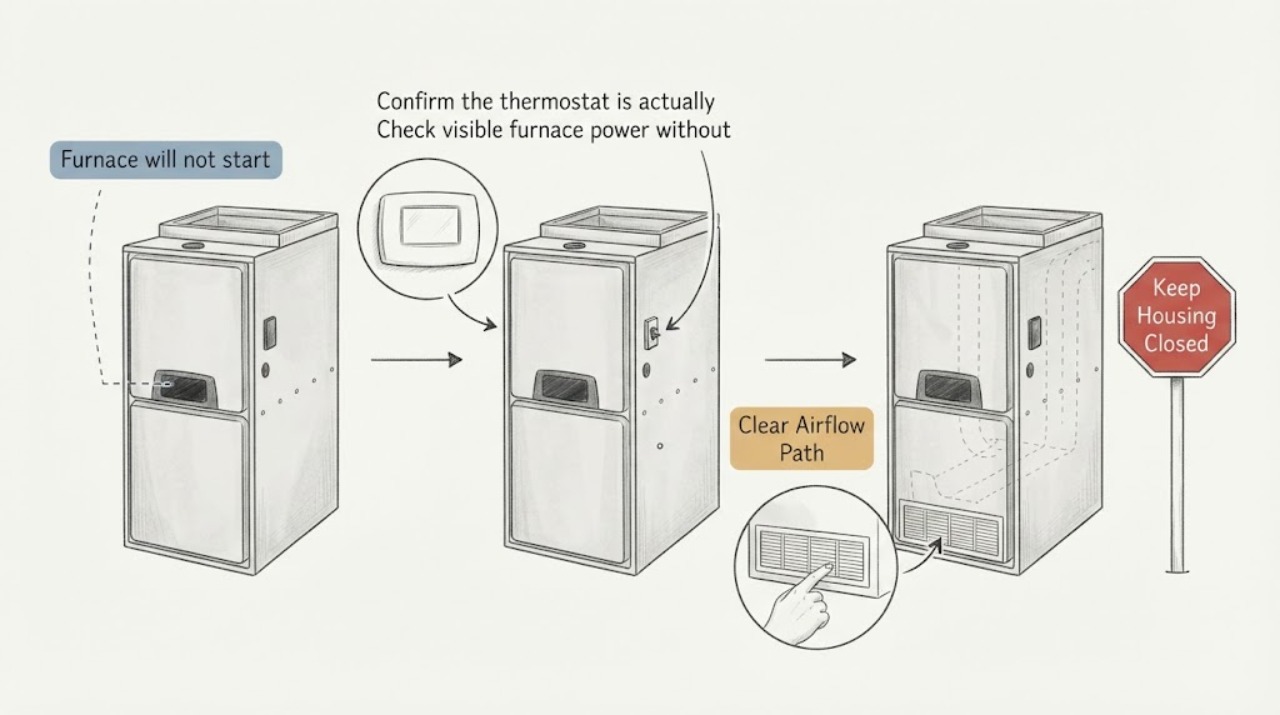
Work through in order
Diagnostic checks
Use only checks that match the exact appliance or system and its official guide.
-
Confirm the thermostat is actually calling for heat
From the thermostat, select Heat, set the fan to Auto if that option is available, and raise the setpoint modestly above the room temperature. Do not remove the thermostat from its base or open wiring.
Expected result: The thermostat display is active and shows a heat call, or it is blank, shows a battery or system warning, or does not respond to the setting change.
Next step: If the thermostat remains blank or cannot call for heat, address only the model-approved battery or control guidance and arrange HVAC service if it remains inactive. If the heat call is active, continue to the furnace's visible power and response checks.
Stop if: Do not jumper thermostat terminals, expose wiring, or keep calling for heat if the thermostat, wiring, or surrounding wall is wet or damaged.
Why this matters
Why: An inactive or blank control can explain a furnace that never begins its sequence. An active heat call with no furnace response moves the check toward furnace power, low-voltage control, or a safety lockout.
-
Check visible furnace power without opening the cabinet
Look for the nearby furnace service switch and the labeled furnace circuit breaker from a dry, stable position. If a breaker is visibly tripped, do not repeatedly reset it; note its state and use only the normal reset procedure if there is no odor, heat, water, damage, or other warning.
Expected result: The furnace has no display or response and the switch or breaker is off or tripped, or power appears normal but the furnace remains completely silent.
Next step: Restore a plainly switched-off service switch only when it is safe and labeled; for a tripped breaker, one normal reset is the limit. If it trips again, stays off, or the furnace remains dead, leave it off and request HVAC service.
Stop if: Do not remove the access panel, defeat a door switch, probe terminals, replace a fuse, or continue if there is burning odor, arcing, melted insulation, water, or a breaker that trips again.
Why this matters
Why: Loss of line power can prevent every heating step, while normal visible power with no response suggests a control, fuse, door-interlock, transformer, or wiring issue that requires testing by a qualified technician.
-
Inspect the filter and room airflow path
With the furnace not running, inspect the filter at its normal user-accessible location and look at return grilles and supply registers. Replace the filter only with the size and type specified for the installation; remove only loose items blocking grilles without disturbing ductwork.
Expected result: The filter is heavily loaded, the wrong restrictive type is installed, registers or returns are blocked, or the airflow path is clear.
Next step: Install the specified clean filter if the replacement is a straightforward, dry, correctly sized user task, keep grilles open, and observe one normal heat call. If the furnace still will not start, the limit opens again, or airflow is weak, stop and request service.
Stop if: Do not remove blower or burner panels, reach into the cabinet, alter blower speed, block or cap registers, or run the furnace with a missing filter.
Why this matters
Why: Goodman says blocked or restrictive filters, ductwork, or inadequate blower airflow can open a primary limit and stop heating. A clear filter does not rule out a blower, duct, limit, or heat-exchanger problem.
-
Observe the first visible response from a safe position
After the thermostat call is active and the area is clear, observe the furnace only through its normal exterior indicators and listen from outside the closed cabinet. Note whether there is no response, an inducer or draft fan sound, an ignition attempt, a brief flame followed by shutdown, or a circulating blower without heat.
Expected result: One of those distinct patterns occurs, or the furnace repeatedly attempts ignition and then stops or locks out.
Next step: Write down the exact sequence and number of attempts, then use the matching branch below when arranging service. Do not restart the sequence repeatedly just to obtain a different symptom.
Stop if: Do not open the cabinet, watch or handle burners, inspect wiring while energized, bypass a pressure or limit circuit, or continue after a hard lockout or abnormal sound.
Why this matters
Why: No response points toward control power; an inducer without ignition points toward pressure, venting, ignition, or flame proving; a brief flame followed by shutdown points toward flame sensing or another safety decision; blower-only operation is consistent with an open limit or a control/mitigation state.
-
Check only the visible vent and intake terminations
From ground level or another stable location, inspect the exterior furnace exhaust and combustion-air termination for snow, leaves, nests, ice, or other visible obstruction. Do not climb, insert tools, disconnect piping, or open the furnace.
Expected result: A termination is visibly blocked, damaged, iced, submerged, or clear while the inducer runs without ignition.
Next step: If a loose obstruction can be removed from safe ground without touching the equipment, clear only that exterior obstruction, then allow the system to settle and make one normal observation. If blockage is fixed, concealed, recurring, or the furnace still fails, request HVAC service.
Stop if: Do not climb, enter a confined area, dismantle venting, poke into a termination, bypass a pressure switch, or operate the furnace when exhaust could enter the home.
Why this matters
Why: Goodman troubleshooting links pressure-switch and induced-draft symptoms with blocked flue or intake paths and draft performance. A clear termination does not prove that the concealed pipe, drain, hose, or inducer is sound.
-
Record the status light or display before service
If the Goodman furnace has a visible status LED or display that can be read with the cabinet closed, record the exact code, flash pattern, and whether the inducer or blower is running. Take a photo without removing a panel and do not clear stored faults.
Expected result: The code identifies an ignition retry or flame loss, a pressure-switch condition, an open primary limit, an open fuse or low-voltage issue, or no status signal at all.
Next step: Give the code, sequence, filter condition, thermostat state, and any visible vent condition to the technician. Leave the furnace out of service if the code returns, the unit locks out, or operation is abnormal.
Stop if: Do not clear codes repeatedly, remove the control cover, test gas or electrical values, replace a board or fuse, or defeat a rollout, limit, pressure, or door safety.
Why this matters
Why: Goodman diagnostic tables use these patterns to separate ignition, draft, airflow/limit, power, and control paths. A code narrows the service diagnosis but does not authorize replacing the named component or bypassing its safety circuit.
Use your observations
Decision map
Find the observation that best matches what you see, then follow the next safe action.
-
PATH 01Safety boundary
What you see
The thermostat is calling for heat, but the furnace has no display, sound, or visible response.
Do this next
Check only the plainly labeled switch and breaker once from a dry safe position. If power is present but the furnace remains dead, or a breaker trips again, keep it off and arrange qualified HVAC diagnosis.
Why this path and its safety boundary
Why it matters: The leading path is control power or low-voltage control: a service switch, breaker, door interlock, fuse, transformer, wiring, or control board may be involved. A thermostat setting alone is less likely once the call is confirmed.
Safety stop: Do not remove panels or test live circuits; stop for odor, heat, arcing, water, damaged wiring, or repeated breaker operation.
-
PATH 02Safety boundary
What you see
The circulating blower runs but no burner heat is produced, especially with a blocked filter, weak airflow, or an open-limit code.
Do this next
Inspect the accessible filter and grilles, then stop if airflow is weak, the code returns, or the blower runs continuously. A technician should evaluate the limit circuit, blower, ductwork, and heat exchanger without bypassing protection.
Why this path and its safety boundary
Why it matters: Goodman associates an open primary limit with insufficient air over the heat exchanger and lists blocked filters, restrictive ductwork, incorrect blower performance, and a failed blower as possible contributors. The blower symptom does not identify which one is at fault.
Safety stop: Do not bridge the limit, alter blower speed, run without a filter, or keep heating with repeated limit trips.
-
PATH 03Safety boundary
What you see
The inducer or draft fan starts, but there is no ignition and a pressure or draft code appears, or the fan runs continuously.
Do this next
Inspect only the visible outdoor termination from a safe location and report the fan behavior and code. Leave pressure-switch, tubing, vent-pipe, drain, and inducer diagnosis to a qualified HVAC technician.
Why this path and its safety boundary
Why it matters: The sequence has reached draft proving but has not safely advanced. Goodman lists pressure-switch circuit conditions, hose problems, blocked flue or intake, and weak induced-draft performance in this path; the switch must not be forced closed.
Safety stop: Do not disconnect tubing, blow into a pressure switch, bypass its contacts, dismantle venting, or operate the furnace when venting is blocked or unsafe.
-
PATH 04Safety boundary
What you see
The furnace attempts ignition, lights briefly, or locks out after repeated ignition retries or flame loss.
Do this next
Record whether the igniter glows, whether flame is established, how long it remains, and the exact code, then stop repeated trials and arrange qualified service for combustion and ignition checks.
Why this path and its safety boundary
Why it matters: Goodman identifies gas interruption, igniter condition, flame sensing, flue or induced-draft performance, and related wiring or controls as possible causes. A brief flame is not proof that the gas valve, igniter, or flame sensor is the failed part.
Safety stop: Do not adjust gas pressure, handle the igniter or flame sensor, clean burner parts, bypass flame proving, or retry after gas odor, delayed ignition, flame rollout, smoke, or scorching.
-
PATH 05Safety boundary
What you see
The filter and accessible airflow path are clear, but the furnace still will not start or the same fault returns.
Do this next
Stop changing filters or resetting the furnace and give the technician the filter specification, sequence observation, code, and thermostat and power results for a complete diagnosis.
Why this path and its safety boundary
Why it matters: A clean filter rules out one accessible restriction but does not rule out concealed duct restriction, blower failure, limit or rollout protection, pressure or venting faults, ignition, gas supply, transformer, fuse, or control problems.
Safety stop: Do not substitute a more permissive filter, remove ductwork, alter wiring, or keep operating through a returning safety fault.
-
PATH 06Safety boundary
What you see
There is a gas odor, smoke, fire or scorching, carbon-monoxide concern, unusual combustion noise, water at electrical equipment, or a damaged vent.
Do this next
Leave the area and contact the appropriate emergency, gas, utility, or qualified HVAC service from a safe location; follow local emergency guidance and do not re-enter a hazardous area to collect a code.
Why this path and its safety boundary
Why it matters: This is no longer a routine no-start diagnosis. Continuing to call for heat can increase fire, combustion, electrical, water, or indoor-air risk.
Safety stop: Do not operate switches in a gas-odor area, relight, reset repeatedly, use an appliance, or investigate inside the furnace.
Helpful context
Understand the symptom
What a Goodman no-start symptom can mean
“Will not start” is a symptom, not a single failed part. Goodman describes a normal heating sequence that includes a thermostat call, induced-draft operation, pressure-switch proof, igniter operation, gas and flame establishment, and blower operation. The useful clue is which step is missing. A furnace with no response has a different decision path from one that starts an inducer, glows an igniter, lights briefly, or runs only the circulating blower. Record that first response instead of treating every no-start as a thermostat or control-board replacement.
Keep the homeowner checks outside the service boundary
The safe checks on this page are limited to thermostat settings, visible power status, an accessible filter, unobstructed return and supply grilles, visible vent terminations, and a status display that can be read without removing a panel. Goodman maintenance guidance places burner, ignition, heat-exchanger, flue, controls, and deeper filter or duct evaluation in a maintenance or professional context. The cabinet door, gas train, combustion area, pressure-switch tubing, wiring, and safety devices are not ordinary user test points.
A reset is not a diagnosis
A single normal power recovery may clear a transient control state when the model instructions call for it, but a repeated lockout is evidence to preserve, not erase. Goodman diagnostic material lists ignition retries, blocked flues, pressure-switch conditions, open limits, blown fuses, and control faults as distinct possibilities. Photograph or write down the displayed status before requesting service, and leave the furnace off when a safety or hazard condition is present.
Safety boundary
Stop conditions
- Do not bypass, jumper, defeat, or tape a pressure switch, primary limit, rollout switch, door interlock, flame-sensing circuit, or other furnace safety device.
- Do not open the cabinet, handle burners or gas controls, adjust gas pressure, probe energized wiring, replace a fuse or control board, or dismantle venting as an ordinary user check.
- Stop for gas odor, smoke, fire or scorching, delayed ignition, abnormal combustion noise, carbon-monoxide symptoms or alarm, damaged venting, water near electrical equipment, or repeated breaker trips.
- Do not keep resetting a lockout or repeatedly calling for heat to force a different sequence; preserve the code and symptom for service.
- Use only the model-specified filter and accessible cleaning steps; do not run the furnace without a filter or with blocked returns and supplies.
Only after diagnosis
Potential parts
- furnace air filter
Consider this category only when the accessible filter is loaded, damaged, missing, or the exact installation specification calls for replacement; a clear filter does not justify changing another part.
Confirm the filter dimensions, media type, airflow rating, and Goodman or installer specification for the exact system before ordering. - hot-surface igniter or flame-sensing component
Consider this category only after a qualified diagnosis confirms an ignition or flame-proving fault; a no-start or brief flame by itself does not identify the igniter or sensor.
Confirm the exact furnace model, control sequence, electrical and mounting requirements, and manufacturer's fit information; do not handle or test the component as a live user check. - induced-draft or pressure-proving component
Consider this category only when service diagnosis confirms a failed inducer, pressure switch, hose, or related draft component after venting, intake, drains, wiring, and operating conditions are evaluated.
Match the exact furnace model and pressure or airflow specification through Goodman documentation or a qualified technician; never substitute or bypass a pressure device. - integrated furnace control or protective device
Consider this category only when qualified electrical and sequence testing identifies a failed control, fuse, transformer, limit, or related protective device after the initiating condition is found.
Confirm exact model, revision, wiring, and safety-device requirements; a board or fuse replacement is not a substitute for correcting a short, airflow fault, overheating, or other cause.
When checks do not resolve it
Need a professional?
Arrange qualified HVAC service when the Goodman furnace remains dead after a safe thermostat and visible-power check, an inducer or blower runs without heat, ignition fails or flame drops out, a status code returns, a limit or pressure condition appears, airflow is weak, the vent path is blocked or uncertain, or the breaker trips again. Treat gas odor, smoke, fire, carbon-monoxide concern, water near electrical equipment, damaged venting, or abnormal combustion as an immediate stop-use and emergency or urgent-service boundary.
Safety scope: This article covers ordinary-access observation and limited filter or grille checks only. Do not open the furnace, handle gas or combustion parts, test live electrical circuits, bypass safety devices, alter venting, or repeatedly reset a lockout.
Common questions
FAQ
Why is my Goodman furnace completely silent when the thermostat calls for heat?
First confirm that the thermostat display is active and calling for Heat, then check the plainly labeled furnace switch and breaker from a dry, safe position. If the breaker trips again, the furnace has no response despite visible power, or there is damage or odor, leave it off and arrange qualified HVAC diagnosis rather than opening the cabinet.
What if the Goodman furnace inducer runs but there is no heat?
That pattern means the sequence reached draft operation but did not safely advance to ignition. A blocked or uncertain vent or intake, pressure-proving problem, inducer issue, ignition fault, or control decision may be involved. Check only the visible exterior termination from a safe location, record the code and sound, and do not bypass the pressure switch.
Can a dirty furnace filter stop a Goodman furnace from starting?
Yes, restricted airflow can contribute to an open primary limit or repeated heating shutdown, but a dirty filter is not the only possible cause. Replace it only with the exact specified size and type if that is a straightforward user task, keep returns and supplies open, and request service if the furnace remains off, airflow is weak, or the fault returns.
Should I keep resetting a Goodman furnace that locks out?
No. Repeated resets can erase useful fault evidence and do not correct the underlying power, airflow, draft, ignition, flame-sensing, gas, or control issue. Record the visible code and first-response pattern, then arrange qualified service; stop immediately for gas odor, smoke, scorching, abnormal combustion, or carbon-monoxide concern.
Is a Goodman furnace control board the likely replacement when it will not start?
Not from the symptom alone. Goodman troubleshooting lists several different paths before a control-board diagnosis, including thermostat or power loss, open limits, pressure or venting problems, ignition or flame proving, wiring, and gas-supply conditions. A qualified technician should identify the failed path and the initiating cause before selecting a compatible part.
Read the exact guide
Official sources
- Service BulletinGoodman Manufacturing · Goodman service bulletin used only as model-dependent context for limit lockout causes; it does not establish that every Goodman furnace uses the same control logic.
- Seasonal HVAC MaintenanceGoodman Manufacturing · Goodman maintenance guidance used for filters, burners, ignition, heat exchanger, flue, controls, and professional seasonal service boundaries.
- What type of filter should I use?Goodman Manufacturing · Goodman FAQ used for the requirement to match the filter to blower capacity and avoid an unnecessarily restrictive filter.
- Service and TroubleshootingGoodman Manufacturing · Goodman service and troubleshooting manual used to interpret no-start patterns and to define technician-only checks; exact codes and sequence vary by model.
- HVAC Learning Center | Heating and Cooling | GoodmanGoodman Manufacturing · Goodman educational guidance used to interpret the heating sequence and distinguish missing steps in a no-start symptom.
Community feedback
Share a repair observation
Share a plain-text repair observation. Accepted observations are published automatically; this page may take a moment to update.