
On this page
Start here
Quick answer
A Goodman furnace that is not heating may not be receiving a call for heat, may have lost electrical power, may have an airflow restriction, or may be stopping during ignition, combustion, exhaust, or blower operation. Start with safe observations: thermostat mode and setpoint, the furnace power switch and clearly labeled breaker, the return-air filter, supply and return airflow, and any status light or code visible without opening the cabinet. Goodman describes the thermostat call, ignition, gas burners, heat exchanger, inducer, blower, and flue as a sequence that must work together; a homeowner should not open the furnace, adjust a gas valve, bypass a safety switch, or test energized wiring. Stop for gas odor, a carbon-monoxide alarm, smoke, burning odor, sparks, a hot electrical connection, water near controls, repeated breaker trips, or an abnormal flame, and leave the home immediately for a sounding carbon-monoxide alarm. If the safe checks do not restore heat, leave the furnace off and arrange qualified HVAC service.
Before you begin
Safety first
- Do not open the furnace, adjust gas or combustion components, bypass safety controls, alter venting, probe energized wiring, or reuse the furnace after a CO alarm or hazardous symptom until qualified personnel have evaluated it.
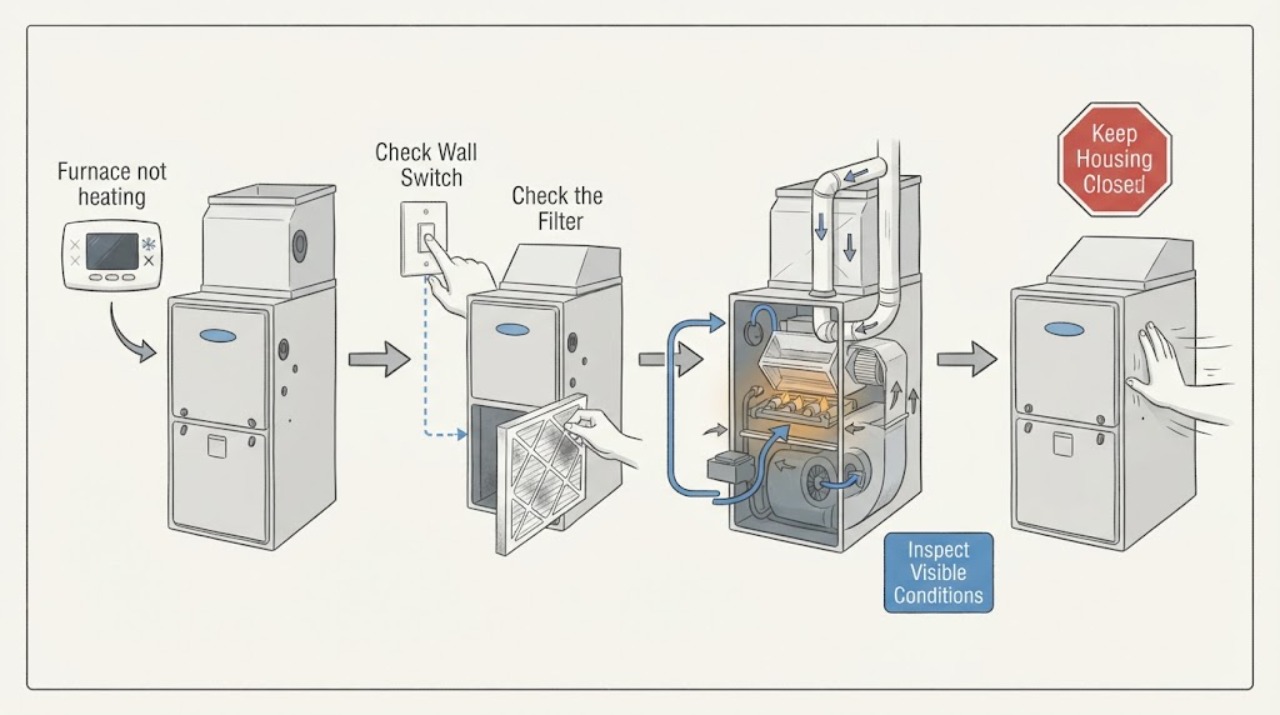
Work through in order
Diagnostic checks
Use only checks that match the exact appliance or system and its official guide.
-
Check 1
Set the thermostat to the exact heat mode and raise the setpoint only enough to create a call for heat, then observe from a safe position whether the thermostat responds, the furnace starts a sequence, warm air appears, or a code or indicator is shown. Do not remove the thermostat or open its wiring.
Expected result: The thermostat is off or in the wrong mode, the display is active but the furnace is silent, the inducer or blower starts without heat, or a code or warning appears.
Next step: Stop for gas odor, a CO alarm, smoke, burning odor, sparks, hot electrical parts, water near controls, or abnormal flame. Otherwise record the exact code and continue only with safe external checks; do not repeatedly reset the furnace.
Why this matters
Why: A control setting can prevent a call for heat; a silent furnace points toward power, thermostat, or control issues, while a partial sequence points toward a later airflow, ignition, combustion, or safety stage.
-
Check 2
From a dry, safe location, check whether the furnace switch and clearly labeled circuit are on and whether the thermostat or other home equipment recently lost power. Do not remove the furnace door, reset an unknown tripped circuit repeatedly, or touch electrical terminals.
Expected result: The switch or circuit is off, the circuit has tripped again, the thermostat is dark, or visible power status is normal.
Next step: Restore a clearly identified switch only once if it is dry and safe to reach. Do not reset after a trip, heat, smell, spark, or other hazard; leave the furnace off and arrange qualified HVAC or electrical service.
Why this matters
Why: A known power interruption can prevent the heating sequence from starting. A returning trip suggests an electrical or equipment fault; normal visible power with no start makes thermostat, control, or furnace diagnosis more likely.
-
Check 3
Inspect the return-air filter and visible return and supply grilles without opening the furnace. Note a filter that is visibly loaded with dust, the wrong size or type, blocked returns, or closed supply registers. Do not operate the furnace with a missing filter or remove a furnace access panel.
Expected result: The filter is visibly restricted, airflow grilles are blocked, the filter is correctly installed and clear, or airflow is weak despite a clear filter.
Next step: Replace a visibly loaded filter only with the model-specified type and fit, then make one supervised heat attempt if no safety symptom exists. Stop for weak airflow, overheating, repeated shutdown, or a returning fault and arrange service.
Why this matters
Why: Goodman says filters should match the blower's capacity and be replaced as directed; restricted airflow can limit safe operation or reduce delivered heat. Weak airflow with a clear filter can involve the blower, ductwork, control, or another fault.
-
Check 4
If the Goodman furnace has a sight window or externally visible status light, record the exact pattern and whether the sequence stops before ignition, after a brief ignition attempt, or after the blower starts. Do not open the cabinet or infer a fault from a generic light chart.
Expected result: The indicator shows a model-specific code, the inducer runs but burners do not visibly establish heat, burners start then stop, the blower runs with cool air, or no indicator is visible.
Next step: Do not relight, bypass a safety, adjust gas, clean a flame sensor, or probe wiring. Leave the furnace off for repeated failed ignition, abnormal flame, rollout indication, smoke, odor, or an unexplained code and arrange qualified service.
Why this matters
Why: The stopping stage narrows the diagnosis to control, draft or venting, ignition or flame proving, heat-exchanger safety, or blower delivery. Goodman says ignition, inducer, burners, heat exchanger, and flue require professional inspection when abnormal.
-
Check 5
Observe the furnace and nearby vent termination only from outside the cabinet and without touching hot or combustion parts. Note an obstructed visible vent, unusual exhaust behavior, water, soot, rust, a new combustion smell, or a blower that runs without warm supply air. Do not clear a roof or combustion vent yourself.
Expected result: A vent appears blocked or damaged, soot or abnormal exhaust is visible, water is present, the blower runs but air is cool, or the exterior looks normal.
Next step: Stop the furnace and obtain qualified HVAC service for any vent, soot, water, combustion, or heat-exchanger concern. Do not cover or modify vents, restart after a failed ignition, or open the cabinet.
Why this matters
Why: Goodman says the inducer moves exhaust and that professionals should inspect the flue for obstructions; the heat exchanger and burners also need professional safety evaluation. Cool air with a running blower can follow a failed ignition or a control sequence that did not permit heat.
-
Check 6
If no hazard is present and the safe checks did not restore heat, document the Goodman model, thermostat setting, power status, filter condition, airflow, visible status pattern, start and stop stage, recent service, and any gas or CO warning. Do not keep cycling the furnace for more evidence.
Expected result: The same failure returns, the furnace stops at ignition or blower, heat is intermittent, the code returns, or the cause remains unknown.
Next step: Leave the furnace off or in its safest stable state and arrange qualified Goodman HVAC service. If a CO alarm sounds, leave immediately and follow emergency guidance rather than waiting for service.
Why this matters
Why: A repeatable stopping stage gives a technician useful evidence but does not identify a replaceable part. Persistent no-heat can involve ignition, flame proving, venting, heat exchanger, blower, controls, or system wiring.
Use your observations
Decision map
Find the observation that best matches what you see, then follow the next safe action.
-
PATH 01Next step
What you see
Do this next
Correct only the obvious thermostat mode or setpoint and check a clearly identified power switch once; arrange service for a dark display, returning trip, or no response.
-
PATH 02Next step
What you see
Do this next
Restore the known-off switch once if dry and safe. Stop after a trip or any odor, heat, spark, or water and arrange qualified service.
-
PATH 03Next step
What you see
Do this next
Replace the filter with the exact model-specified type and clear only accessible grilles; stop if airflow remains weak, the furnace overheats, or the fault returns.
-
PATH 04Next step
What you see
Do this next
Leave the furnace off and arrange qualified HVAC service; do not relight, adjust gas, bypass a safety, or clean internal components.
-
PATH 05Next step
What you see
Do this next
Stop the furnace and obtain qualified HVAC service; do not clear combustion vents or open the cabinet yourself.
-
PATH 06Next step
What you see
Do this next
Stop repeated resets and arrange service with the model, codes, stage observations, and filter or airflow findings.
-
PATH 07Next step
What you see
Do this next
For a CO alarm or possible symptoms, leave immediately for fresh air, call emergency services from outside, and do not reenter until authorities permit it. For gas odor or other furnace hazards, leave clear of the area and obtain emergency, gas utility, HVAC, or electrical help as appropriate; do not restart the furnace.
Helpful context
Understand the symptom
Identify where the heating sequence stops
A furnace can fail before the thermostat call reaches the equipment, at the electrical start, during inducer and ignition, when burners fail to remain lit, or when the blower cannot deliver warm air. Observe only the controls and indicators that are visible without opening the furnace. Do not interpret a dark or flashing status light without the exact Goodman manual.
Start with controls, power, and airflow
Confirm that the thermostat is calling for heat, the furnace switch and clearly labeled circuit are on, the return filter is not visibly blocked, and supply registers and return grilles are open. These checks do not prove that ignition or combustion is safe. A filter replacement must follow the model's specified type and fit; never remove a furnace door or defeat its interlock to make the blower run.
Ignition and combustion are professional boundaries
Goodman describes burners, ignition, the heat exchanger, inducer, flue, and blower as connected parts of the heating process. A failure to ignite, repeated reset, rollout indication, blocked exhaust suspicion, abnormal flame, or unusual combustion sound is not a homeowner adjustment. Do not touch the gas valve, flame sensor, igniter, pressure switch, vent, or control wiring.
Carbon monoxide and gas safety override troubleshooting
Carbon monoxide cannot be seen or smelled. If a CO alarm sounds or anyone has compatible symptoms, leave immediately for fresh air, call emergency services from outside, and do not reenter until authorities say it is safe. If you smell gas, do not operate switches or create a flame; leave and contact the appropriate emergency or gas utility service. A furnace involved in a CO event must not be used until qualified personnel service it.
Safety boundary
Stop conditions
- If a CO alarm sounds or anyone may have CO symptoms, leave immediately for fresh air, call emergency services from outside, and do not reenter until authorities say it is safe. Do not operate the furnace until trained personnel service it.
- Stop for gas odor, smoke, burning odor, sparks, abnormal flame, soot, a hot or damaged cord or connection, water near controls, repeated breaker trips, a blocked or damaged combustion vent, or a furnace that will not stop. Do not operate switches or create a flame when gas odor is present.
- Do not open the furnace cabinet, remove a burner door, adjust a gas valve, bypass a door or safety switch, clean an igniter or flame sensor, probe energized wiring, or alter venting as a homeowner check.
- Do not repeatedly reset the breaker or furnace after a failed ignition, safety code, overheating event, or unexplained shutdown. Leave the system off and arrange qualified HVAC service.
- If thermostat, power, filter, grille, and other safe external checks do not restore heat, stop troubleshooting and arrange qualified service rather than identifying a part by symptom alone.
Only after diagnosis
Potential parts
- furnace return-air filter
Consider only when the exact Goodman manual or filter marking identifies a visibly loaded or damaged filter requiring routine replacement.
Confirm the full furnace and filter dimensions, type, and airflow requirements before ordering; do not substitute a restrictive filter by appearance. - furnace ignition or flame-proving component
Consider only after qualified diagnosis confirms a failed model-specific ignition or flame-proving component following the observed ignition stage.
Confirm the full Goodman model and service diagnosis; do not clean, adjust, or replace combustion components based on a code or symptom alone. - furnace blower or airflow component
Consider only after qualified diagnosis finds a blower, wheel, motor, or related airflow component fault with correct filter and visible airflow conditions.
Confirm the full model and electrical and airflow specifications before any part decision; a cool-air symptom does not identify a blower part.
When checks do not resolve it
Need a professional?
Arrange qualified Goodman HVAC service when the furnace remains cold after safe thermostat, power, filter, and airflow checks; the sequence stops during ignition; a code returns; the blower runs without heat; venting, flame, heat exchanger, blower, control, or wiring issues are suspected; or the furnace is intermittent. Use emergency response for a sounding CO alarm or possible CO symptoms, and urgent gas, smoke, spark, overheating, water, or repeated-trip conditions.
Safety scope: Do not open the furnace, adjust gas or combustion components, bypass safety controls, alter venting, probe energized wiring, or reuse the furnace after a CO alarm or hazardous symptom until qualified personnel have evaluated it.
Common questions
FAQ
What should I check first when my Goodman furnace is not heating?
Check the thermostat heat setting, a clearly identified furnace power switch or circuit, the return-air filter, and visible airflow. If the furnace starts but stops during ignition, shows a code, or the blower runs with cool air, stop external troubleshooting and arrange qualified service.
Can a dirty filter make a Goodman furnace stop heating?
A visibly restricted filter can reduce airflow and affect furnace operation. Goodman says the filter should match the blower's capacity and be replaced as directed. Use the exact model-specified replacement; do not remove furnace panels to inspect the blower.
What if my Goodman furnace starts but the burners do not stay on?
That pattern can involve ignition, flame proving, draft, gas, controls, or a safety system. Goodman treats burner ignition and related furnace components as professional maintenance work. Do not relight, adjust gas, bypass a safety, or repeat resets; arrange qualified HVAC service.
Why does my Goodman furnace blower run but the air is cold?
The blower may be running after an incomplete heat sequence, or an airflow, ignition, control, or equipment fault may be present. Record the stopping stage and visible code, then stop if the condition repeats rather than opening the cabinet.
What should I do if a carbon-monoxide alarm sounds near my furnace?
Leave immediately for fresh air, call emergency services from outside, and do not reenter until authorities say it is safe. Do not operate the furnace again until trained personnel have serviced it. Carbon monoxide cannot be seen or smelled.
When should I stop troubleshooting a Goodman furnace that is not heating?
Stop for gas odor, smoke, burning odor, sparks, a CO alarm, abnormal flame, a blocked vent, water near controls, a hot connection, repeated breaker trips, or a recurring no-heat condition after safe external checks. Leave the furnace off and arrange the appropriate qualified service.
Read the exact guide
Official sources
- Carbon Monoxide Safety Tips - Feb 17, 2026U.S. Consumer Product Safety Commission · Public safety notice covering furnaces and other fuel-burning equipment.
- How a Central Heating System WorksGoodman · General Goodman gas-furnace overview; exact sequence and controls vary by model.
- What type of filter should I use?Goodman · General Goodman filter guidance; exact size and type are model and system dependent.
- Carbon Monoxide Fact SheetU.S. Consumer Product Safety Commission · Government safety guidance for fuel-burning appliances including furnaces; emergency response takes priority over troubleshooting.
- What Type ThermostatGoodman · Goodman guidance across system types; wiring and voltage must be assessed for the installed system.
- Gas Furnace Maintenance & Insulation CheckGoodman · General maintenance guidance; service access and components are model-specific.
Community feedback
Share a repair observation
Share a plain-text repair observation. Accepted observations are published automatically; this page may take a moment to update.