
On this page
Start here
Quick answer
A heat pump that starts and stops repeatedly may have restricted airflow, a thermostat or control problem, persistent ice or a defrost fault, an electrical or refrigerant issue, or equipment that is oversized for the home. First confirm that the stops are rapid and repeated rather than a normal cold-weather defrost event: note the mode, thermostat display, outdoor frost or steam, indoor comfort, and approximate run pattern. Check only homeowner-accessible items such as the thermostat mode, a visibly dirty filter, blocked registers, and loose leaves or snow around the outdoor unit with power left on or off as the equipment instructions require. Do not open electrical panels, handle refrigerant, scrape ice, or keep resetting a tripping breaker. If ice remains, cooling or heating is poor, the breaker trips, the compressor makes unusual noise, or short cycling continues with clean airflow, leave the system off when needed and arrange qualified heat-pump service.
Before you begin
Safety first
- A qualified HVAC professional should test live electrical components, controls, defrost operation, refrigerant circuits, compressors, coils, concealed ductwork, and equipment sizing; homeowners should stay with non-invasive settings, filter, register, and debris checks.
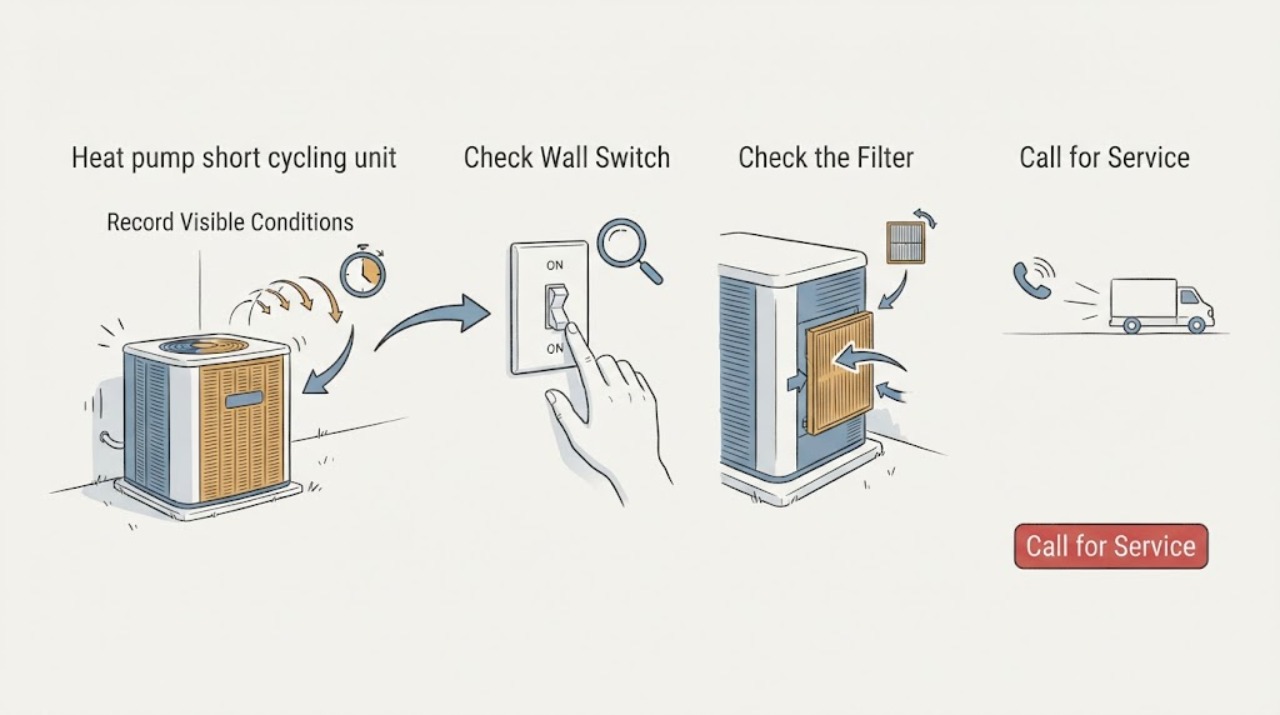
Work through in order
Diagnostic checks
Use only checks that match the exact appliance or system and its official guide.
-
Check 1
For one heating or cooling demand, record the thermostat mode and call, when the outdoor compressor starts and stops, whether the indoor fan continues, the outdoor temperature, and whether the home is reaching the set temperature.
Expected result: The unit only pauses during a visible frost-clearing event and then resumes normally; or it repeatedly starts and stops during an ordinary demand without restoring comfort.
Next step: Keep a short log and continue to the settings and airflow checks if the system is otherwise safe. If rapid cycling persists, leave the system off when operation is unsafe and arrange heat-pump service rather than repeatedly forcing another start.
Why this matters
Why: A frost-clearing pause may be normal heat-pump defrost behavior. Repeated rapid cycling outside that context is more consistent with a control, airflow, sizing, or equipment problem and can increase wear.
-
Check 2
Verify the thermostat is in the intended Heat or Cool mode, not an automatic mode that can switch modes, and inspect its accessible location for direct sun, a supply register, or a nearby heat source; do not open the thermostat or alter installer settings.
Expected result: The mode was wrong, the thermostat is being heated or cooled locally, the display or call changes unexpectedly, or the settings and location are stable.
Next step: Correct only the user-facing mode and setpoint according to the thermostat instructions, then observe one normal demand. If the call still drops or the display behaves erratically, stop changing settings and have the controls tested professionally.
Why this matters
Why: A mode or local-temperature problem can end a call before the rest of the home is comfortable. An unstable display or call makes thermostat, wiring, or control diagnosis more likely; stable settings shift attention to airflow or equipment operation.
-
Check 3
Inspect the accessible air filter, return grilles, supply registers, and the area around the outdoor unit; replace a visibly dirty filter only with the size and type specified by the equipment instructions and remove only loose debris that is safe to reach.
Expected result: The filter is loaded, registers or returns are blocked, snow or leaves restrict the outdoor unit, frost is heavy, or airflow and visible clearances look normal.
Next step: Correct the accessible filter or obstruction, then allow the system to operate under the normal control sequence. If short cycling, heavy ice, weak airflow, or poor comfort remains, arrange service; do not wash coils, remove panels, or handle refrigerant as a homeowner check.
Why this matters
Why: Restricted indoor or outdoor airflow can make the system work harder and may contribute to shutdowns, icing, or short cycling. Persistent heavy frost points beyond a simple debris check to defrost, refrigerant, or coil diagnosis. Normal visible airflow does not rule out hidden duct or mechanical faults.
-
Check 4
From a safe distance, observe the outdoor unit during a suspected cycle for frost or ice, steam, fan behavior, unusual noise, and whether the indoor air changes as the unit switches modes; keep hands and tools out of the unit.
Expected result: Light frost clears with a brief defrost pattern and comfort returns; or ice grows or remains, the unit repeatedly enters defrost, heat output is poor, or an unusual sound appears.
Next step: Do not scrape or chip ice and do not bypass a defrost control. Keep the system off if ice blocks the unit, comfort is failing, or the cycle is abnormal, and arrange qualified HVAC diagnosis.
Why this matters
Why: Frost that clears with normal defrost behavior is not by itself a failure. Persistent ice or increasingly frequent or incomplete defrost makes airflow restriction, low refrigerant, a defrost sensor/control, or another refrigeration fault more likely.
-
Check 5
Check only the thermostat display and the closed electrical panel for a visible fault indication or tripped breaker; do not remove covers, probe wiring, or repeatedly reset a breaker.
Expected result: A breaker trips again, a fault indicator returns, the unit makes a burning or electrical sound, or no electrical warning is visible.
Next step: If the breaker trips again or there is smoke, burning odor, sparking, or damaged wiring, leave the system off and obtain qualified HVAC or electrical help. If no warning is present, continue only with the non-invasive history and airflow information for a service call.
Why this matters
Why: A repeated trip or electrical symptom can indicate a fault that can damage equipment or create a shock or fire hazard. No visible warning does not clear the compressor, controls, or refrigerant circuit.
-
Check 6
Compare the onset and operating pattern with the installation date, recent thermostat or duct changes, season, and outdoor conditions; gather the model information and service history without removing equipment panels.
Expected result: Short cycling began from the first day or after an installation or control change, occurs mostly in mild weather, or began recently with clean airflow and no setting change.
Next step: Give the technician the cycle log, mode, weather, filter condition, fault indications, and installation history. Request a complete diagnosis of load and sizing, airflow, thermostat/control sequence, coils, defrost operation, electrical components, and refrigerant rather than replacing a part by symptom alone.
Why this matters
Why: A day-one or post-change pattern increases suspicion of sizing, airflow design, control configuration, or installation setup. A new pattern with no accessible cause makes a developing control, coil, compressor, refrigerant, or defrost fault more likely.
Use your observations
Decision map
Find the observation that best matches what you see, then follow the next safe action.
-
PATH 01Next step
What you see
The outdoor unit pauses or changes sound during cold-weather frost, steam appears, the frost clears, and the heat pump resumes normal heating.
Do this next
Monitor the pattern and keep the outdoor area clear as allowed by the equipment instructions. Arrange service if the ice does not clear, defrost appears constant, or heating performance declines.
Why this path and its safety boundary
Why it matters: A normal defrost cycle is more likely than a short-cycling failure, especially when the home remains comfortable and the event does not repeat excessively.
-
PATH 02Next step
What you see
Short cycling occurs with a dirty filter, blocked registers or returns, outdoor debris, heavy frost, or weak airflow.
Do this next
Correct only the accessible filter or obstruction and observe the normal sequence. If the cycle continues, the coil remains iced, or comfort is poor, stop operation as needed and arrange HVAC service.
Why this path and its safety boundary
Why it matters: An airflow or coil condition is more likely than a thermostat-only problem, although persistent ice can also reflect defrost or refrigerant trouble.
-
PATH 03Next step
What you see
The thermostat call changes unexpectedly, the thermostat is exposed to sun or supply air, or the problem began after a control or installation change.
Do this next
Correct only the user-facing mode or setpoint, document the timing, and have a technician test the thermostat and control sequence and review the equipment sizing and installation.
Why this path and its safety boundary
Why it matters: Thermostat placement, configuration, wiring, or installation/sizing is more likely than a simple dirty filter.
-
PATH 04Next step
What you see
A breaker trips, ice persists or grows, the system fails to heat or cool, an unusual electrical or mechanical sound appears, or short cycling continues after accessible checks.
Do this next
Leave the heat pump off when unsafe or when ice blocks operation and arrange qualified service. Do not open panels, test live circuits, alter refrigerant, bypass safeties, or keep resetting the breaker.
Why this path and its safety boundary
Why it matters: A compressor, electrical, refrigerant, defrost, coil, or concealed airflow fault is more likely, and continued cycling can worsen wear or damage.
Helpful context
Understand the symptom
Confirm that the pattern is actually short cycling
A heat pump may pause or change behavior during a normal defrost cycle in cold, damp weather. Outdoor frost or a brief cloud of steam that clears and is followed by normal heating is different from a compressor that repeatedly starts and stops without recovering comfort. Record the operating mode, thermostat call, whether the indoor fan continues, outdoor weather, frost, noises, and whether the home reaches the set temperature. This pattern is more useful to a technician than a single start or stop.
Check settings and airflow before assuming a failed part
Use the mode intended for the season, avoid an automatic mode that can change between heating and cooling, and keep the thermostat away from direct sunlight, supply air, and heat-producing appliances when its location is adjustable. Check the accessible filter and make sure return grilles and registers are not blocked. From outside, clear only loose leaves or snow that the equipment manual identifies as safe to remove; do not wash, bend coil fins, or open the cabinet.
Cold-weather frost can be normal, persistent ice is not
During heating, a heat pump can frost its outdoor coil and enter defrost to melt that frost. Steam, a temporarily stopped outdoor fan, or a change in sound can occur during this process. Ice that keeps growing, never clears, or is paired with weak heat points to restricted airflow, a defrost-control problem, low refrigerant, or another fault. These causes need testing rather than a guessed part replacement.
The day-one clue matters
If the rapid cycling began immediately after installation or has always happened in mild weather, equipment sizing, airflow design, controls, or installation setup deserves review. An oversized system can satisfy the thermostat too quickly, while a system that cannot meet the load may run for long periods instead. A contractor should evaluate the home's load and the installed equipment together rather than simply increasing or decreasing a setpoint.
Protect the compressor and electrical system
Repeated starts place extra stress on the system and can reduce comfort and humidity control. A homeowner can note a breaker or thermostat fault indication, but should not repeatedly reset a breaker or open a live cabinet. Burning odor, smoke, sparking, a tripping breaker, refrigerant concerns, or water near electrical equipment are stop-and-call conditions.
Safety boundary
Stop conditions
- Stop operating the heat pump and arrange service if the outdoor coil is heavily iced and does not clear, heating or cooling is failing, or the unit repeatedly enters an incomplete defrost pattern.
- Do not open electrical panels, probe wiring, handle refrigerant, scrape ice, bypass safeties, or repeatedly reset a breaker. Smoke, burning odor, sparking, or repeated breaker trips require immediate professional attention.
- A clean filter and clear registers do not prove the system is healthy. Use a qualified heat-pump technician for hidden duct or airflow faults, controls, defrost components, refrigerant, compressor, electrical testing, and persistent short cycling.
- If the pattern began with installation or has always occurred in mild weather, request a load, sizing, airflow, and control review rather than assuming that a replacement part is the solution.
Only after diagnosis
Potential parts
- air filter
Consider this only when the existing accessible filter is visibly dirty and the equipment instructions specify a replacement; a new filter will not correct a control, sizing, coil, or refrigerant fault.
Match the filter dimensions and rating specified for the installed air handler or return grille; do not force a different size or restrict airflow. - thermostat
Consider this only after a professional confirms an unstable thermostat or incompatible control sequence; short cycling alone does not identify the thermostat as failed.
Confirm the heat-pump stages, auxiliary or emergency heat, wiring, power requirements, and manufacturer compatibility before selecting a control. - defrost control or sensor
Consider this only when testing confirms persistent ice or an incomplete defrost cycle is caused by the control or sensor rather than airflow, refrigerant, or coil conditions.
Use the exact equipment model and manufacturer service information; do not infer fit or replace a control without diagnosis.
When checks do not resolve it
Need a professional?
Safety scope: A qualified HVAC professional should test live electrical components, controls, defrost operation, refrigerant circuits, compressors, coils, concealed ductwork, and equipment sizing; homeowners should stay with non-invasive settings, filter, register, and debris checks.
Common questions
FAQ
Is every heat-pump stop during winter a short-cycling problem?
No. A heat pump may temporarily change operation during a normal defrost cycle, sometimes with steam or a stopped outdoor fan, and then resume heating. Persistent or rapidly repeated starts and stops without normal recovery, comfort, or frost clearing are more concerning.
Can a dirty filter make a heat pump short cycle?
Restricted airflow from a dirty filter or blocked registers can make the system work harder and may contribute to shutdowns, icing, or short cycling. Replace only an accessible filter specified by the equipment instructions. If airflow or cycling remains abnormal, professional testing is needed.
Could the heat pump be too large for the home?
Yes. If short cycling has occurred since installation or is most obvious during mild conditions, sizing and load calculations deserve review. Oversizing can satisfy the thermostat quickly and reduce useful runtime, but short cycling can also come from controls, airflow, ice, or mechanical faults.
Should I reset the heat-pump breaker when it keeps stopping?
Do not repeatedly reset a breaker. A breaker that trips again, a burning odor, sparking, smoke, or visible wiring damage requires the system to remain off and qualified HVAC or electrical help. A single visible control indication should be documented rather than used to infer a failed part.
When does repeated heat-pump cycling need service?
Arrange service when cycling persists after safe thermostat and airflow checks, when ice does not clear, heating or cooling is weak, a fault or breaker trip returns, the system makes unusual sounds, or the symptom began after installation or a control change. Refrigerant, electrical, defrost, compressor, and concealed duct work are not homeowner repairs.
Read the exact guide
Official sources
- Heat Pump Service & Maintenance TipsCarrier · Residential heat pumps; homeowner tasks and access depend on the installed system
- HVAC - Cold Climate Heat Pump SizingU.S. Department of Energy Building Science Education · Cold-climate air-source heat-pump design and training; installed systems require site-specific assessment
- Homeowner's Guide to Heat Pump RepairTrane · Residential heat pumps; exact defrost sequence and service access vary by model
- Air-Source Heat PumpsENERGY STAR · Residential air-source heat pumps; control options vary by thermostat and equipment
- Heat Pump Not Heating? Here’s How to TroubleshootCarrier · Residential heat-pump heating problems; exact controls and access vary by model
- HVAC Short Cycling: Causes and SolutionsTrane · Residential HVAC guidance; cycle behavior and controls vary by equipment and thermostat
Community feedback
Share a repair observation
Share a plain-text repair observation. Accepted observations are published automatically; this page may take a moment to update.