
On this page
Start here
Quick answer
Heat pump short cycling means the system starts and stops repeatedly without completing a normal heating or cooling run. First confirm that the pattern is not a brief defrost or fan-only event, then check thermostat mode and location, the user-accessible air filter, open registers and visible outdoor airflow. A dirty filter or an incorrect thermostat signal can affect cycling, while a system that has short-cycled since installation may be oversized. Low refrigerant, compressor, pressure-safety, control and duct problems require HVAC diagnosis. Do not open the electrical cabinet, handle refrigerant, bypass a safety control or repeatedly reset a breaker. If there is burning smell, smoke, ice, water, unusual noise, a tripped breaker or rapidly repeating starts and stops, switch the system off if safe and arrange qualified HVAC service.
Before you begin
Safety first
- The reader should not open electrical panels, attach refrigerant gauges, handle refrigerant, rewire the thermostat, adjust blower or gas settings, bypass pressure or temperature safeties, scrape ice from coils or repeatedly reset a breaker.
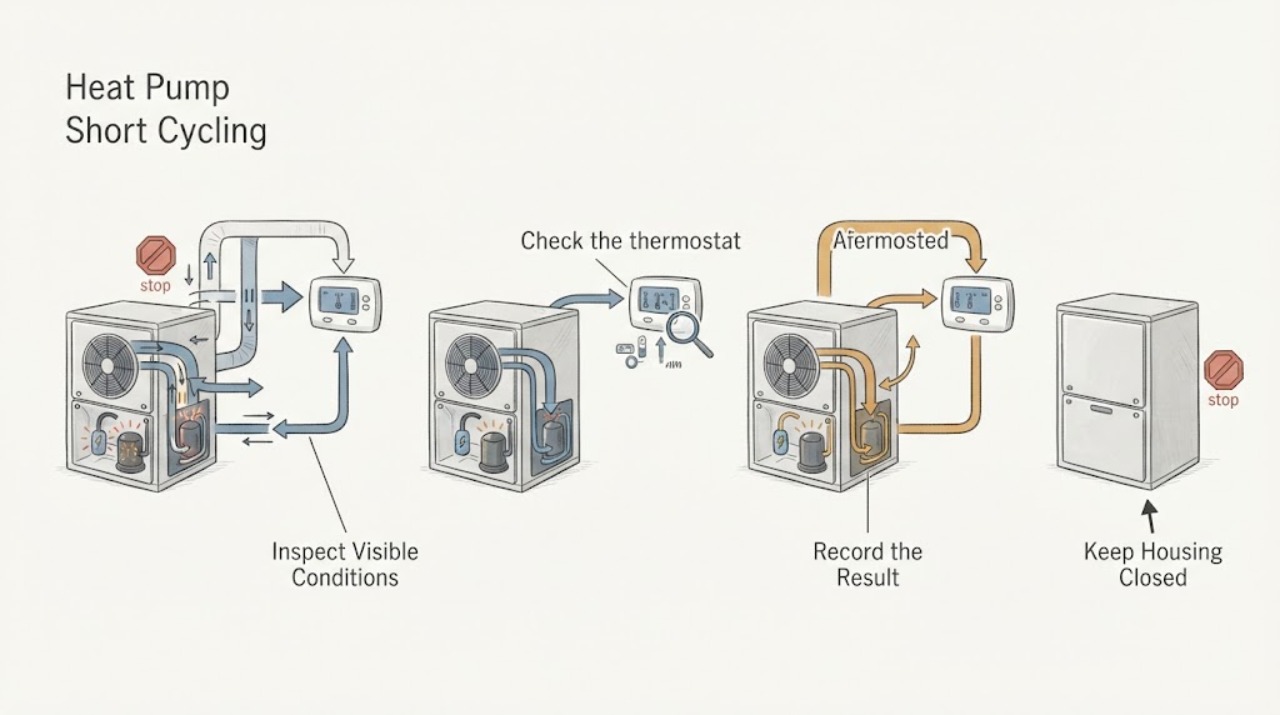
Work through in order
Diagnostic checks
Use only checks that match the exact appliance or system and its official guide.
-
Check 1
Observe one complete event from the thermostat call through the indoor blower and outdoor unit, noting whether the compressor starts, how soon it stops, whether the thermostat still calls, and whether the event repeats.
Expected result: The system repeatedly starts and stops while there is still a heating or cooling call, or the pause occurs only during a recognizable defrost or fan-only event.
Next step: Record the mode, outdoor conditions, thermostat call and any display code, then continue with the thermostat and airflow checks only if the start-stop pattern is genuinely recurring.
Stop if: Stop the observation and switch the system off if safe when there is smoke, a burning smell, sparking, a tripped breaker, severe vibration, water near electrical equipment or rapidly repeating compressor starts.
Why this matters
Why: Repeated starts with an unresolved call fit the short-cycling symptom; a brief defrost or fan-only behavior may be normal operation and should not be diagnosed as a failed compressor from observation alone.
-
Check 2
Check the thermostat from the user interface: confirm the intended heating or cooling mode, a normal fan setting, and that it is not in direct sun, beside a supply vent or next to a heat-producing appliance. Do not remove the thermostat from its base.
Expected result: The mode or fan setting is wrong, or the thermostat is exposed to a local heat or airflow source; alternatively, settings and placement appear reasonable.
Next step: Correct only the user settings or obvious placement issue, then watch one call. If short cycling continues with a sensible thermostat signal, stop changing settings and arrange HVAC evaluation.
Stop if: Do not rewire the thermostat, jumper terminals, remove its cover to test live voltage or repeatedly change the setpoint to force cycling.
Why this matters
Why: Carrier says a wrong mode or fan setting can make heat-pump operation appear abnormal, and Trane identifies a malfunctioning or poorly placed thermostat as a short-cycling cause. A normal thermostat setup shifts the check toward airflow, sizing or equipment diagnosis.
-
Check 3
Inspect the indoor air filter and visible supply and return openings. Replace or clean the filter only with the type and procedure specified for the system, and remove obvious furniture or debris blocking registers. Look at the outdoor coil area without removing panels.
Expected result: The filter is visibly loaded, a register or return is blocked, or the outdoor coil is visibly obstructed; alternatively, airflow paths look clear.
Next step: Restore only the user-accessible airflow items, allow the system to stabilize, and observe one normal call. If short cycling remains, arrange a qualified inspection rather than changing blower settings or opening the cabinet.
Stop if: Stop if the coil is heavily iced, the filter is wet, there is water near electrical equipment, or the unit makes abnormal noise; do not scrape ice, wash energized equipment or reach into the blower or outdoor unit.
Why this matters
Why: Carrier links a dirty filter or dirty outdoor coil with poor heat-pump performance. Restricted airflow can alter run behavior, but a clean filter does not rule out refrigerant, control, compressor or sizing problems.
-
Check 4
Compare the history of the symptom: did short cycling exist from the first installation, begin after a thermostat or duct change, or appear suddenly after years of normal operation? Note whether it occurs in heating, cooling or both modes.
Expected result: The behavior has existed since installation or occurs mainly at low demand, or it began suddenly and affects one mode or follows a maintenance or control change.
Next step: Give the technician the timeline, mode, weather, thermostat behavior and any recent work. Do not attempt to correct a suspected oversized system by adjusting refrigerant or safety controls.
Stop if: Do not continue operation if short cycles are accompanied by ice, burning odor, a high-pitched or grinding sound, a pressure alarm, water leakage or repeated power trips.
Why this matters
Why: A long-standing pattern can support a sizing, load or thermostat-location investigation; a sudden change makes airflow, controls, refrigerant, defrost, pressure or component faults more relevant. These observations guide a technician but do not identify a part.
-
Check 5
After the external checks, decide whether the system can complete a normal call without a safety symptom. If it cannot, switch it off at the normal control and leave equipment panels closed while arranging service.
Expected result: The system completes a call after a user-accessible correction, or short cycling continues with normal settings and clear airflow.
Next step: For persistent cycling, provide the recorded pattern and filter or thermostat findings to a qualified HVAC technician and request a whole-system diagnosis before authorizing parts.
Stop if: Do not open the electrical cabinet, connect refrigerant gauges, bypass a pressure or temperature safety, reset a tripped breaker repeatedly or run the unit unattended to reproduce the fault.
Why this matters
Why: A single corrected event is not proof that the underlying system is healthy. Persistent cycling with normal external conditions needs measurements and inspection of professional-only items such as refrigerant circuit, compressor, controls, pressure protection and equipment sizing.
Use your observations
Decision map
Find the observation that best matches what you see, then follow the next safe action.
-
PATH 01Next step
What you see
The pause is brief, follows a recognizable defrost sequence or occurs with no active thermostat call.
Do this next
Do not label it short cycling from that event alone; monitor the next full call and consult the equipment manual if the pause becomes prolonged or the home loses comfort.
-
PATH 02Next step
What you see
The mode, fan setting or thermostat location is inconsistent with the desired call.
Do this next
Correct the user setting or obvious placement issue and observe one call; recurring cycling requires thermostat and HVAC service diagnosis.
-
PATH 03Next step
What you see
The filter is dirty, a register is blocked or the outdoor coil area is visibly obstructed.
Do this next
Restore only the user-accessible airflow items and observe one call. If the filter is wet, the coil is iced or cycling continues, stop and arrange service.
-
PATH 04Next step
What you see
The issue existed from installation or appears mainly when the load is small.
Do this next
Ask an HVAC professional to review equipment sizing, building load and thermostat location; do not alter refrigerant or controls yourself.
-
PATH 05Next step
What you see
The problem began suddenly or comes with ice, unusual noise, burning odor, water, an alarm or a tripped breaker.
Do this next
Switch the system off if safe, keep panels closed and arrange qualified HVAC service promptly; do not repeatedly restart it.
Helpful context
Understand the symptom
Separate short cycling from a normal pause
Watch the whole system rather than only the outdoor fan. A brief pause during a defrost sequence or a fan that runs without an active heating or cooling call can look like a failure. Short cycling is the repeated start-stop pattern that leaves comfort unresolved and keeps restarting the compressor or system controls.
Use homeowner checks to narrow the cause
Thermostat placement, mode, fan setting, filter restriction and blocked airflow are observable without entering the equipment. If those checks are normal, the next useful information is whether the behavior began after installation, happens only in one mode or weather condition, and whether ice, error indicators or power interruptions accompany it.
Do not turn a cycling complaint into a refrigerant or electrical DIY repair
Refrigerant charge, compressor operation, pressure switches, contactors, wiring, reversing valves and load calculations are professional HVAC work. Do not remove panels, attach gauges, bridge a safety control or keep restarting a system that is overheating, icing or tripping power.
Only after diagnosis
Potential parts
- thermostat or temperature sensor
Consider this category only when a qualified diagnosis finds an incorrect or unstable thermostat signal after user settings and placement are normal; short cycling alone does not prove the thermostat is faulty.
Confirm the exact heat-pump system, control protocol and manufacturer fit information before replacement; do not rewire a thermostat as a trial. - air filter
Consider this category only when the installed filter is loaded, damaged or the system documentation calls for replacement; a clean filter will not correct a refrigerant, sizing or control fault.
Use the system documentation to confirm dimensions and filtration requirements; do not install a more restrictive filter as an experiment. - refrigerant, compressor or control component
This is a professional-diagnosis category only when normal thermostat and airflow checks do not resolve persistent cycling and measurements identify a circuit, compressor or control problem.
Do not order, charge or replace sealed-system or electrical components from the symptom alone; qualified service must confirm the fault and system compatibility.
When checks do not resolve it
Need a professional?
Call a qualified HVAC technician when short cycling continues with correct thermostat settings and clear user-accessible airflow, has existed since installation, or follows a sudden change. Stop and switch the system off if safe for ice, smoke, burning smell, unusual noise, water near electrical equipment, an alarm or repeated breaker trips. Do not open panels, handle refrigerant, bypass safety controls or keep restarting the compressor.
Safety scope: The reader should not open electrical panels, attach refrigerant gauges, handle refrigerant, rewire the thermostat, adjust blower or gas settings, bypass pressure or temperature safeties, scrape ice from coils or repeatedly reset a breaker.
Common questions
FAQ
What is heat pump short cycling?
It is a repeated start-stop pattern during an active heating or cooling call, rather than a single normal defrost or fan pause. It can affect comfort and increase wear, so the cause should be identified instead of repeatedly restarting the system.
Can a dirty filter cause a heat pump to short cycle?
Restricted airflow can affect heat-pump performance, and Carrier recommends checking the air filter and outdoor coil as user-accessible troubleshooting steps. Replace or clean the filter only as the system documentation allows; persistent cycling needs service diagnosis.
Does short cycling mean my heat pump is oversized?
Oversizing is one possible explanation, especially when the pattern has existed since installation or occurs at low demand. A technician should verify building load and equipment performance; do not infer sizing from the symptom alone.
Should I keep running a heat pump that short cycles?
Do not keep running it when short cycling is rapid or accompanied by ice, smoke, burning smell, unusual noise, water, an alarm or repeated power trips. Switch it off if safe and arrange qualified HVAC service; do not bypass a safety control.
Read the exact guide
Official sources
- HVAC Short Cycling: Causes and SolutionsTrane · Manufacturer explanation of heat-pump or air-conditioner short cycling, impacts, thermostat causes and equipment-sizing causes.
- SM Series Heat PumpBosch Home Comfort · Bosch official installation and operation manual troubleshooting table covering short cycling, sizing, thermostat location and airflow-related checks.
- Heat Pump Troubleshooting Guide | Common Heat Pump Problems & FixesCarrier · Manufacturer troubleshooting guidance for thermostat mode, fan settings, filters, outdoor coil, defrost behavior and professional escalation.
Community feedback
Share a repair observation
Share a plain-text repair observation. Accepted observations are published automatically; this page may take a moment to update.