
On this page
Start here
Quick answer
If a furnace controlled by a Honeywell thermostat starts and stops before the home is comfortable, time several calls and note whether the burners stop while the blower continues. Check the Honeywell thermostat's Heat mode, setpoint, display, and any normal “Waiting for equipment” delay; then inspect the accessible air filter and make sure supply registers and return grilles are not blocked. Do not open the furnace, adjust gas or combustion parts, defeat a safety control, or work on thermostat wiring. A clean filter and clear airflow that do not stop the short cycling point to a professional diagnosis of airflow, limit or flame-sensing safety, thermostat/control, duct design, or furnace sizing. Leave immediately and contact emergency services if a carbon-monoxide alarm sounds or anyone has possible CO symptoms; stop the furnace for gas odor, smoke, burning odor, or unsafe heat.
Before you begin
Safety first
- This article is limited to thermostat display/settings observation and ordinary-access filter and airflow checks. Internal furnace, gas, combustion, venting, electrical, safety-control, and thermostat-wiring work belongs to qualified HVAC personnel.
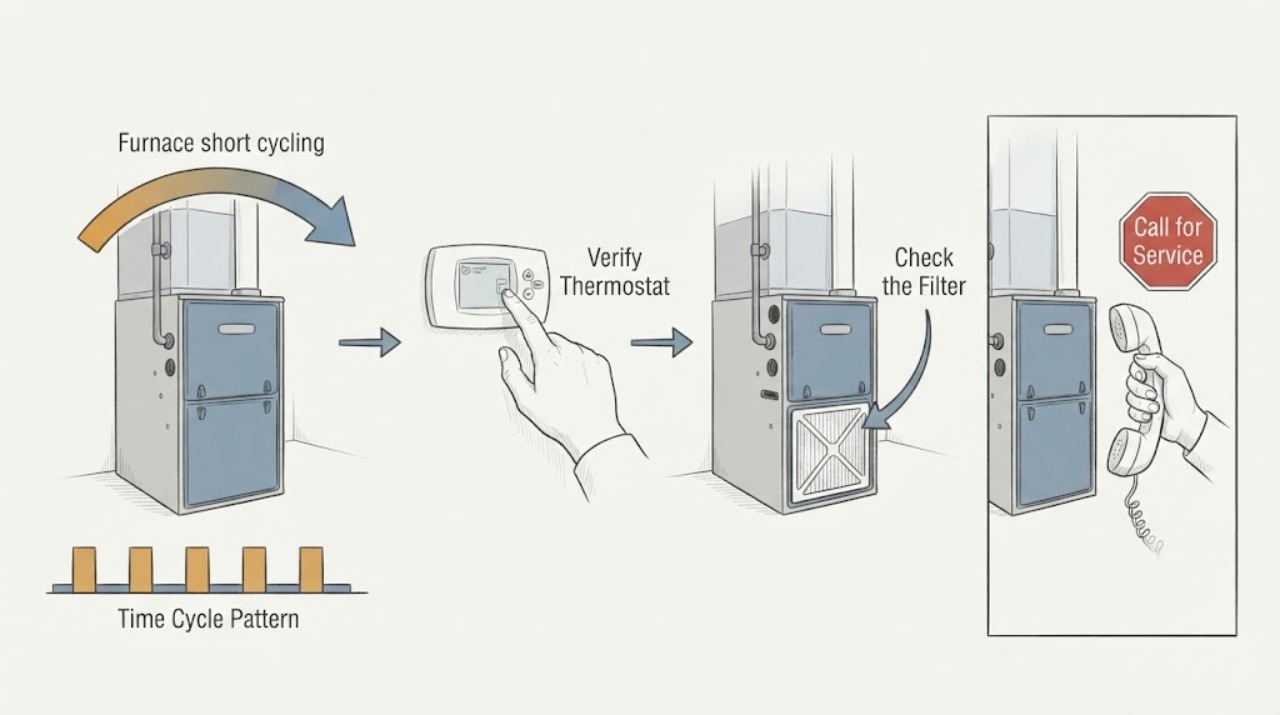
Work through in order
Diagnostic checks
Use only checks that match the exact appliance or system and its official guide.
-
Check 1
From a safe location, time several heating calls and note when the thermostat calls, when heat begins, when the blower runs, when heat stops, and when the next call begins.
Expected result: Record whether the furnace stops after ignition, stops with the blower still running, reaches the setpoint rapidly, or simply waits between calls while the home remains comfortable.
Next step: Use the pattern and the thermostat and furnace model numbers for the next checks; do not remove a furnace panel.
Stop if: Stop for smoke, gas odor, burning electrical odor, unusual heat, a CO alarm, or symptoms of possible CO exposure.
Why this matters
Why: These patterns separate a thermostat delay from a furnace safety shutdown or a system that satisfies too quickly; the elapsed pattern does not identify a part by itself.
-
Check 2
At the Honeywell thermostat, verify Heat mode, the setpoint above the room reading, the fan setting, battery or power status if applicable, and any “Waiting for equipment” or active alert message.
Expected result: Note whether the thermostat is calling for heat, shows a normal protective delay, goes blank or reboots, or stops calling while the room is still below the setpoint.
Next step: Follow the exact thermostat manual for user-level mode or battery checks only; do not change installer configuration or disturb wires.
Stop if: Do not remove the thermostat from its wall plate, expose terminals, or alter wiring; stop if the display or equipment behaves erratically.
Why this matters
Why: Honeywell documents that a waiting message can hold off heating to prevent short cycling and that a delay of up to 5 minutes is normal for the cited T10/T10+ guidance; other models differ. A blank or recurring control alert points to service.
-
Check 3
Inspect the furnace filter at its normal user-accessible location with the system off; clean or replace it only with the exact size and method stated by the furnace or filter instructions.
Expected result: Record a visibly loaded filter, an incorrectly fitted filter, a filter that is clean, or no safe user access to the filter.
Next step: Refit the correct filter in the indicated airflow direction and observe one normal call; arrange service if short cycling continues.
Stop if: Do not operate without a required filter, force a filter into place, or open the furnace cabinet to reach an inaccessible filter.
Why this matters
Why: Energy guidance says a dirty filter can reduce airflow and damage equipment, while furnace guidance links restricted airflow with overheating and a safety shutdown. A clean filter makes another restriction or internal fault more likely, not a guarantee that the furnace is sound.
-
Check 4
Walk the occupied rooms and visually confirm that supply registers are open and return grilles are not covered by furniture, rugs, storage, or other obstructions.
Expected result: Record blocked or closed openings, weak airflow in several rooms, one isolated weak register, or normal airflow throughout the system.
Next step: Clear only movable obstructions and reopen registers, then observe one call; do not change ductwork or access the blower compartment.
Stop if: Stop if there is a hot-metal smell, smoke, abnormal cabinet heat, or airflow that suddenly disappears.
Why this matters
Why: Restricted supply or return airflow can raise furnace temperature and contribute to short cycling; normal visible openings make duct, blower, control, sizing, or combustion diagnosis more likely.
-
Check 5
Without opening the furnace, note whether warm air stops shortly after ignition, whether the blower continues to cool the system, and whether the thermostat still calls for heat.
Expected result: Record ignition followed by an early heat stop, a blower-only period, repeated lockout indication, or a furnace that runs normally but satisfies the thermostat unusually quickly.
Next step: Keep the furnace off and arrange HVAC service when the heat stops early, a lockout appears, or the pattern persists after airflow checks.
Stop if: Do not open the burner compartment, clean a flame sensor, adjust gas, defeat a limit, or interfere with venting.
Why this matters
Why: Early heat loss with a continuing blower can be consistent with a limit or flame-sensing safety response; rapid satisfaction can be consistent with sizing, thermostat location, or control behavior. Only a qualified technician can distinguish these causes.
-
Check 6
From outside the equipment area, check only for obvious warning signs such as gas odor, soot or smoke, a CO alarm, abnormal flame noise, or burning electrical odor; do not investigate inside the furnace.
Expected result: Record no warning sign, or any gas, smoke, soot, CO, unusual flame, or electrical symptom and whether people feel headache, dizziness, nausea, or unusual fatigue.
Next step: For a CO alarm or possible symptoms, leave for fresh air and call emergency services from outside; for gas odor or smoke, leave the area and use the local emergency or gas-safety procedure. Do not reuse the furnace until cleared.
Stop if: Never remain indoors to find the source, operate switches near a gas odor, or run a furnace after a CO alarm.
Why this matters
Why: Fuel-burning furnaces can produce carbon monoxide when malfunctioning or improperly vented. A warning sign overrides ordinary troubleshooting and requires evacuation or qualified emergency response, not another thermostat reset.
-
Check 7
If there are no safety warnings, the filter and visible airflow are addressed, and the exact manuals allow normal operation, observe one supervised heating call without changing installer settings.
Expected result: Record whether the furnace completes a call, the home temperature rises normally, short cycling returns, or the thermostat becomes blank or shows an alert.
Next step: Stop testing and provide the cycle record to an HVAC professional if the symptom returns or the thermostat loses power.
Stop if: Stop immediately for smoke, gas odor, burning smell, abnormal heat, a CO alarm, leak, sparking, or a repeating lockout.
Why this matters
Why: A single normal call after correcting a filter or obstruction supports an operating-condition issue; recurrence means the underlying control, airflow, sizing, or furnace fault remains unresolved.
-
Check 8
Prepare a service record with the Honeywell thermostat model, furnace manufacturer and model, fuel type, filter condition, register and return observations, exact display message, cycle times, and safety symptoms.
Expected result: Note whether the fault is repeatable, whether burners stop before the blower, whether the thermostat reboots, and whether the issue occurs only in extreme outdoor weather or at a particular setpoint.
Next step: Arrange qualified HVAC service and keep the furnace off when a safety warning, repeated lockout, early ignition shutdown, or unresolved short cycling is present.
Stop if: Do not keep cycling the furnace to reproduce the fault or perform internal electrical, gas, combustion, or venting checks.
Why this matters
Why: This record helps the technician distinguish thermostat/control behavior, airflow or duct restriction, sizing, limit or flame-sensing safety, and combustion or venting concerns without unsafe homeowner access.
Use your observations
Decision map
Find the observation that best matches what you see, then follow the next safe action.
-
PATH 01Safety boundary
What you see
The Honeywell thermostat shows “Waiting for equipment” for the documented normal delay, then the furnace starts and completes a normal heat call.
Do this next
Use the exact thermostat manual and monitor; service a delay longer than documented, repeated blanking, or a furnace that still stops early.
Why this path and its safety boundary
Why it matters: The observed pause is more likely a thermostat protection delay than furnace short cycling; the cited T10/T10+ guidance says up to 5 minutes can be normal, but models differ.
Safety stop: Do not alter installer wiring or bypass the delay.
-
PATH 02Safety boundary
What you see
The filter is loaded, a return is covered, or several supply registers are closed or blocked, and airflow is weak or the furnace stops with the blower continuing.
Do this next
Correct only the accessible filter or obstruction and observe one call; arrange HVAC service if the pattern remains.
Why this path and its safety boundary
Why it matters: Restricted airflow and heat buildup are more likely, with a safety shutdown possible; visible correction does not prove the internal furnace is safe.
Safety stop: Stop for abnormal heat, smoke, burning odor, or a recurring shutdown.
-
PATH 03Safety boundary
What you see
The burner or heat output stops soon after ignition while the blower continues, or a lockout or fault alert appears before the room reaches setpoint.
Do this next
Keep the furnace off and arrange qualified diagnosis of the furnace and its safety controls.
Why this path and its safety boundary
Why it matters: A limit, flame-sensing, ignition, control, or combustion issue is more likely than a thermostat setting; the cause cannot be selected from the symptom alone.
Safety stop: Do not open the burner compartment, alter gas settings, or defeat a safety control.
-
PATH 04Safety boundary
What you see
The furnace produces heat normally, the thermostat is stable, the home reaches the setpoint unusually quickly, and the whole system restarts frequently without an airflow warning.
Do this next
Ask an HVAC professional to review load, duct design, thermostat placement, and configuration; do not adjust furnace capacity or installer settings yourself.
Why this path and its safety boundary
Why it matters: Oversizing, thermostat location, load conditions, or installer cycle settings are more likely than a dirty filter. DOE guidance associates oversizing with short cycling and reduced durability.
Safety stop: Do not repeatedly raise and lower the setpoint to force longer cycles.
-
PATH 05Safety boundary
What you see
The Honeywell display goes blank or reboots, heating calls disappear, or a documented waiting period lasts longer than the exact model allows.
Do this next
Record the display behavior and arrange HVAC service; provide the thermostat and furnace model numbers.
Why this path and its safety boundary
Why it matters: Thermostat power, wiring, configuration, or equipment control behavior is more likely; the thermostat brand alone does not identify the failed component.
Safety stop: Do not remove the thermostat, expose terminals, or change wiring.
-
PATH 06Safety boundary
What you see
A CO alarm sounds, anyone has possible CO symptoms, or there is gas odor, smoke, soot, abnormal flame noise, or a burning electrical odor.
Do this next
Leave immediately for fresh air, call emergency services or the applicable gas emergency service from outside, and do not re-enter or reuse the furnace until authorities or qualified personnel clear it.
Why this path and its safety boundary
Why it matters: This is a combustion or electrical safety emergency, not ordinary short-cycle troubleshooting. CPSC warns that fuel-burning appliances can produce CO and says not to operate a malfunctioning appliance until trained personnel service it.
Safety stop: Never stay to locate the source, silence the alarm, operate switches near gas odor, or restart the furnace.
Helpful context
Understand the symptom
Make sure it is actually short cycling
Write down when the thermostat calls for heat, when the burners or heat output start, when the blower starts, when heat stops, and when the next call begins. A normal thermostat delay is different from a furnace that lights and then drops out, or a system that reaches the setpoint unusually fast and restarts. Honeywell's “Waiting for equipment” message can be a protective delay; it does not prove the furnace has a failed part.
Honeywell is often the control, not the furnace maker
Honeywell Home thermostats can control furnaces made by many manufacturers. The thermostat model and furnace data plate therefore matter more than the Honeywell name alone. Record the thermostat model, furnace manufacturer and model, fuel type, display message, and the timing of each cycle before applying any model-specific guidance.
Start with airflow and settings that are user-accessible
Confirm the thermostat is in Heat and the requested temperature is above the room reading. Inspect the accessible filter and change or clean it only as the furnace and filter instructions allow. Make sure supply registers are open and return grilles are not covered by furniture or stored items. Restricted airflow can overheat the furnace and trigger a safety shutdown; if the symptom remains with clear airflow, repeated resets are not a repair.
Use the cycle pattern to choose the next safe boundary
If the furnace warms the home very quickly and then restarts, sizing, thermostat location, or control settings deserve professional review. If heat stops soon after ignition while the blower continues, a flame-sensing or limit-safety event is possible; do not access the burner compartment. If the thermostat is blank, repeatedly reboots, or shows a delay longer than its documented normal period, the control or its power path needs HVAC service rather than a wiring experiment.
Treat fuel and combustion symptoms as safety issues
Short cycling is not a reason to inspect gas pressure, burners, venting, the heat exchanger, limit switches, or flame sensors yourself. A gas smell, soot, smoke, burning electrical odor, unusual flame behavior, a CO alarm, or symptoms such as headache, dizziness, nausea, or unusual fatigue changes the priority to leaving the area and obtaining emergency or qualified help. Do not run the furnace again until it is cleared by trained personnel.
Safety boundary
Stop conditions
- Stop and leave for fresh air if a carbon-monoxide alarm sounds or anyone has headache, dizziness, nausea, shortness of breath, confusion, or unusual fatigue that could indicate CO exposure; call emergency services from outside.
- Stop for gas odor, smoke, soot, burning electrical odor, sparking, abnormal cabinet or vent heat, or a damaged fuel or electrical connection; use the local emergency or gas-safety procedure.
- Do not open the furnace cabinet, burner compartment, venting, heat exchanger, blower compartment, or control enclosure.
- Do not adjust gas pressure, burners, flame sensors, limit controls, installer cycle settings, thermostat wiring, or any safety device.
- Do not operate without the required filter, with blocked venting, after repeated lockout, or when the blower or heat stops abnormally.
- After one safe thermostat, filter, register, and return-air check, arrange qualified HVAC service for recurring short cycling or any unresolved alert.
Only after diagnosis
Potential parts
- furnace air filter
Consider a replacement only when the installed filter is loaded or damaged and the exact furnace or filter instructions identify the correct type and size.
Match the exact filter dimensions and airflow direction; do not substitute a higher-restriction filter without the equipment guidance. - Honeywell thermostat or thermostat power/control component
Consider this category only after service confirms that the thermostat, its power path, or configuration is causing the recorded calls, blanking, or delay behavior.
Confirm the exact Honeywell model, furnace system type, wiring scheme, and professional configuration; the thermostat brand does not identify the furnace part. - furnace limit, flame-sensing, or control component
Consider these internal categories only after qualified diagnosis finds an early heat shutdown, lockout, or safety-control fault; short cycling alone does not select a component.
Confirm the furnace manufacturer, complete model, safety rating, and approved service procedure before any part selection.
When checks do not resolve it
Need a professional?
Arrange qualified HVAC service when short cycling continues after the accessible filter and airflow checks; when heat stops soon after ignition, a lockout or thermostat power fault appears, the home reaches setpoint unusually quickly, or the system may be oversized; and immediately for gas, smoke, electrical, venting, abnormal heat, or CO warnings. A CO alarm or possible CO symptoms require leaving for fresh air and contacting emergency services before any troubleshooting.
Safety scope: This article is limited to thermostat display/settings observation and ordinary-access filter and airflow checks. Internal furnace, gas, combustion, venting, electrical, safety-control, and thermostat-wiring work belongs to qualified HVAC personnel.
Common questions
FAQ
Is every pause between furnace cycles short cycling?
No. A thermostat may intentionally wait between calls to protect equipment. Honeywell's T10/T10+ guidance calls a “Waiting for equipment” delay of up to 5 minutes normal for those models, while actual furnace behavior and cycle rate depend on system type and load. Use the exact thermostat manual.
Can a dirty furnace filter cause short cycling?
Yes. Restricted airflow can cause heat buildup and a safety shutdown, and ENERGY STAR and DOE guidance identify filter maintenance as an accessible first check. If a correct filter and clear visible airflow do not resolve the symptom, arrange HVAC service.
Why does the blower keep running after the heat stops?
The blower may continue while the furnace cools after a safety response, but this observation does not identify whether airflow, a limit, flame sensing, control, or combustion is involved. Do not open the furnace; record the pattern and arrange qualified diagnosis if it repeats.
Could a Honeywell thermostat be causing furnace short cycling?
It could be a factor if the thermostat has an incorrect setting, unstable power, configuration issue, or a location that reads temperature incorrectly, but Honeywell is often the thermostat brand rather than the furnace maker. Record the thermostat and furnace models and have HVAC personnel evaluate persistent behavior.
Can an oversized furnace short cycle?
Yes. DOE guidance associates oversized HVAC equipment with short cycling, reduced comfort, and premature equipment wear. Sizing and duct design require a professional load review; do not change furnace capacity or installer settings based only on cycle timing.
When is furnace short cycling an emergency?
Treat a CO alarm, possible CO symptoms, gas odor, smoke, soot, burning electrical odor, sparking, or abnormal heat as a safety event. Leave for fresh air when appropriate, contact emergency or gas-safety services from outside, and do not reuse the furnace until qualified personnel clear it.
Read the exact guide
Official sources
- What Is Furnace Short Cycling? Causes and SolutionsCarrier · Official Carrier residential furnace guidance used for general furnace mechanics, not as a Honeywell model or code manual.
- HVAC Proper Installation of FiltersU.S. Department of Energy Building Science Education · Official U.S. Department of Energy HVAC education page; use only for general airflow and filter principles, not a Honeywell or furnace-model procedure.
- Strategy Guideline: Accurate Heating and Cooling Load CalculationsU.S. Department of Energy · Official DOE technical guide used only for the professional sizing branch; it does not identify the size or repair for an individual furnace.
- My system turns on and off too fast. What should I do?Honeywell Home · Official Honeywell Home support article for its programmable thermostat guidance; cycle behavior varies with heating system type and load.
- Carbon Monoxide Fact SheetU.S. Consumer Product Safety Commission · Official U.S. CPSC safety guidance for fuel-burning appliances including furnaces; emergency instructions supersede ordinary troubleshooting.
- Maintenance ChecklistENERGY STAR · Official ENERGY STAR homeowner maintenance guidance for central heating systems; internal gas, combustion, and electrical checks are contractor work.
- Troubleshooting and SupportHoneywell Home · Official Honeywell Home T10/T10+ support page; the five-minute waiting guidance is model-specific and must not be generalized to every Honeywell thermostat.
Community feedback
Share a repair observation
Share a plain-text repair observation. Accepted observations are published automatically; this page may take a moment to update.