
On this page
Start here
Quick answer
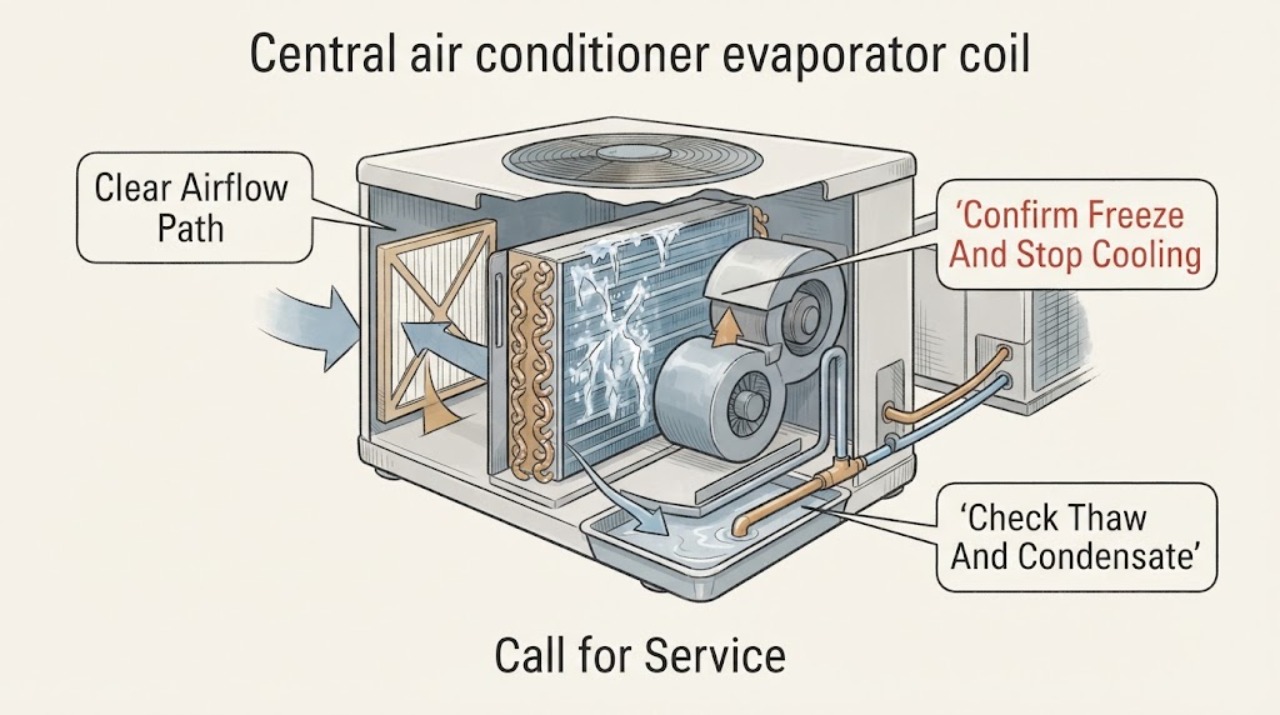
A frozen Lennox evaporator coil means cooling should be stopped so the ice can thaw. Turn the thermostat out of cooling, let the ice melt naturally, and inspect only the filter, visible return and supply obstructions, and outdoor debris. Lennox identifies reduced airflow from a dirty filter or blocked vents, low refrigerant, dirty coils, blower faults, and running cooling in cold outdoor conditions as possible causes. Replace a dirty filter with the correct type and size, but do not chip ice, run without a filter, adjust refrigerant, open panels, or force a fan. If ice returns after airflow is restored, airflow remains weak, water overflows, the condensate safety trips, or the outdoor unit is abnormal, leave the system off and arrange qualified Lennox HVAC service.
Before you begin
Safety first
- This article supports thermostat shutoff, natural thawing, ordinary-access filter and airflow checks, visible condensate observation, and loose outdoor-debris clearing only. A qualified person must handle electrical testing, refrigerant, sealed-system work, coil or blower access, fan repair, drain repair, and startup verification.
Work through in order
Diagnostic checks
Use only checks that match the exact appliance or system and its official guide.
-
Check 1
From ordinary safe access, look for ice on the indoor coil area or refrigerant lines, frost, weak or warm supply air, unusual gurgling or hissing, and water around the indoor unit; then turn the thermostat out of cooling.
Expected result: Record visible ice, weak airflow, warm air, a dry system, or meltwater; note whether the outdoor unit is still running after cooling is turned off.
Next step: Leave cooling off and allow the ice to thaw naturally. Do not use a heat gun, hair dryer, sharp tool, or hot water on the coil.
Stop if: Stop for water near electrical equipment, active overflow, smoke, burning odor, exposed wiring, refrigerant-line damage, or a loud mechanical event.
Why this matters
Why: Ice plus weak or warm airflow is consistent with a frozen evaporator coil. Water can appear as the ice melts. An outdoor unit that continues after the cooling call ends, or abnormal sound or odor, needs service rather than repeated cycling.
-
Check 2
With cooling off and the system safely accessible, inspect the installed filter, return grilles, and supply registers without opening the air-handler cabinet.
Expected result: Classify the filter as clean, loaded, wet, damaged, missing, or wrong-sized; note blocked returns, closed supplies, furniture or curtains over vents, and whether airflow was weak before the freeze.
Next step: Replace a disposable filter only with the correct type and size specified for the system, restore open unobstructed registers, and keep cooling off until the coil is fully thawed.
Stop if: Do not run the unit without a filter, install a high-resistance filter by guesswork, remove a cabinet panel, or clean a hidden coil as an owner-side shortcut.
Why this matters
Why: Lennox identifies dirty filters and blocked or closed vents as common airflow restrictions that can lower coil temperature and produce ice. A missing, wet, or wrong filter can allow dirt or airflow problems but does not establish that the coil or refrigerant circuit is sound.
-
Check 3
While the ice thaws, inspect only visible drain tubing, the area below the indoor unit, and any accessible pan or secondary drain outlet; protect nearby surfaces from meltwater.
Expected result: Record a dry drain, water draining normally, standing water, an overflowing pan, wet insulation, or a drain outlet that appears blocked; note whether a visible float safety has interrupted operation.
Next step: Keep cooling off, catch or route water only through the existing safe drain path, and arrange service for standing water, overflow, wet insulation, a blocked-looking drain, or a repeated safety interruption.
Stop if: Do not pour chemicals into an unknown drain, bypass a float switch, open the pan or air handler, or work near water and electrical parts.
Why this matters
Why: Meltwater can expose a drain or pan problem, and Lennox notes that a high pan level can trip a float switch and stop the system. Water or a safety trip may coexist with a frozen coil; clearing a drain alone does not explain recurrent ice.
-
Check 4
With the cooling call off, look around the outdoor condenser for leaves, grass, trash, or shrubs that restrict the airflow path; do not reach through the grille or remove cabinet panels.
Expected result: Record a clear path, loose debris outside the cabinet, a fan that does not run during a later normal call, unusual vibration, persistent hum, or visible coil, line, or wiring damage.
Next step: Remove only loose debris that can be cleared without touching the cabinet, then leave the system off until indoor ice is gone. Arrange service for abnormal sounds, fan faults, damage, or recurrent freezing.
Stop if: Do not wash a frozen system, bend coil fins, push the fan, spray into the cabinet, or operate after visible electrical or refrigerant damage.
Why this matters
Why: Lennox says outdoor debris can decrease capacity and airflow, while damaged coils, wiring, fan operation, and refrigerant lines require professional inspection. A clear outdoor path does not rule out an indoor airflow or sealed-system fault.
-
Check 5
Record the outdoor temperature and weather when the freeze occurred, and note whether cooling was running during an unusually cool period; do not run the system merely to reproduce icing.
Expected result: Record normal warm-weather operation followed by freezing in cool weather, freezing during ordinary warm conditions, or no reliable temperature history.
Next step: Avoid cooling when outdoor conditions are too cold for the equipment's instructions; if the system freezes in normal conditions or the pattern is unclear, arrange qualified diagnosis rather than changing controls.
Stop if: Do not alter low-temperature controls, thermostat wiring, refrigerant settings, or safety switches to keep the system running.
Why this matters
Why: Lennox says running air conditioning below about 60°F can interfere with the pressure and temperature balance and contribute to freezing. Freeze-ups in ordinary cooling conditions, or repeated icing after weather changes, keep airflow, coil, blower, and refrigerant causes in the service path.
-
Check 6
After all visible ice has melted, the filter is installed, airflow paths are open, no water or damage is present, and the outdoor conditions are suitable, make one normal cooling call and observe the system without opening it.
Expected result: Record steady cool air and normal airflow, weak airflow, warm air with the system running, return of ice, renewed water, an outdoor fan or compressor abnormality, or a protection trip.
Next step: Turn cooling off for any recurrence and use the matching branch below. Give the technician the filter condition, thaw duration, airflow pattern, outdoor temperature, ice location, water, sounds, and service history.
Stop if: Stop the retest for smoke, burning odor, sparking, refrigerant damage, active water near electrical equipment, repeated breaker or float operation, or loud fan or compressor noise.
Why this matters
Why: A stable result after a clearly dirty filter or blocked vent was corrected makes that restriction a plausible contributor but does not rule out a deeper fault. Any repeat ice, weak airflow, warm air, water, abnormal sound, or protection trip requires diagnosis.
Use your observations
Decision map
Find the observation that best matches what you see, then follow the next safe action.
-
PATH 01Safety boundary
What you see
The filter is loaded or missing, returns or supplies are blocked, and airflow was weak before or during the freeze.
Do this next
Correct only the filter or ordinary visible obstruction, let the coil thaw fully, and make one safe retest; call for service if airflow remains weak or ice returns.
Why this path and its safety boundary
Why it matters: An airflow restriction is plausible and can make the coil too cold, but the ice itself may also conceal a dirty coil, blower problem, or other fault.
Safety stop: Do not run without a filter, chip ice, open the air handler, or use an improvised filter.
-
PATH 02Safety boundary
What you see
The filter is correct and airflow is normal after thawing, but the coil freezes again in normal cooling conditions.
Do this next
Leave cooling off and arrange qualified Lennox HVAC diagnosis; provide the timing of the repeat freeze and the location of ice or water.
Why this path and its safety boundary
Why it matters: Low refrigerant, a leak, dirty or damaged coil, blower or metering issue, or another system fault is more likely than a simple filter problem.
Safety stop: Do not add refrigerant, adjust pressures, open the coil cabinet, or keep restarting the system.
-
PATH 03Safety boundary
What you see
The system froze while cooling was operated during unusually cool outdoor weather, and the coil does not recur in suitable conditions.
Do this next
Avoid cooling in conditions outside the equipment guidance and monitor only under suitable conditions; call if freezing recurs or cooling remains weak.
Why this path and its safety boundary
Why it matters: Outdoor temperature may have contributed to the pressure and temperature balance, but a cool-weather event does not rule out an underlying airflow or charge problem.
Safety stop: Do not defeat low-temperature protection or change controls to force operation.
-
PATH 04Safety boundary
What you see
Ice melts into a pan or floor area, the condensate drain is not flowing, water overflows, or a float safety stops the system.
Do this next
Keep cooling off, protect materials, and arrange service for drain, pan, float, coil, and airflow checks.
Why this path and its safety boundary
Why it matters: Drainage or pan capacity is a safety concern that may be secondary to the frozen coil; continued cooling can cause water damage.
Safety stop: Stop for active overflow, ceiling or wall damage, water near electrical equipment, or any need to bypass a float or open a panel.
-
PATH 05Safety boundary
What you see
The outdoor unit is silent, only hums, vibrates, trips protection, smells hot, or shows damaged wiring or refrigerant lines after the thaw.
Do this next
Leave the system off and arrange qualified service; record the sound, timing, protection response, and visible condition from a safe position.
Why this path and its safety boundary
Why it matters: An outdoor fan, compressor, electrical, control, or sealed-system fault is more likely than a visible indoor airflow restriction.
Safety stop: Do not push the fan, open the condenser, reset protection repeatedly, or touch wiring or refrigerant lines.
Helpful context
Understand the symptom
Thaw first, then look for the pattern that caused the freeze
Ice blocks the very airflow needed to warm the evaporator coil, so continued cooling can make the condition worse and can send meltwater into a pan or floor area. Lennox's freeze-up guidance says to shut off cooling, allow the ice to melt, replace a dirty filter, and verify that supply and return vents are open and unobstructed. Treat thawing as a safe reset for observation, not as proof that a filter was the only cause.
Weak airflow and low refrigerant look similar from the room
A loaded filter, closed register, blocked return, dirty indoor coil, or blower problem can reduce warm air crossing the coil. Low refrigerant can also lower coil pressure and temperature, causing ice and weak cooling. Room-level observations cannot distinguish a charge leak from an airflow fault; recurring ice after a correct filter and clear vents needs measured HVAC diagnosis.
Keep panels, refrigerant, and electrical testing out of owner checks
Lennox manuals reserve coil cleaning, refrigerant checks, voltage checks, amp measurements, wiring checks, and drain service for qualified personnel. An owner can record thermostat response, airflow, filter condition, visible ice, water, outdoor debris, and sounds from a safe position. Do not open the air handler or condenser, test live terminals, add refrigerant, wash a frozen indoor coil, or bypass a drain safety.
Safety boundary
Stop conditions
- Turn cooling off and let the evaporator coil thaw naturally for visible ice; do not chip ice or apply direct heat.
- Do not run without a filter, open HVAC panels, test live wiring, add refrigerant, adjust system pressures, or bypass a float or other protection.
- Stop for active water or overflow, water near electrical equipment, ceiling or wall damage, smoke, burning odor, sparking, damaged wiring, or damaged refrigerant lines.
- Do not keep restarting a unit that refreezes, has weak airflow, hums, vibrates, trips protection, or produces warm air after thawing.
Only after diagnosis
Potential parts
- air filter
Consider this category only when the installed filter is dirty, damaged, missing, or the wrong size and the correct replacement is identified from the equipment documentation.
Confirm exact filter dimensions, type, airflow direction, and system pressure requirements; do not substitute a restrictive filter by guesswork or run without one. - indoor blower motor or capacitor
Consider this category only after qualified airflow and electrical testing confirms a blower motor, capacitor, or related air-handling fault that can account for weak airflow and icing.
Confirm the exact air-handler or furnace model, motor characteristics, capacitor specification, controls, and mounting before replacement; weak airflow alone does not establish fit. - condensate drain or float safety component
Consider this category only when testing confirms a blocked or damaged drain, pan, or float safety after the water source and recurring ice are evaluated.
Confirm the exact pan, drain routing, switch behavior, wiring, and installation requirements; never use a replacement to bypass condensate protection. - refrigerant-circuit or metering component
Consider this category only after a qualified technician confirms a leak, incorrect charge, metering fault, or sealed-system issue through appropriate measurements.
Confirm exact model, refrigerant designation, metering arrangement, repair procedure, and qualified handling requirements; do not add refrigerant or select a sealed-system part from ice alone.
When checks do not resolve it
Need a professional?
Arrange qualified Lennox HVAC service when the coil freezes again after a correct filter and clear visible airflow path, airflow remains weak, the system freezes in normal outdoor conditions, water overflows or a condensate safety trips, the outdoor unit is abnormal, or cooling stays warm after thawing. Refrigerant, coil, blower, metering, electrical, compressor, duct, drain, and panel-access work require equipment-specific diagnosis.
Safety scope: This article supports thermostat shutoff, natural thawing, ordinary-access filter and airflow checks, visible condensate observation, and loose outdoor-debris clearing only. A qualified person must handle electrical testing, refrigerant, sealed-system work, coil or blower access, fan repair, drain repair, and startup verification.
Common questions
FAQ
What should I do first when my Lennox evaporator coil is frozen?
Turn the thermostat out of cooling and let the ice melt naturally. Then check the installed filter and visible return and supply airflow, and clear only ordinary obstructions. Do not chip ice, run without a filter, open the cabinet, or add refrigerant.
Can a dirty filter freeze a Lennox evaporator coil?
Yes. Lennox says a dirty filter can restrict airflow over the evaporator coil, making it too cold and allowing ice to form. Replace it with the correct type and size, thaw the coil fully, and arrange service if airflow remains weak or ice returns.
Why does my Lennox coil freeze even after I replace the filter?
A filter is only one possible cause. Recurring ice with normal airflow can indicate a dirty coil, blower problem, low refrigerant, metering issue, duct restriction, or another system fault. Leave cooling off and have a qualified technician diagnose it rather than adding refrigerant or changing controls.
Should I run the fan to thaw a frozen Lennox coil?
Lennox consumer guidance says the fan can be set to run without cooling to help thaw the coil, but use the installed system instructions and stop if water approaches electrical equipment or overflows. Never use direct heat or tools on the ice, and keep the filter installed.
When does a frozen Lennox coil need professional service?
Call for service when freezing returns after the filter and visible airflow path are corrected, airflow stays weak, the outdoor unit is abnormal, condensate overflows or a float safety trips, water damage appears, or the system remains warm after thawing. Refrigerant, electrical, blower, coil, drain, and sealed-system work require qualified diagnosis.
Read the exact guide
Official sources
- Homeowner MaintenanceLennox · Official Lennox homeowner maintenance document; use the installed unit's instructions for model-specific access and cleaning.
- Why is My AC Unit Freezing Up? Find Out?Lennox · Official Lennox consumer guidance for air-conditioner freeze-ups; exact equipment instructions control when they differ.
- 504500aLennox Industries Inc. · Official archived Lennox HSX15 manual used for safety and maintenance boundaries; the exact manual for the installed model controls.
- Air Conditioner Maintenance TipsLennox · Official Lennox maintenance guidance; exact filter type and service intervals depend on the installed system.
- Outdoor AC unit not turning onLennox · Official Lennox consumer article; it covers common central-air symptoms and directs refrigerant work to qualified professionals.
Community feedback
Share a repair observation
Share a plain-text repair observation. Accepted observations are published automatically; this page may take a moment to update.