
On this page
Start here
Quick answer
A Lennox central air conditioner is short cycling when it starts and stops in rapid repeated bursts before the thermostat is satisfied. Begin with safe external checks: replace a visibly dirty air filter, make sure supply and return vents are not blocked, verify thermostat mode, setpoint, batteries, and location, and look for ice without touching the coil. Lennox identifies restricted airflow, thermostat problems, ice or low refrigerant, and an oversized system as possible causes; refrigerant, electrical, compressor, and sizing work require a qualified HVAC professional. Do not keep forcing restarts or bypass the compressor's protection. Stop and arrange service for ice, water leakage, repeated breaker trips, burning odor, unusual noise, poor cooling, or short cycles that continue after the filter, thermostat, and vent checks.
Before you begin
Safety first
- This article covers external observation, filter and grille checks, thermostat settings, visible ice and water inspection, and one model-directed observation only. Do not open HVAC equipment, handle refrigerant, test live electrical parts, or bypass safety controls.
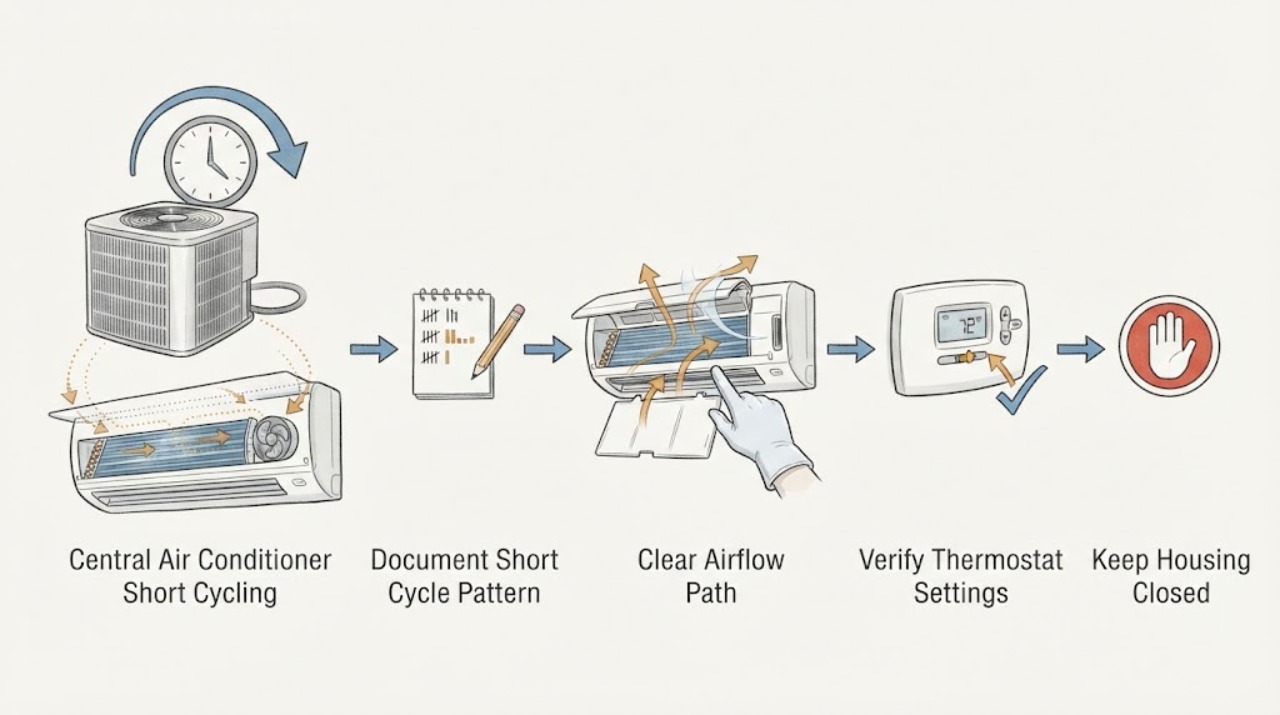
Work through in order
Diagnostic checks
Use only checks that match the exact appliance or system and its official guide.
-
Check 1
From a safe position, record the thermostat setpoint, indoor temperature, whether the thermostat still calls for cooling, and the sequence of indoor blower and outdoor-unit starts and stops. Do not change wiring or remove panels.
Expected result: The system stops only after the setpoint is reached, or it stops while the room is still warm and restarts repeatedly after short runs; note whether the blower and outdoor unit stop together.
Next step: Continue with filter, vent, thermostat, and visible-ice checks only for a confirmed repeated pattern; document the timing and model number for service if it persists.
Stop if: Stop operating the system for smoke, burning odor, sparking, refrigerant release, water near electrical equipment, a breaker that trips, or an outdoor unit making a severe abnormal noise.
Why this matters
Why: A completed cycle after the thermostat is satisfied is normal operation. Repeated stops before satisfaction support short cycling, while different indoor and outdoor timing can point toward a control, delay, airflow, or equipment issue that cannot be identified from sound alone.
-
Check 2
Turn the thermostat to Off before handling the accessible filter. Inspect the filter and accessible return and supply grilles; replace the filter only with the type and orientation specified for the system, and move loose furniture or objects that visibly block a vent.
Expected result: The filter is visibly loaded with dust, the filter is clean but a return or supply is blocked, or the accessible airflow path is clear.
Next step: After the filter is correctly installed and grilles are clear, make one controlled cooling call and compare the cycle pattern. If short cycling continues, do not open the air handler or coil cabinet; continue to the next safe checks and service branch.
Stop if: Do not run the system without its required filter, use a filter that does not fit, block a return to reduce noise, open panels, or clean coils near energized equipment.
Why this matters
Why: A loaded filter or blocked grille can restrict airflow and contribute to premature protective shutdown. A clean filter and clear grilles make thermostat, ice, refrigerant, sizing, control, or equipment faults more likely; they do not prove those faults.
-
Check 3
Inspect the thermostat display and accessible surroundings without removing it from the wall. Verify cooling mode, setpoint, schedule or hold, battery status if applicable, and whether direct sun, a supply vent, a lamp, or another heat source is affecting the thermostat location.
Expected result: The thermostat is in cooling mode and still calling for cooling, the setpoint or schedule is unexpectedly ending the call, the display or battery is unreliable, or the thermostat is exposed to a local heat or air source.
Next step: Correct only the documented setting, schedule, battery, or obvious environmental interference, then observe one normal call. If the behavior remains, record the thermostat model and leave wiring or installer settings to a professional.
Stop if: Do not move a wired thermostat, short terminals, change installer configuration, or repeatedly lower the setpoint to force the system to run.
Why this matters
Why: Lennox notes that incorrect settings, battery issues, or a thermostat location that is unusually hot or cold can end a cooling call too early. A correct stable call with continued short cycling makes an equipment or airflow cause more likely.
-
Check 4
With cooling off, inspect only visible areas around the indoor unit, accessible refrigerant lines, and drain pan for frost, ice, unusual condensation, or water; do not touch the coil or scrape ice.
Expected result: No ice or unusual water is visible, frost or ice is present on the coil or line, the drain pan is overflowing, or the area cannot be safely seen without opening the cabinet.
Next step: If ice or an overflowing pan is present, leave cooling off and arrange HVAC service after documenting the location. If no ice is visible, continue with external vent and outdoor-unit checks without opening the cabinet.
Stop if: Do not chip ice, pour hot water on the coil, add refrigerant, open the coil cabinet, or touch wet equipment near electrical parts.
Why this matters
Why: Lennox identifies evaporator-coil ice as a possible sign associated with short cycling and says low refrigerant requires professional help. Water or ice can also be associated with airflow or drainage problems; the visual check cannot identify the root cause.
-
Check 5
From outside the condenser, inspect the surrounding clearance for leaves, bags, fencing, or other loose obstructions and listen for the normal start and stop pattern without removing the cabinet or reaching through the grille.
Expected result: The outdoor coil area is visibly obstructed, the outdoor fan or compressor is silent while the thermostat calls, the unit stops and restarts rapidly, or unusual noise is present.
Next step: Remove only loose objects that are safely outside the cabinet and do not disturb the coil. If the unit still short cycles, is noisy, or does not start normally, turn cooling off and arrange qualified service.
Stop if: Do not wash the coil with power connected, remove the grille, reach into the fan, bypass a contactor, or operate a noisy or damaged condenser.
Why this matters
Why: Obstructed outdoor airflow can add heat load and reduce cooling performance, but a silent, rapidly restarting, or noisy unit can involve controls, electrical components, compressor protection, or refrigerant conditions.
-
Check 6
If the filter, vents, thermostat, and visible outdoor area are normal and there is no ice, odor, water, noise, or electrical hazard, follow the exact Lennox model instructions for one normal stop and restart observation; do not repeatedly cycle power or change the compressor delay.
Expected result: The system completes a normal cooling call, short cycling returns, an alert appears, or the breaker or disconnect operates.
Next step: Leave the system out of cooling and arrange qualified HVAC diagnosis for a returning pattern, alert, or electrical operation. Provide the cycle record, filter state, thermostat settings, ice and airflow observations, and model number.
Stop if: Do not repeatedly reset a breaker, override a timed-off delay, remove panels, measure live voltage, or recharge refrigerant.
Why this matters
Why: A single normal call after an external correction suggests that correction may have helped, but a returning pattern indicates an unresolved airflow, thermostat, refrigerant, sizing, control, or compressor issue. A breaker or disconnect operation is not a normal reset result.
Use your observations
Decision map
Find the observation that best matches what you see, then follow the next safe action.
-
PATH 01Next step
What you see
The system runs until the thermostat reaches its setpoint, then remains off until there is a new demand, with no ice, unusual noise, odor, or water.
Do this next
Continue normal operation and monitor comfort and humidity. If the system begins stopping before the setpoint or starts repeatedly, document the changed pattern and use the troubleshooting path.
Why this path and its safety boundary
Why it matters: The observed pattern is more consistent with a completed cooling cycle than short cycling.
-
PATH 02Next step
What you see
The filter was loaded or a visible return or supply obstruction was removed, and the next controlled cooling call completes normally.
Do this next
Keep the required filter correctly installed, keep grilles clear, and monitor for recurrence. Arrange service if short cycling returns or cooling remains poor.
Why this path and its safety boundary
Why it matters: Restricted airflow was a plausible contributor, although the result does not prove that no other fault exists.
-
PATH 03Next step
What you see
The thermostat setting, schedule, battery, or local heat or air source ends the cooling call while the room is still warm, and correcting the documented setting changes the cycle.
Do this next
Keep the thermostat in the documented location and settings. If the call still ends early or the display is unreliable, request thermostat and system diagnosis without changing wiring.
Why this path and its safety boundary
Why it matters: Thermostat control or placement is more likely than an immediately failed compressor or coil.
-
PATH 04Next step
What you see
Ice is visible on the evaporator coil or refrigerant line, water is accumulating, or short cycling continues with clear airflow and a valid thermostat call.
Do this next
Turn cooling off, avoid scraping or recharging, and arrange qualified HVAC service. Provide photos from a safe distance and the filter, thermostat, and cycle history.
Why this path and its safety boundary
Why it matters: Airflow, refrigerant charge or leak, drainage, coil, or protective-control problems remain possible; the homeowner cannot distinguish them safely from the visible symptom.
-
PATH 05Next step
What you see
The filter and accessible airflow are clear, the thermostat is stable, no ice is visible, but the central AC still stops and restarts before the setpoint, or the outdoor unit is noisy or electrically interrupted.
Do this next
Leave the system out of service if the pattern is severe or accompanied by noise or electrical operation, and arrange qualified diagnosis. Do not order a compressor, control, or refrigerant component from the symptom alone.
Why this path and its safety boundary
Why it matters: A control, compressor protection, electrical, refrigerant, equipment-sizing, or other internal HVAC fault is more likely than a user setting issue. Lennox notes that an oversized system can also complete cooling too quickly and reduce comfort and humidity control.
Helpful context
Understand the symptom
Confirm the pattern before diagnosing the cause
Short cycling is not simply an outdoor unit that stops after the thermostat is satisfied. Look for repeated starts and stops while the room is still above the cooling setpoint, little improvement in indoor temperature, or a cycle that ends after only a brief run and restarts soon afterward. A variable-capacity or staged Lennox system may change output, so use the thermostat display and the model literature rather than a single run as proof of failure.
Airflow is the first user-serviceable boundary
A dirty filter or blocked return and supply path can reduce airflow and contribute to protective shutdown. Check only the filter and accessible grilles, and remove furniture or loose objects that are obviously blocking a vent. Do not open the air handler, clean an evaporator coil with the power connected, or alter ductwork as a troubleshooting experiment.
Ice and refrigerant symptoms change the escalation decision
Ice on the indoor coil or refrigerant lines is not a home recharge task. Turn cooling off and use the fan or other mode only as the exact thermostat and system instructions allow; arrange HVAC service to determine whether airflow, refrigerant, or another control issue is involved. Repeated short cycling can stress the compressor, so continued testing is not a substitute for diagnosis.
Safety boundary
Stop conditions
- Do not open the air handler or condenser, remove electrical covers, probe live wiring, bypass a contactor or safety control, or change installer settings.
- Do not chip ice, pour hot water on a coil, add refrigerant, recover refrigerant, or diagnose a leak as an ordinary-user check.
- Do not keep resetting a breaker or disconnect that operates, and do not override a compressor timed-off or short-cycle delay.
- Stop cooling for smoke, burning odor, sparking, severe unusual noise, refrigerant release, overflowing water, water near electrical equipment, or a damaged outdoor unit.
- Leave persistent short cycling out of service for qualified HVAC diagnosis when filter, vent, thermostat, and visible-ice checks do not resolve it.
Only after diagnosis
Potential parts
- air filter
Consider this category only when the installed filter is visibly loaded or damaged and the exact system documentation identifies the correct replacement type and size.
Confirm the exact Lennox system, filter dimensions, airflow direction, and manufacturer requirements; do not use a filter that does not seat correctly. - thermostat
Consider this category only after diagnosis confirms that the thermostat, sensor, schedule, or communication path is ending the cooling call or issuing an incorrect demand.
Confirm the exact system controls, staging, wiring, accessories, and model compatibility with Lennox or a qualified technician before ordering. - evaporator coil or condensate drain component
Consider this category only when a qualified technician confirms coil icing, a leak, restricted drainage, or a failed component contributing to the short-cycle symptom.
Confirm the exact model, refrigerant circuit, coil configuration, drain arrangement, and installation requirements; do not select a part from symptoms or photos alone. - compressor control or electrical control component
Consider this category only when qualified testing isolates a control, timed-off protection, electrical, or compressor-start fault after airflow and thermostat causes are assessed.
Confirm exact model fit, electrical ratings, safety controls, and technician diagnosis before any replacement.
When checks do not resolve it
Need a professional?
Arrange qualified HVAC service when a Lennox central air conditioner continues short cycling after the accessible filter, vent, thermostat, and visible outdoor-area checks, or when ice, water, poor cooling, unusual noise, an alert, repeated breaker operation, or suspected refrigerant trouble is present. Sizing, refrigerant, compressor, electrical, coil, drain, and internal control work require a qualified technician; stop using the system immediately for smoke, sparking, burning odor, severe noise, or water near electrical equipment.
Safety scope: This article covers external observation, filter and grille checks, thermostat settings, visible ice and water inspection, and one model-directed observation only. Do not open HVAC equipment, handle refrigerant, test live electrical parts, or bypass safety controls.
Common questions
FAQ
What does short cycling mean on a Lennox central air conditioner?
It means the air conditioner starts and stops repeatedly before the thermostat reaches the setpoint, often with short runs and little cooling. A normal cycle ends after the thermostat is satisfied and remains off until there is another demand.
Can a dirty filter make a Lennox AC short cycle?
Yes. Lennox says a dirty or clogged filter can restrict airflow, cause the system to overheat, and shut down prematurely. Replace a visibly dirty filter only with the exact type and orientation specified for the system.
Could the thermostat cause Lennox short cycling?
Yes. Lennox identifies incorrect settings, battery issues, and thermostat placement near unusual heat or airflow as possible causes. Check only accessible settings and surroundings; do not move wiring or change installer configuration.
What should I do if I see ice on the Lennox AC coil?
Turn cooling off and do not chip the ice, add refrigerant, or open the coil cabinet. Lennox notes that evaporator-coil ice can signal a problem such as low refrigerant; arrange qualified HVAC service and report the visible ice, water, filter condition, and cycle pattern.
Is it normal for a Lennox AC to wait before restarting?
Many modern thermostats and systems use compressor short-cycle protection with a timed delay to prevent an immediate restart. Do not override that delay. Repeated starts and stops before the thermostat is satisfied are different from a documented protective delay.
When should I stop running a Lennox AC that is short cycling?
Stop cooling and arrange qualified service for ice, water leakage, burning odor, smoke, sparking, severe unusual noise, a returning alert, repeated breaker trips, or short cycling that continues after safe filter, vent, and thermostat checks. Do not handle refrigerant or live electrical parts.
Read the exact guide
Official sources
- Turning AC On and Off vs Leaving It on ExplainedLennox · Lennox consumer guidance on normal control behavior and compressor protection; timing and features vary by thermostat and system.
- Understanding Air Conditioner Short CyclingLennox · Lennox consumer guidance for central air conditioner short cycling; exact system model documentation controls the installed equipment.
- Lennox Product Manuals and LiteratureLennox Residential · Use the product-literature index to locate the exact model instructions; this index does not establish a universal filter, reset, wiring, or repair procedure.
Community feedback
Share a repair observation
Share a plain-text repair observation. Accepted observations are published automatically; this page may take a moment to update.