
On this page
Start here
Quick answer
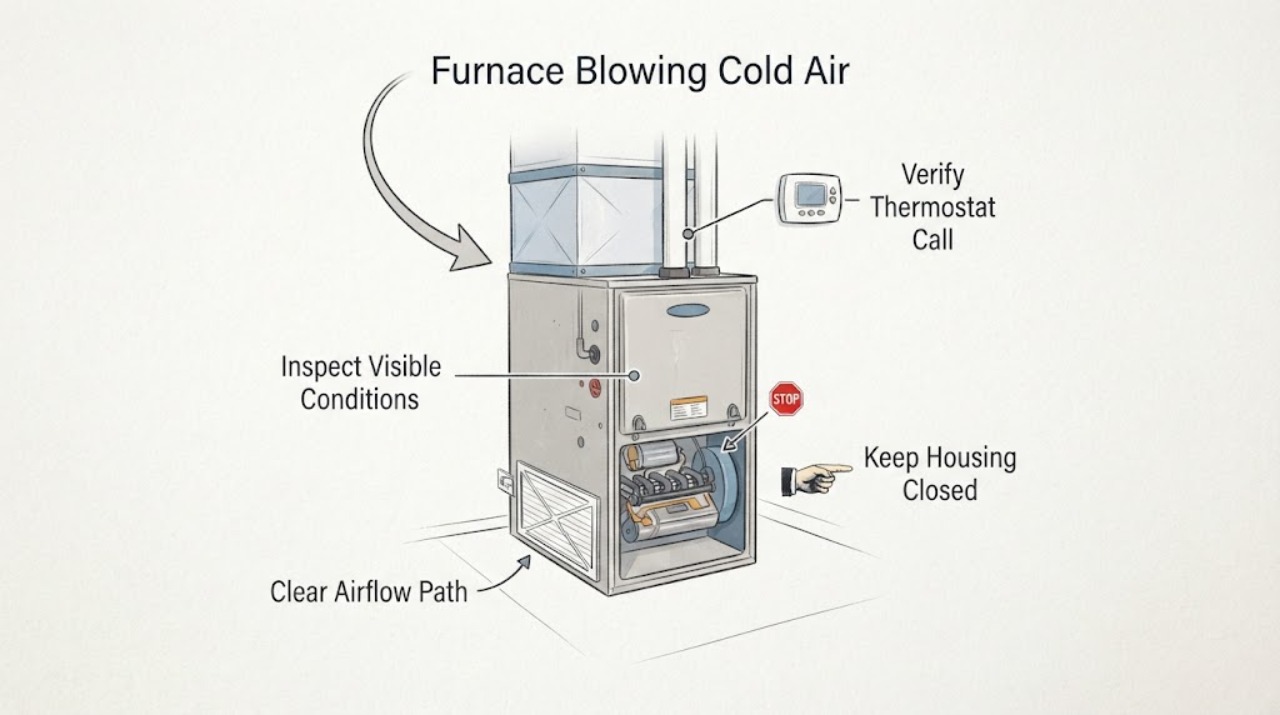
A brief cool stream when a Lennox furnace first starts can be air that was sitting in the ducts, but air that stays cold, turns cold after the burners light, or returns repeatedly means the heat cycle is not completing or the heat is not reaching the rooms. First confirm the thermostat is in Heat, the target is above room temperature, and the fan is set to Auto rather than On. Replace a dirty return-air filter only as the model permits and keep supply and return openings clear. From a safe position, note whether the furnace ignites and then shuts off, whether the blower runs with no heat, whether the thermostat or furnace shows an alert, and whether a high-efficiency unit has a condensate issue. A dirty flame sensor, low gas supply, blocked condensate path, restricted airflow, limit protection, ignition or control fault, or duct leakage can produce cold air. Do not open the furnace, clean or test a flame sensor, adjust gas controls, bypass a limit or pressure switch, or test live wiring. Arrange qualified HVAC service for persistent cold air, repeated ignition attempts, unusual flame, gas odor, smoke, or a safety shutdown.
Work through in order
Diagnostic checks
Use only checks that match the exact appliance or system and its official guide.
-
Check 1
Check the Lennox thermostat without opening it: confirm Heat mode, set the target above the room temperature, confirm the schedule is not overriding the call, and set the fan to Auto unless the manual says otherwise. Note any alert, blank display, or repeated call for heat.
Expected result: The thermostat was in the wrong mode or fan was On; the target is not above room temperature; the display shows an alert; or Heat and Auto are correct but the furnace still supplies cold air.
Next step: Correct only the setting that the exact thermostat manual describes and observe one normal call. If the call is correct or cold air persists, record the alert and continue with the external filter and airflow check; do not open the thermostat or furnace.
Stop if: Stop and arrange service for exposed or damaged thermostat wiring, a recurring alert, smoke, burning odor, gas odor, or a furnace that repeatedly starts and stops.
Why this matters
Why: A mode, schedule, or fan setting can move air without a completed heating call. A correct call with cold supply shifts attention to ignition, flame sensing, airflow protection, condensate, gas, control, or duct delivery rather than thermostat settings alone.
-
Check 2
Turn the system off before touching the filter. Inspect the return-air filter and visible supply and return openings. Replace a standard filter only from an accessible location and only with the size and airflow direction specified by the exact Lennox instructions; do not remove an equipment panel to reach it.
Expected result: The filter is visibly loaded, a return or supply opening is blocked, airflow is weak, or the filter and visible air path are clear while cold air remains.
Next step: Correct the accessible filter or opening issue and allow a normal heat call. If cold air, weak airflow, or a repeated shutdown remains, keep the furnace off and arrange qualified HVAC diagnosis.
Stop if: Do not run with a missing, wet, collapsed, or incorrectly installed filter; stop for a burning smell, smoke, water near the furnace, repeated breaker trips, or a panel that must be removed to continue.
Why this matters
Why: A dirty filter or restricted return can reduce airflow and cause the furnace to overheat and shut burners down on safety protection. A clear filter and air path make an internal limit, ignition, flame-sensing, condensate, control, or duct problem more likely.
-
Check 3
From outside the furnace cabinet and without looking through removed panels, note the sequence during one normal call: whether the inducer or ignition sound starts, whether warm air appears, whether burners appear to light only if visible through the model-approved viewing area, and whether the blower then continues with cold air. Do not reach into or open the heating compartment.
Expected result: The furnace never attempts ignition; burners light briefly and stop; the blower runs without warm air; the cycle repeatedly retries; or the furnace heats normally after a brief cool start.
Next step: Keep the equipment closed and record the timing, sound, visible status, and alert code for service. If the furnace heats normally after startup and no warning sign remains, monitor it without repeated cycling; return to service for recurrence.
Stop if: Do not relight a pilot unless the exact manual explicitly gives a safe procedure and there is no gas odor; stop immediately for yellow or unstable flame, flame rollout, smoke, gas odor, repeated ignition attempts, or a hot electrical smell.
Why this matters
Why: No ignition can point toward the thermostat, power, ignition, gas, pressure, or control path. Burners that light and stop make flame sensing, gas, or a safety control more plausible. A blower-only period can occur during a normal startup or purge, but persistent blower-only cold air indicates the heat cycle is not completing.
-
Check 4
If the Lennox furnace is a high-efficiency model, inspect only the visible condensate drain route and floor area for pooling water, an obvious external blockage, or a float-switch shutdown; do not disconnect tubing. Also inspect accessible duct sections for a visibly disconnected joint or hole without entering the furnace cabinet.
Expected result: Water is pooling, the visible drain route is blocked, the furnace is near a drain or condensate pump that is not operating, a duct is visibly disconnected, or no external issue is visible.
Next step: Turn the furnace off and arrange service for condensate water, a nonworking pump, repeated shutdown, or duct repair that requires access. Do not pour chemicals into a drain or tape a hot, inaccessible, or gas-related furnace component.
Stop if: Stop for water near electrical parts, a cracked drain or hose, combustion-air or flue damage, gas odor, carbon-monoxide alarm, smoke, or a duct or cabinet that is hot or unstable.
Why this matters
Why: Lennox notes that a blocked condensate line can deactivate burners, while duct leakage or a disconnected duct can make delivered air feel cold even when the furnace is producing heat. An external visual check cannot confirm a hidden blockage, float switch, heat exchanger, or sealed combustion fault.
-
Check 5
Record the complete Lennox model, thermostat mode and fan setting, filter condition, whether ignition occurs, how long warm air lasts, alert or fault text, visible condensate or duct observations, and any odor or sound. Photograph labels and visible conditions without removing panels.
Expected result: Cold air persists after a correct call and accessible filter check; burners repeatedly shut off; an alert returns; the blower runs without heat; or the furnace has a gas, combustion, electrical, water, or carbon-monoxide warning.
Next step: Keep the furnace off for persistent or unsafe symptoms and arrange qualified HVAC service. Provide the model, exact alert, sequence timing, filter result, and any safe photos so the technician can start with the correct manual and safety checks.
Stop if: Do not remove panels, clean a flame sensor, adjust gas pressure, bypass a limit or pressure switch, test live wiring, or repeatedly reset the furnace to clear a returning fault.
Why this matters
Why: The pattern indicates a heating-sequence, safety-control, airflow, condensate, gas, ignition, duct, or control diagnosis beyond ordinary homeowner checks. A part cannot be selected reliably from cold air alone.
Use your observations
Decision map
Find the observation that best matches what you see, then follow the next safe action.
-
PATH 01Next step
What you see
Do this next
Monitor the next normal cycle without repeated resets. Arrange service if the cool period becomes prolonged, recurs with burner shutdown, or is accompanied by weak airflow, odor, or an alert.
Why this path and its safety boundary
Why it matters: Cold duct air at startup is more likely than a heating fault when the furnace completes a normal call and no warning symptom returns.
-
PATH 02Next step
What you see
Do this next
Set the fan to Auto if appropriate and replace the accessible filter exactly as the manual specifies. Persistent cold air or repeated shutdown needs qualified diagnosis.
Why this path and its safety boundary
Why it matters: Fan settings or restricted airflow can make the blower run without useful heat; a dirty filter can contribute to overheating and safety shutdown.
-
PATH 03Next step
What you see
Do this next
Keep the cabinet closed, record the sequence and alert, and arrange qualified HVAC service. Do not clean or test the flame sensor or bypass a safety control.
Why this path and its safety boundary
Why it matters: Flame sensing, ignition, gas supply, airflow protection, condensate, or control issues are possible. Lennox identifies flame detection as a safety input that can stop the heating cycle.
-
PATH 04Next step
What you see
Do this next
Keep the furnace off if the fault repeats and arrange service with the exact alert and model. Do not adjust gas components, pressure switches, controls, or wiring.
Why this path and its safety boundary
Why it matters: Thermostat communication, power, ignition, gas, inducer or pressure proving, condensate, or control diagnosis is more likely than a simple filter issue.
-
PATH 05Next step
What you see
Do this next
Turn the system off for water or a recurring shutdown and arrange HVAC service; have accessible duct leakage evaluated if it requires opening the cabinet or altering combustion or flue components.
Why this path and its safety boundary
Why it matters: A condensate safety shutdown can stop burners, while a duct leak can lose warm air before it reaches the room. Neither external observation proves the internal fault or safe repair.
Helpful context
Understand the symptom
Cold at startup is not the same as cold throughout the call
When the furnace has been off, the first air through the ducts can feel cool until the heat exchanger and supply path warm. If the air never becomes warm, becomes cold after a short warm period, or the blower continues while burners are absent, the heating sequence is stopping or the heat is not being delivered. The useful observations are what the thermostat is calling for, whether ignition occurs, when the blower starts, and whether the pattern repeats.
A Lennox furnace can stop burners while leaving the blower running
Lennox explains that a dirty or unreliable flame detector can let burners ignite and then shut them down, and its furnace documentation describes a high-temperature limit opening the gas valve circuit while energizing the supply blower. That can feel like cold air even though the blower is operating. These are safety and combustion controls, not homeowner adjustment points. Record the pattern and leave internal diagnosis to a qualified technician.
Start with airflow and control checks that do not expose the furnace
Check the thermostat mode, target temperature, fan setting, schedule, and any displayed alert. Inspect the return filter and replace it only if its location and replacement are covered by the exact Lennox instructions; some filters are inside an access panel. Keep registers and the visible return path clear. Do not remove a furnace panel to reach a filter or component, and do not repeatedly reset a breaker or thermostat when a safety message or fault returns.
Safety boundary
Stop conditions
- Turn the furnace off for gas odor, yellow or unstable flame, suspected flame rollout, smoke, fire, a carbon-monoxide alarm, or a hot electrical or burning-plastic odor; leave the area and seek appropriate emergency help.
- Stop for repeated ignition attempts, lockouts, blower-only cold air, recurring alerts, water near electrical components, or a blocked or damaged condensate or flue path.
- Do not remove furnace panels, clean or test a flame sensor, adjust gas pressure, bypass a limit or pressure switch, test live wiring, or reset a returning safety fault repeatedly.
- Replace or inspect a filter only from the accessible location and procedure specified by the exact Lennox manual; do not run without a correctly installed filter.
- Arrange qualified service when the furnace stays cold after the thermostat and filter checks or when diagnosis requires combustion, gas, electrical, sealed heat-exchanger, condensate, or internal control access.
Only after diagnosis
Potential parts
- Lennox flame sensor or ignition assembly
Consider this part class only after qualified diagnosis confirms that flame sensing or ignition failure is causing burners to light briefly, shut off, or fail to establish heat.
Sensor, ignitor, connector, mounting, and furnace sequence vary by model; confirm the complete Lennox model and service documentation before ordering. - Lennox air filter or airflow component
Consider this part class only when the exact model identifies a replaceable filter or a qualified diagnosis confirms an airflow component is restricted or damaged after accessible filter and register checks.
Filter size, type, housing, blower configuration, and airflow ratings are model-specific; do not install a filter or component from appearance alone. - Lennox condensate drain, float, or control component
Consider this part class only when a qualified technician confirms a blocked or failed condensate safety path or control is stopping the burners after thermostat and airflow causes are ruled out.
Drain routing, float arrangement, control board, connectors, and safety logic vary by model; do not bypass a float or pressure safety device.
When checks do not resolve it
Need a professional?
Call qualified HVAC service when cold air persists after correct thermostat and accessible filter checks, burners light and stop, the blower runs without heat, alerts or lockouts recur, condensate water appears, airflow is weak, or duct or furnace access requires panel removal. Seek emergency help for gas odor, a carbon-monoxide alarm, smoke, fire, or suspected flame rollout.
Have this ready
- Complete Lennox model and serial information if visible without opening the furnace
- Thermostat mode, target, fan setting, schedule, and any alert or fault text
- Filter and visible register or return condition
- Whether ignition occurs, how long warm air lasts, and whether the blower continues afterward
- Condensate, duct, odor, sound, breaker, smoke, gas, or carbon-monoxide observations
Common questions
FAQ
Is a brief burst of cold air from a Lennox furnace normal?
It can be when the furnace has been off and cool air from the ducts is pushed out first. The air should become warm during a completed heat call. Persistent or repeated cold air, blower-only operation, ignition shutdown, or an alert needs diagnosis.
Why does my Lennox furnace blow warm air and then turn cold?
Burners may be shutting down while the blower continues. Lennox identifies flame sensing, airflow restriction, condensate, gas, limit protection, ignition, and controls as possible paths. Keep the cabinet closed, record the sequence, and arrange qualified HVAC service rather than cleaning or bypassing a safety component.
Can a dirty filter make a Lennox furnace blow cold air?
Yes. A restricted filter can reduce airflow, make the furnace overheat, and lead to a safety shutdown that leaves the blower moving cold air. Replace an accessible filter only with the size and airflow direction specified by the exact manual; persistent symptoms need service.
What thermostat settings should I check when a Lennox furnace blows cold?
Confirm Heat mode, a target above room temperature, the correct schedule, and fan Auto unless your exact manual says otherwise. If settings are correct but air stays cold, look for alerts and arrange service rather than opening the thermostat or furnace.
When should I stop using a Lennox furnace and call for service?
Stop for gas odor, yellow or unstable flame, smoke, burning electrical odor, a carbon-monoxide alarm, repeated ignition attempts, lockouts, water near electrical components, recurring alerts, or persistent blower-only cold air. Arrange qualified HVAC service for internal combustion, gas, electrical, limit, flame-sensing, condensate, or control diagnosis.
Read the exact guide
Official sources
- How to fix furnace blowing cold airLennox · Official Lennox consumer guidance used for startup-versus-continuous cold air, thermostat, filter, flame, gas, condensate, duct, and control branches; exact furnace documentation controls the procedure.
- Thermostat Not Turning Heat On? Here’s WhyLennox · Official Lennox consumer guidance used for thermostat and filter triage; exact thermostat model and furnace manual control reset and wiring procedures.
- C- Heating Components (FIGURE 13)Lennox · Official Lennox technical manual used to explain that a limit opening closes the gas valve and energizes the supply blower and that flame sensing controls the gas valve; the documented model family is not universal to every Lennox furnace.
- Understanding Furnace Flame Sensor BasicsLennox · Official Lennox consumer guidance used for flame-sensing symptom interpretation; the page is a Lennox regional-language path and the installed model's manual controls any service procedure.
- Lennox Air Filters | Air Filter Replacement | Lennox ResidentialLennox · Official Lennox filter guidance used for accessible filter checks; some filter locations require a panel or professional assistance, and the exact furnace manual controls.
Community feedback
Share a repair observation
Share a plain-text repair observation. Accepted observations are published automatically; this page may take a moment to update.