
On this page
Start here
Quick answer
Short cycling means a Lennox furnace starts and stops repeatedly before a normal heating cycle is complete, often leaving the home unevenly heated. Start with the thermostat setting and location, the furnace filter, and open return and supply paths; restricted airflow can make the furnace overheat and shut down. Note whether the burner lights briefly and drops out, whether the furnace stops after becoming hot, or whether it cycles off soon after reaching the thermostat setting. Those patterns can point to flame sensing or ignition, a limit or airflow issue, thermostat control, an oversized system, a coil or duct problem, or a blocked flue. Do not bypass a safety, adjust gas pressure, open the burner compartment, or repeatedly reset the furnace. Keep it off and arrange qualified HVAC service if short cycling continues after the filter and accessible airflow checks, or immediately for gas odor, carbon-monoxide alarm, smoke, soot, flame rollout, unusual heat, or damaged venting.
Before you begin
Safety first
- This article supports recording the cycle, checking thermostat settings and location, inspecting the accessible filter and grilles, and viewing safely accessible exterior vent conditions. It does not authorize panel removal, live electrical work, gas or blower adjustment, flame-sensor or burner service, vent alteration, or safety-control bypass.
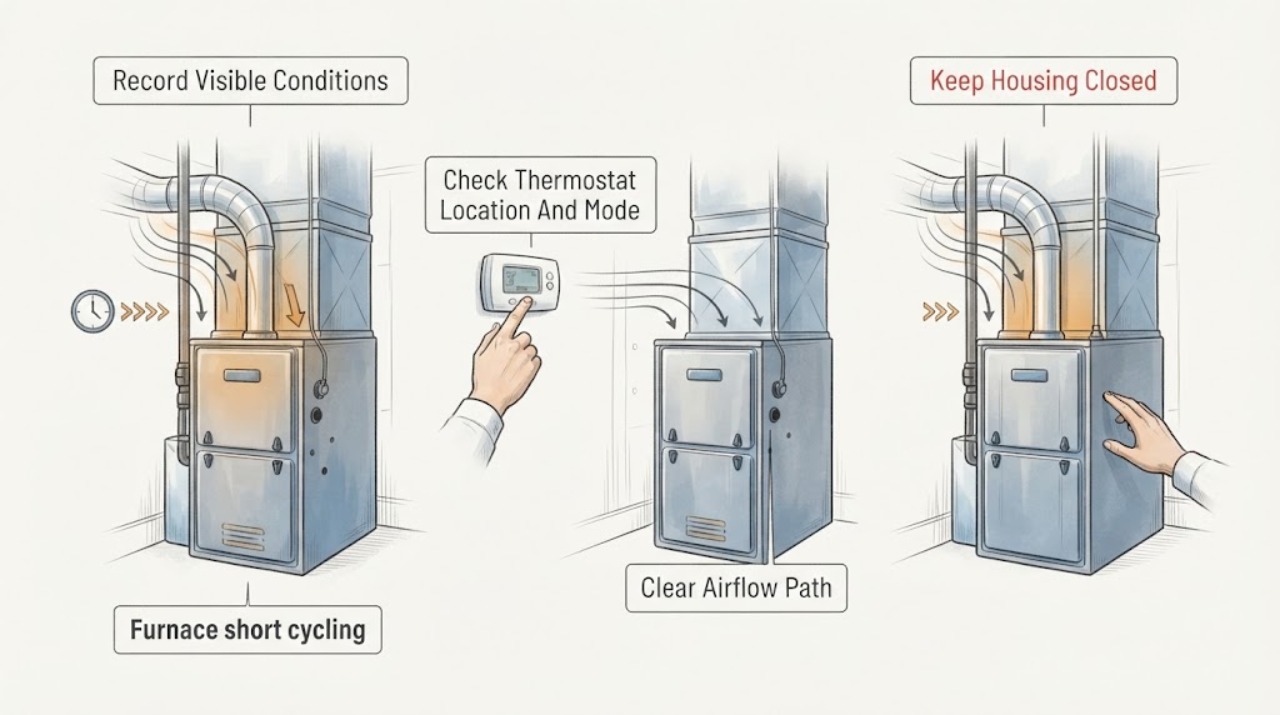
Work through in order
Diagnostic checks
Use only checks that match the exact appliance or system and its official guide.
-
Check 1
From a safe position, note whether the Lennox furnace turns off after the thermostat reaches its setting, shuts down while the home is still cool, restarts soon after stopping, or runs briefly after the burner lights; do not repeatedly cycle it to reproduce the symptom.
Expected result: The home is satisfied before shutdown, the furnace becomes hot before stopping, the burner lights and then goes out, the blower runs with no heat, or the unit enters repeated rapid starts and stops.
Next step: Record the timing, sounds, display indication, and whether the blower or burner was operating. Use the filter and accessible airflow checks only; keep the furnace off for repeated or unexplained short cycling.
Stop if: Stop immediately for gas odor, carbon-monoxide alarm, smoke, soot, flame rollout, sparking, unusual heat, or a damaged or blocked flue.
Why this matters
Why: A satisfied thermostat or oversized-system pattern differs from an interrupted heat sequence. Hot shutdown suggests airflow or a limit response; burner dropout suggests flame sensing, ignition, fuel, or safety control; blower-only operation can reflect fan mode or failed heat production.
-
Check 2
Check that the thermostat is in Heat, the fan is set as intended, and the temperature reading is not being affected by a draft, direct sun, supply register, cooking appliance, or other nearby heat source; do not open or rewire it.
Expected result: The thermostat is incorrectly set, the fan is forcing continuous circulation, the thermostat is near a draft or heat source, the displayed temperature differs markedly from the room, or its location and settings appear reasonable.
Next step: Correct only an obvious setting. Have a qualified technician assess wiring, calibration, placement, and compatibility if the thermostat reading or cycling remains abnormal.
Stop if: Do not bridge terminals, move the thermostat, change installer settings, or bypass a control to keep the furnace running.
Why this matters
Why: Incorrect mode or placement can make the furnace call too often or circulate unheated air. A reasonable setting with rapid cycling makes an airflow, safety, sizing, or internal control issue more likely.
-
Check 3
Turn the furnace off and inspect the air filter; check that return grilles and supply registers are open and unobstructed, and that furniture or stored material is not blocking the air path.
Expected result: The filter is dirty, returns or registers are blocked, airflow is weak or uneven, or the filter and accessible air paths are clear while short cycling continues.
Next step: Replace or clean the filter using the model's specified type and orientation, reopen blocked grilles, and refit covers. If the cycle still ends early or airflow remains weak, leave the furnace off and arrange HVAC service.
Stop if: Never operate without the required filter or access doors, and do not enter the blower compartment, clean a coil, or adjust blower speed as a homeowner short-cycle fix.
Why this matters
Why: A dirty filter or restricted duct path can reduce airflow, cause overheating, and make the furnace cycle off before the home is heated. Clear filter and open grilles with continued cycling points toward ducts, coil, blower, limit, thermostat, sizing, or another internal condition.
-
Check 4
From ground level and without climbing or inserting anything, inspect any safely visible flue or intake termination and the furnace surroundings for leaves, snow, nests, corrosion, holes, or other blockage; keep combustibles away from the furnace.
Expected result: A flue or intake is blocked, damaged, or corroded, the furnace area is crowded, water or soot is visible, or the exterior appears clear.
Next step: Keep the furnace off for any questionable vent, intake, soot, water, or combustion condition and arrange qualified HVAC inspection. Move only loose, safe-to-move storage away from the unit.
Stop if: Do not climb to a roof termination, seal or reroute venting, remove panels, reset a safety control, or operate with damaged or blocked venting.
Why this matters
Why: A blocked flue can cause the furnace to shut down through a pressure or safety response, while corrosion, soot, water, or damage can indicate a combustion or venting problem. A clear exterior does not rule out an internal restriction.
-
Check 5
Compare the short-cycle pattern across ordinary heating demands and rooms: note whether the thermostat is satisfied quickly while the house is otherwise comfortable, or whether the furnace cycles with cold rooms, uneven temperatures, weak airflow, or a safety symptom; do not alter the furnace size or controls.
Expected result: The furnace shuts off only after quickly satisfying the thermostat, or it short-cycles while the thermostat still calls for heat and the home remains cold or uneven.
Next step: Ask a qualified HVAC technician to verify system sizing, thermostat placement, airflow, temperature rise, safety operation, and the heating sequence; do not change controls or replace the furnace based on cycle timing alone.
Stop if: Do not increase the thermostat setting to force a longer cycle, disable a limit, change gas or blower settings, or operate through repeated lockouts.
Why this matters
Why: Rapid thermostat satisfaction can make improper sizing or thermostat sensing more likely. Short cycling before the call is satisfied points more toward airflow, overheating, flame sensing, flue, ignition, control, or another operating fault.
-
Check 6
Before returning the furnace to normal use, review the thermostat, filter and airflow, flue, room-temperature, and cycle-sequence observations; keep it off if short cycling persists after permitted checks or if an internal component or safety would need access.
Expected result: Cycling stops after an allowed filter, grille, or setting correction with no safety sign, or rapid cycling returns, a breaker trips, the burner drops out, the unit overheats, or a service panel would need to be opened.
Next step: Arrange qualified HVAC service and provide the model, cycle timing, thermostat state, filter and airflow findings, flue observations, room comfort pattern, and any code or alarm. Do not keep restarting to maintain heat.
Stop if: Do not remove panels, clean or replace a flame sensor, adjust gas pressure, alter blower settings, test live wiring, or bypass a safety control.
Why this matters
Why: A simple airflow or thermostat issue may have been corrected, but recurrence indicates an unresolved filter/duct, thermostat, sizing, flame-sensor, flue, ignition, limit, blower, or control problem.
Use your observations
Decision map
Find the observation that best matches what you see, then follow the next safe action.
-
PATH 01Next step
What you see
The furnace shuts off soon after starting because the thermostat reaches its setting, while the home is otherwise comfortable and there is no overheating or safety symptom.
Do this next
Check only the thermostat mode and nearby drafts or heat sources. Arrange a qualified assessment of thermostat placement, calibration, airflow, and furnace sizing rather than changing settings to force longer cycles.
Why this path and its safety boundary
Why it matters: Thermostat placement or calibration, system sizing, or an unusually concentrated heat source is more likely than a burner or limit failure.
-
PATH 02Safety boundary
What you see
The furnace stops while the thermostat still calls for heat, airflow is weak or uneven, and the filter, return, register, duct, or coil path shows restriction.
Do this next
Turn the furnace off, correct only the accessible filter or blocked grille condition, and keep it off if the cycle repeats. Have a qualified technician inspect ducts, coil, blower, temperature rise, and limit operation.
Why this path and its safety boundary
Why it matters: Restricted airflow can cause the furnace to overheat and cycle off before the thermostat is satisfied.
Safety stop: Do not operate without the filter, close additional registers, alter blower speed, or bypass a limit control.
-
PATH 03Safety boundary
What you see
The burners light briefly and then go out, the blower may continue with cool air, and the furnace attempts to restart or locks out.
Do this next
Keep the furnace off, record any code and the sequence, and arrange qualified HVAC diagnosis. Do not open the burner compartment or clean, reposition, or bypass the sensor yourself.
Why this path and its safety boundary
Why it matters: Lennox identifies a dirty or failing flame sensor as a possible reason the control shuts off gas after it cannot confirm the flame; ignition, fuel, burner, or another safety condition can look similar.
Safety stop: Do not repeat ignition attempts, relight a pilot without exact model instructions, alter gas controls, or defeat flame or safety monitoring.
-
PATH 04Safety boundary
What you see
A visible flue or intake is blocked or damaged, or short cycling is accompanied by soot, unusual heat, a safety lockout, water, or a combustion concern.
Do this next
Keep the furnace off and arrange qualified HVAC inspection. Leave the area and use emergency or gas-utility guidance for gas odor or a carbon-monoxide alarm.
Why this path and its safety boundary
Why it matters: A flue or combustion-air restriction can interrupt safe operation; soot, water, or unusual heat raises the urgency beyond an airflow adjustment.
Safety stop: Do not climb, insert objects into the vent, seal the opening, reset the lockout repeatedly, or operate until the cause is corrected.
-
PATH 05Safety boundary
What you see
Short cycling remains after the filter, accessible airflow, thermostat setting, and exterior observations are normal, or there is a breaker trip, gas odor, carbon-monoxide alarm, smoke, sparking, flame rollout, or unusual heat.
Do this next
Stop operating the furnace and arrange qualified HVAC service. For gas odor, carbon-monoxide alarm, smoke, or fire danger, leave immediately and contact emergency services or the gas utility from a safe location.
Why this path and its safety boundary
Why it matters: An internal control, blower, limit, flame, ignition, sizing, electrical, heat-exchanger, or combustion fault remains possible; hazardous symptoms require immediate action.
Safety stop: Do not restore operation to test the furnace, open panels, change gas or electrical settings, or bypass a safety device.
Helpful context
Understand the symptom
First identify what ends the cycle
A Lennox furnace that shuts off soon after reaching the thermostat setting may be responding to a control or sizing condition. One that shuts down while the home is still cold, then restarts after a short pause, is more consistent with an interrupted heating process. If the burners light for a few seconds and go out, flame sensing or ignition is more relevant; if the furnace becomes very hot before the blower or burner stops, airflow or a limit response needs attention.
Use the filter and air paths as the safe starting point
Lennox advises starting short-cycle troubleshooting with the filter and airflow. With the furnace off, inspect the filter, open blocked registers and returns, and keep the furnace area clear. Do not run without the correct filter. A clean filter does not prove the ducts, coil, blower, flue, or internal safety controls are healthy; persistent cycling requires service.
Do not confuse a safety shutdown with a solution
A flame sensor, limit control, pressure or flue condition, or another safety can stop the heating sequence to prevent a dangerous condition. Lennox also notes that a furnace that is too large for the home can short-cycle, which is an installation or sizing matter rather than a filter repair. Do not bypass a safety or keep restarting the unit to make it heat temporarily.
Safety boundary
Stop conditions
- Do not keep operating a Lennox furnace that short-cycles before the thermostat is satisfied, especially when it becomes hot, leaves rooms cold, or repeatedly locks out.
- Stop immediately for gas odor, carbon-monoxide alarm, smoke, soot, flame rollout, sparking, unusual heat, water near electrical components, or blocked, damaged, or corroded venting.
- Do not bypass or reset a limit, flame, rollout, pressure, door, or other safety to extend a cycle, and do not repeatedly restart after a lockout.
- Do not open the burner or blower compartment, adjust gas or blower settings, test live wiring, clean internal coils or flues, or replace a flame sensor, limit, motor, or control as a homeowner check.
- Never operate the furnace without its required filter, doors, or covers; arrange qualified HVAC service when accessible checks do not stop the short cycling.
Only after diagnosis
Potential parts
- Lennox furnace flame sensor
Consider this category only when qualified testing identifies flame-sensing failure as the reason burners ignite briefly and then shut down after airflow and other causes are evaluated.
Confirm the exact Lennox model and technician diagnosis before ordering; do not bypass or handle a flame-safety component as a shortcut. - Lennox furnace limit or safety control
Consider this category only when qualified diagnosis confirms a failed limit or safety control after the cause of overheating, restricted airflow, or abnormal combustion has been identified.
Confirm the exact model and root-cause diagnosis before ordering; a safety control must never be bypassed or replaced without correcting the condition that trips it. - Lennox furnace blower motor or capacitor
Consider this category only when service identifies a blower motor or capacitor fault contributing to weak airflow, overheating, or short cycling after filter and duct checks.
Confirm the exact model, motor, capacitor rating, and mounting details before ordering; electrical and airflow verification require qualified service.
When checks do not resolve it
Need a professional?
Arrange qualified HVAC service when short cycling continues after the thermostat, filter, grille, and safe exterior checks, when the burner lights and drops out, the furnace overheats or locks out, a flue or combustion-air path is questionable, the thermostat appears miscalibrated, or system sizing, blower, limit, flame sensor, ignition, electrical, gas, or control access would be required. Leave immediately and use emergency or gas-utility help for gas odor, a carbon-monoxide alarm, smoke, fire, or flame rollout.
Safety scope: This article supports recording the cycle, checking thermostat settings and location, inspecting the accessible filter and grilles, and viewing safely accessible exterior vent conditions. It does not authorize panel removal, live electrical work, gas or blower adjustment, flame-sensor or burner service, vent alteration, or safety-control bypass.
Common questions
FAQ
What does short cycling mean on a Lennox furnace?
It means the furnace turns on and off repeatedly before completing a normal heating process, often while the thermostat still calls for heat. Dirty filters or blocked airflow, thermostat faults, flame sensing, a clogged flue, and improper sizing are different possibilities; start with the accessible filter and airflow checks, then call for service if it continues.
Can a dirty filter cause my Lennox furnace to short cycle?
Yes. Restricted airflow can make the furnace overheat and shut down before the thermostat is satisfied. Turn the furnace off, inspect and correctly replace or clean the filter, and open blocked returns or registers. If short cycling returns, keep the furnace off and have the ducts, blower, coil, and limit operation checked.
Why does my Lennox furnace light and then shut off?
A flame sensor may fail to confirm the flame, but ignition, fuel, burner, venting, or another safety condition can look similar. Keep the furnace off, record the sequence or code, and arrange qualified HVAC diagnosis. Do not open the burner compartment, adjust gas, or bypass flame monitoring.
Can an oversized Lennox furnace cause short cycling?
Yes. Lennox explains that an oversized furnace can heat the space quickly and shut off before a full cycle is complete. A technician should verify thermostat placement, airflow, and perform a proper load and sizing assessment; do not change controls or replace the furnace based on cycle timing alone.
Read the exact guide
Official sources
- Thermostat Replacement GuideLennox · Used for thermostat-related short-cycle patterns; wiring, relocation, and compatibility require qualified installation.
- Furnace Short Cycling: Causes & SolutionsLennox · Used for the core short-cycling diagnosis; exact equipment model, installation, and local professional guidance control.
- Calculating Furnace Size for Your Home NeedsLennox · Used for the thermostat-satisfied-too-quickly branch; sizing requires professional load calculation and is not a homeowner adjustment.
- Understanding Furnace Flame Sensor BasicsLennox · Used for burner-ignition dropout and repeated short-cycle branches; sensor access and repair remain professional work.
- What to Do If Your Furnace Has a Cracked Heat ExchangerLennox · Used for safety escalation only; a short-cycle symptom does not establish a cracked heat exchanger, which requires qualified inspection.
Community feedback
Share a repair observation
Share a plain-text repair observation. Accepted observations are published automatically; this page may take a moment to update.