
On this page
Start here
Quick answer
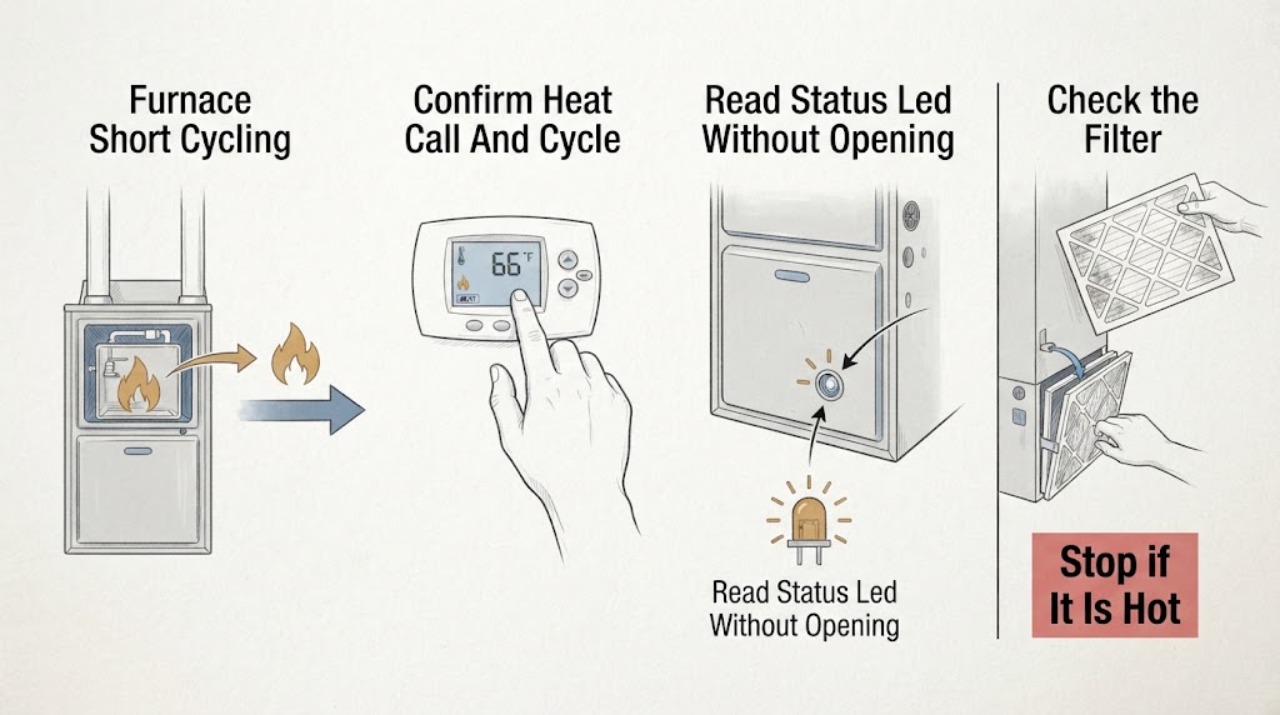
A Lennox G61MP-36B-045-06 that repeatedly shuts its burners off before the thermostat is satisfied should be treated as a fault until you distinguish a normal blower delay or two-stage transition from a true short cycle. The opened Lennox G61MP installation manual is for the G61MP series and lists the G61MP-36B-045 family; use the furnace nameplate and Lennox model-specific data for any suffix-specific service values. From a safe position, note whether the thermostat still calls for heat, whether the blower continues after the burners stop, whether the filter and return/supply paths are unobstructed, and whether the control LED shows a repeatable code. A 3+1 limit code or 4+5 limit watchguard pattern makes an airflow, temperature-rise, limit, or related service fault more likely; pressure-switch, flame, rollout, low-voltage, or grounding codes need qualified HVAC diagnosis. Do not open the burner compartment, adjust gas pressure, test combustion, bypass a limit or rollout switch, or repeatedly reset a lockout. Turn the furnace off and leave the building if a CO alarm sounds, anyone has headache, dizziness, nausea, confusion, or unusual fatigue, or you smell gas; call emergency services or the gas supplier from outside. Arrange a licensed HVAC professional when short cycling returns after a filter/path check, any safety code appears, venting or combustion air looks obstructed, or internal electrical, gas, pressure, limit, flame, or heat-exchanger work is needed.
Work through in order
Diagnostic checks
Use only checks that match the exact appliance or system and its official guide.
-
Check 1
Set the thermostat to a normal heat demand and observe one cycle from a safe position without removing panels. Note whether the burners stop while the thermostat still calls for heat, whether the blower continues afterward, how the thermostat call changes, and whether the behavior repeats.
Expected result: The thermostat is satisfied before shutdown, the thermostat still calls for heat when burners stop, the blower runs through a delay after burner shutdown, or the furnace restarts several times during one call.
Next step: Record the approximate burner-on time, blower behavior, thermostat mode, and any LED pattern. If the unit repeatedly cycles before satisfying the call, turn heat off at the thermostat and arrange HVAC service after the safe visual checks.
Stop if: Stop the observation for gas odor, smoke, unusual flame noise, a CO alarm, symptoms of CO exposure, a hot or damaged cabinet, or any uncontrolled electrical or combustion behavior.
Why this matters
Why: A satisfied call followed by a blower or inducer delay can be normal G61MP sequence behavior. Burner shutdown during an active call is more consistent with a limit, pressure, flame, rollout, control, or airflow interruption. Repeated restarts during one call are the short-cycle symptom; the timing alone does not identify the failed component.
-
Check 2
If the G61MP status LED can be seen through the normal user-accessible indication point, observe the complete repeating flash pattern without opening an energized compartment or defeating an access-door switch. Write the flashes as X + Y and compare them with the exact G61MP manual.
Expected result: The LED shows normal pulse or heartbeat behavior, 3 + 1, 4 + 5, a pressure-switch code beginning with 2, a flame or watchguard code, a rollout code, or an unreadable/intermittent pattern.
Next step: Photograph or write the exact pattern, then turn the heat demand off. For a limit, pressure, rollout, flame, watchguard, grounding, or repeated retry code, leave the furnace off and give the code to a licensed HVAC professional.
Stop if: Do not remove the burner or blower access panel to read a code, bridge thermostat or safety terminals, reset a rollout switch, or keep restarting the furnace to make the LED repeat.
Why this matters
Why: The Lennox manual identifies pulse and heartbeat states as operating indications, 3 + 1 as a limit switch open, 4 + 5 as a limit watchguard state, 2-series codes as pressure-switch conditions, and 5 + 1 as a rollout circuit condition. A code narrows the service path but does not authorize a homeowner to reset, bypass, or test the control.
-
Check 3
With the furnace off and cool, inspect the homeowner-accessible filter, return grille, supply registers, and nearby cabinet area. Confirm the filter is the correct type and seated as installed, return grilles are not covered, and supply registers are open; do not reach into the blower or burner sections.
Expected result: The filter is visibly loaded, collapsed, wet, missing, or incorrectly seated; return or supply openings are blocked; or the accessible air path looks clear.
Next step: Correct only a clearly obstructed register or replace a visibly unsuitable filter with the exact size and type specified for the installation, then allow one supervised test. If the short cycle or safety code returns, leave the heat off and call HVAC service.
Stop if: Do not operate without the required filter, stack filters, seal a return opening with improvised material, remove ductwork, or continue if the filter is wet, the cabinet overheats, or airflow is dangerously weak.
Why this matters
Why: Restricted return or supply airflow can raise furnace temperature and contribute to a limit opening, while a clear visible path does not rule out duct restriction, blower performance, coil blockage, incorrect filter resistance, or an internal fault. A 3 + 1 or 4 + 5 pattern alongside an airflow restriction makes an HVAC airflow and temperature-rise check especially important.
-
Check 4
From outside and without dismantling anything, check that the G61MP combustion-air intake and exhaust termination are not visibly blocked by snow, leaves, nests, stored items, or a disconnected or sagging pipe. Inside, keep the furnace room's air grilles and combustion-air openings unobstructed.
Expected result: An intake or exhaust termination is blocked, the vent is cracked, sagging, disconnected, or wet with an unexplained change; a combustion-air grille is covered; or the visible terminations are clear and intact.
Next step: Do not enter the vent or intake and do not seal or reconfigure pipe. Keep the furnace off when a blockage, cracked or disconnected vent, water damage, or combustion-air restriction is present and arrange HVAC inspection.
Stop if: Stop immediately for flue-gas odor, soot, water in the cabinet, a disconnected vent, a blocked termination that cannot be cleared safely from ground level, or any CO alarm or symptoms.
Why this matters
Why: The Lennox manual links unobstructed combustion air and sound venting to safe operation and lists pressure-switch and limit behavior in the heating sequence. A visible obstruction or damaged vent can explain cycling but must be assessed by a qualified technician; a clear exterior does not prove the internal vent, condensate path, pressure tubing, or combustion process is safe.
-
Check 5
Review only the thermostat's visible heat, fan, and stage settings; do not change furnace DIP switches or wiring. Note whether the thermostat is configured for single-stage or two-stage heat, whether it is calling continuously, and whether the blower changes speed or continues during the burner-off interval.
Expected result: The thermostat call is satisfied normally, the fan is set to ON, a second-stage request appears, the blower changes speed before shutdown, or the burner stops while the call remains active.
Next step: Return the thermostat to the homeowner's intended settings, do not alter furnace controls, and correlate the thermostat call with the LED code and cycle timing. Give those observations to the HVAC technician if the furnace still cycles.
Stop if: Do not jumper R, W1, W2, or other terminals, alter DIP switches, defeat the blower-door interlock, or test low-voltage signals unless trained and equipped for HVAC service.
Why this matters
Why: A fan-ON setting or a G61MP blower delay can be mistaken for short cycling. The manual describes staged heat and different blower behavior after first- and second-stage demand. Burner shutdown with an active call remains abnormal even if the blower continues; a stage mismatch, thermostat configuration, or low-voltage issue can require professional testing.
-
Check 6
After only a clear, low-risk correction such as restoring a blocked register or installing the exact required filter, make one supervised heat call. Stay near the thermostat and furnace, watch the LED and blower, and stop the call at the first abnormal pattern.
Expected result: The furnace completes the call without a safety code, the burner stops early again, the same code returns, the unit enters watchguard/lockout, or a vent, flame, odor, noise, or CO concern appears.
Next step: Turn the heat demand off, leave the furnace off for recurring or coded faults, and arrange licensed HVAC service. Provide the exact model and serial number, LED pattern, thermostat state, filter and airflow observations, vent observations, and cycle timing.
Stop if: Do not repeat the test after a failed cycle, reset a safety lockout repeatedly, or operate the furnace when a CO alarm, gas odor, rollout indication, damaged vent, soot, or symptoms are present.
Why this matters
Why: A single normal call after an obvious airflow correction supports that restriction as a contributor but does not prove the furnace is fully safe. Early shutdown, repeated code, watchguard, lockout, or combustion concern means the underlying fault remains and may involve a limit, pressure switch, inducer, flame-sensing, gas, vent, control, or heat-exchanger condition.
Use your observations
Decision map
Find the observation that best matches what you see, then follow the next safe action.
-
PATH 01Next step
What you see
The thermostat satisfies the heat call, the gas burners turn off, the blower or inducer continues for its documented delay, and no abnormal LED code repeats.
Do this next
Record the behavior as normal only if the home reaches the setpoint and the sequence remains repeatable. Use the exact Lennox manual and HVAC service if the thermostat is not satisfied or the pattern changes.
Why this path and its safety boundary
Why it matters: This is more consistent with the G61MP heating sequence, two-stage transition, post-purge, or blower off delay than with a true short cycle.
-
PATH 02Next step
What you see
Burners stop while the thermostat still calls for heat and the LED repeats 3 + 1 or 4 + 5, especially with a loaded filter, weak airflow, blocked registers, or an overheating cabinet.
Do this next
Turn the furnace off after the safe visual checks, do not bypass or reset the limit, and arrange licensed HVAC diagnosis.
Why this path and its safety boundary
Why it matters: A limit circuit or temperature/airflow problem is more likely. A visible restriction is only one possible contributor; blower performance, duct/static pressure, temperature rise, limit wiring, and internal conditions require professional measurements.
-
PATH 03Next step
What you see
The furnace starts and stops during an active call with a 2-series pressure-switch code, a blocked or damaged intake/exhaust, water or a disconnected vent, or repeated retry behavior.
Do this next
Keep the furnace off and have a qualified HVAC technician inspect the complete vent, combustion-air, condensate, inducer, pressure-switch circuit, and related controls. Do not probe tubing or adjust gas operation.
Why this path and its safety boundary
Why it matters: The combustion-air, vent, inducer, condensate, pressure tubing, or pressure-switch sequence may not be proving safely. A clear outside termination does not rule out an internal obstruction or measurement fault.
-
PATH 04Next step
What you see
A 5 + 1 rollout code appears, flame behavior is abnormal, soot or flue-gas odor is present, a CO alarm sounds, or occupants have headache, dizziness, nausea, confusion, or unusual fatigue.
Do this next
Leave the building if a CO alarm, gas odor, or symptoms are present and seek emergency help from outside. Do not re-enter or restart the furnace until emergency responders or qualified HVAC/gas professionals say it is safe.
Why this path and its safety boundary
Why it matters: This is a combustion and life-safety event, not a homeowner short-cycle adjustment. Fuel-burning furnace malfunction or venting failure can expose occupants to carbon monoxide.
-
PATH 05Next step
What you see
The thermostat still calls for heat, burners shut down early, the LED shows no clear code, and the filter, registers, visible return path, and exterior terminations appear clear.
Do this next
Leave the furnace off if the pattern repeats and provide the exact G61MP-36B-045-06 nameplate, cycle timing, thermostat state, and observations to a licensed HVAC professional.
Why this path and its safety boundary
Why it matters: A clear homeowner-visible path does not clear the furnace. Thermostat staging, blower speed, temperature rise, low-voltage controls, flame proving, pressure sequence, gas input, limit behavior, or an internal heat-exchanger issue may still be involved.
Helpful context
Understand the symptom
First decide whether this is a true short cycle
On this two-stage G61MP family, the indoor blower and combustion inducer do not necessarily stop at the same moment as the gas valve. The manual describes first-stage and second-stage heating, recognition delays, post-purge, and blower off delays. A burner that turns off after the thermostat is satisfied can be normal. A burner that shuts off while the thermostat still calls for heat, then restarts repeatedly or produces a limit/watchguard code, is the pattern that needs diagnosis.
The G61MP manual is a series reference, not a license to adjust combustion
The official Lennox document opened for this job is the G61MP series installation manual and lists the G61MP-36B-045 family; it does not provide a separate homeowner procedure for every -06 suffix. Keep the exact nameplate model and serial number with the service request. The checks below stay at visible, low-risk observations; gas pressure, temperature-rise measurement, combustion analysis, pressure-switch testing, limit diagnosis, and heat-exchanger work belong to a licensed HVAC technician.
Do not trade a safety control for longer run time
A limit or rollout control opening can protect against unsafe temperature or combustion conditions. A jumper, forced thermostat call, repeated power cycling, or a defeated access-door interlock can hide the cause. Keep combustion air grilles, vent terminations, and furnace access areas clear, but do not open the burner compartment or alter gas, wiring, or safety controls.
Safety boundary
Stop conditions
- Turn the furnace off and leave the building for a CO alarm, gas odor, smoke, soot, suspected flue-gas leakage, or headache, dizziness, nausea, confusion, unusual fatigue, or other possible CO symptoms; seek emergency help from outside.
- Do not open the burner compartment, adjust gas pressure, measure combustion, probe pressure tubing, bypass a limit or rollout switch, alter DIP switches or thermostat wiring, or defeat an access-door interlock.
- Do not repeatedly reset a rollout, watchguard, or lockout condition, and do not keep operating after a 3 + 1 limit code, 4 + 5 limit watchguard, pressure-switch code, rollout code, damaged vent, or repeated early shutdown.
- After one supervised retest following a clearly corrected visible airflow restriction, stop and call a licensed HVAC professional if short cycling returns, no safe cause is visible, or any internal electrical, gas, vent, pressure, flame, limit, or heat-exchanger diagnosis is needed.
Only after diagnosis
Potential parts
- exact-model air filter
Consider this only if the installed filter is visibly loaded, damaged, missing, or not the size/type specified for the actual installation, and a technician or the installation documentation confirms the replacement.
Confirm the complete nameplate model, filter dimensions, installation orientation, and system requirements; a filter change does not prove or repair an internal limit or airflow fault. - exact-model primary or secondary limit control
Consider this only after a licensed HVAC diagnosis confirms a failed limit control rather than an airflow, temperature-rise, vent, blower, wiring, or combustion cause associated with a limit code.
Verify the exact G61MP-36B-045-06 nameplate and control specification; never substitute, jumper, or change a safety limit based only on appearance.
When checks do not resolve it
Need a professional?
Arrange licensed HVAC service when the Lennox G61MP-36B-045-06 short-cycles during an active heat call, any status code repeats, the filter and visible airflow path are clear but the fault persists, the vent or combustion-air path is damaged or obstructed, the thermostat staging is uncertain, or testing would involve gas pressure, combustion, electrical controls, pressure switches, limits, rollout devices, the inducer, blower, or heat exchanger. Leave the furnace off for safety-code or combustion concerns.
Common questions
FAQ
What counts as short cycling on a Lennox G61MP-36B-045-06?
The useful distinction is whether the burners stop while the thermostat still calls for heat and then restart repeatedly during that same call. A burner shutdown after the thermostat is satisfied, followed by the model's blower or inducer delay, can be normal. Record the thermostat state and LED pattern rather than relying on a fixed time threshold.
What does a 3 + 1 code mean on the G61MP?
The opened Lennox G61MP series manual labels 3 + 1 as a limit switch open condition. It does not identify a single homeowner-replaceable cause: airflow restriction, temperature-rise, blower, wiring, limit, or another internal condition may be involved. Turn the furnace off and have a licensed HVAC technician diagnose it; do not bypass or repeatedly reset the limit.
Could a dirty filter cause this Lennox furnace to short cycle?
A loaded or incorrect filter can restrict airflow and contribute to overheating and a limit opening, but a clear filter does not rule out duct, blower, coil, temperature-rise, control, or combustion faults. Check only the accessible filter and registers, then use the LED pattern and professional measurements to identify the cause.
Why does the blower keep running after the burners stop?
The G61MP heating sequence includes blower delays and post-purge behavior, so a blower continuing after burner shutdown is not by itself proof of a fault. If the thermostat still calls for heat, the burners restart repeatedly, or a limit/watchguard code appears, treat it as abnormal and stop repeated operation.
When is a short-cycling G61MP furnace an emergency?
Leave the building and seek emergency help from outside for a CO alarm, gas odor, smoke, soot, suspected flue-gas leakage, rollout indication, or possible CO symptoms such as headache, dizziness, nausea, confusion, or unusual fatigue. For any recurring safety code or unexplained short cycle without those signs, leave the furnace off and arrange licensed HVAC service.
Read the exact guide
Official sources
- PRODUCT LITERATURELennox International Inc. · Official Lennox literature portal; use it to verify the exact nameplate model and current or archived product documentation before service.
- Furnace Safety Fact SheetCenters for Disease Control and Prevention · CDC public-health furnace safety guidance; it does not diagnose the Lennox model or replace HVAC service.
- 506406Lennox Industries Inc. · Official Lennox G61MP series installation manual opened for this job; it lists the G61MP-36B-045 family, while the exact -06 suffix and nameplate-specific service data must be confirmed before repair.
- Protect Your Family from Carbon Monoxide PoisoningU.S. Consumer Product Safety Commission · CPSC consumer-safety guidance for fuel-burning heating systems; emergency response and local requirements also apply.
Community feedback
Share a repair observation
Share a plain-text repair observation. Accepted observations are published automatically; this page may take a moment to update.