
On this page
Start here
Quick answer
If a Lennox furnace will not start, first check for gas odor, a carbon-monoxide alarm, smoke, soot, or an abnormal flame and leave the home for danger signs. Otherwise confirm the thermostat is active and calling for heat, check the furnace switch and breaker from a safe position, and replace or clean the filter only as the exact model instructions allow. Make sure accessible supply and return grilles are open and that exterior intake or exhaust terminations are not obviously blocked. From outside the cabinet, note whether the furnace is silent, starts an inducer, attempts ignition, lights and loses flame, or shows an alert. Lennox documentation identifies dirty filters, blocked flues, pressure-switch or condensate conditions, ignition lockout, and rollout protection as possible reasons for a furnace to stop or refuse a start. Do not open the burner or control compartment, adjust gas pressure, bypass a safety, test live wiring, or keep resetting the unit. If the breaker trips, a fault repeats, ignition fails, the blower does not start, or the home remains cold after the safe checks, keep the furnace off and arrange qualified HVAC service.
Before you begin
Safety first
- Homeowner checks should remain outside the cabinet and be limited to thermostat settings and batteries, safe visual power checks, a model-correct filter, accessible grilles, external intake or exhaust observations, and alert documentation. A qualified technician should inspect ignition, flame sensing, gas and combustion safety, pressure and venting, heat exchanger, blower and inducer, controls, limits, rollout protection, and condensate as applicable.
Work through in order
Diagnostic checks
Use only checks that match the exact appliance or system and its official guide.
-
Check 1
Leave immediately if there is a strong gas odor, carbon-monoxide alarm, smoke, soot, flame outside the burner area, or symptoms such as headache, dizziness, weakness, nausea, chest pain, or confusion; do not operate switches or use flames inside.
Expected result: No combustion or illness warning is present, or a gas, carbon-monoxide, smoke, soot, flame, or illness warning is present.
Next step: For any danger sign, get everyone outside and contact emergency services or the gas utility from a safe location; keep the furnace off until qualified personnel clear it. Otherwise continue only with external checks.
Why this matters
Why: A furnace that will not start may be protecting occupants from a combustion or venting problem, and that hazard takes priority over restoring heat.
-
Check 2
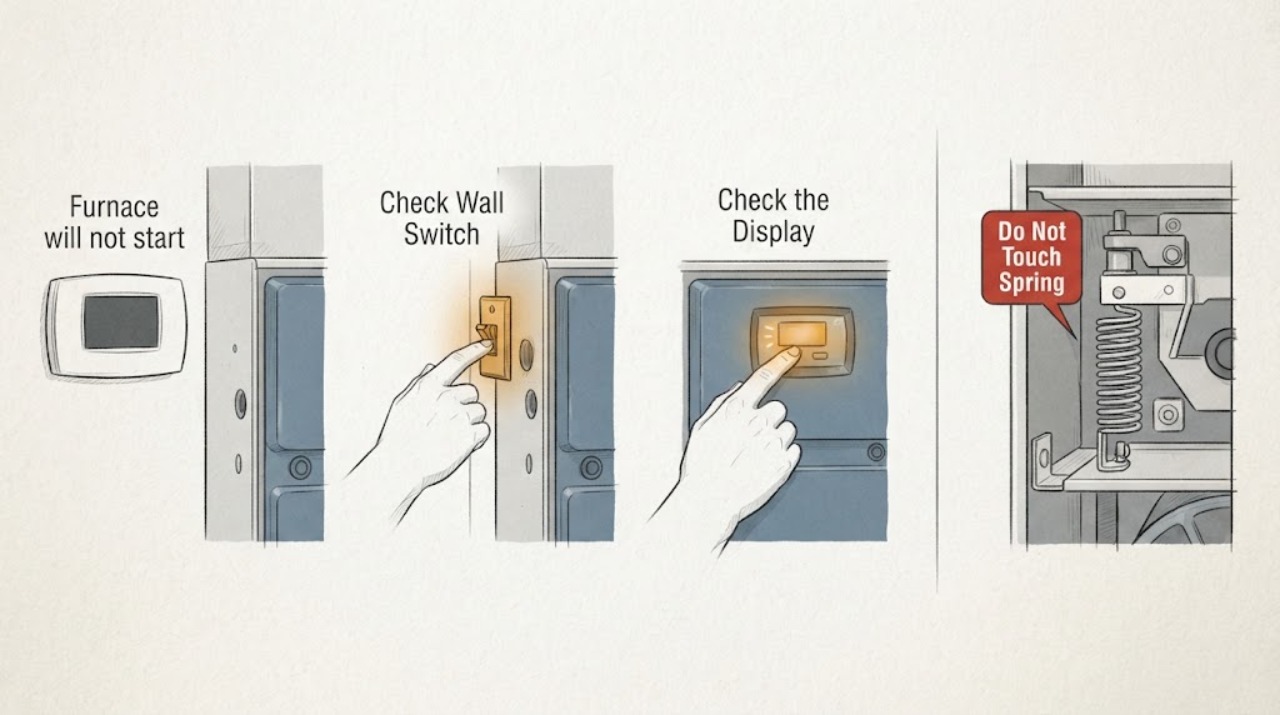
At the thermostat, confirm the display is active, Heat mode is selected, the setpoint is above room temperature, and no alert or delay is shown; replace batteries only when the thermostat instructions call for them.
Expected result: The display is blank, batteries are low, Heat mode or setpoint is wrong, an alert is shown, or the thermostat clearly calls for heat while the furnace remains silent.
Next step: Correct only the accessible setting or battery issue and allow one normal call. If the display or heat call remains abnormal, do not remove the thermostat or change wiring; arrange HVAC diagnosis.
Why this matters
Why: A missing heat call can prevent the entire furnace sequence from starting. A continuing heat call with silence shifts attention to power, controls, interlocks, or an internal safety condition.
-
Check 3
From a dry, safe position, check the labeled furnace service switch and the HVAC breaker for an obvious off or tripped state; do not touch wiring, open a panel, or repeatedly reset a breaker.
Expected result: The switch is off, the breaker is tripped, a reset holds but the furnace still will not start, or power appears normal while the unit is silent.
Next step: Restore a plainly switched-off control once according to the equipment instructions. If the breaker trips again, the switch is hot or damaged, or the furnace remains silent, leave it off and arrange HVAC or electrical service.
Why this matters
Why: An off control can stop the sequence, but a repeated trip or silent unit with power may indicate an electrical, control, motor, interlock, or safety fault.
-
Check 4
With the furnace off, inspect the return filter and accessible supply and return grilles; replace or clean the filter only as the exact Lennox model instructions specify, and remove only obvious furniture or drape blockage.
Expected result: The filter is dirty or plugged, returns are blocked, supplies are closed, the filter type is unknown, or airflow paths appear clear.
Next step: Install only the model-correct filter and open accessible grilles. If the furnace still does not start, short-cycles, or has weak airflow, stop changing parts and request professional inspection.
Why this matters
Why: Restricted airflow can cause a limit control to stop the furnace or prevent a normal heating cycle. A clear filter does not rule out duct, blower, pressure, ignition, or control faults.
-
Check 5
Look from a safe ground-level position at accessible combustion-air intake and exhaust terminations for snow, leaves, a nest, debris, or visible damage; do not climb, remove a termination, patch a flue, or reach into the pipe.
Expected result: A termination is blocked or damaged, weather recently changed, the exterior appears clear, or the furnace has a pressure or vent-related alert.
Next step: Keep the furnace off and arrange qualified HVAC inspection for blockage, damage, or a vent-related alert. Do not alter venting or restart repeatedly to force ignition.
Why this matters
Why: A blocked flue or intake can prevent pressure proving and may allow combustion products to enter the home. A clear exterior does not rule out an internal blockage, condensate, inducer, or pressure-switch problem.
-
Check 6
During one normal heat call, observe only from outside the cabinet whether the inducer or blower starts, ignition is attempted, a flame is established through an approved sight area if present, warm air begins, and an alert or light pattern appears.
Expected result: The furnace is silent, an inducer starts without ignition, ignition clicks but no flame appears, a flame starts then drops out, the blower runs without heat, or a code repeats.
Next step: Record the exact sequence and code, then stop for delayed ignition, abnormal flame, smoke, soot, repeated lockout, or unusual noise. Do not open the burner compartment, adjust gas, clean sensors, or bypass safeties; arrange qualified HVAC service.
Why this matters
Why: The first missing step narrows the handoff toward thermostat/power, pressure or venting, ignition, flame sensing, gas/control, blower, or limit protection. It does not identify a replaceable part.
-
Check 7
Gather the exact Lennox model, fuel type, thermostat display, alert or flash code, switch and breaker status, filter size and condition, startup sequence, recent outage or maintenance, vent observations, and whether the blower or any warm air appears.
Expected result: The problem is intermittent, began after a filter or thermostat change, follows weather, repeats a code, or persists after the safe checks.
Next step: Give the record to a qualified HVAC technician and request inspection of the filter and airflow, inducer and vent, ignition and flame sensing, gas and safeties, blower, controls, heat exchanger, and condensate system as applicable.
Why this matters
Why: Timing and sequence help distinguish a heat-call, power, airflow, pressure, ignition, flame, blower, limit, condensate, or control issue without unsafe access. Lennox's support workflow emphasizes recording active alert codes for model-specific resolution.
Use your observations
Decision map
Find the observation that best matches what you see, then follow the next safe action.
-
PATH 01Next step
What you see
The thermostat is blank or not calling for heat, and the furnace does not begin its sequence.
Do this next
Correct the accessible battery or setting once and allow one call. If the display or heat call remains abnormal, arrange thermostat/HVAC diagnosis without changing wiring.
Why this path and its safety boundary
Why it matters: The immediate issue is more likely thermostat power, setting, battery, signal, or upstream electrical supply than an ignition or gas fault.
-
PATH 02Next step
What you see
A heat call is present, the switch and breaker appear on, but the furnace is completely silent.
Do this next
Save any alert or light pattern and leave the equipment closed. Do not jump a switch or repeatedly reset power; request qualified HVAC/electrical service.
Why this path and its safety boundary
Why it matters: A control, door interlock, fuse, wiring, motor, lockout, or other electrical/safety condition is more likely than a thermostat setting.
-
PATH 03Next step
What you see
The inducer starts but ignition does not occur, or the flame starts and drops out while a pressure, ignition, flame, or condensate alert repeats.
Do this next
Keep the furnace off and arrange qualified HVAC diagnosis. Do not adjust gas, clean burner components, bypass a pressure or rollout switch, or repeatedly reset lockout.
Why this path and its safety boundary
Why it matters: A blocked vent or condensate path, pressure proving, igniter, flame sensing, gas/control, or safety issue is more likely; the alert does not identify which component is defective.
-
PATH 04Next step
What you see
The blower runs but no warm air is delivered, airflow is weak, or the furnace stops after heating while the thermostat still calls.
Do this next
Correct only an obvious model-correct filter or accessible grille obstruction. If weak airflow or shutdown persists, keep the furnace off and request professional airflow and safety testing.
Why this path and its safety boundary
Why it matters: A dirty filter, blocked return or duct, blower problem, limit response, heat-exchanger, ignition, or control issue remains possible.
-
PATH 05Next step
What you see
There is gas odor, a carbon-monoxide alarm, smoke, soot, abnormal flame, loud banging or hissing, a damaged flue, water near electrical parts, or a breaker that trips again.
Do this next
Leave for gas, carbon-monoxide, smoke, or flame danger and contact emergency or gas authorities from outside. Otherwise keep the furnace off and arrange qualified HVAC/electrical service before reuse.
Why this path and its safety boundary
Why it matters: A combustion, venting, fire, mechanical, water, or electrical hazard outweighs ordinary no-start troubleshooting.
Helpful context
Understand the symptom
Identify where the start sequence stops
A furnace that will not start may have no heat call, no power, a control lockout, a failed inducer or pressure proof, an ignition or flame-sensing issue, or a safety shutdown. Lennox's documented sequence gives useful safe observations: thermostat call, combustion-air blower, ignition attempt, flame proof, and blower heat delivery. Record the first missing step without opening the cabinet.
Start with the thermostat and accessible power
A blank display, dead battery, wrong mode, or setpoint below room temperature can prevent a heat call. An off furnace switch or tripped breaker can also make the unit appear dead. Check only labeled controls from a dry, safe position; do not remove thermostat covers, probe terminals, or repeatedly reset a breaker.
Filter and vents can stop a safe start
A loaded filter or blocked return can reduce airflow and cause a limit response. A blocked combustion-air intake or exhaust termination can prevent pressure proving or create a carbon-monoxide hazard. Replace the filter only with the exact model-approved type and inspect external terminations without climbing, opening panels, or modifying flue piping.
A code or light pattern is evidence, not a repair instruction
Lennox systems may expose alerts or codes through a thermostat, app, or control indicator. Save the exact text, color, flash pattern, and timing before changing anything. A code related to ignition, flame, pressure, limit, blower, or condensate is a reason for model-specific service, not permission to bypass a switch or repeatedly clear the alert.
Do not confuse a normal delay with a failed start
Some furnaces have a startup sequence and may pause before ignition or after a safety response. A furnace that remains silent, clicks without ignition, lights and drops out, or starts the blower without heat is not diagnosed by waiting indefinitely. One controlled observation is enough; repeated attempts can worsen a fault or mask its code.
Keep gas, combustion, and electrical work professional
Igniters, flame sensors, gas valves, pressure switches, rollout switches, heat exchangers, blower motors, and control boards require model-specific testing. Lennox warns about the consequences of improper gas or electrical repair. Homeowner checks should stop at settings, safe power, filter, accessible grilles, external terminations, and documentation.
Safety boundary
Stop conditions
- Leave immediately and contact emergency or gas authorities from outside for gas odor, carbon-monoxide alarm, smoke, soot, abnormal flame, or symptoms consistent with carbon-monoxide exposure; do not operate switches, use flames, or restart.
- Keep the furnace off and arrange qualified HVAC service for repeated ignition lockout, rollout or limit trips, a blocked or damaged flue, unexplained flame loss, a condensate leak near electrical parts, or a breaker that trips again.
- Do not open the burner or control cabinet, test live voltage, adjust gas pressure, clean or replace ignition/flame-sensing parts by guesswork, bypass a limit/pressure/rollout/door safety, or patch the vent.
- Arrange service when no start persists after one safe thermostat, power, filter, grille, and external-termination check; when alerts repeat; or when the furnace remains silent, blower-only, or cold. Do not keep resetting the unit to collect evidence.
Only after diagnosis
Potential parts
- furnace air filter
Consider replacement only when the filter is dirty, damaged, or the exact model-correct type is confirmed; a no-start symptom does not prove the filter is the cause.
Match the exact Lennox model, dimensions, airflow direction, and owner guidance; never operate without the required filter. - furnace igniter or flame sensor
Consider only after a qualified technician confirms failed ignition or flame proof; a click, code, or brief flame cannot identify the component without model-specific testing.
Match the exact model, ignition system, connector, mounting, and approved combustion-safety procedure; cabinet access is service work. - furnace limit, pressure, or rollout safety
Consider only when a technician confirms a failed safety after finding and correcting the cause of its trip; airflow, venting, combustion, and heat-exchanger issues can produce the same symptom.
Match the exact model, trip characteristics, mounting, wiring, and safety sequence; never bypass or substitute a safety device. - furnace blower or inducer motor
Consider only after testing confirms a motor, wheel, capacitor, or inducer fault causing no airflow, no pressure proof, abnormal noise, or repeated lockout.
Match the exact model, motor type, wheel, speed/control method, wiring, and vent-pressure requirements; internal access requires qualified service.
When checks do not resolve it
Need a professional?
Safety scope: Homeowner checks should remain outside the cabinet and be limited to thermostat settings and batteries, safe visual power checks, a model-correct filter, accessible grilles, external intake or exhaust observations, and alert documentation. A qualified technician should inspect ignition, flame sensing, gas and combustion safety, pressure and venting, heat exchanger, blower and inducer, controls, limits, rollout protection, and condensate as applicable.
Common questions
FAQ
What should I check first when a Lennox furnace will not start?
Rule out gas or carbon-monoxide danger, then check the thermostat heat call, labeled furnace switch and breaker, model-correct filter, accessible grilles, and external intake or exhaust blockage. Record any alert before arranging service.
Can a dirty filter stop a Lennox furnace from starting?
Yes. A plugged filter can restrict airflow and cause a safety or limit response. Replace or clean it only according to the exact model instructions; if the furnace remains silent or locks out, professional diagnosis is needed.
Why does the inducer run but the Lennox furnace does not ignite?
The sequence may be stopping at pressure proving, ignition, flame sensing, gas/control, venting, condensate, or another safety condition. Do not open the burner area or bypass a switch; record the alert and arrange qualified HVAC service.
Should I reset a Lennox furnace repeatedly when it will not start?
No. One safe restoration of an accidentally switched-off control may be reasonable, but repeated resets can mask a lockout or worsen an electrical, combustion, airflow, or safety fault. Keep it off when the problem repeats and request service.
Read the exact guide
Official sources
- How can I troubleshoot or diagnose what is wrong with my system?Lennox Support Center · Lennox instructs owners to check active alerts or warnings, record the code, and use product-specific support for resolution.
- Failure To OperateLennox · Lennox's official furnace documentation identifies the heating sequence and lists dirty filters, blocked flues, ignition lockout, pressure proving, and rollout conditions that can prevent operation.
- Furnace Troubleshooting: Gas Furnace SolutionsLennox · Lennox gives limited checks for thermostat, registers, filter, power, and visible furnace symptoms while directing gas, electrical, combustion, and unresolved issues to professionals.
Community feedback
Share a repair observation
Share a plain-text repair observation. Accepted observations are published automatically; this page may take a moment to update.