
On this page
Start here
Quick answer
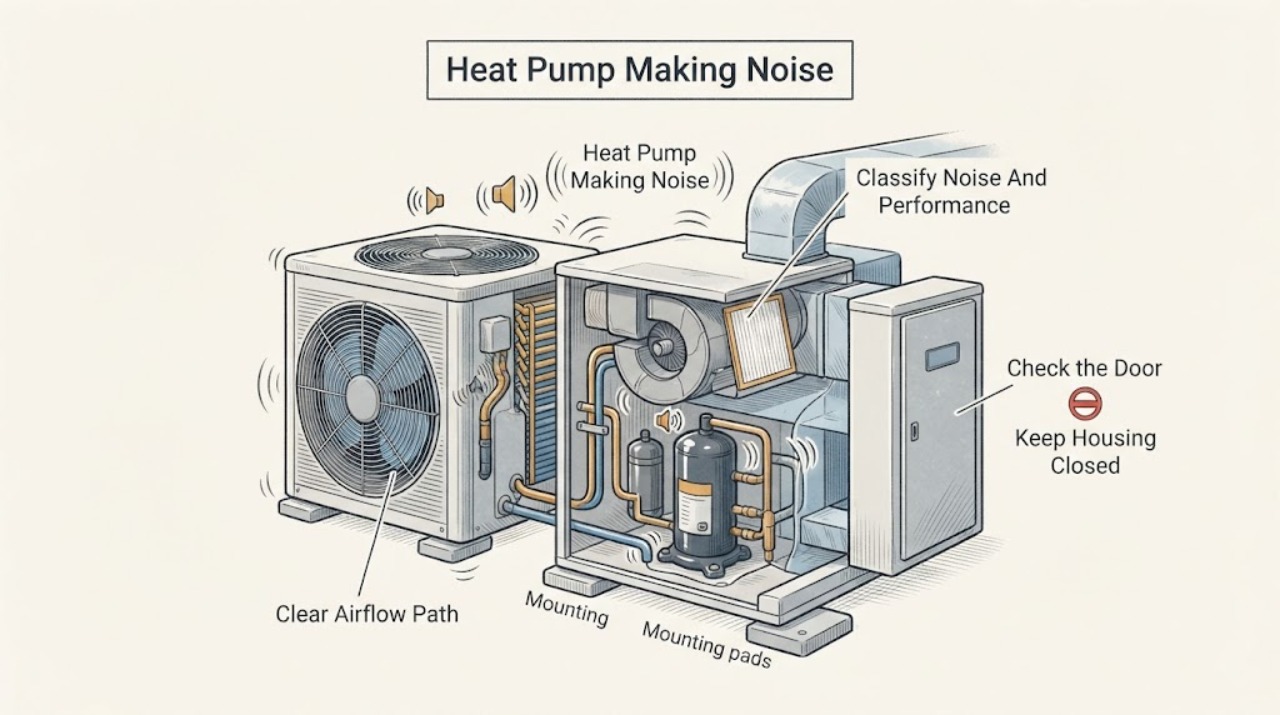
A Lennox heat pump may briefly change sound as a fan or compressor starts, stops, or enters defrost, but a new, very loud, grinding, screeching, buzzing, rattling, or persistent hissing noise should not be diagnosed by sound alone. First note whether the noise comes from the indoor air handler, outdoor unit, registers, or exposed refrigerant lines, and whether it occurs at startup, shutdown, heating, cooling, or defrost. From a safe distance, look for leaves, snow, ice, or other visible obstructions around the outdoor unit; check the accessible air filter and registers according to the model instructions. Do not open a panel, touch wiring, probe a capacitor, handle refrigerant, or reach near a moving fan. Lennox identifies strange sounds, ice, restricted airflow, compressor or capacitor concerns, and repeated breaker events as reasons to involve a professional. A heat pump can make temporary hissing, gurgling, steam, or fan changes during defrost, but the sound should settle and the unit should recover. Turn the system off at the thermostat and arrange qualified HVAC service for a burning or electrical odor, smoke, exposed wiring, repeated breaker trip, hard ice, refrigerant-line concern, fan contact, severe vibration, or loss of heating or cooling.
Work through in order
Diagnostic checks
Use only checks that match the exact appliance or system and its official guide.
-
Check 1
From a safe distance, record the Lennox heat pump noise type, location, duration, and mode. Note whether it occurs only at startup or shutdown, during heating, cooling, or a possible defrost event, and whether the system also has weak airflow, uneven temperature, long runtime, ice, odor, or a recent change from its usual sound.
Expected result: The sound is brief and cycle-linked; it is new, loud, or continuous; it is a rattle or vibration; it is grinding or screeching; it is hissing or gurgling with steam or defrost water; or comfort has changed with it.
Next step: Use the pattern to select a safe visual check. Turn the system off at the thermostat and arrange service for severe, worsening, continuous, or safety-related noise.
Stop if: Stop for smoke, burning or electrical odor, exposed wiring, a tripped breaker, grinding, fan contact, uncontrolled vibration, refrigerant-line damage, or loss of heating or cooling.
Why this matters
Why: A short cycle-linked sound may be normal operation, but a new, prolonged, or mechanical-sounding noise is more concerning. Noise combined with weak airflow, ice, odor, or lost comfort increases the likelihood of a fault rather than a normal operating sound.
-
Check 2
With the outdoor cabinet closed, look around the accessible perimeter for leaves, branches, snow, debris, hard ice, or anything obstructing the air inlet or discharge. Clear only loose material that can be removed without tools and without touching the coil, fan, wiring, or cabinet. Do not chip ice, hose a running unit, or remove a panel.
Expected result: Loose debris or snow is blocking airflow; hard ice surrounds the coil or fan; a grille or blade appears damaged; the unit is clear but the noise remains; or the fan does not turn normally.
Next step: After clearing only safe loose debris, observe one normal cycle without opening the unit. If noise, hard ice, abnormal fan behavior, or poor comfort remains, leave the system off and arrange HVAC service.
Stop if: Stop for hard ice, a fan that is striking or not turning, a bent grille or blade, exposed wiring, oil-like residue, refrigerant-line damage, water near electrical parts, or any need to open the cabinet.
Why this matters
Why: An obstruction can strain airflow and change fan or compressor sound. Hard ice, damaged fan hardware, an abnormal fan, or persistent noise with a clear perimeter makes a defrost, motor, compressor, mount, or control issue more likely.
-
Check 3
If the sound seems to come from the indoor air handler or registers, check the accessible air filter and visible supply and return openings. Clean or replace the filter only as the Lennox model instructions specify, and remove only obvious furniture or household items blocking a register. Do not remove blower panels or reach into the air handler.
Expected result: The filter is visibly loaded; a register or return is blocked; airflow is weak at several registers; the indoor unit rattles while airflow is restricted; or the filter and air path are clear.
Next step: Restore the filter and airflow path correctly and observe whether sound and airflow improve. Escalate if the noise persists, the filter becomes dirty unusually quickly, ice appears, or comfort remains poor.
Stop if: Stop for a wet or damaged filter, ice at the indoor coil, water near electrical equipment, burning odor, a blower that strikes or scrapes, or any need to remove an air-handler panel.
Why this matters
Why: A loaded filter or blocked airflow can make the blower work harder and reduce comfort. If the filter and openings are clear but the blower rattles, hums loudly, scrapes, or changes speed abnormally, the blower assembly, motor, mount, coil, or ductwork needs professional diagnosis.
-
Check 4
If the noise appears outdoors in cold weather, observe one cycle from a safe distance for a brief fan change, steam, or defrost water without forcing the thermostat or interrupting the unit. Note whether the sound settles and normal operation returns, and whether hard ice remains on the outdoor coil afterward.
Expected result: A short hiss or gurgle accompanies steam or water and then normal operation resumes; the fan stops briefly and restarts; noise continues beyond the event; hard ice remains; or defrost repeats without recovery.
Next step: Do not chip ice or apply heat. Keep the system off for severe noise or substantial hard ice and arrange qualified HVAC service with the timing and weather conditions recorded.
Stop if: Stop for hard ice, steam or water entering electrical components, a fan that does not restart, repeated failed defrost, smoke, burning odor, or any attempt to use heat or sharp tools.
Why this matters
Why: A short-lived defrost pattern can be normal. Persistent noise, hard ice, or failure to recover suggests a defrost-control, airflow, drainage, refrigerant, fan, or coil issue requiring professional testing.
-
Check 5
Record the complete Lennox model, indoor or outdoor sound location, sound description, cycle and mode, outdoor weather, filter and airflow state, obstruction or ice pattern, thermostat behavior, comfort change, odors, breaker events, and whether safe exterior cleanup changed the sound. Photograph only labels and visible conditions with equipment cabinets closed.
Expected result: The noise is new, worsening, continuous, accompanied by weak airflow or comfort loss, associated with ice or a visible mechanical concern, or unchanged after safe checks.
Next step: Turn the system off at the thermostat for severe or safety-related noise and arrange qualified HVAC diagnosis. Provide the model, timing, sound description, and all safe observations; do not open the cabinet or handle refrigerant or electrical components.
Stop if: Do not remove panels, test voltage, inspect or discharge a capacitor, add refrigerant, adjust controls, bend fan blades, or continue operation when safety or equipment-damage symptoms are present.
Why this matters
Why: Possible causes include a fan, blower, compressor, capacitor, electrical connection, refrigerant circuit, defrost control, coil, mount, or duct issue. These possibilities overlap and cannot be identified reliably from sound alone.
Use your observations
Decision map
Find the observation that best matches what you see, then follow the next safe action.
-
PATH 01Next step
What you see
Do this next
Record the pattern and monitor without opening the unit. Arrange service if it becomes louder, longer, continuous, or is joined by weak airflow, ice, odor, or comfort loss.
Why this path and its safety boundary
Why it matters: Normal fan, compressor, refrigerant-flow, or defrost behavior is more likely than an immediate fault, although a sound that changes over time still deserves documentation.
-
PATH 02Next step
What you see
Do this next
Clear only loose exterior debris without tools or contact with moving parts, never chip ice or open the cabinet, and arrange service when ice, fan contact, abnormal motion, or persistent noise remains.
Why this path and its safety boundary
Why it matters: Restricted airflow, ice, fan damage, defrost trouble, or an outdoor mechanical issue is more likely than an indoor duct sound.
-
PATH 03Next step
What you see
Do this next
Restore the filter and registers according to the model instructions. Arrange HVAC service for persistent rattling, scraping, weak airflow, ice, water, or any need to remove panels.
Why this path and its safety boundary
Why it matters: Airflow restriction, blower mounting, blower motor, duct vibration, or an indoor coil issue is more likely. A clear filter does not rule out an internal blower or coil problem.
-
PATH 04Next step
What you see
Do this next
Turn the heat pump off at the thermostat, stay clear of indoor and outdoor cabinets, and arrange qualified HVAC service. Seek urgent help for smoke, active electrical damage, suspected refrigerant exposure, uncontrolled water, or dangerous indoor conditions.
Why this path and its safety boundary
Why it matters: A fan, motor, compressor, capacitor, electrical connection, refrigerant circuit, defrost control, or another internal fault is possible. These are professional diagnostic boundaries, not safe part-identification clues.
Helpful context
Understand the symptom
Classify the sound and the operating phase
Record whether the sound is a low hum, click, whoosh, hiss, gurgle, rattle, vibration, grinding, or high-pitched tone. Locate it by listening from a safe distance at the indoor unit, outdoor unit, registers, and exposed lines without removing panels. A brief sound during startup, shutdown, or defrost has a different meaning from a noise that continues during the entire cycle. Pair the sound with airflow, ice, odor, runtime, and comfort changes; the noise by itself does not identify a Lennox part.
Keep owner checks visual and outside the service boundary
Safe checks include looking for loose debris or snow around the outdoor unit, confirming the filter and registers are not obviously blocked, and recording thermostat mode and system behavior. Lennox's service material includes refrigerant, electrical connections, capacitors, motors, coils, reversing or defrost operation, and blower components. Those checks need appropriate tools and training; do not open the cabinet, test voltage, touch a capacitor, handle refrigerant, or straighten a fan blade.
Defrost can change the sound temporarily
In cold weather, the outdoor coil can frost and the heat pump can enter defrost. The fan may stop or change sound, and short-lived hissing, gurgling, steam, or dripping water may occur. The unit should return to normal after the event. Persistent loud noise, repeated failed defrost, or significant hard ice indicates a problem with airflow, drainage, controls, refrigerant, or the defrost system. Do not chip ice or use a heat source to accelerate defrosting.
Safety boundary
Stop conditions
- Turn the heat pump off at the thermostat for smoke, burning or electrical odor, exposed wiring, a tripped breaker, grinding, fan contact, uncontrolled vibration, refrigerant-line concern, water near electrical equipment, or loss of heating or cooling.
- Do not open an indoor or outdoor cabinet, test voltage, inspect or discharge a capacitor, handle refrigerant, adjust controls, or bypass a safety device.
- Do not chip outdoor ice, apply a heat source, straighten a fan blade, hose a running unit, or reach near a moving fan.
- Do not infer a replacement part from the Lennox name or sound alone; confirm the complete model and qualified diagnosis before selecting any part.
- Arrange qualified HVAC service when noise persists after safe airflow and obstruction checks, defrost does not recover, or any electrical, refrigerant, compressor, motor, fan, duct, or control work is implicated.
Only after diagnosis
Potential parts
- Outdoor fan blade, motor, or mounting hardware
Consider this part class only when qualified diagnosis confirms the noise is from the outdoor fan or mount after airflow obstructions and ice have been ruled out.
Fan geometry, motor ratings, mounts, connectors, and model revisions vary; confirm the complete Lennox model and technician diagnosis before selecting a part. - Indoor blower motor, wheel, or airflow component
Consider this part class only when the filter and registers are clear but qualified inspection finds a noisy, damaged, or improperly supported blower or related airflow component.
Blower wheel size, motor type, controls, filter arrangement, and air-handler configuration vary; use the exact model documentation and service diagnosis. - Heat pump capacitor, compressor, or defrost control
Consider this part class only after a qualified technician links the sound and operating pattern to an electrical, compressor, or defrost-control fault.
Electrical ratings, refrigerant circuit, controls, and model-specific revisions vary; these are not homeowner-identifiable replacements from sound alone.
When checks do not resolve it
Need a professional?
Arrange service for new, loud, grinding, screeching, buzzing, rattling, or continuous noise; weak airflow; hard or recurring ice; failed defrost; a tripped breaker; burning odor; exposed wiring; refrigerant-line concern; water damage; loss of heating or cooling; or any need to open the cabinet or work on electrical, refrigerant, fan, compressor, or defrost components.
Have this ready
- Complete Lennox heat-pump model and indoor or outdoor unit location
- Sound description, recording if available, exact location, and when it occurs in the cycle
- Thermostat mode, outdoor weather, airflow, comfort, frost, steam, and defrost observations
- Filter and register condition, visible outdoor obstruction, ice pattern, odor, breaker event, and recent service
- Any safe exterior cleanup performed without opening or touching the HVAC cabinet
Common questions
FAQ
Is it normal for a Lennox heat pump to make noise?
Brief startup, shutdown, fan, refrigerant-flow, or defrost sounds can be normal if the unit promptly returns to normal heating or cooling. A new, very loud, grinding, screeching, rattling, buzzing, or continuous sound is not something to diagnose by sound alone; record the timing and arrange qualified service if it persists or comes with ice, weak airflow, odor, or comfort loss.
Why does my Lennox heat pump hiss or gurgle outside?
A short hiss or gurgle with steam or defrost water can occur while an air-source heat pump defrosts its outdoor coil. The sound should settle and normal operation should return. Continuous or worsening hissing, hard ice, refrigerant-line concern, or lost heating or cooling requires the system to be turned off and professionally inspected.
What should I check if my Lennox heat pump is rattling?
First note whether the rattle is indoors or outdoors and whether a filter, register, loose debris, snow, or ice is visibly affecting airflow. Clear only loose material without opening the unit or touching moving parts. If the rattle remains, is accompanied by vibration or weak airflow, or seems to come from a fan, blower, motor, compressor, or cabinet, arrange qualified HVAC service.
Can a dirty filter cause a noisy Lennox heat pump?
A dirty filter can restrict airflow and make the system work harder, which may contribute to blower or comfort symptoms. Check and clean or replace the accessible filter only as the exact model instructions specify. If noise or weak airflow continues with a correct filter and clear registers, the indoor coil, blower, ductwork, or another component needs professional diagnosis.
When should I turn off a noisy Lennox heat pump?
Turn it off at the thermostat for smoke, burning or electrical odor, exposed wiring, a tripped breaker, grinding, a fan striking ice or housing, uncontrolled vibration, hard ice that does not clear, suspected refrigerant damage, water near electrical equipment, or loss of heating or cooling. Keep the cabinets closed and arrange qualified HVAC service rather than testing electrical, refrigerant, compressor, fan, or defrost parts yourself.
Read the exact guide
Official sources
- Midwest Weatherization Best Practices Field GuideU.S. Department of Energy · Official DOE field guide used narrowly for normal defrost-related hissing, gurgling, steam, frost, and hard-ice escalation; climate and equipment-specific instructions still apply.
- Heat Pump Not Turning On: Common Causes ExplainedLennox · Official Lennox homeowner guidance used for safe visual checks and escalation signals; the page addresses startup problems but its noise warnings apply only as symptom guidance, not a universal diagnosis.
- Heat Pump Service & Maintenance TipsLennox · Official Lennox service and maintenance guidance used for homeowner-safe maintenance boundaries and the internal service checklist; model-specific procedures still control.
- How to identify an AC Refrigerant leakLennox · Official Lennox refrigerant guidance used only for hissing and refrigerant-warning escalation; it does not diagnose every heat-pump noise or authorize refrigerant work.
- Is This Normal? HVAC Smells and Sounds, ExplainedTrane · Official HVAC manufacturer guidance used as general symptom context for startup, defrost, rattling, humming, and hissing; Lennox model instructions and technician diagnosis supersede it.
- INSTALLATION AND MAINTENANCELennox · Official Lennox installation document used for the professional boundary and for the principle that unit support, airflow, drainage, and sound or vibration transmission depend on installation; it is not a model-universal repair manual.
- You Installed an Air Source Heat Pump. Now What?U.S. Department of Energy Building Science Education Solution Center · Official DOE-supported maintenance guide used for filter, airflow, excessive-noise, ice, and escalation context; model-specific manuals control any exact cleaning or maintenance procedure.
Community feedback
Share a repair observation
Share a plain-text repair observation. Accepted observations are published automatically; this page may take a moment to update.