
On this page
Start here
Quick answer
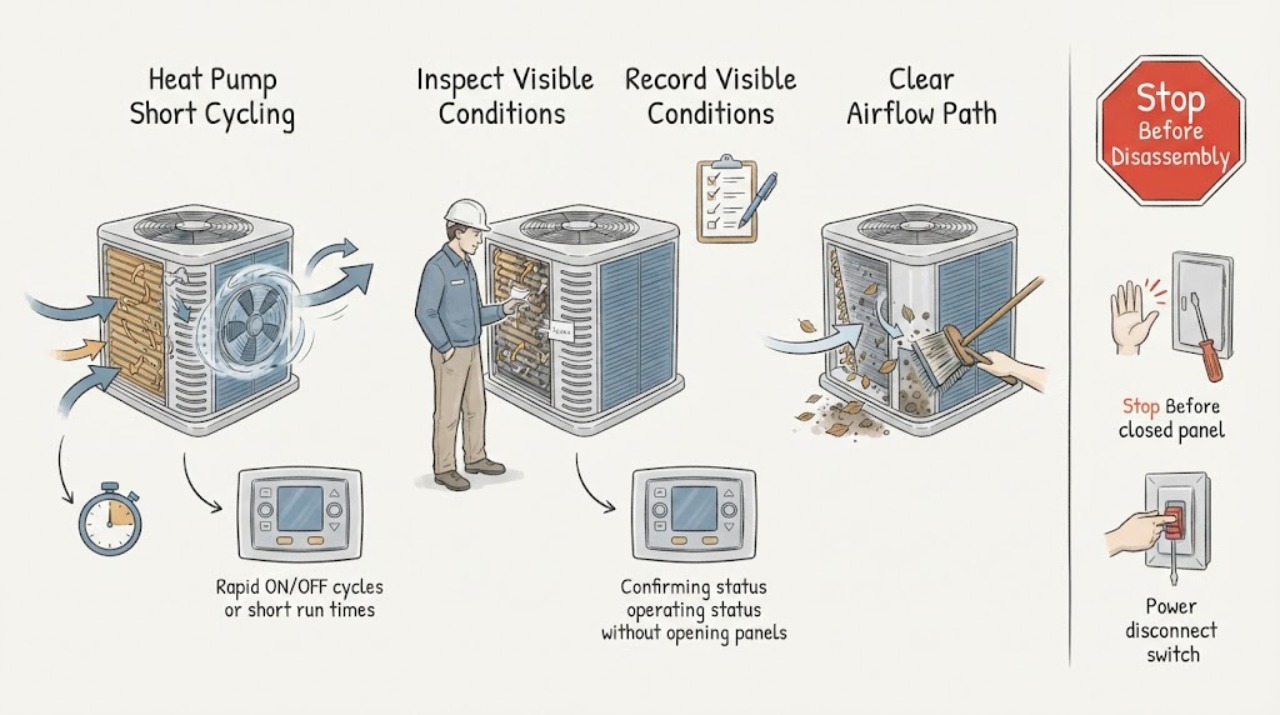
A Lennox heat pump that starts and stops every few minutes should not be diagnosed by replacing a part at random. First record whether the thermostat is still calling, whether the indoor airflow is weak, whether the outdoor coil is blocked or heavily iced, and whether a Lennox alert is present. A dirty filter or blocked grille can restrict airflow; snow, leaves, or ice can restrict the outdoor coil; a thermostat or control issue can create an unwanted call; and refrigerant, compressor, defrost, or safety-control faults require HVAC testing. Replace an accessible dirty filter with the correct type, clear loose debris without opening the equipment, and turn the system off and arrange service when it short-cycles with little or no heating or cooling, repeatedly trips a breaker, smells electrical, has heavy ice, or makes abnormal noises.
Work through in order
Diagnostic checks
Use only checks that match the exact appliance or system and its official guide.
-
Check 1
Observe one or two cycles from a safe location without opening either unit. Note the thermostat mode and demand, indoor-air temperature trend, indoor blower behavior, outdoor fan behavior, approximate run time, time between starts, and whether the system provides heat or cool air before stopping.
Expected result: The outdoor unit stops after only a few minutes while comfort changes little; the thermostat still calls; the blower continues; or the system is simply changing operation during a visible defrost event.
Next step: If short cycles continue with little or no heating or cooling, turn the heat pump off and arrange Lennox or qualified HVAC service. If the thermostat is no longer calling, continue with the thermostat and airflow checks rather than repeatedly restarting the equipment.
Why this matters
Why: Repeated short runs with little output are the high-value fault pattern. A continuing thermostat call suggests the system is not satisfying demand, while a stopped call points more toward a setting, schedule, sensor, or control decision. A temporary defrost change is not by itself proof of a failed component.
-
Check 2
Check the thermostat display without changing installer settings. Confirm the intended Heat or Cool mode, the setpoint relative to room temperature, any schedule or hold that may be changing the demand, and any active alert or warning. Write down the exact alert text or code if shown.
Expected result: The mode or setpoint is not what was intended, the call disappears when the setpoint is met, an alert is displayed, or the demand remains while the heat pump stops and restarts.
Next step: Correct only an obvious user setting and observe one controlled cycle. Do not clear an alert by repeated power cycling or change installer parameters. Give the alert, mode, setpoint, and demand pattern to the service provider if cycling remains.
Why this matters
Why: An incorrect mode, schedule, or satisfied setpoint can look like cycling but is not the same as a system that cannot complete a demand. An alert provides a useful service clue; a continuing demand with repeated outdoor-unit stops keeps equipment, airflow, defrost, and safety-control causes in play.
-
Check 3
Inspect the indoor filter, return grille, supply registers, and any accessible airflow path. Replace a visibly loaded filter with the correct filter specified for the system, and make sure furniture or stored items are not blocking grilles; do not remove access panels.
Expected result: The filter is dirty, several grilles are blocked, airflow is weak at multiple registers, or the filter and grilles are clear with normal airflow.
Next step: After an accessible filter change or grille clearance, allow the system to make one monitored demand. If airflow stays weak, the coil is frozen, or short cycling returns, turn the system off and schedule HVAC service for the indoor coil, blower, ductwork, and controls.
Why this matters
Why: Restricted indoor airflow can reduce heat-pump performance and contribute to protective shutdown or coil problems. Clear, steady airflow makes a simple filter or grille restriction less likely, so persistent short cycling should not be attributed to the filter alone.
-
Check 4
From outside the equipment, look for leaves, snow, vegetation, or other loose material blocking the outdoor coil and fan openings. Look for heavy ice on the coil, cabinet, fan area, or refrigerant lines; do not remove panels, chip ice, pour hot water, or touch wiring.
Expected result: Airflow is visibly blocked, heavy ice prevents normal airflow or fan movement, light frost clears during operation, or the outdoor unit is clear and not heavily iced.
Next step: Turn the system off if heavy ice is present and let it thaw naturally according to Lennox guidance; clear only loose material that can be removed without tools or contact with the equipment. If ice returns quickly, the fan does not run after thawing, or short cycling continues, call for service.
Why this matters
Why: Loose debris can restrict the outdoor coil, while heavy or recurring ice makes airflow, defrost, refrigerant, or control problems more likely. Light frost can occur during normal operation and does not identify a fault by itself.
-
Check 5
Check the HVAC or heat-pump breaker and any accessible service disconnect only by looking at their status; do not remove covers. Note whether a breaker is tripped, the outdoor unit is silent while the indoor blower runs, or the breaker trips again after a normal reset.
Expected result: A breaker is tripped, the outdoor unit does not start while the blower runs, the breaker trips again, or power status is normal.
Next step: Do not repeatedly reset a tripping breaker. Leave the system off and request HVAC service for a repeated trip, burning smell, buzzing, or an outdoor unit that will not start. If power status is normal, continue to the handoff rather than opening the equipment.
Why this matters
Why: A single power interruption can explain a stopped unit, but a repeated trip or a fan/compressor mismatch can indicate an electrical, motor, compressor, or control fault. These cannot be confirmed safely from the breaker position.
-
Check 6
Prepare a service record with the Lennox model and serial information, thermostat mode and alert text, filter date and condition, outdoor ice or obstruction pattern, indoor and outdoor fan behavior, cycle timing, and whether the problem occurs in heating, cooling, or both.
Expected result: The model and serial labels are accessible, only partial information is available, or a label can be reached only by opening an energized panel.
Next step: Give the record and photos of safe, external conditions to a qualified HVAC technician or Lennox support channel. Keep the system off when short cycling is accompanied by poor output, heavy ice, repeated breaker trips, abnormal noise, or an electrical smell.
Why this matters
Why: Heat-pump controls, defrost behavior, communicating thermostats, and replacement components vary by model and system pairing. A complete cycle record helps a technician test the correct branch; missing information is not a reason to open the equipment.
Use your observations
Decision map
Find the observation that best matches what you see, then follow the next safe action.
-
PATH 01Next step
What you see
The outdoor unit starts and stops every few minutes while the thermostat continues calling and little or no heating or cooling is produced.
Do this next
Turn the heat pump off and arrange prompt HVAC service. This pattern can involve a safety control, compressor, refrigerant circuit, defrost control, or another fault that cannot be confirmed by a homeowner filter check.
-
PATH 02Next step
What you see
The filter is loaded or grilles are blocked, airflow is weak, and the system improves only after that accessible restriction is corrected.
Do this next
Use the correct filter and keep returns and supplies open, then monitor one demand. If weak airflow or cycling remains, stop the system and have the indoor coil, blower, ductwork, and controls inspected.
-
PATH 03Next step
What you see
The outdoor coil or fan is blocked by debris or heavy ice, or ice returns soon after natural thawing.
Do this next
Turn the system off, clear only loose exterior material without tools, and let ice thaw naturally. Recurring ice, an outdoor fan that will not run, or refrigerant lines covered in ice requires a qualified technician.
-
PATH 04Next step
What you see
The thermostat mode, setpoint, schedule, or demand changes as the unit stops, with no persistent poor-output pattern.
Do this next
Correct only the obvious user setting and watch one cycle. If the thermostat continues to call while the unit cycles, record any alert and move to service rather than changing installer settings.
-
PATH 05Next step
What you see
A breaker trips again, the outdoor fan and compressor do not behave together, there is a burning or electrical smell, or the unit makes grinding, squealing, or banging sounds.
Do this next
Leave the heat pump off and request prompt HVAC service. Do not reset the breaker repeatedly or open electrical panels to test a capacitor, motor, compressor, or control board.
Helpful context
Understand the symptom
Short cycling is a pattern, not a diagnosis. Write down when the compressor or outdoor fan starts, when it stops, whether the indoor blower continues, whether the thermostat still shows a demand, and whether the home is gaining or losing comfort. A normal defrost event can change outdoor-unit sounds and operation for a time, but repeated starts with little heating or cooling need attention.
Keep homeowner checks outside the energized equipment. The filter, registers, thermostat display, breaker status, and visible outdoor clearance can be checked without removing electrical panels. Do not test capacitors, refrigerant charge, wiring, pressure switches, compressor current, or defrost controls yourself.
If the system runs for only a few minutes and produces little or no heating or cooling, Lennox's heat-pump guide says to turn it off and contact a Lennox service provider. Preserve alert text and the observed cycle pattern so the technician can distinguish airflow, control, defrost, refrigerant, and compressor branches.
Safety boundary
Stop conditions
- Turn the heat pump off and call for service when it short-cycles every few minutes with little or no heating or cooling, or when frequent defrost cycles are observed.
- Do not chip ice, pour hot water on the outdoor unit, remove access panels, test refrigerant or electrical components, or change installer control settings.
- Stop and obtain prompt HVAC help for a repeated breaker trip, burning or electrical smell, loud mechanical noise, a compressor that will not start, a fan that will not run after thawing, or refrigerant lines covered in ice.
- Do not keep restarting a system that has heavy ice, weak airflow, water damage, or an unresolved alert; record the conditions and leave the equipment off until it is assessed.
Only after diagnosis
Potential parts
- HVAC air filter
Consider only when the installed filter is visibly loaded or the Lennox system documentation specifies replacement after an airflow check.
Confirm the filter dimensions, type, airflow rating, and system requirements; a thicker or more restrictive filter is not automatically suitable. - thermostat or temperature sensor
Consider only when service testing shows that the thermostat or sensor is issuing an incorrect demand or ending and restarting a call without a mechanical cause.
Thermostat compatibility, wiring, communicating controls, sensor pairing, and configuration are model- and system-specific and require confirmation before replacement. - defrost sensor or defrost control
Consider only when recurring ice or abnormal defrost behavior is confirmed and technician testing isolates the sensor or control rather than airflow or refrigerant causes.
Defrost components vary by outdoor-unit model and control architecture; do not infer fit from a similar-looking board or sensor. - outdoor fan motor or start component
Consider only when testing confirms that the outdoor fan or its start and control circuit is causing the cycling or failure to restart.
Motor electrical ratings, control method, capacitor requirements, and mounting must be matched by a qualified technician to the exact outdoor unit.
When checks do not resolve it
Need a professional?
Contact a qualified HVAC technician or Lennox service provider for persistent short cycling, short cycles with little or no heating or cooling, frequent defrosting, recurring heavy ice, weak airflow that remains after an accessible filter check, repeated breaker trips, abnormal noise, electrical odor, refrigerant-line ice, or any fault requiring panels, gauges, wiring tests, or control diagnosis.
Common questions
FAQ
How often should a Lennox heat pump run before it is considered short cycling?
There is no single homeowner timing threshold that fits every Lennox model, weather condition, and load. Repeated starts every few minutes, especially with little or no heating or cooling and a continuing thermostat demand, match Lennox's service warning pattern. Record the cycle and arrange service rather than repeatedly restarting it.
Can a dirty filter make a Lennox heat pump short cycle?
A dirty filter can restrict airflow and contribute to freezing or protective shutdown. Replace an accessible dirty filter with the correct type and check grilles, but persistent cycling after that check needs HVAC diagnosis of the coil, blower, controls, and refrigerant circuit.
Is frost on a Lennox heat pump always a problem?
Light frost can occur during cold, humid operation and should be managed by the system's defrost function. Heavy ice that blocks airflow, returns quickly, leaves the fan unable to run, or occurs with short cycling is a service condition. Never chip ice or pour hot water on the unit.
Should I reset the breaker when the heat pump keeps cycling?
A single normal reset may restore power after an isolated interruption, but a breaker that trips again is a stop condition. Leave the system off and request HVAC service; do not repeatedly reset it or open the electrical compartment.
What information should I give the Lennox technician?
Provide the model and serial information, thermostat mode and setpoint, alert text or code, cycle timing, whether the thermostat kept calling, filter condition, indoor airflow, outdoor ice or debris, fan behavior, breaker status, and whether the symptom occurs in heating, cooling, or both. Do not open panels to obtain a label.
Read the exact guide
Official sources
- BEFORE CALLING FOR SERVICELennox · Directly supports the short-cycling topic across Lennox heat-pump systems; model-specific service instructions still control.
- What to Do If Your Heat Pump Is Frozen?Lennox · Supports safe exterior checks and the stop boundary for a short-cycling Lennox heat pump with ice or weak airflow.
- Lennox S40 Smart Thermostat Alert Codes and TroubleshootingLennox · Supports preserving displayed alert information when the installed system uses an S40 control; no S40-specific code is assumed for other models.
- Heat Pump Not Turning On: Common Causes ExplainedLennox · Supports separating thermostat, power, airflow, outdoor-unit, and electrical observations when short cycling includes failed restarts.
- How can I troubleshoot or diagnose what is wrong with my system?Lennox Support Center · Supports recording an active Lennox alert or warning before requesting service; it does not identify a fault without the applicable system documentation.
Community feedback
Share a repair observation
Share a plain-text repair observation. Accepted observations are published automatically; this page may take a moment to update.