
On this page
Start here
Quick answer
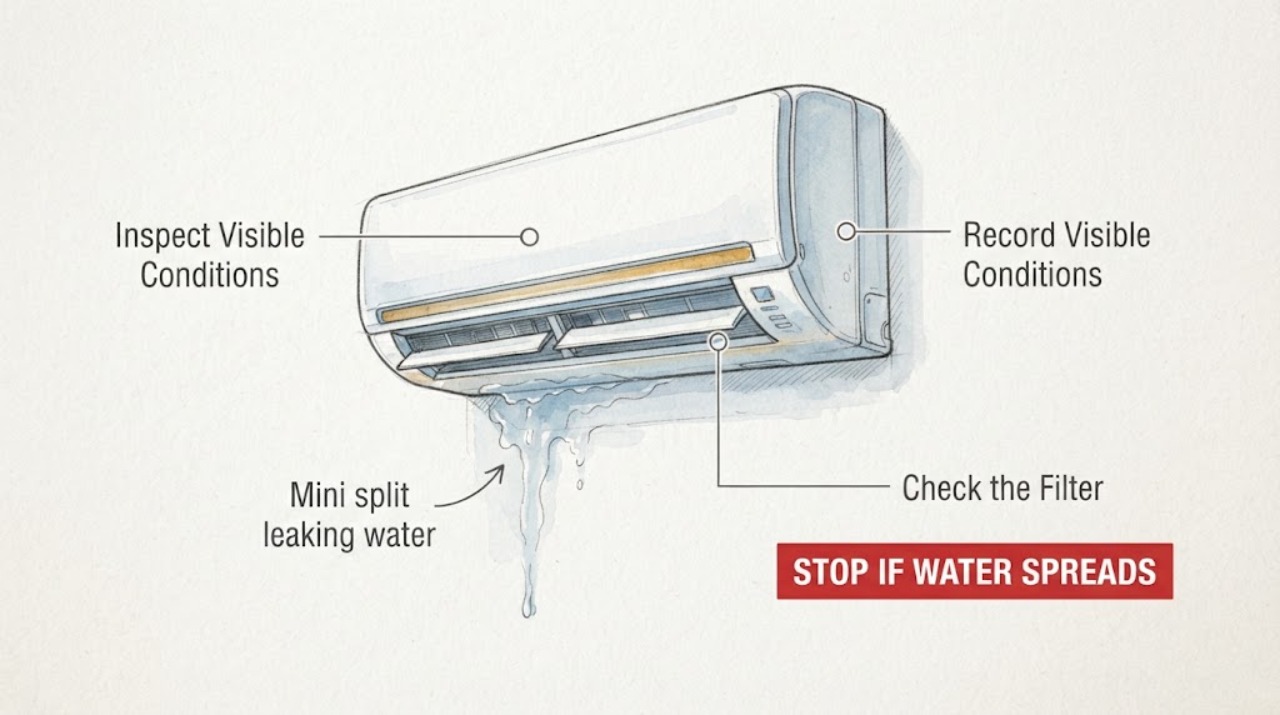
Treat water from a mini-split indoor unit as a stop-and-assess condition, not as a reason to keep running repeated cooling cycles. From a safe position, note exactly where the water starts, whether it appears only during cooling or also while the system is off, whether the visible filter is heavily loaded, and whether the drain outlet is visibly flowing without touching it. Water near wiring, controls, an outlet, or other electrical equipment requires stopping the system if it can be done without contact with water and arranging urgent HVAC service. Do not open the unit, dismantle the drain path, handle refrigerant or electrical parts, climb to reach it, or keep operating a unit that is leaking.
Before you begin
Safety first
- This is an observation-only guide. Do not open the indoor unit, dismantle or clear the drain, handle refrigerant or electrical parts, climb, probe tubing, apply chemicals, or repeatedly run a leaking system.
Work through in order
Diagnostic checks
Use only checks that match the exact appliance or system and its official guide.
-
Check 1
From a dry, stable position, look at the indoor unit and nearby wall or floor without touching the unit, and identify whether water is at the front edge, one side, the wall penetration, or only on a surface below.
Expected result: Note the first visible point, the direction of any drip or stain, and whether the surrounding wall, trim, floor, or furnishings are already wet.
Next step: Stop operation and arrange HVAC service; move people and belongings away from the wet area only if that can be done without reaching through water or near electrical equipment.
Stop if: Stop immediately if water is near wiring, controls, an outlet, a power strip, or other electrical equipment; do not touch the wet equipment.
Why this matters
Why: The location helps a technician distinguish a drainage or pan symptom from a wall, insulation, or room-condensation symptom, but it does not identify a part by itself.
-
Check 2
Record when the water appears: during cooling, after cooling stops, during heating, after a long idle period, or independently of any operation.
Expected result: Use the normal household timeline and do not restart the system to provoke another leak; note whether the amount is rising, stable, or absent while idle.
Next step: Give the timeline to the HVAC technician and keep the system off until the leak is assessed, especially if water is recurring or spreading.
Stop if: Stop observing if the leak becomes a stream, reaches the floor or electrical area, or creates a slip hazard; isolate the area and escalate promptly.
Why this matters
Why: A cooling-linked pattern can be associated with condensate handling or condensation, while water that continues while idle may indicate stored water, an unrelated leak, or another building moisture source.
-
Check 3
From the normal user-access position, look only at the visible filter surface and front cover for heavy dust, frost, ice, or obvious obstruction; do not open covers or reach into the unit.
Expected result: Note whether the visible filter looks unusually loaded and whether ice or frost is present on exposed surfaces, without scraping, thawing with heat, or attempting an internal inspection.
Next step: Tell the technician what was visible and follow the unit's owner instructions only for any ordinary, clearly accessible filter step; do not operate a leaking unit to test the result.
Stop if: Stop if frost, ice, unusual odor, smoke, heat, or a damaged cover is present, and keep the system off while arranging service.
Why this matters
Why: Restricted airflow or ice can be relevant clues, but the underlying cause may still require professional inspection and may involve components that are unsafe to access.
-
Check 4
From ground level and without climbing, look at the visible condensate outlet or termination if it can be seen safely, and compare it with the indoor leak timeline; do not insert anything, disconnect tubing, or apply pressure.
Expected result: Note whether the outlet appears to discharge water during a normal existing event, is visibly dry, is kinked or displaced, or cannot be seen from a safe position.
Next step: Photograph the outlet from a safe distance and provide the image and timing to the HVAC technician; leave the drain assembly untouched.
Stop if: Stop if reaching the outlet would require a ladder, entering a restricted area, approaching a roof edge, or working near power lines or standing water.
Why this matters
Why: A dry or displaced-looking outlet during an indoor leak is a service clue, not permission to clear or reconnect the drain; a visible discharge does not rule out a pan, slope, or secondary issue.
-
Check 5
Look around the room and adjacent wall for condensation on windows or walls, high-humidity cues, damp insulation or trim, staining, musty odor, or a separate plumbing or roof moisture path, without opening surfaces.
Expected result: Note whether the moisture is limited to the unit area or appears throughout the room, whether it follows weather or showering, and whether mold-like growth or persistent odor is visible.
Next step: Tell the HVAC and, where applicable, building or plumbing professional the room pattern and weather/timing; keep a suspected contaminated system off until evaluated.
Stop if: Stop and keep people away if there is extensive water damage, sewage or contaminated water, visible mold-like growth with symptoms, ceiling or wall instability, or an electrical hazard.
Why this matters
Why: Room humidity or another moisture source can mimic or worsen a mini-split leak; visible mold-like growth or extensive wet material changes the response and may require a moisture or remediation professional.
Use your observations
Decision map
Find the observation that best matches what you see, then follow the next safe action.
-
PATH 01Next step
What you see
Water is near electrical equipment, the leak is active or spreading, or the area is a slip hazard.
Do this next
Stop using the mini-split; if the power control can be reached without touching water or wet equipment, switch it off, otherwise keep clear and obtain urgent HVAC/electrical help.
-
PATH 02Next step
What you see
The leak appears during cooling and the visible outlet is dry, displaced, or has an unusual pattern, with no safe user-level cause identified.
Do this next
Keep the system off and request HVAC service to inspect the condensate pan, drain route, installation, and airflow; do not clear or disconnect the drain yourself.
-
PATH 03Next step
What you see
The visible filter is heavily loaded or exposed surfaces show frost or ice.
Do this next
Report the observation and follow only clearly stated owner-level filter guidance; do not restart a leaking unit or remove ice by force or heat, and have the system assessed.
-
PATH 04Next step
What you see
Moisture is widespread, mold-like growth or a persistent odor is present, or the water source may be plumbing, roof, or contaminated water.
Do this next
Keep the system off, limit access to wet or contaminated areas, and coordinate HVAC and the appropriate water-damage or building professional.
Helpful context
Understand the symptom
An indoor leak can involve condensate drainage, a pan or hose condition, airflow and filter conditions, installation or insulation, or room humidity and condensation. The outside appearance cannot identify the failed part, so record observations for the technician and protect nearby flooring, furnishings, and electrical equipment without reaching into the unit.
The timing and location matter: a drip that follows cooling is different from water that continues while the system is idle, and water at the wall edge is different from water at the front or below the unit. A visible drain outlet that is dry during a leak does not prove a blockage, but it is useful information for service.
Keep the response observational. A qualified HVAC technician should inspect the condensate pan, drain route, airflow, installation, and any electrical or refrigerant-related cause. If the area is damp or mold-like growth is visible, address the moisture source and do not run a suspected contaminated system.
Only after diagnosis
Potential parts
- mini split drain hose
Consider this category only after a technician confirms the drain hose is damaged or incompatible and identifies the required routing and fit.
Confirm the indoor-unit model, hose dimensions, routing, slope, and manufacturer guidance; do not treat a generic hose as a confirmed fit. - condensate drain treatment
Consider this category only if a qualified technician confirms that a treatment is appropriate for the specific system and does not replace correcting a blockage, slope, leak, or installation fault.
Use only a product approved for the system and local requirements; never pour an unapproved chemical into a drain or use treatment while the cause is unknown. - mini split drain pan
Consider this category only after service confirms a cracked, corroded, or otherwise failed pan and identifies the exact replacement path.
Confirm the complete indoor-unit model and pan configuration with the manufacturer or technician; fit and drainage cannot be inferred from appearance.
When checks do not resolve it
Need a professional?
Arrange HVAC service promptly for any indoor water leak. Escalate urgently when water reaches wiring or electrical equipment, the leak is spreading, the system shows ice or unusual odor, the room has extensive moisture or mold-like growth, or the system cannot be safely switched off.
Safety scope: This is an observation-only guide. Do not open the indoor unit, dismantle or clear the drain, handle refrigerant or electrical parts, climb, probe tubing, apply chemicals, or repeatedly run a leaking system.
Common questions
FAQ
Should I keep running the mini-split to see if it leaks again?
No. Do not repeat an operating test when water is leaking. Keep the unit off and record when the leak first appeared; water near electrical equipment requires extra distance and urgent help.
Can I clear the mini-split drain hose myself?
Do not disconnect, probe, flush, or pressure-clean the drain path from this guide. The leak may involve pan damage, routing, installation, airflow, or another cause, so have HVAC service assess it.
What if the unit is dripping only in humid weather?
Humidity and condensation can contribute, but weather timing does not prove the drain is healthy. Record the room pattern and have the technician evaluate drainage, insulation, airflow, and moisture conditions.
What should I do if I see mold-like growth near the indoor unit?
Keep the suspected contaminated system off, limit disturbance, and arrange appropriate HVAC and moisture or remediation advice. Seek health advice for symptoms; do not treat appearance alone as a confirmed identification.
Read the exact guide
Official sources
- What are the main ways to control moisture in your home?U.S. Environmental Protection Agency · EPA describes leaks, seepage, humidity, and condensation as household moisture sources, supporting the need to distinguish an HVAC drain symptom from wider room or building moisture.
- A Brief Guide to Mold, Moisture and Your HomeU.S. Environmental Protection Agency · EPA explains that moisture control is central to mold control, recommends keeping air-conditioning drip pans clean and drain lines flowing, and says not to run an HVAC system known or suspected to be contaminated with mold.
- Should You Have the Air Ducts in Your Home Cleaned?U.S. Environmental Protection Agency · EPA identifies condensation near cooling coils, standing water or debris, wet insulation, and improperly repaired leaks as moisture concerns requiring prompt attention and professional assessment.
Community feedback
Share a repair observation
Share a plain-text repair observation. Accepted observations are published automatically; this page may take a moment to update.