
On this page
Start here
Quick answer
An outdoor mini-split unit can run while the room stays warm if the indoor unit is in the wrong mode, airflow is restricted, the outdoor coil is blocked, the indoor coil is frozen, or the refrigeration circuit has a leak or another fault. Confirm the remote is in Cool with a setpoint below the room temperature, then check the indoor filter and visible air inlets and outlets. Keep the outdoor unit clear of loose debris, but do not open its electrical cover or handle refrigerant. If the indoor airflow is weak, ice is present, water is leaking, the outdoor unit makes an unusual sound, or cooling stays poor after the accessible checks, turn the system off as appropriate and arrange qualified mini-split service.
Before you begin
Safety first
- A qualified HVAC professional should test refrigerant charge and leaks, indoor and outdoor coils, drain paths, sensors, control boards, compressor, electrical connections, and multi-zone operation; homeowners should remain with non-invasive settings, filter, and debris checks.
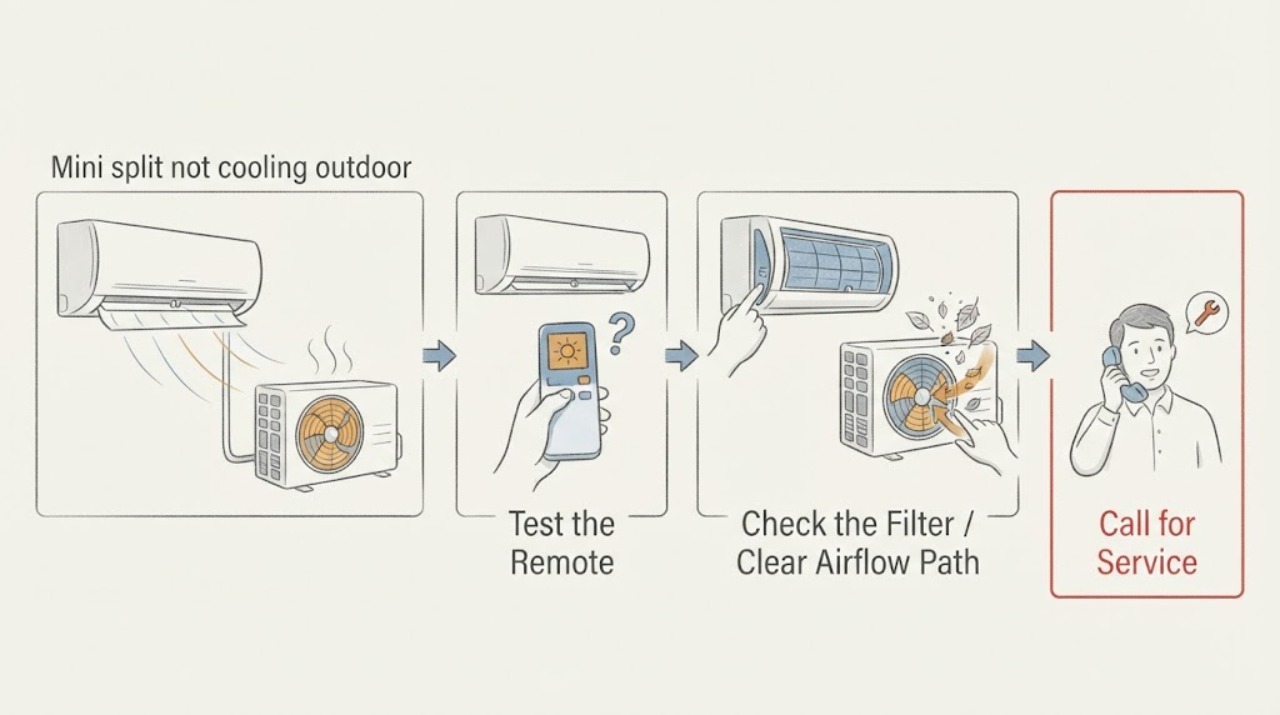
Work through in order
Diagnostic checks
Use only checks that match the exact appliance or system and its official guide.
-
Check 1
Set the affected mini-split remote or controller to Cool, select a temperature below the room temperature, and verify that the indoor fan is set to a mode that should deliver air; note any display code or mode indicator.
Expected result: The unit was in Fan, Dry, Heat, or an unintended automatic mode; the controller shows a fault; or Cool is selected and the indoor head still blows room-temperature air.
Next step: Correct only the user-facing mode and target, then observe one normal cooling demand. If the setting is correct and cooling remains poor, continue with filter and airflow checks rather than repeatedly changing modes.
Why this matters
Why: An incorrect mode can make a running fan feel like failed cooling. A fault indicator or correct cooling call with warm output shifts suspicion to airflow, coil, refrigerant, controls, or another system fault.
-
Check 2
Inspect the indoor head's accessible reusable filter and make sure its air inlet and outlet are not covered by dust, furniture, curtains, or stored items; clean the filter only as directed by the equipment manual.
Expected result: The filter is visibly dirty, airflow is weak, the louvers or inlet are obstructed, or airflow appears normal with a clean filter.
Next step: Clean and fully dry the reusable filter before reinstalling it, clear the room-side obstruction, and retest. If airflow remains weak or cooling does not return, arrange mini-split service; do not remove the blower or coil for deep cleaning.
Why this matters
Why: A dirty filter or blocked inlet can restrict the air crossing the indoor coil and reduce cooling. Normal visible airflow does not rule out a dirty blower, frozen coil, refrigerant issue, or hidden control problem.
-
Check 3
With the outdoor unit powered off according to the equipment instructions, inspect from a safe distance for leaves, snow, dirt, or objects blocking its air intake or discharge; do not reach through the grille or open a panel.
Expected result: Loose debris restricts the outdoor airflow, the coil appears heavily dirty or damaged, or the outdoor area is clear while the unit continues to run without cooling the room.
Next step: Remove only loose reachable debris as permitted by the manual and keep the area clear. If the coil is damaged, dirty beyond safe access, or cooling remains poor, stop hands-on work and arrange a qualified technician.
Why this matters
Why: An outdoor obstruction can reduce heat exchange and cooling capacity. A clear area with continued poor cooling points farther toward the indoor coil, refrigerant circuit, controls, compressor, or another fault.
-
Check 4
Look at the accessible indoor head, drain outlet, and nearby wall or floor for frost, ice, water, or a musty smell while the system is off or observed without touching the coil, refrigerant lines, or electrical parts.
Expected result: Ice or frost is present, water is leaking, the drain outlet is not flowing as expected, or no moisture warning is visible.
Next step: Turn cooling off as appropriate and do not scrape ice, pour water into the unit, or handle refrigerant. Arrange service for persistent ice, leaks, weak airflow, or poor cooling after the filter check.
Why this matters
Why: A frozen indoor coil can result from restricted airflow or low refrigerant, and a blocked drain or pan can cause leakage. The absence of visible ice or water does not rule out a refrigeration or control fault.
-
Check 5
For a multi-zone system, note which indoor heads are calling for cooling, whether the warm symptom affects one head or all heads, and whether the outdoor unit changes behavior when other zones are turned off using their normal controls.
Expected result: Only one zone is warm while another cools normally, all zones are warm, or the symptom appears after changing zone modes.
Next step: Keep the settings documented and do not alter installer parameters or refrigerant lines. If one or more zones remain warm after accessible filter and mode checks, arrange ductless HVAC service with the zone pattern and controller indications.
Why this matters
Why: One-zone failure makes that head's filter, airflow, drain, sensor, or indoor coil more likely. All-zone poor cooling makes outdoor airflow, shared controls, refrigerant, or compressor issues more likely. Mode conflicts or controller settings can affect a multi-zone system.
-
Check 6
Check only visible remote or controller warnings and, if the manual permits, look at the closed dedicated breaker or disconnect for an obvious trip; do not open electrical covers or repeatedly reset a tripping device.
Expected result: A fault returns, the breaker or safety device trips again, smoke or burning odor is present, the outdoor unit makes a severe unusual sound, or no electrical warning is visible.
Next step: Stop operation and obtain qualified HVAC or electrical help for a repeated trip, burning odor, smoke, sparking, or damaged wiring. Otherwise provide the technician with the controller code and symptom log rather than opening the unit.
Why this matters
Why: Recurring electrical warnings or unusual sounds can indicate a component or wiring fault and continued operation can create equipment or safety risk. No visible warning does not clear the refrigeration or control system.
Use your observations
Decision map
Find the observation that best matches what you see, then follow the next safe action.
-
PATH 01Next step
What you see
The remote was not in Cool or the target was not below room temperature, and the mini-split cools after the user-facing setting is corrected.
Do this next
Keep the mode and target documented and monitor the indoor temperature and airflow. If the controller returns to the wrong mode or cooling drops again, arrange service for the control or sensor.
Why this path and its safety boundary
Why it matters: A control setting was more likely than a failed outdoor unit; outdoor operation alone had been misleading.
-
PATH 02Next step
What you see
The mode is correct, the filter is dirty or the inlet and outlet are blocked, and the indoor airflow improves after a safe filter or obstruction correction.
Do this next
Retest with the filter clean and dry and the air paths clear. If the room remains warm, the coil freezes, or cooling cycles abnormally, stop hands-on work and call a mini-split technician.
Why this path and its safety boundary
Why it matters: An airflow restriction is more likely than a refrigerant or compressor fault, but persistent poor cooling after airflow is restored needs further diagnosis.
-
PATH 03Next step
What you see
The outdoor unit runs and its area is clear, but the indoor head has weak or warm airflow, frost, water, or recurring poor cooling.
Do this next
Turn cooling off when ice or water is present and arrange professional service to test airflow, coils, drainage, refrigerant, controls, and compressor operation. Do not scrape ice or open panels.
Why this path and its safety boundary
Why it matters: A frozen indoor coil, drain problem, low refrigerant, sensor, compressor, or other component fault is more likely than a simple outdoor obstruction.
-
PATH 04Next step
What you see
Only one indoor head in a multi-zone installation is warm while another zone cools, or all zones are warm despite correct settings and clean visible airflow.
Do this next
Give the technician the zone-by-zone pattern and controller history. Do not change hidden settings or disconnect refrigerant lines in an attempt to restore one zone.
Why this path and its safety boundary
Why it matters: A single-zone indoor fault is more likely in the first pattern; a shared outdoor, control, refrigerant, or compressor problem is more likely when all zones are affected.
-
PATH 05Next step
What you see
A breaker trips, smoke or burning odor appears, water reaches electrical parts, ice does not clear, or the unit makes a severe unusual sound.
Do this next
Stop operation, keep away from energized or wet components, and arrange qualified HVAC or electrical help. Do not repeatedly reset power or run the mini-split to see whether the condition worsens.
Why this path and its safety boundary
Why it matters: The symptom exceeds a safe homeowner check and may involve electrical, refrigerant, mechanical, or water-damage risk.
Helpful context
Understand the symptom
Running outside does not prove cooling is working
The outdoor unit contains the compressor and condenser, while the indoor head must move air across its coil and deliver the cooled air to the room. A fan or compressor sound outside can therefore coexist with incorrect settings, a dirty indoor filter, a blocked coil, a frozen indoor coil, low refrigerant, or a multi-zone control issue. Judge the result by the indoor air, room temperature trend, airflow, and any frost or water—not by outdoor noise alone.
Check the remote and indoor airflow first
Set the affected indoor head to Cool and choose a target below the current room temperature, following the remote's instructions. Confirm the fan is not merely circulating room air. Clean reusable filters as the manual directs and let them dry before reinstalling. Keep furniture and curtains away from the indoor inlet and outlet and clear loose debris around the outdoor unit without reaching into it.
Ice and water change the decision
A frozen indoor coil can restrict airflow and prevent cooling; a blocked drain or pan can also cause water to appear. Frost or ice that remains, a leaking indoor head, or weak airflow after filter cleaning is not a reason to scrape the coil or pour water into the unit. Leave the system off as needed and have a technician identify whether airflow, drainage, refrigerant, or another component caused it.
Outdoor obstructions are safe to assess, not every repair
Leaves, dirt, or other objects at the outdoor intake or discharge can reduce heat exchange. Remove only loose material that is safely reachable with the unit off according to the equipment instructions. Do not bend coil fins, wash an energized unit, open the cabinet, or touch wiring. Persistent poor cooling with a clear outdoor area moves the problem into professional diagnosis.
Multi-zone systems need zone context
In a multi-zone mini-split, one indoor head may be warm while another works, or the outdoor unit may be responding to another zone. Note which indoor heads call for cooling, whether airflow differs by zone, and whether the symptom is limited to one room. Do not change hidden installer settings or assume an outdoor-unit replacement is needed from one warm zone.
Safety boundary
Stop conditions
- Stop cooling when the indoor coil is iced, water is leaking, the system has severe unusual noise, or the room remains warm despite the outdoor unit running; arrange qualified ductless HVAC service.
- Do not open electrical covers, handle refrigerant, scrape ice, remove the blower or coil, alter installer settings, or disconnect refrigerant lines as an ordinary homeowner check.
- If a breaker or safety device trips again, or there is smoke, burning odor, sparking, damaged wiring, or water near electrical equipment, leave the system off and obtain HVAC or electrical help.
- Use professional service when correct settings, clean dry filters, and clear air paths do not restore cooling, or when one zone or all zones continue to show poor performance.
Only after diagnosis
Potential parts
- reusable indoor air filter
Consider this only when the installed filter is damaged or cannot be cleaned as the manual directs; a dirty filter alone should first be cleaned and fully dried.
Match the exact indoor-unit model, dimensions, frame, and filter design before selecting a replacement. - mini-split remote or room sensor
Consider this only after testing confirms a controller or sensor fault; warm air with a running outdoor unit can also come from airflow, coil, refrigerant, or compressor problems.
Confirm the indoor-unit model, communication method, sensor configuration, and manufacturer fit information before ordering. - defrost or control component
Consider this only when a qualified technician identifies a failed control or sensor after ruling out filter, airflow, coil, drain, and refrigerant causes.
Use the exact equipment model and service documentation; do not infer compatibility from a similar-looking board or sensor.
When checks do not resolve it
Need a professional?
Safety scope: A qualified HVAC professional should test refrigerant charge and leaks, indoor and outdoor coils, drain paths, sensors, control boards, compressor, electrical connections, and multi-zone operation; homeowners should remain with non-invasive settings, filter, and debris checks.
Common questions
FAQ
Why is my mini-split outdoor unit running but the room is not cooling?
The outdoor sound only shows that some outdoor operation is occurring. Check Cool mode and target, indoor filter and airflow, outdoor obstructions, and signs of ice or water. If those checks are normal, low refrigerant, a frozen coil, control problem, compressor issue, or another fault needs professional diagnosis.
Can a dirty mini-split filter stop cooling?
Yes. A dirty filter can restrict air across the indoor coil and reduce cooling, and it may contribute to icing or protective shutdowns. Clean a reusable filter as directed, let it dry fully, and arrange service if airflow or cooling remains poor.
Is ice on a mini-split normal in cooling mode?
Persistent ice on the indoor coil is not a normal cooling result. Restricted airflow and low refrigerant are among the possible causes, and a frozen coil can reduce airflow and cooling. Turn cooling off as needed and do not scrape the ice or handle refrigerant.
Should I wash the mini-split outdoor coil to restore cooling?
Start with a visual check and remove only loose debris that the equipment instructions allow you to reach. Do not wash an energized unit, use high pressure, bend fins, or open panels. A dirty coil or continued poor cooling needs model-specific professional cleaning and testing.
When should I call for mini-split repair?
Call when correct settings, clean dry filters, and clear air paths do not restore cooling, or when ice, water, fault indications, weak airflow, unusual sounds, repeated breaker trips, or a refrigerant concern appears. Provide the zone pattern and what the outdoor unit did, but leave electrical, refrigerant, coil, and control work to a qualified technician.
Read the exact guide
Official sources
- Mini Split Maintenance: What Do Ductless Systems Need?Trane · Residential ductless air conditioners and heat pumps; maintenance tasks depend on model and access
- Mini Split Repair Guide | Troubleshooting & ServiceCarrier · Residential ductless mini-split systems; homeowner checks and component layouts vary by installation
- Mini-Split Not Cooling: Causes and SolutionsTrane · Residential ductless mini-split systems; exact controls and service access vary by model
Community feedback
Share a repair observation
Share a plain-text repair observation. Accepted observations are published automatically; this page may take a moment to update.