
On this page
Start here
Quick answer
A mini split is short cycling when it starts and stops repeatedly before completing a normal heating or cooling demand, rather than simply modulating its inverter speed or pausing during a documented defrost or setpoint hold. First record the mode, indoor airflow, outdoor-unit behavior, and any code; verify that the remote or zone is not immediately satisfied; then inspect the indoor filter and outdoor unit for accessible airflow obstructions with power off. A dirty filter, blocked outdoor coil, sensor or control problem, low refrigerant, and incorrect sizing can all produce similar symptoms. Do not open the outdoor unit, measure live voltage, add refrigerant, bypass a control, or keep restarting a unit that trips, ices, leaks, smells hot, or makes a new harsh noise. If the pattern remains after the safe checks, arrange qualified mini-split service for airflow, refrigerant, controls, and compressor diagnosis.
Before you begin
Safety first
- This article supports ordinary-access observation, controller checks, manufacturer-approved filter care, and removal of loose outdoor obstructions only. It does not authorize live electrical testing, panel removal, refrigerant work, line-set work, control bypass, compressor diagnosis by touch, or part replacement.
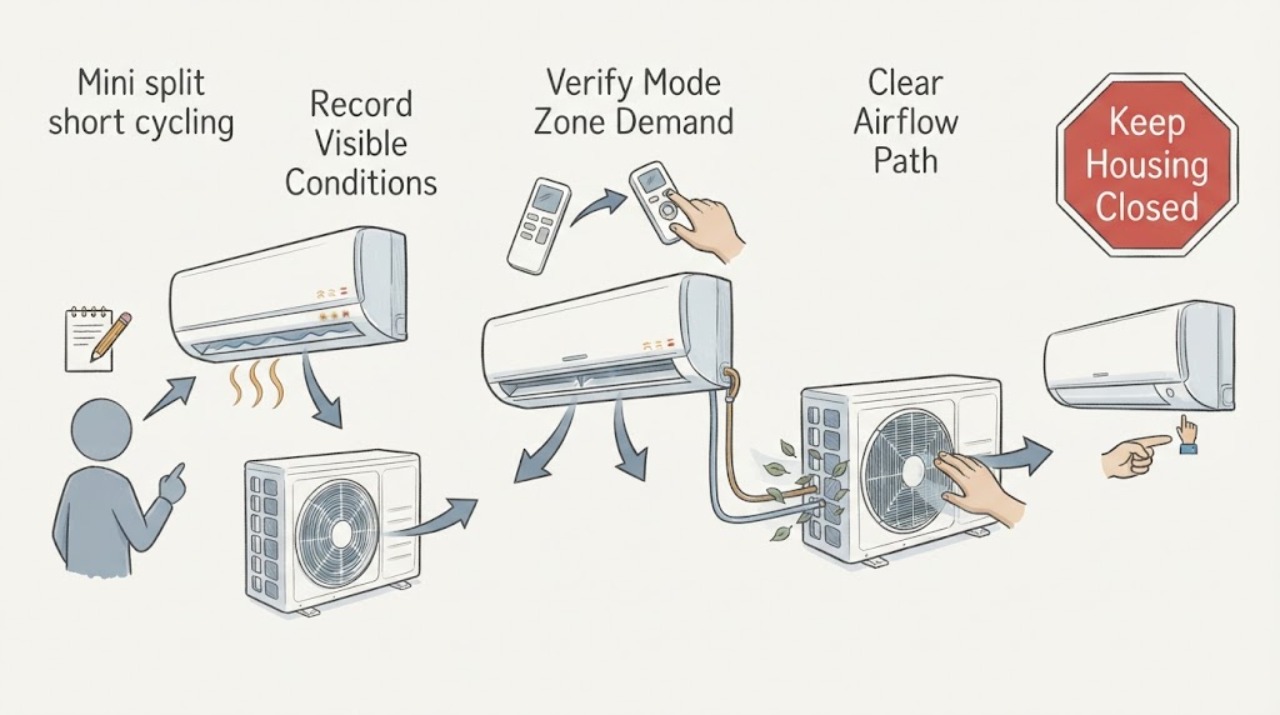
Work through in order
Diagnostic checks
Use only checks that match the exact appliance or system and its official guide.
-
Check 1
From a safe position, set the mini split to its normal mode and observe one affected zone and the outdoor unit without opening either unit. Record whether the system is in cooling, heating, dry, auto, or fan mode; whether the indoor fan and outdoor unit start together; whether the room is already near the setpoint; and whether the unit restarts soon after stopping.
Expected result: The system changes speed or pauses after reaching the target, pauses during a documented heat-pump defrost, or repeatedly starts and stops while the zone still needs heating or cooling; note whether every zone or only one head is affected.
Next step: Continue with the mode and airflow checks only when there is no smoke, burning smell, water hazard, abnormal harsh noise, or breaker trip; save any displayed code and the recorded pattern for service.
Stop if: Stop operation for smoke, a burning odor, sparking, exposed wiring, refrigerant hissing, a strong new mechanical noise, repeated breaker trips, or a unit that becomes dangerously hot.
Why this matters
Why: A load-matching speed change or documented defrost may be normal. Repeated starts before the demand is satisfied are more consistent with short cycling, while a single affected head points toward its sensor, airflow, or zone controls rather than proving a compressor failure.
-
Check 2
Using the remote or wall controller only, verify the selected mode, setpoint, fan setting, schedule, and any sleep or energy-saving program. In a multi-zone system, check each indoor head for a conflicting mode or a zone that has already satisfied its demand; keep the sensor or remote away from direct sun and obvious heat sources without relocating fixed equipment.
Expected result: The rapid cycling occurs only in one mode, on one zone, during a schedule, when the setpoint is close to room temperature, or when a remote sensor is in a warm or sunny location; alternatively, settings are consistent and the symptom affects all calls.
Next step: Correct only an obvious setting or schedule mismatch according to the model manual, then observe without repeatedly forcing restarts. If settings are correct or the issue returns, proceed to filter and outdoor-airflow inspection and plan service.
Stop if: Do not alter wiring, bridge terminals, open the controller, defeat a sensor, or keep testing if the system reports a protection fault or any hazard sign.
Why this matters
Why: A mode, schedule, sensor-location, or zone-demand pattern can make the system remove its call without indicating compressor damage. Consistent cycling across settings and zones makes a shared control, airflow, refrigerant, power, or sizing issue more plausible.
-
Check 3
Turn the mini split off and, after the fan stops, inspect the removable indoor filter and the visible inlet and discharge area from ordinary safe access. Clean or reseat the filter only by the installed manufacturer's instructions; do not remove the coil, blower wheel, cover, or electrical parts.
Expected result: The filter is visibly loaded with dust, wet, damaged, or incorrectly seated; airflow is weak or uneven; the visible coil has frost or ice; or the filter and airflow appear normal.
Next step: Restore only a clean, dry, correctly seated filter and make no other changes. If ice or water is present, leave the system off and arrange qualified service; if airflow remains weak after the permitted filter care, arrange service rather than deep-cleaning or dismantling the unit.
Stop if: Do not scrape ice, spray cleaner into the coil, reach into a moving blower, remove panels, or operate the system with a wet, damaged, or missing filter.
Why this matters
Why: A loaded filter or blocked inlet can restrict airflow and contribute to overheating or protective shutdown. Frost, water, or persistent weak airflow can indicate a deeper airflow, drain, or refrigerant problem; a clean filter does not rule out an indoor coil or blower fault.
-
Check 4
With the system and its accessible disconnect state safely off, make a visual inspection around the outdoor cabinet. Remove only loose leaves or objects that can be lifted away without touching wiring or coil fins, and verify that shrubs, stored items, snow, or other barriers are not crowding the air path; follow the model manual for any cleaning method.
Expected result: The outdoor air path is blocked, the coil is visibly dirty or damaged, the fan does not run during a normal call, ice is present, or the cabinet and airflow path look clear.
Next step: Clear only safe loose obstructions and observe one normal call without forcing repeated starts. If the fan does not run, the coil is damaged or iced, or the symptom persists with a clear path, stop and provide the observations to a qualified HVAC technician.
Stop if: Do not remove the outdoor cover, wash toward electrical parts, straighten fins, touch refrigerant tubing, or continue operation when the fan is stalled, the coil is heavily iced, or a line is damaged.
Why this matters
Why: An obstructed or fouled outdoor heat exchanger can raise operating stress and contribute to protective cycling. A fan fault, ice, damaged coil, or clear outdoor unit with persistent cycling requires diagnosis beyond loose-debris removal.
-
Check 5
Before resetting anything, photograph and record any display code, flashing indicator, frost or ice, condensate or oil-like residue, hissing or bubbling sound, and whether the unit loses cooling or heating capacity. Compare the symptom with the exact model manual rather than assuming a code or sound has the same meaning on every mini split.
Expected result: There is no code or physical warning, a code returns after a normal reset, frost or ice returns, water appears, or cooling or heating falls while the compressor starts and stops.
Next step: Leave the system off for frost, water, suspected refrigerant leakage, or a recurring protection code and arrange qualified HVAC service. Give the technician the code, mode, zone, weather/load context, and photographs.
Stop if: Do not add refrigerant, loosen fittings, recover refrigerant, probe a service port, bypass a pressure switch, or repeatedly reset a returning fault.
Why this matters
Why: Recurring codes, ice, leakage, or reduced capacity can point to pressure protection, airflow, a refrigerant leak, drain trouble, or a control fault. A lack of a code does not establish that the compressor or sealed system is healthy.
-
Check 6
Compare the cycling history with the installation and room conditions: note whether it began immediately after installation, occurs only in mild weather or one small room, follows a room-temperature or insulation change, or affects a multi-zone system only when other heads are off. Use the equipment label and model manual only to identify the system; do not change capacity settings or wiring.
Expected result: The mini split reaches the setpoint very quickly in a small or lightly loaded zone, the problem has existed since installation, the issue is new after a building or control change, or the system cycles despite a sustained load and normal airflow.
Next step: Document the room, zones, setpoints, weather, and cycle pattern and request a qualified assessment of sizing, sensor placement, control demand, airflow, refrigerant circuit, and compressor protection. Do not solve a sizing suspicion by changing the charge or installing a part yourself.
Stop if: Stop if the system is tripping protection, overheating, leaking, icing, or producing abnormal electrical or mechanical signs; leave capacity, charge, and control changes to a qualified technician.
Why this matters
Why: A low load or incorrect sizing can make a system satisfy demand quickly, while a new symptom after an installation or control change raises a commissioning or control question. Cycling under a sustained load with normal airflow is less consistent with simple oversizing and needs technical diagnosis.
Use your observations
Decision map
Find the observation that best matches what you see, then follow the next safe action.
-
PATH 01Safety boundary
What you see
The compressor speed changes or the system pauses after the zone reaches its target, or a heat-pump pause matches the model's documented defrost behavior and does not repeatedly restart while demand remains.
Do this next
Use the exact model manual to confirm the indicator and observe whether comfort is maintained. Escalate if the pauses become rapid starts, the zone cannot hold temperature, or a code or hazard appears.
Why this path and its safety boundary
Why it matters: This pattern is less consistent with compressor short cycling. Inverter capacity control and defrost can create pauses that should not be diagnosed as a fault from timing alone.
Safety stop: Do not force a longer run by changing wiring, overriding defrost, or repeatedly cycling power.
-
PATH 02Safety boundary
What you see
Only one indoor head cycles, its filter or airflow is weak, or the behavior follows a remote/sensor location, mode, schedule, or setpoint condition while other zones operate normally.
Do this next
Correct only the visible filter, obstruction, or documented setting mismatch; then record whether the zone recovers. Request service if airflow remains weak or the cycle pattern returns with correct settings.
Why this path and its safety boundary
Why it matters: The evidence favors a zone-level airflow, sensor, controller, or demand issue over a failed shared compressor, although the outdoor unit still needs professional assessment if it is starting and stopping with the call.
Safety stop: Do not relocate fixed sensors, open the head, bridge controls, or continue if ice, water, electrical damage, or unusual noise is present.
-
PATH 03Safety boundary
What you see
Multiple zones cycle, indoor airflow is restricted, the indoor filter is loaded, or the outdoor cabinet has blocked or fouled airflow; the system improves only briefly after a permitted filter or loose-debris correction.
Do this next
Keep filters correctly installed and the outdoor path clear, then arrange professional cleaning and performance checks if cycling persists. Provide the before-and-after observations rather than repeatedly restarting the system.
Why this path and its safety boundary
Why it matters: A system-wide airflow or heat-exchange limitation is more likely than a single remote error. A brief improvement does not prove that the compressor or refrigerant circuit is sound.
Safety stop: Stop for icing, water, a stalled outdoor fan, damaged coil, or any need to wash, dismantle, or touch electrical or refrigerant components.
-
PATH 04Safety boundary
What you see
The unit starts and stops while the zone still needs conditioning and there is recurring frost or ice, a displayed protection code, reduced capacity, water, hissing, or an abnormal outdoor-unit sound.
Do this next
Turn the system off, preserve the code and photographs, and arrange qualified HVAC diagnosis of airflow, controls, refrigerant circuit, and compressor protection.
Why this path and its safety boundary
Why it matters: This combination makes a simple setpoint explanation less likely and raises airflow, pressure/refrigerant, control, or compressor-protection concerns. The visible symptom cannot identify which sealed-system or electrical part has failed.
Safety stop: Do not add refrigerant, open panels, test live voltage, bypass protection, or run the unit to see whether it fails again.
-
PATH 05Safety boundary
What you see
The system has normal airflow and no hazard signs, but it satisfies a small or lightly loaded zone very quickly, the behavior is weather-dependent, or the pattern has existed since installation.
Do this next
Request a commissioning or sizing assessment with room conditions, zone settings, cycle history, and installation details. Keep the system settings within the manual and do not alter charge, controls, or capacity yourself.
Why this path and its safety boundary
Why it matters: Low load, sensor placement, zoning, or equipment sizing becomes more plausible than a sudden compressor defect. Carrier notes that an oversized ductless system can cool or heat a space too quickly and short cycle.
Safety stop: Escalate sooner if short cycling begins under a sustained load, comfort or humidity worsens, or any code, ice, leak, trip, or abnormal sound appears.
Helpful context
Understand the symptom
Confirm that the pattern is actually short cycling
A ductless system may change compressor speed, reduce airflow, pause when the room reaches its target, or pause briefly in a heat-pump defrost sequence. Those behaviors are different from repeated starts and stops that happen before the zone is comfortable. Write down whether the symptom occurs in cooling, heating, or both, which indoor head is calling, how long each run lasts in broad terms, and whether the outdoor unit restarts soon after stopping. Carrier describes inverter-driven compressors as adjusting speed to match the load, while Trane defines short cycling as shutting down before a cooling cycle is complete. Use the model manual for the unit's normal indicator and defrost behavior rather than applying a fixed timer to every mini split.
Start with airflow and accessible operating conditions
Restricted indoor airflow can make a mini split work harder and may trigger protective shutdowns. A clogged filter, a blocked return or discharge area, or leaves and dirt packed around the outdoor cabinet can also reduce heat exchange. With the system off, inspect only the user-accessible filter and the area around the outdoor unit; follow the exact manufacturer's cleaning instructions and do not bend delicate coil fins or remove covers. If airflow is weak, the coil is icing, water is appearing, or the outdoor fan behaves abnormally, stop treating the symptom as a simple filter issue and arrange service.
Use the pattern to separate load, control, and sealed-system causes
If the room reaches the setpoint quickly only in mild weather, a low load, sensor location, zone setting, or an oversized system becomes more plausible. If the indoor airflow is weak or ice is present, airflow or a sealed-system problem needs attention. If airflow is normal but the outdoor unit stops and restarts with a code, a control signal, pressure protection, or compressor-related fault is possible. These observations narrow the service call; they do not authorize refrigerant work, electrical testing, compressor replacement, or a change to the system charge.
Protect the compressor while the cause is unresolved
Frequent starts place extra stress on the system and can reduce comfort and humidity control. Do not repeatedly cycle the breaker or remote to force a run. Capture the display, operating mode, outdoor and indoor observations, and the time pattern, then leave the unit off when a protective shutdown or hazard is present. A qualified HVAC technician can check the demand signal, controls, coil condition, refrigerant circuit, and compressor without turning a homeowner observation into live electrical or sealed-system work.
Safety boundary
Stop conditions
- Stop using the mini split for smoke, burning odor, sparking, exposed wiring, repeated breaker trips, a dangerously hot cabinet, or a harsh new mechanical noise.
- Stop for frost or ice that returns, water leakage, suspected refrigerant leakage, a stalled outdoor fan, damaged tubing or coil, or a recurring protection or error code.
- Do not open electrical covers, measure live voltage, bridge terminals, bypass pressure or temperature protection, or disassemble the indoor or outdoor unit.
- Do not add, release, recover, or alter refrigerant; do not loosen line-set fittings or substitute a compressor, control, sensor, or capacitor based only on a symptom.
- Do not repeatedly cycle the remote, breaker, or disconnect to force a run after a protective shutdown; preserve the code and call a qualified HVAC technician.
Only after diagnosis
Potential parts
- indoor air filter
Consider this category only if the exact unit's filter is damaged, missing, or cannot be restored by the manufacturer's cleaning procedure and the technician confirms it is restricting airflow.
Confirm the exact indoor-unit model, filter dimensions, filter type, and manufacturer's fit information before ordering; do not operate with an improvised filter. - temperature sensor or thermistor
Consider this category only after a qualified diagnosis finds that a sensor is misreading or failed and the sensor, wiring, and connector are the documented cause of the cycling pattern.
Confirm the exact indoor-unit model, sensor specification, connector, and manufacturer procedure; a cycling symptom alone does not establish compatibility or failure. - control board or inverter control assembly
Consider this category only when model-specific diagnostics identify an intermittent demand, control, or inverter-board fault after airflow and sealed-system causes are assessed.
Have a qualified technician verify the exact model, revision, firmware or configuration requirements, and electrical safety before any replacement. - compressor assembly
Consider this category only if qualified testing confirms compressor or compressor-drive failure after controls, airflow, pressure, refrigerant, and power causes are ruled out.
Confirm the exact outdoor-unit model, refrigerant design, electrical requirements, and manufacturer's service procedure; never select a compressor from the short-cycling symptom alone.
When checks do not resolve it
Need a professional?
Arrange qualified HVAC service when short cycling continues after the documented mode, filter, and accessible-airflow checks; when it affects multiple zones; when airflow is normal but the compressor still starts and stops; or when the symptom began after installation or a control change. Request prompt service for recurring codes, icing, water, reduced capacity, abnormal noise, or a stalled fan. Leave the system off for smoke, burning odor, sparking, exposed wiring, repeated breaker trips, suspected refrigerant leakage, or severe mechanical noise and seek appropriate emergency or qualified help from a safe location.
Safety scope: This article supports ordinary-access observation, controller checks, manufacturer-approved filter care, and removal of loose outdoor obstructions only. It does not authorize live electrical testing, panel removal, refrigerant work, line-set work, control bypass, compressor diagnosis by touch, or part replacement.
Common questions
FAQ
How can I tell whether a mini split is short cycling or just modulating?
A variable-speed mini split may change compressor speed or pause after the room reaches its target, and a heat-pump system may pause for a documented defrost sequence. Short cycling is repeated starting and stopping before the zone is satisfied. Record the mode, zone, outdoor-unit behavior, and any code, then compare the pattern with the exact model manual rather than using a universal timer.
Can a dirty mini-split filter cause short cycling?
It can contribute to restricted airflow and protective shutdowns. Turn the system off, inspect the removable filter, and clean or reseat it only according to the manufacturer's instructions. Weak airflow, icing, water, or cycling that continues with a clean filter needs qualified diagnosis rather than deeper homeowner disassembly.
Can an oversized mini split short cycle?
Yes. Carrier and Mitsubishi Electric explain that an oversized ductless system can satisfy a small or lightly loaded space too quickly, causing repeated starts and stops and poorer humidity control. This is a sizing or commissioning question; do not change refrigerant charge, controls, or capacity settings yourself.
Should I add refrigerant when a mini split short cycles?
No. Low refrigerant is only one possible cause, and refrigerant does not get safely corrected by guessing from a cycle pattern. Ice, hissing, reduced capacity, or a recurring protection code are reasons to leave the system off and have a qualified technician inspect the sealed system and find any leak.
What should I give the HVAC technician?
Provide the indoor and outdoor model information, affected zone, mode and setpoint, broad start/stop pattern, filter and outdoor-airflow observations, photos of codes or ice, and whether the issue began after installation or a control or building change. Mention breaker trips, odors, leaks, unusual sounds, reduced capacity, and any permitted cleaning that changed the symptom.
Read the exact guide
Official sources
- What Is a Mini Split Air Conditioner?Carrier Residential · General manufacturer overview of ductless mini-split systems; actual modes, indicators, and defrost behavior vary by model.
- Mini Split Repair Guide | Troubleshooting & ServiceCarrier · Manufacturer HVAC education for ductless mini splits; use the installed system's manual for model-specific operation.
- AC Short Cycling? Learn Why and What to DoTrane · Manufacturer air-conditioning troubleshooting explanation used to distinguish repeated premature shutdown from normal operation; it is not a model-specific mini-split manual.
- What Is AC Short Cycling: Causes, Effects, and TroubleshootingCarrier · General Carrier air-conditioning guidance used for the definition and cause categories; ductless model behavior remains model-specific.
- What Size Mini Split Do I Need? | Mini Split CalculatorCarrier · Manufacturer sizing education; a qualified load calculation and installed-system assessment control any sizing decision.
- Mythbusters: the Bigger the HVAC System, the BetterMitsubishi Electric HVAC US · Manufacturer HVAC education used for the oversizing and wear branch; an installed system needs a model-specific load and commissioning assessment.
- TROUBLESHOOTINGDaikin Comfort · Manufacturer service manual for specified Daikin outdoor-unit controls; used only to show why code and control diagnosis are model-specific, not as a homeowner wiring procedure.
- Ductless Mini Split MaintenanceCarrier · Manufacturer maintenance guidance for ductless systems; follow the exact installed model's instructions and local safety requirements.
Community feedback
Share a repair observation
Share a plain-text repair observation. Accepted observations are published automatically; this page may take a moment to update.