
On this page
Start here
Quick answer
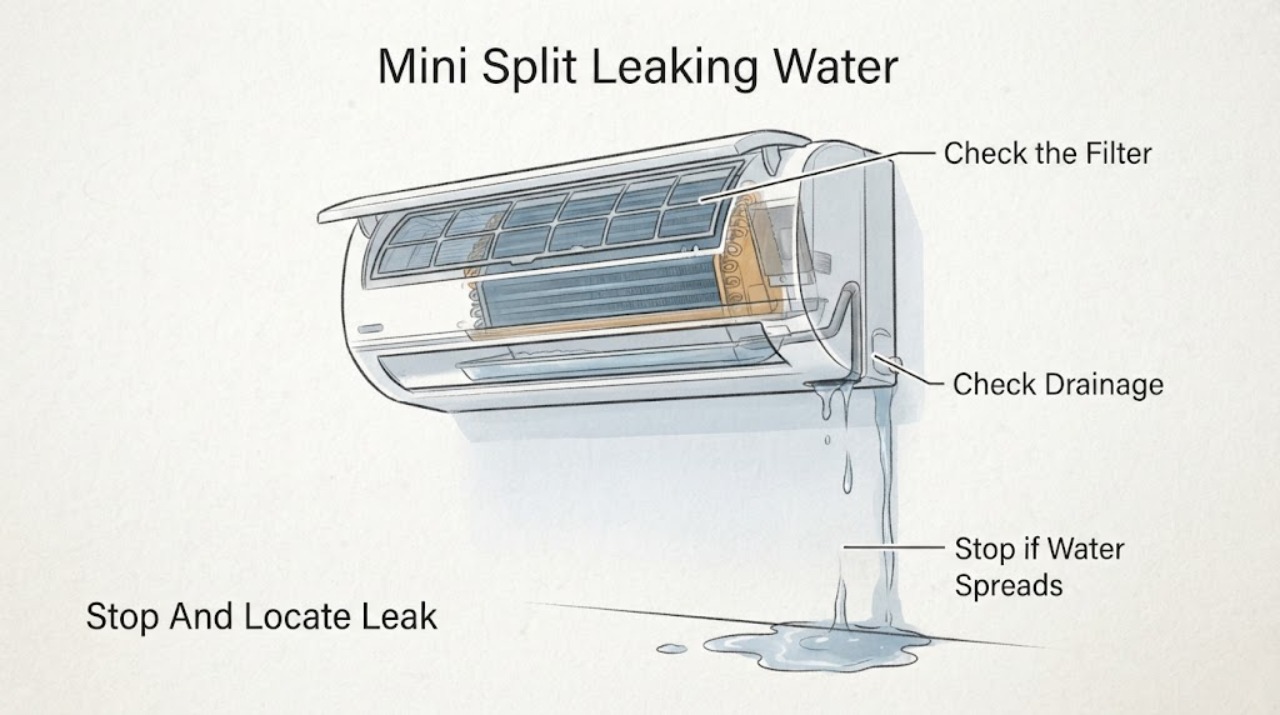
A Mitsubishi mini split leaking from the indoor unit most often has a restricted condensate drain, a dirty filter or coil that is reducing airflow, a leaking drain connection or pan, or an installation slope problem. Turn the system off, contain the water, and identify whether the water is from the indoor head, the visible drain outlet, or only the outdoor unit. Clean only a user-removable filter according to the exact Mitsubishi manual and inspect visible drain routing without opening the cabinet. Water near electrical parts, a returning leak, ice, weak airflow, poor cooling, a tilted unit, or a hidden drain problem needs qualified HVAC service; do not open the refrigerant circuit or internal panels.
Before you begin
Safety first
- This article covers shutting down, containing water, locating the leak, cleaning a user-removable filter, checking visible drain routing, observing ice and airflow, and one safe supervised retest. A qualified technician must handle internal covers, pan or pump access, mounting and drain correction, electrical diagnosis, coil and fan service, and refrigerant leak or charge work.
Work through in order
Diagnostic checks
Use only checks that match the exact appliance or system and its official guide.
-
Check 1
Turn the mini split off with its normal controller, contain the water with a towel or shallow container, and inspect from outside the cabinet. Record whether the water is from the indoor head, running down a wall or ceiling, appearing at a visible drain connection, or coming only from the outdoor unit.
Expected result: The indoor unit is dripping; the wall or ceiling is wet; water is only beneath the outdoor unit during heating; the indoor drain outlet is dry; or water is near a receptacle, disconnect, wiring, or other electrical part.
Next step: Leave the system off while an indoor leak or electrical exposure is present. If the water is only outdoor heating discharge and there is no indoor moisture, keep the area clear and consult the model manual; otherwise continue only with the safe filter and visible drain checks.
Stop if: Stop immediately for smoke, burning odor, arcing, a damaged cord or disconnect, water near electrical parts, ceiling damage, or an uncontrolled leak.
Why this matters
Why: Indoor water makes a condensate collection, drain, pan, joint, airflow, or installation issue more likely. Outdoor water during heating may be normal heat-pump drainage, but it should not be confused with an indoor leak. Water near electrical equipment is a safety stop rather than a routine diagnostic clue.
-
Check 2
With the unit stopped, remove only the filter that the Mitsubishi owner's manual identifies as user-accessible. Inspect it for dust or matting and vacuum or wash it by the manual's method; let a washed filter dry completely before reinstalling it.
Expected result: The filter is visibly dirty, airflow had been weak, the filter is clean and airflow is normal, or the filter cannot be reached without tools or a fixed cover.
Next step: Reinstall the dry filter and never run the unit without it. Keep the system off if water is active, ice is visible, or the leak is near electrical parts; proceed to visible checks only when the area is safe.
Stop if: Do not remove the indoor coil cover, fan guard, drain pan, or electrical panel, and do not force a filter that does not fit.
Why this matters
Why: Restricted filtration can reduce airflow and can contribute to excess condensation or icing, but it does not prove that the drain is clear. A clean filter shifts attention to the drain, pan, installation, coil, or sealed system. A filter that is not user-accessible is a service boundary.
-
Check 3
Trace the visible condensate hose or pipe from the indoor unit as far as it can be viewed safely. Look for a crushed or sharply kinked section, a separated joint, standing water, debris at the outlet, or a route that cannot drain away. Do not open the cabinet or apply pressure, wire, or chemicals to a hidden line.
Expected result: The hose is kinked, disconnected, visibly blocked, or poorly routed; the outlet is clear and the line drains; or the line is hidden or inaccessible.
Next step: Correct only a plainly visible external issue when the exact manual permits it, then keep the unit off until the water stops. Arrange service for a hidden blockage, recurring backup, pump-equipped installation, or any repair requiring cabinet access.
Stop if: Do not force the hose, push a wire into the drain, use compressed air or high pressure, pour improvised chemicals, or disconnect a concealed joint.
Why this matters
Why: A kink, gap, or poor route can back up condensate and make it leave the indoor unit. A clear visible outlet does not rule out a blockage inside the line, a failed pump, a pan problem, or an inaccessible joint. Hidden drainage needs professional access.
-
Check 4
Without removing covers, inspect the indoor air outlet and visible surfaces for frost or ice. Note weak airflow, reduced cooling, unusual hissing, or ice on the indoor coil or refrigerant line; do not scrape or touch a frozen coil.
Expected result: Ice or frost is present, airflow is weak, cooling has declined, hissing is heard, or there is no ice and airflow is normal.
Next step: Leave the system off and let ice melt naturally. If ice returns, cooling remains poor, or hissing accompanies the leak, arrange qualified HVAC diagnosis; do not attach gauges or add refrigerant.
Stop if: Do not open the refrigerant circuit, bend line-set tubing, chip ice, apply a flame or heat gun, or operate continuously while the coil is frozen or the indoor leak continues.
Why this matters
Why: Ice with weak airflow can follow filter or coil restriction. Persistent ice, poor cooling, or hissing can indicate low refrigerant or another internal fault, but the pattern cannot identify a particular part. No ice and normal airflow make an airflow-freeze pattern less likely but do not clear a drain or pan issue.
-
Check 5
From outside the cabinet, compare the installation with the Mitsubishi manual and look for an indoor unit tilted toward the room, a drain route without a visible fall, staining below one corner, or a cracked or shifted pan or connection only if it is already visible without removing a cover.
Expected result: The unit appears tilted, water stains one corner, a visible drain joint or pan is damaged, the drain route lacks a fall, or visible installation surfaces look sound.
Next step: Do not shim, remount, reseal, or replace the pan yourself. Photograph the safe visible findings, keep the unit off, and arrange qualified ductless service for a slope, joint, mounting, pan, or hidden-connection diagnosis.
Stop if: Do not remove the wall unit, loosen mounting hardware, drill into the wall, open the cabinet, or work around line-set, electrical, or condensate connections.
Why this matters
Why: Mitsubishi guidance identifies inadequate slope, drain-joint gaps, and improper installation as leakage risks. A sound visible installation does not rule out a concealed pan, joint, pump, or line fault.
-
Check 6
After a dry filter is reinstalled and any plainly visible external issue has been addressed exactly as the manual permits, perform at most one brief supervised cooling retest only when there is no active indoor water, ice, electrical exposure, or wall damage. Watch the indoor unit and drain outlet from a safe position.
Expected result: No indoor water returns and the outlet behaves normally; the leak returns quickly; water appears as cooling starts; the drain remains dry; or cooling, airflow, ice, odor, or electrical symptoms are abnormal.
Next step: Stop the test at the first sign of renewed indoor water. Keep the system off and provide the technician with the leak location, mode, filter and drain observations, ice or airflow findings, installation concerns, and photos.
Stop if: Do not repeatedly cycle the unit to reproduce the leak or keep operating for comfort when water reaches a wall, ceiling, floor, or electrical area.
Why this matters
Why: A dry unit after a filter or visible-route correction supports that accessible cause, although recurrence still needs service. A rapid return, a dry outlet with indoor water, or a leak that begins with cooling points to a concealed drain, pan, pump, slope, coil, or refrigeration issue.
Use your observations
Decision map
Find the observation that best matches what you see, then follow the next safe action.
-
PATH 01Next step
What you see
Water is seen only below the outdoor unit during heating, with no drip from the indoor head and no wet wall or ceiling.
Do this next
Keep the outdoor discharge area safe and clear and compare timing with the model manual. Arrange service if water enters the building, creates an unsafe condition, or occurs outside the expected operating pattern.
Why this path and its safety boundary
Why it matters: Outdoor heating drainage is more likely than an indoor condensate leak; Mitsubishi installation guidance notes that heating operation can produce drainage from the outdoor unit.
-
PATH 02Next step
What you see
The filter is dirty and airflow is weak, with frost or water appearing from the indoor unit but no electrical hazard.
Do this next
Clean and dry the user-removable filter, leave the system off until any ice melts naturally, and perform no more than one safe retest. Call a qualified technician if water or ice returns.
Why this path and its safety boundary
Why it matters: Restricted airflow and condensation or icing are more likely than a leak caused only by the cabinet shell, though a drain restriction can coexist.
-
PATH 03Next step
What you see
Water comes from the indoor unit, the drain outlet is dry or backed up, and the filter is clean or the leak persists after cleaning.
Do this next
Keep the system off and address only a plainly visible external problem permitted by the manual. Have a technician inspect and test the full condensate path and joints; do not improvise pressure, wire, or chemical clearing.
Why this path and its safety boundary
Why it matters: A clogged or poorly routed drain, separated joint, condensate pump, pan connection, or concealed blockage is more likely than the filter alone.
-
PATH 04Next step
What you see
The indoor unit appears tilted, water stains one corner, a drain joint has a gap, or a visible pan or connection is damaged or shifted.
Do this next
Do not shim, reseal, remount, or remove the unit. Stop operation and arrange qualified ductless service for mounting, slope, pan, and joint correction, with wall or ceiling damage assessed.
Why this path and its safety boundary
Why it matters: An installation slope, drain-joint, pan, or mounting fault is more likely; condensate can bypass the intended route even when the outlet is open.
-
PATH 05Safety boundary
What you see
Ice returns, airflow or cooling remains poor, or hissing accompanies the leak after the filter is clean and the visible drain route is reasonable.
Do this next
Keep the unit off and arrange qualified HVAC service for airflow, coil, refrigerant, electrical, and leak diagnosis. Do not attach gauges, add refrigerant, or order a sealed-system part from symptoms alone.
Why this path and its safety boundary
Why it matters: Low refrigerant, coil or fan restriction, or another internal fault becomes more likely; the symptoms do not identify the failed component or confirm a refrigerant leak.
Safety stop: Stop immediately for smoke, burning odor, arcing, exposed wiring, or water near electrical parts.
Helpful context
Understand the symptom
First identify where the water is coming from
A mini split has an indoor air handler and an outdoor unit connected by refrigerant lines. Water from the indoor head, a wall, or a ceiling cassette is not the same symptom as water below the outdoor unit. Mitsubishi's installation guidance notes that a clogged drain can make water leave the indoor unit, while heating operation can produce drainage from the outdoor unit. Stop and contain an indoor leak before trying to distinguish a normal outdoor discharge from a fault.
Drain slope and joints matter
Condensate has to travel through the drain route rather than pool inside the unit. Mitsubishi's published FAQ identifies inadequate drainpipe slope and gaps at drain joints as possible causes of leakage, and also notes that an obstruction in the cool-air path can create condensation droplets. A clear-looking outlet does not prove that a concealed hose, joint, pan, or pump is sound.
Use the filter as an airflow check, not as a complete diagnosis
Mitsubishi says many of its filters are removable and washable and recommends keeping airflow and filters in good condition. A dirty filter can make cooling performance worse, but a clean filter will not repair a blocked drain, damaged pan, poor installation, or refrigerant problem. Deep coil, drain, electrical, and refrigerant work belongs with a licensed HVAC contractor.
Safety boundary
Stop conditions
- Turn the system off and stop testing for water near electrical parts, smoke, burning odor, arcing, damaged wiring, ceiling damage, or an active leak that cannot be contained safely.
- Do not remove the indoor cabinet, drain pan, fan guard, electrical cover, or wall-mounted unit; do not loosen line-set or condensate connections.
- Do not open the refrigerant circuit, attach gauges, add refrigerant, bend tubing, chip ice, apply a flame or heat gun, or test live voltage.
- Do not force a drain hose, push wire into it, use compressed air or high pressure, or pour an improvised chemical treatment; follow only the exact model manual or leave drain clearing to a technician.
- Do not keep operating a leaking or frozen unit to reproduce the symptom. Give the technician the leak location, operating mode, filter, drain, ice, airflow, and installation observations.
Only after diagnosis
Potential parts
- Mitsubishi mini split air filter
Consider this category only if the user-removable filter is damaged, missing, or will not fit after the manual-directed cleaning check.
Confirm the exact indoor-unit model, filter dimensions, frame, and washable or replaceable design before ordering. - Mini split condensate drain hose or joint
Consider this category only when a technician confirms a cracked, separated, crushed, or failed model-specific hose or drain joint after tracing the full path.
Confirm the exact indoor-unit model, drain outlet, hose dimensions, joint type, routing, and required slope before ordering or installing. - Mini split indoor drain pan
Consider this category only if professional inspection confirms that a cracked, corroded, warped, or incorrectly seated pan is the leak source.
Confirm the exact indoor-unit model and pan orientation; pan access and replacement require qualified service. - Condensate pump
Consider this category only if the installation uses a condensate pump and a technician confirms that the pump or float fails after the drain path is checked.
Confirm whether the unit has a pump, the exact model and electrical specification, float arrangement, lift requirement, and approved replacement procedure.
When checks do not resolve it
Need a professional?
Arrange qualified HVAC service for any indoor leak that returns after the filter and safe visible checks, a dry outlet with indoor water, a hidden or pump-equipped drain, a tilted unit, a damaged pan or joint, recurring ice, weak airflow, poor cooling, hissing, or a fault requiring cabinet access. Seek prompt help for water near electrical parts, ceiling or wall damage, smoke, burning odor, arcing, exposed wiring, or an uncontrolled leak.
Safety scope: This article covers shutting down, containing water, locating the leak, cleaning a user-removable filter, checking visible drain routing, observing ice and airflow, and one safe supervised retest. A qualified technician must handle internal covers, pan or pump access, mounting and drain correction, electrical diagnosis, coil and fan service, and refrigerant leak or charge work.
Common questions
FAQ
Why is my Mitsubishi mini split leaking water inside?
The likely categories are a clogged or poorly sloped condensate drain, a leaking drain joint or pan, airflow-related condensation, a dirty filter or coil, improper installation, or an internal refrigeration issue. Turn the system off and arrange service if the leak returns, water is near electrical parts, or ice or poor cooling is present.
Can a dirty Mitsubishi mini split filter cause water?
A dirty filter can restrict airflow and contribute to condensation or icing, but it does not prove that the drain is clear. Clean only the user-removable filter according to the exact manual, let it dry fully, and call a qualified technician if water or ice returns.
Is water under the outdoor Mitsubishi unit normal?
It can be normal during heating or defrost, because Mitsubishi installation guidance notes that heating operation may produce outdoor drainage. Water dripping from the indoor head or entering a wall or ceiling is a different symptom and needs a condensate and equipment diagnosis.
Can I clear a Mitsubishi mini split drain myself?
You may inspect the visible hose and outlet and correct only a plainly visible external issue when the exact manual allows it. Do not force the hose, push a wire, use compressed air or high pressure, or pour an improvised chemical into a concealed drain. Recurring, hidden, or pump-equipped drainage needs a qualified technician.
Should I run the mini split while it is leaking?
No. Turn it off when water comes from the indoor unit, reaches a wall or ceiling, or approaches electrical parts. One brief supervised retest is reasonable only after the filter is dry, visible conditions are corrected as the manual permits, and there is no ice, active leak, damage, or electrical exposure.
Does a leaking Mitsubishi mini split need a new drain pan?
Not automatically. A blocked drain, leaking joint, poor slope, filter or airflow issue, pump, or installation fault can look similar. Consider a drain pan only after a technician confirms it is cracked, corroded, warped, or incorrectly seated and checks the rest of the condensate path.
Read the exact guide
Official sources
- What is a mini-split?Mitsubishi Electric HVAC US · Official Mitsubishi Electric HVAC US system overview; it supports component roles, not model-specific repair instructions.
- HVAC Maintenance Tips to Ensure Equipment Longevity and EfficiencyMitsubishi Electric HVAC US · Official Mitsubishi Electric HVAC US maintenance guidance; the assigned Mitsubishi system manual controls model-specific homeowner tasks.
- Drain Water Lift-Up Kit PAC-KE04DM-F Installation ManualMitsubishi Electric · Official Mitsubishi Electric installation manual; it is not a substitute for the exact manual for an individual indoor-unit model.
- FAQ - Frequently Asked QuestionsMitsubishi Electric · Official Mitsubishi Electric FAQ; regional product and model manuals control the exact installation and service procedure.
Community feedback
Share a repair observation
Share a plain-text repair observation. Accepted observations are published automatically; this page may take a moment to update.