
On this page
Start here
Quick answer
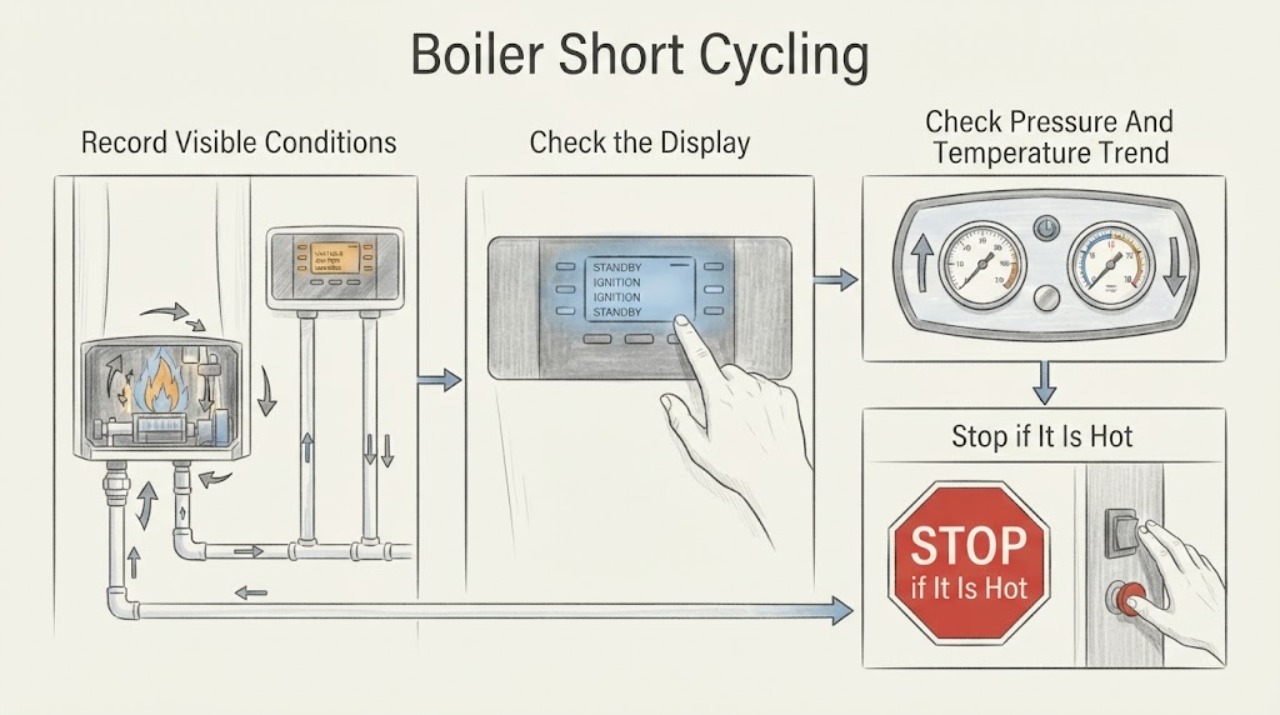
A Navien boiler is short cycling when it starts and stops repeatedly during one thermostat call instead of running long enough to heat the zone. The pattern can come from a small current heat load or oversized capacity, a supply temperature or differential control setting, restricted circulation, air or low system pressure, a zone or thermostat problem, or a vent, sensor, or combustion fault. First record which zones are calling, the display status, cycle timing, system pressure and temperatures from the installed gauges, and any error code. Check only visible, model-approved items such as thermostat demand, exposed valve position, obvious vent or intake obstruction, and the Navien manual's owner checks; do not open the cabinet or adjust gas, combustion, installer parameters, or safety controls. If pressure rises abnormally, water or gas leaks, the boiler overheats, an error returns, carbon-monoxide alarm sounds, or short cycling persists after safe observations, leave the boiler off as appropriate and arrange qualified boiler service.
Work through in order
Diagnostic checks
Use only checks that match the exact appliance or system and its official guide.
-
Check 1
During a normal call for space heat, observe the boiler from a safe position and record the time from ignition to shutdown, the time off before the next start, which thermostat or zone is calling, whether the circulating pump continues, and whether the thermostat is satisfied between starts. Do not open the cabinet or touch hot piping.
Expected result: The thermostat remains calling while the burner repeatedly starts and stops; the thermostat is satisfied between normal cycles; only one small zone is open; several zones call together; or the boiler never completes ignition.
Next step: Continue with the display, pressure, and visible-system checks only when the boiler is stable. If ignition fails, a fault appears, or combustion sounds abnormal, follow the exact manual and arrange service instead of repeatedly resetting the unit.
Stop if: Stop observing and keep clear if there is a gas odor, smoke, flame outside the combustion area, a carbon-monoxide alarm, water near electrical equipment, or any sign of overheating.
Why this matters
Why: Repeated burner cycles during an active call support short cycling. A thermostat-satisfied pattern may be normal control operation, while a single small zone points toward low load or minimum-output mismatch. Failure to complete ignition is a fault pattern rather than ordinary short cycling.
-
Check 2
Use the front-panel controls described in the installed Navien manual to note the space-heating demand icon, combustion or operating status, supply and return readings if shown, outdoor-reset status, and any current or stored error code. Photograph or write down the display before attempting any single manual-approved reset.
Expected result: A heat demand is present with repeated burner stops; an overheat, fan, ignition, sensor, water-pressure, or other error is displayed; no heat demand is shown; or the display values are unavailable on this model.
Next step: Follow the exact manual for the recorded code and use at most the documented reset path. If no demand is shown despite a thermostat call, arrange controls or HVAC service; if an error recurs, stop resetting and provide the code to a qualified technician.
Stop if: Do not clear the error history to hide the pattern, change installer parameters, bridge thermostat terminals, or open the front cover while powered.
Why this matters
Why: Demand with frequent stops keeps a low-load, temperature-limit, flow, or control explanation possible. An error code narrows the next step to the model's troubleshooting procedure and may require service. No demand points toward thermostat or zone controls rather than boiler firing logic.
-
Check 3
From the installed gauge or display, compare the cold system pressure with the boiler's manual and watch the supply and return temperatures during one safe call for heat. Look for a rapid supply rise, little return-water movement, an abnormal pressure rise, or a pressure reading outside the manual's range without removing covers or adjusting the fill system.
Expected result: Pressure is stable in the manual's range and the return warms gradually; pressure rises sharply as the boiler heats; the supply reaches its target almost immediately while the zone remains cool; readings are missing; or water leaks from the system.
Next step: Record the readings and arrange qualified hydronic service for abnormal pressure, leaks, missing gauges, or a rapid supply rise. Do not add water, bleed radiators, change relief-valve settings, or adjust the expansion tank unless the model-specific service procedure and a qualified professional direct it.
Stop if: Stop immediately for a leaking relief valve, rapidly rising pressure, escaping steam or hot water, a damaged pipe, or a surface too hot to approach safely.
Why this matters
Why: Stable pressure and a gradual temperature response make a severe pressure or flow restriction less obvious. A sharp pressure rise can indicate expansion-tank or system problems, while a rapid supply rise with a cool zone can indicate inadequate flow, air, closed valves, or a load too small for the boiler's minimum output.
-
Check 4
With the boiler off or idle and from a safe exterior position, inspect accessible heating pipes, zone valves, circulator indicators, condensate routing, flue termination, and combustion-air intake for an obvious closed valve, leak, blockage, ice, corrosion, or disconnected pipe. Do not remove panels or disturb vent joints.
Expected result: A visible heating valve is closed, a zone actuator does not respond, a pipe or fitting leaks, the condensate path is blocked, the vent or intake is obstructed or damaged, or no exterior abnormality is visible.
Next step: Correct only an unmistakably user-accessible control position identified by the manual; otherwise photograph the finding and arrange boiler or hydronic service. Stop using the unit for damaged or obstructed venting, water leaks, or condensate discharge problems.
Stop if: Do not open the combustion chamber, move venting, clean internal heat-exchanger passages, alter gas piping, or operate the boiler with a damaged or disconnected vent.
Why this matters
Why: A closed valve or nonresponsive zone control can reduce heat transfer and make the boiler reach its limit quickly. Vent, intake, condensate, or leak findings affect combustion or water safety and are not DIY adjustments. An unobstructed exterior does not prove internal flow or combustion is correct.
-
Check 5
Compare the cycling pattern with the active zone and thermostat demand without changing installer settings: note whether it occurs only in mild weather, only when one small zone is open, after a setback, or on every call; note whether other zones heat normally and whether the thermostat is correctly located and calling.
Expected result: Cycling occurs only on a small zone or mild load; it occurs after a setback and then settles; all zones short cycle; one thermostat or zone never maintains temperature; or the boiler runs normally when several zones call.
Next step: Give the cycle log to the installer or hydronic technician so they can verify heat loss, minimum modulation, zoning, flow, outdoor reset, and control differentials. Do not widen differentials, raise setpoints, or alter the heating curve as a trial.
Stop if: Do not bypass thermostats, jump zone controls, disconnect outdoor sensors, or change hidden installer parameters to make the burner run longer.
Why this matters
Why: A pattern limited to a small load or mild weather is consistent with the boiler reaching its minimum practical output or supply target quickly. All-zone cycling, a zone that cannot heat, or a thermostat that drops the call unexpectedly keeps circulation, sizing, control, or sensor faults possible.
-
Check 6
Compile the model and serial information, cycle log, active zone, thermostat behavior, display and error history, pressure and temperature trend, visible valve and vent findings, maintenance history, and any gas, water, condensate, or electrical symptoms before requesting service.
Expected result: Short cycling persists after safe observations; an error returns; the boiler overheats or loses pressure; a zone remains cold; a vent, condensate, gas, or water problem is visible; or the cause remains uncertain.
Next step: Keep the boiler out of service when a safety symptom is present and arrange a qualified boiler or hydronic technician. Provide the complete record so the technician can distinguish low-load cycling from a flow, control, sensor, combustion, or installation fault.
Stop if: Do not repeatedly reset the boiler, run it with a gas or water leak, continue after a carbon-monoxide alarm, or order a control, pump, sensor, or expansion component solely from the short-cycling symptom.
Why this matters
Why: Persistent cycling can require measurements of flow, combustion, heat load, minimum firing rate, sensors, control logic, and expansion-tank or piping performance. These measurements and adjustments are professional work and cannot be established from burner timing alone.
Use your observations
Decision map
Find the observation that best matches what you see, then follow the next safe action.
-
PATH 01Next step
What you see
The boiler reaches its supply target quickly and cycles only when one small zone is open or during mild weather, while the thermostat, pressure, venting, and visible piping appear normal.
Do this next
Have a qualified installer verify heat loss, minimum modulation, zone sizing, outdoor-reset configuration, flow, and whether a control or thermal-storage solution is appropriate. Do not change installer parameters as a consumer experiment.
Why this path and its safety boundary
Why it matters: A low current load or boiler output above the active zone's demand is more likely than a failed ignition component. Short cycling from an oversized or insufficiently low-modulating system can reduce efficiency and equipment life.
-
PATH 02Next step
What you see
The supply temperature rises rapidly, the return remains unexpectedly cool, a zone does not heat, a visible valve or circulator is not operating, or the boiler reaches a limit while a thermostat still calls.
Do this next
Stop changing settings and arrange hydronic service to measure flow and inspect pumps, valves, air elimination, sensors, and heat-exchanger condition. Keep the boiler off for abnormal pressure, leaks, or overheating.
Why this path and its safety boundary
Why it matters: Restricted or inadequate circulation, air, a closed valve, control issue, or sensor/limit behavior is more likely than a simple load mismatch. A user cannot prove internal flow from pipe temperature alone.
-
PATH 03Next step
What you see
The burner stops because the display no longer shows a space-heating demand, the thermostat is satisfied, or only one thermostat/zone drops the call unexpectedly.
Do this next
Record the thermostat and display behavior and arrange HVAC or controls service if the room remains cold or the demand disappears prematurely. Do not jumper terminals or alter wiring.
Why this path and its safety boundary
Why it matters: The cycling may be caused by thermostat placement, anticipator or control logic, a zone valve end switch, wiring, or a normal satisfaction cycle rather than the Navien burner itself.
-
PATH 04Next step
What you see
Short cycling occurs with a recurring error, failed ignition, unstable flame, obstructed or damaged vent/intake, abnormal combustion sound, gas odor, smoke, or a carbon-monoxide alarm.
Do this next
Leave the area and follow local gas or emergency guidance for a gas odor or carbon-monoxide alarm. Otherwise keep the boiler off, do not open the cabinet, and arrange qualified service using the recorded code and visible findings.
Why this path and its safety boundary
Why it matters: This is a combustion, venting, fuel, electrical, or safety fault pattern, not a sizing adjustment problem. A Navien safety control or error must not be bypassed.
-
PATH 05Next step
What you see
Pressure rises abnormally, a relief valve or pipe leaks, the boiler overheats, water or condensate reaches electrical parts, or the unit has been flooded.
Do this next
From a dry safe location, turn the boiler off and follow the manual's emergency gas-shutoff guidance when applicable. Keep people away from hot discharge and arrange urgent qualified service; do not restart a submerged or damaged boiler.
Why this path and its safety boundary
Why it matters: The system has a pressure, expansion, overheating, water-damage, or electrical hazard. Continued firing can worsen property damage or create a scald, shock, or combustion risk.
Helpful context
Understand the symptom
Short cycling is a pattern, not a diagnosis
A brief post-purge or a normal shutdown after the thermostat is satisfied is not automatically a fault. Short cycling is the repeated on-off pattern while a zone still needs heat. A boiler may reach its supply target quickly because the active load is small, or it may stop because circulation, sensor, limit, control, or combustion conditions are not normal. Record the pattern before changing any setting.
What the Navien display can tell you
On the Navien NCB-H user manual used as a model-family reference, the front panel can show space-heating demand, current and set temperatures, system pressure, outdoor-reset status, combustion status, and error or service indications. Other Navien boiler families can label these items differently. Use the exact manual for the installed model and treat an error code as a reason to follow that manual, not as permission to bypass a safety control.
Installer adjustments are not ordinary user checks
Changing the heating curve, firing limits, differential, pump behavior, gas settings, sensor wiring, or safety limits can change combustion, freeze protection, comfort, and equipment safety. A technician should verify heat loss, minimum modulation, flow, hydraulic separation, zone control, and combustion before making those changes. A buffer tank or control change may be appropriate only after that diagnosis, not simply because the boiler cycles.
Safety boundary
Stop conditions
- Stop troubleshooting for gas odor, smoke, a carbon-monoxide alarm, flame outside the combustion area, damaged or obstructed venting, abnormal pressure rise, hot-water or steam discharge, a leak near electrics, flooding, repeated error codes, failed ignition, or overheating. Do not open the boiler cabinet, perform live electrical or combustion tests, change gas piping, bridge thermostat or safety controls, adjust installer parameters, or repeatedly reset the unit. A qualified boiler or hydronic technician must diagnose persistent short cycling after basic observation.
Only after diagnosis
Potential parts
- system circulator pump
Consider this only after a qualified technician confirms inadequate circulation and identifies a failed or incorrectly specified pump rather than a closed valve, air, control, or piping problem.
Pump type, control signal, head rating, connectors, and system design are model- and installation-specific; confirm the exact Navien boiler and hydronic layout before selecting a part. - expansion tank
Consider this only when pressure rises abnormally and a qualified technician confirms expansion-tank sizing, charge, or diaphragm failure as the cause.
Tank volume, connection, operating pressure, and system fluid requirements must match the hydronic design; do not select one from short cycling alone. - outdoor reset or temperature sensor
Consider this only if the model's diagnostics and a technician's testing confirm a failed or inaccurate sensor that is causing incorrect demand or temperature control.
Sensor type, connector, location, and control compatibility vary across Navien families; verify the exact model documentation before replacement. - hydronic buffer tank
Consider this only after heat-load, minimum-output, zoning, and flow analysis shows that additional thermal mass is an appropriate design solution for the persistent low-load cycling.
A buffer tank is a system-design decision requiring sizing, piping, controls, and local-code review; it is not a universal replacement for a faulty component.
When checks do not resolve it
Need a professional?
Call a qualified boiler or hydronic technician when short cycling persists, the thermostat demand is lost unexpectedly, a zone remains cold, pressure or temperatures behave abnormally, flow is uncertain, an error returns, venting or condensate is damaged, or control, sensor, pump, expansion-tank, or sizing changes may be needed. Use urgent service for gas odor, carbon-monoxide alarm, smoke, overheating, flooding, a serious leak, or water near electrical equipment.
Have this ready
- Provide the Navien model and serial information, cycle timing, active zone and thermostat behavior, display icons and exact error code, pressure and supply/return observations, visible valve/pump/vent findings, outdoor conditions, maintenance history, and any gas, water, condensate, smoke, or carbon-monoxide symptoms.
Common questions
FAQ
What does short cycling mean on a Navien boiler?
It means the burner starts and stops repeatedly while a zone still appears to need heat, rather than completing a stable heating run. Confirm whether the thermostat demand remains active and record cycle timing. A normal shutdown after the thermostat is satisfied is not by itself proof of a fault.
Can an oversized boiler cause short cycling?
Yes. If the active heating load is below what the boiler can continuously modulate to, it may reach its supply target quickly and shut down. Oversizing is only one possibility; flow, zoning, temperature controls, sensors, and combustion faults can produce a similar pattern. A technician should verify the load and minimum output before changing controls.
Should I change the Navien differential or heating curve to stop cycling?
Do not change installer parameters as a trial. Differential, outdoor-reset, firing, pump, and safety settings affect temperature, combustion, freeze protection, and equipment operation. Give the cycle log and display readings to a qualified installer or hydronic technician, who can verify the heat load, flow, controls, and model-specific settings first.
What can I safely check on a Navien boiler that short cycles?
From outside the cabinet, record thermostat demand and cycle timing, read the display and any error code, compare pressure and temperature readings with the exact manual, and look for obvious external vent, intake, leak, valve, or condensate problems. Do not open the cabinet, test live wiring or combustion, adjust gas, or bypass controls.
Does a cool return pipe prove the Navien pump is bad?
No. A cool return can also result from a closed valve, air, zone-control problem, restricted piping, a small active load, or a temperature-sensor or control issue. Pipe temperature is only an observation. A qualified technician should measure flow and inspect the pump, valves, air elimination, and controls before replacing a component.
When is Navien boiler short cycling an emergency?
Treat gas odor, a carbon-monoxide alarm, smoke, flame outside the combustion area, damaged or obstructed venting, overheating, a rapidly rising pressure reading, hot-water or steam discharge, flooding, or water near electrical equipment as an urgent stop. Leave the area or shut the appliance down only as safely directed, do not open the cabinet, and arrange emergency or qualified service.
Could a buffer tank fix a short-cycling boiler?
Additional thermal mass can reduce cycling in some low-load systems, but it is a design decision rather than a universal fix. Heat loss, minimum modulation, zoning, flow, controls, and the existing piping must be evaluated first. A qualified hydronic professional should size and integrate any buffer tank.
Read the exact guide
Official sources
- Measure Guideline: Condensing Boilers - Control Strategies for Optimizing Performance and Comfort in Residential ApplicationsU.S. Department of Energy, Energy Efficiency & Renewable Energy · DOE technical guidance explaining that oversized systems increase short cycling, that a differential controls re-fire timing using time or return-water temperature, and that thermal mass can reduce cycling when loads fall below the boiler's minimum modulation.
- Minimize Boiler Short Cycling LossesU.S. Department of Energy, Advanced Manufacturing Office · DOE fact sheet defining short cycling as a boiler quickly satisfying a process or space-heating demand and shutting down until heat is needed again, and describing the efficiency penalty of repeated purge and firing cycles.
- User's Information ManualNavien, Inc. · Official Navien user manual used as a model-family reference for space-heating demand and status icons, supply/return and system-pressure displays, vent/intake and water-system checks, error-code handling, and the boundary requiring qualified service for unusual behavior or internal work.
Community feedback
Share a repair observation
Share a plain-text repair observation. Accepted observations are published automatically; this page may take a moment to update.