
On this page
Start here
Quick answer
If a Nordyne furnace shuts the burner off before the thermostat is satisfied and then restarts, do not assume the blower motor is the cause. First record whether the indoor blower starts, runs continuously after the burner stops, runs weakly, or fails to start. A dirty or incorrectly fitted filter, blocked return or supply, a blower wheel or motor problem, a capacitor or control fault, a high-temperature limit opening, a pressure or venting problem, or a thermostat issue can produce similar cycling. From a safe external position, inspect the filter, open airflow paths, thermostat demand, visible intake/exhaust, and any externally visible diagnostic code. Do not open the cabinet, touch motor wiring or a capacitor, change blower taps, bypass a limit or pressure switch, or perform live voltage tests. Gas odor, smoke, flame rollout, a CO alarm, damaged venting, or repeated lockout requires immediate safety action and qualified HVAC service.
Before you begin
Safety first
- Keep the furnace off for CO alarm, suspected exposure, gas odor, smoke, flame rollout, damaged venting, arcing, wet electrical parts, or repeated safety lockout. Do not open panels, handle capacitors, bypass safeties, alter gas settings, or perform energized tests as an owner check.
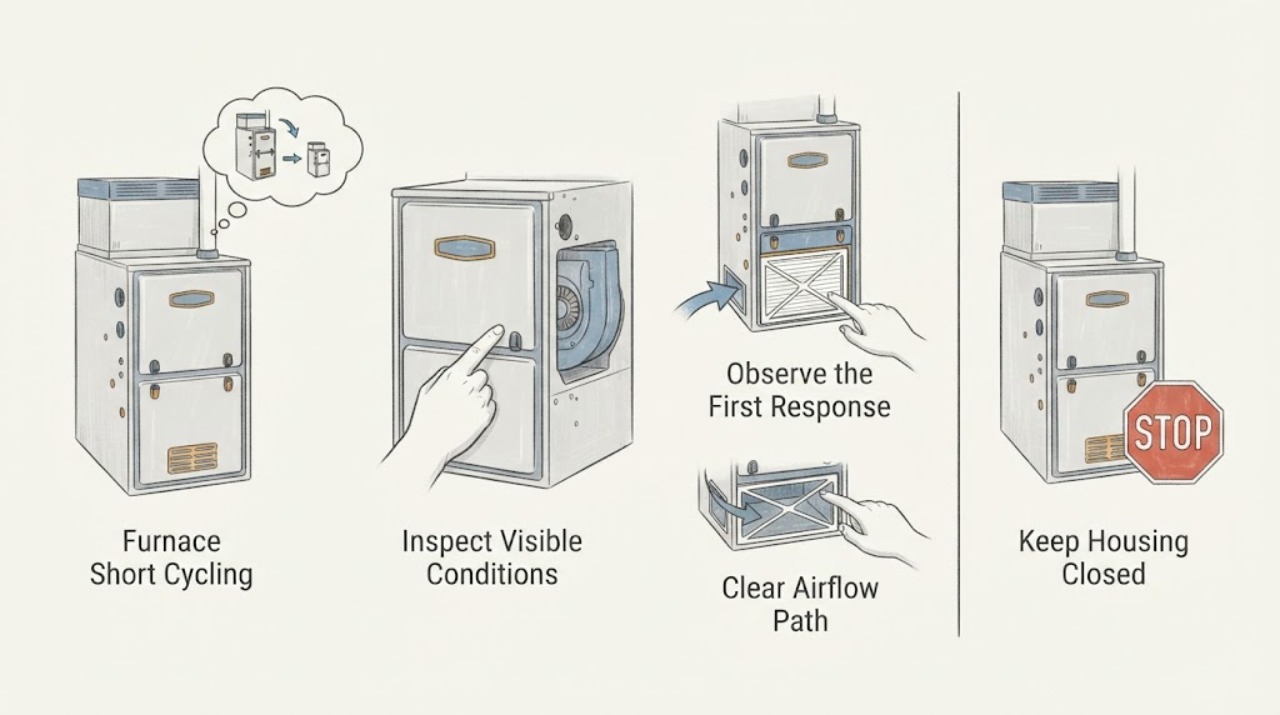
Work through in order
Diagnostic checks
Use only checks that match the exact appliance or system and its official guide.
-
Check 1
Observe one call for heat from outside the furnace cabinet and record thermostat setting, room temperature, burner-on duration, restart interval, whether the blower starts before flame-off, and whether it continues after the burner stops. Keep hands away from the burner, blower opening, flue, and moving equipment.
Expected result: The thermostat is satisfied before shutdown, or the burner stops while the thermostat still calls; the blower starts normally, runs weakly, hums, scrapes, or does not start.
Next step: Record the exact Nordyne model and pattern. Stop repeated restarts and arrange qualified HVAC service if the call remains active or the blower behavior is abnormal.
Why this matters
Why: A satisfied thermostat can be a completed call or thermostat/load issue. Flame-off during an active call with weak or absent blower operation raises an airflow, blower, fan-control, limit, or related safety concern, but does not identify the failed part.
-
Check 2
From an accessible filter location, inspect the filter without opening the furnace cabinet. Compare its size, airflow direction, condition, and fit with the exact Nordyne documentation, and look for a blocked return grille.
Expected result: The filter is loaded, wet, crushed, missing, backward, the return is blocked, or the filter is clean and correctly fitted.
Next step: If the manual permits it, replace only with the specified size and approved rating from a dry safe location, then observe one call. Do not run without a filter or select a more restrictive filter by guess.
Why this matters
Why: A loaded or poorly fitted filter and blocked return can reduce airflow and cause overheating or longer equipment stress. A clean filter does not clear the blower wheel, motor, capacitor, coil, ducts, limits, or controls.
-
Check 3
With the furnace off and without moving equipment or opening panels, inspect accessible return grilles and supply registers. Note whether several paths are blocked, airflow is weak throughout the home, or only one branch is weak; do not change blower taps or damper settings.
Expected result: Several returns or supplies are obstructed, whole-home airflow is weak, one branch is weak, or visible airflow appears normal while the burner still stops early.
Next step: Remove only an obvious movable obstruction if safe, then make one supervised observation. Persistent weak airflow or early flame-off needs HVAC airflow and temperature-rise checks by a professional.
Why this matters
Why: Whole-home weak airflow makes filter, blower wheel/motor, coil, duct, or system-static problems more likely; a single weak branch points toward local distribution. Normal visible airflow does not clear the temperature rise or safety controls.
-
Check 4
Check the thermostat from a normal standing position for heat mode, intended setpoint, normal display, schedule, and placement away from a supply register, draft, sunlight, doorway, or heat-producing appliance.
Expected result: The thermostat is affected by a local draft or heat source, shows an unexpected mode or schedule, has a weak or blank display, or appears correctly placed while an active heat call continues.
Next step: Correct only an obvious setting or placement issue allowed by the thermostat instructions and observe one call. Do not rewire, recalibrate, or replace the thermostat from the cycling symptom alone.
Why this matters
Why: A thermostat reading or demand problem can end a call early. A correctly placed thermostat with an active call shifts suspicion toward airflow, blower, safety, combustion, or control behavior.
-
Check 5
From ground level and a safe distance, inspect visible intake and exhaust terminations for debris, snow, nests, separation, corrosion, or damage. If a status light is visible without opening a panel, record its exact pattern and compare it only with the matching Nordyne manual.
Expected result: A vent termination is blocked or damaged, a code indicates limit/pressure/flame/lockout behavior, the pattern returns, or the accessible vent and indicator appear normal.
Next step: Keep the furnace off for blocked, damaged, or uncertain venting, repeated lockout, or abnormal flame behavior and arrange qualified HVAC service. Do not climb, insert tools, open panels, jumper safeties, touch the capacitor, or measure live voltage.
Why this matters
Why: Blocked or damaged venting can affect pressure proving and combustion safety; a returning safety code points to qualified diagnosis. A clear termination or absent code does not prove that internal venting, blower motor, capacitor, limit, or control operation is normal.
Use your observations
Decision map
Find the observation that best matches what you see, then follow the next safe action.
-
PATH 01Next step
What you see
The thermostat reaches its setpoint and the blower completes its normal off-delay, with no active call during the stop.
Do this next
Verify thermostat placement, mode, schedule, and reading. If comfort is poor or calls are unusually frequent, have a qualified technician evaluate sizing, staging, airflow, and thermostat operation.
Why this path and its safety boundary
Why it matters: The observation may represent a completed heating call or a thermostat/load condition rather than a blower-motor or limit fault.
-
PATH 02Next step
What you see
The burner stops while the thermostat still calls, the blower continues, and the cycle repeats after the furnace cools.
Do this next
Stop repeated resets and arrange HVAC service for airflow, temperature-rise, blower, limit, pressure, and control-sequence checks. Do not bypass or replace a limit from the symptom alone.
Why this path and its safety boundary
Why it matters: A high-temperature limit or related safety sequence, restricted airflow, blower performance issue, or control problem is more likely than a satisfied thermostat. The symptom does not identify which safety or component operated.
-
PATH 03Next step
What you see
The blower does not start, starts slowly, hums, scrapes, or delivers weak airflow while the filter and visible airflow paths are clear.
Do this next
Keep the furnace off if the blower is absent or abnormal and have a qualified HVAC technician test the motor, capacitor, fan control, wiring, and airflow. Do not open the electrical compartment or touch a capacitor.
Why this path and its safety boundary
Why it matters: A blower motor, capacitor, wheel, fan switch, wiring, or control issue is possible. Nordyne service documentation separates these checks and warns that motor/capacitor work involves internal electrical access.
-
PATH 04Next step
What you see
The filter or return path is restricted, several registers are blocked, or a visible intake/exhaust termination is obstructed or damaged.
Do this next
Correct only an obvious accessible filter or room obstruction as allowed by the manual, then observe one call. Use HVAC service for persistent cycling, hidden duct restrictions, blower diagnosis, or any venting problem.
Why this path and its safety boundary
Why it matters: An airflow or combustion-air restriction is more plausible, but correcting one visible obstruction does not prove the blower or safety system is healthy.
-
PATH 05Next step
What you see
A CO alarm sounds, anyone has possible CO symptoms, or there is gas odor, smoke, flame rollout, arcing, or a strong burning electrical smell.
Do this next
Leave immediately for fresh air and call emergency services from outside or another safe location. Do not re-enter or operate the furnace until emergency responders and trained personnel authorize it.
Why this path and its safety boundary
Why it matters: This is an immediate life-safety or fire/combustion emergency, not a blower-motor branch. CO is colorless and odorless, so the absence of a smell does not clear the furnace.
Helpful context
Understand the symptom
Separate burner cycling from blower behavior
A normal heat sequence can leave the blower running after the burner stops while residual heat is removed. Short cycling is more concerning when the burner drops out while the thermostat still calls for heat and then returns after a cooldown. Note the timing and blower behavior before choosing a part.
The blower motor is a component, not a diagnosis
A blower that does not start, starts slowly, makes a new hum or scrape, or delivers weak airflow can involve the motor, capacitor, wheel, fan switch, wiring, or control. The motor and capacitor are inside an electrical compartment on many Nordyne designs. External checks can establish a useful pattern; internal testing and replacement belong to qualified service.
Use the exact Nordyne documentation
Nordyne furnace families and older M1 designs differ in controls, fan switching, limits, pressure proving, and blower arrangements. Use the model and serial label to obtain the matching manual. Do not apply a code meaning, wiring diagram, blower speed, or replacement part from another Nordyne model.
Combustion safety outranks the cycling symptom
A blocked or disconnected vent, abnormal flame, gas odor, or CO alarm is not a blower troubleshooting branch. Leave a suspected CO exposure area for fresh air, call emergency services from outside, and keep the furnace off until trained personnel inspect it.
Safety boundary
Stop conditions
- Stop and leave for fresh air if a CO alarm sounds or anyone has headache, dizziness, nausea, confusion, or unusual weakness. Call emergency services outside and do not reuse the furnace until trained personnel clear it.
- Stop for gas odor, smoke, flame rollout, damaged or disconnected venting, arcing, burning electrical odor, shock, or repeated breaker operation. Do not restart to test.
- Do not open the blower or burner cabinet, touch a capacitor or motor wiring, change blower taps, bypass a limit/pressure/flame safety, adjust gas input, or perform live electrical or combustion tests.
- Stop repeated resets when the thermostat still calls for heat, a limit/pressure/flame/lockout indication returns, airflow is weak, or the blower is absent, noisy, or overheating.
- Do not operate the furnace with a removed filter, blocked return/supply path, or suspected blocked intake/exhaust. Do not climb or insert tools into vent terminations.
Only after diagnosis
Potential parts
- blower motor
Consider this category only when qualified testing finds the blower motor fails to start or deliver the required airflow after the filter, wheel, capacitor, fan control, and duct path are evaluated.
Motor type, mounting, speed, voltage, and airflow requirements vary by Nordyne model. Confirm exact model documentation and professional diagnosis before selecting a part. - blower motor capacitor
Consider this category only when a qualified technician confirms a capacitor fault in a design that uses one; a hum or slow start alone is not sufficient proof.
Capacitance, voltage rating, mounting, and motor compatibility are exact-model concerns. Do not handle or test a capacitor as an owner check. - blower wheel or fan control
Consider this category only when qualified inspection finds a damaged or obstructed wheel or a failed fan-control component after external airflow checks are clear.
Wheel dimensions, rotation, fan controls, and wiring differ across Nordyne platforms. Confirm fitment from the exact model service documentation. - temperature limit or pressure switch
Consider this category only when qualified sequence and safety testing identifies a failed device after airflow, venting, combustion, and temperature causes are addressed.
Safety settings and switch forms are model-specific. Never substitute, bypass, or choose a safety switch by appearance or cycling symptom.
When checks do not resolve it
Need a professional?
Arrange qualified Nordyne HVAC service when the burner short cycles during an active thermostat call, the pattern returns after one safe observation, a filter or visible airflow correction does not help, the blower motor is absent/noisy/weak, a limit/pressure/flame/lockout indication appears, or venting is uncertain. Use emergency help for a CO alarm, suspected exposure, gas odor, smoke, flame rollout, arcing, or fire risk.
Safety scope: Keep the furnace off for CO alarm, suspected exposure, gas odor, smoke, flame rollout, damaged venting, arcing, wet electrical parts, or repeated safety lockout. Do not open panels, handle capacitors, bypass safeties, alter gas settings, or perform energized tests as an owner check.
Common questions
FAQ
Does short cycling prove the Nordyne blower motor is bad?
No. A short cycle can involve the thermostat, filter or duct airflow, blower wheel, motor, capacitor, fan control, temperature limit, pressure proving, venting, combustion, or control. Record blower behavior and have the exact model tested before selecting a motor.
What can I safely check first?
From outside the cabinet, record cycle timing, verify thermostat demand and placement, inspect the exact filter, look for blocked returns or supplies, and view visible intake/exhaust conditions. Do not open the electrical compartment or touch the motor or capacitor.
Why does the blower keep running after the burner stops?
A blower off-delay can remove residual heat, and a high-temperature limit can also shut the burner off while the blower continues. If the thermostat still calls and the pattern repeats, treat it as a service symptom rather than a normal completed call.
What should I do if a CO alarm sounds?
Leave immediately for fresh air, call emergency services from outside or another safe location, and do not re-enter or operate the furnace until responders and trained personnel authorize it. CO is colorless and odorless.
Read the exact guide
Official sources
- Nordyne Downflow/Horizontal IOM ManualNordyne · Official Nordyne installation and operation manual used for airflow, blower-access, fan/limit, filter, and safe service boundaries; not a universal procedure for every Nordyne model.
- Carbon Monoxide Fact SheetU.S. Consumer Product Safety Commission · CPSC safety guidance for malfunctioning fuel-burning appliances, blocked/disconnected venting, CO alarms, suspected exposure, and trained service.
- Indoor airPLUS Technical Bulletin FiltrationU.S. Environmental Protection Agency · EPA technical bulletin explaining that dirty filters reduce airflow and that filter resistance must be compatible with the blower and filter slot.
- 690A-0999 M1 Series sm.p65Nordyne · Official Nordyne service manual used for model-specific examples of blower, fan/limit, pressure, and combustion safety behavior; the exact installed model manual controls.
- Guide to Energy-efficient Heating and CoolingU.S. Environmental Protection Agency · EPA/ENERGY STAR guide covering furnace filters, thermostat placement, system start/stop checks, airflow, flues, gas connections, combustion, and heat exchangers.
Community feedback
Share a repair observation
Share a plain-text repair observation. Accepted observations are published automatically; this page may take a moment to update.