
On this page
Start here
Quick answer
A Peerless boiler is short cycling when its burner starts and stops repeatedly before the thermostat or zone has been satisfied. First record whether the thermostat or zone call stays on, whether the boiler reaches a temperature limit quickly, whether one or all zones receive heat, and whether a lockout or fault appears. Peerless guidance identifies a boiler that is oversized for the active load, a very small zone, mild weather, and insufficient flow through the heat exchanger as possible contributors; a thermostat or zone relay that repeatedly cycles can create a different pattern. Check only the thermostat interface, visible display or gauge, and accessible heat distribution without opening the jacket or changing installer settings. Persistent cycling, a lockout, failed ignition, abnormal pressure or temperature, gas or oil odor, smoke, carbon monoxide alarm, or a boiler that fires without circulation needs qualified heating service.
Before you begin
Safety first
- Boiler sizing, flow and piping diagnosis, circulator or zone-control testing, combustion and ignition work, venting, fuel, pressure, temperature-limit, sensor, anti-cycling, and buffer-tank changes should be performed by a qualified heating professional using the exact model documentation.
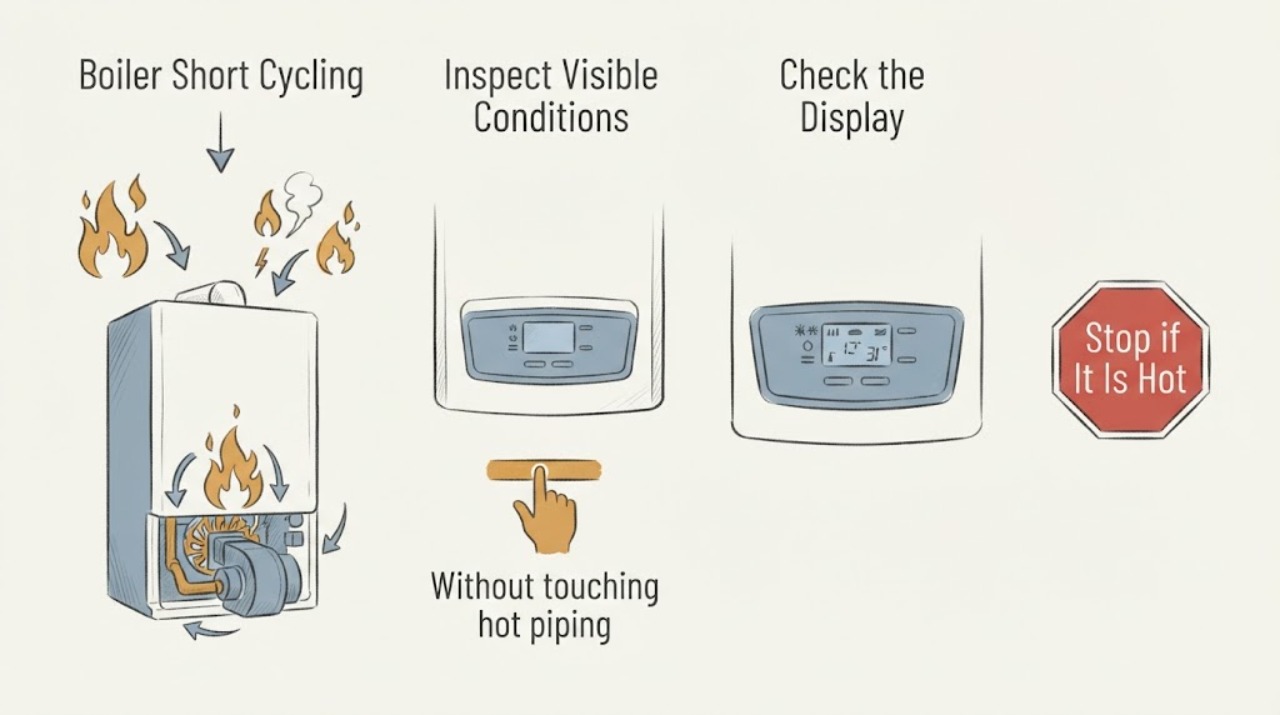
Work through in order
Diagnostic checks
Use only checks that match the exact appliance or system and its official guide.
-
Check 1
During a normal call for heat, observe the thermostat or zone controller and the boiler from outside the cabinet. Record whether the call remains active, how often the burner starts and stops, whether the circulator continues, and whether the room or zone reaches its setpoint.
Expected result: The call stays on while the burner cycles, the call itself repeatedly ends and restarts, or the boiler cycles after the setpoint is reached.
Next step: Write down the timing, affected zone, and whether the circulator runs, then continue to the display, gauge, and distribution checks. Do not jumper thermostat terminals or open the control compartment.
Stop if: Stop if the boiler fires without an active call, a safety alarm or lockout appears, or there is gas or oil odor, smoke, flame outside the combustion area, or a carbon monoxide alarm.
Why this matters
Why: A steady call with repeated burner cycling points toward the boiler reaching a limit, a heat-load or flow mismatch, or a safety sequence; a call that toggles makes the thermostat, schedule, zone relay, or control signal more plausible. Cycling after the zone is satisfied may be normal control behavior rather than a fault.
-
Check 2
Read the boiler's external display, indicator, or gauge from a safe position while the cycling occurs. Note any temperature-limit message, ignition or flame-failure indication, pressure or temperature movement, lockout, or other exact code; do not reset repeatedly to make the cycle continue.
Expected result: The boiler reaches its temperature target quickly, shows a recurring fault or lockout, has abnormal or rapidly changing pressure or temperature, or shows no warning while cycling.
Next step: Photograph or transcribe the exact display and provide the trend to a qualified heating professional. Follow the exact model manual's stop guidance, and do not alter temperature limits, anti-cycling settings, fuel controls, or safety devices.
Stop if: Stop and leave the boiler off if the gauge rises rapidly, a relief path discharges, water leaks, the unit overheats, or a lockout returns after the normal user reset described by the model manual.
Why this matters
Why: A rapid approach to the target supports a heat-load or flow mismatch, while a recurring fault or lockout points to a model-specific safety or ignition sequence. A normal-looking display does not rule out a circulator, zone, sizing, or control issue.
-
Check 3
Without touching hot piping or removing covers, compare the accessible radiators, baseboards, radiant zones, or air handlers during a heat call. Note whether every zone is warm, only one zone is cold, a zone valve or circulator appears inactive, or heat starts at the boiler but does not reach the affected space.
Expected result: All zones stay cold, one small zone is calling by itself, one zone remains cold while another warms, or the boiler gets hot while heat is not being carried away.
Next step: Record the affected zones and any unusual noise or leak for service. Do not bleed radiators, force zone valves, adjust balancing valves, add water, or work on hot or pressurized components.
Stop if: Stop if a pipe or fitting is leaking, a surface is dangerously hot, the circulator or valve is damaged, or water contacts electrical equipment.
Why this matters
Why: No heat anywhere makes a call, boiler startup, or system-wide circulation issue more likely. One cold zone or a boiler that heats rapidly without distribution makes a local valve, circulator, air, piping, or insufficient-flow problem more plausible; a small active zone can also present too little load for the boiler.
-
Check 4
Compare the cycling pattern with outdoor conditions and the active load. Note whether it happens mainly in mild weather, when only one small zone calls, after insulation or window improvements, after a zone was disabled, or after a recent boiler, thermostat, pump, or piping change.
Expected result: Short cycling is limited to mild conditions or one small zone, began after a system change, or occurs even when several zones call during cold weather.
Next step: Give the professional the zone count, recent changes, weather pattern, and cycling log. Ask for a system-level assessment of sizing, flow, controls, and load; do not attempt to solve it by changing hidden limits or fuel settings.
Stop if: Do not run repeated test cycles if the boiler locks out, overheats, loses pressure, or fires without circulation.
Why this matters
Why: A mild-weather or single-zone pattern is consistent with the boiler output exceeding the active heat load or with a zone that cannot absorb heat quickly. A pattern that persists under a substantial load, or starts after a change, makes sizing, controls, piping, flow, or commissioning issues more likely.
-
Check 5
Check the thermostat's visible schedule, mode, and setpoint, and compare the displayed room temperature with the active zone's behavior. Look for a schedule change, a very narrow demand, a loose or unresponsive user interface, or a call that disappears while the room is still below the requested temperature; do not remove wiring or open the thermostat.
Expected result: The call ends and restarts with the schedule or setpoint, the thermostat remains calling but the boiler cycles, or the interface is blank, erratic, or inconsistent with the zone.
Next step: Record the thermostat state and time alongside the boiler response. Have a qualified technician test the thermostat, zone relay, sensors, and boiler sequence rather than jumpering or replacing controls from the symptom alone.
Stop if: Stop if the thermostat is damaged, wiring is exposed, the boiler responds unexpectedly, or any combustion, electrical, or water hazard is present.
Why this matters
Why: A schedule or setpoint-driven call can be expected control behavior; a call that drops prematurely can indicate thermostat or zone-control trouble. A steady call shifts attention back toward boiler limit, flow, load, or safety behavior.
Use your observations
Decision map
Find the observation that best matches what you see, then follow the next safe action.
-
PATH 01Next step
What you see
Do this next
Have a qualified heating professional evaluate boiler sizing, zone flow, circulator and valve operation, piping, and whether a properly designed system change is needed. Do not alter the boiler's firing, limit, or anti-cycling settings yourself.
Why this path and its safety boundary
Why it matters: An active load that is too small for the boiler, a flow restriction, or insufficient circulation is more likely than a thermostat that is simply satisfied. Peerless identifies oversized applications, small zones, and low heat-exchanger flow as short-cycling conditions.
-
PATH 02Next step
What you see
Do this next
Document the thermostat and zone state during each transition and arrange control diagnosis. Do not jumper terminals, replace wiring, or bypass a relay or safety input.
Why this path and its safety boundary
Why it matters: A demand-control, schedule, sensor, or thermostat issue is more plausible than a boiler that is independently short cycling.
-
PATH 03Next step
What you see
Do this next
Provide the weather, active-zone, and recent-change history to a heating professional for a system-level assessment. Do not add or resize a buffer tank without design and installation by a qualified professional.
Why this path and its safety boundary
Why it matters: The active heat demand may be below the boiler's practical minimum output or the system may need different load distribution; this pattern is consistent with a sizing or system-volume issue.
-
PATH 04Next step
What you see
Do this next
Keep clear of hot and pressurized parts and arrange qualified service to inspect flow and controls. Do not bleed, refill, force valves, or adjust system pressure based on the symptom alone.
Why this path and its safety boundary
Why it matters: A zone valve, circulator, air, piping, pressure, or heat-transfer problem is more likely than a simple boiler oversize diagnosis; restricted flow can make the boiler reach its limit rapidly.
-
PATH 05Next step
What you see
Do this next
Stop operating the boiler and follow the applicable emergency, gas-supplier, detector, or fuel-supplier guidance. Obtain urgent qualified heating service and do not reset repeatedly or open the cabinet.
Why this path and its safety boundary
Why it matters: A safety, combustion, ignition, fuel, venting, or control fault is possible; this is not a routine load-matching check.
Helpful context
Understand the symptom
Separate a load problem from a call-for-heat problem
The useful first distinction is whether the heat call remains active while the boiler cycles, or whether the thermostat or zone relay itself is ending and restarting the call. With a steady call, the boiler may be reaching a temperature limit faster than the active emitters can carry heat away. With a call that toggles, the thermostat, schedule, zone relay, or a wiring/control fault becomes more plausible. One cold zone can also point to local flow or valve trouble rather than a boiler-size problem.
Short cycling is not a reason to change hidden settings
Peerless manuals and technical literature cover model-specific anti-cycling, modulation, pump, vent, and combustion settings, but those adjustments are not ordinary homeowner troubleshooting. Use the boiler's exact model and the observations from the checks below when arranging service. Do not bypass safeties, open the cabinet, alter fuel or pressure controls, or add a buffer tank or replace a circulator based only on the cycling symptom.
Safety boundary
Stop conditions
- Stop immediately for gas or oil odor, smoke, fire, flame outside the combustion area, a carbon monoxide alarm, severe overheating, or water contacting electrical equipment; leave the hazard area and follow emergency guidance.
- Stop for a recurring lockout, failed ignition, abnormal pressure or temperature, relief discharge, leak, or a boiler that fires without circulation. Keep the unit off until qualified service evaluates it.
- Do not open the jacket, test live wiring, adjust gas, oil, combustion, pressure, limit, sensor, or anti-cycling controls, jumper thermostat or safety terminals, or bypass a lockout.
- Do not bleed hot radiators, force zone valves, add makeup water repeatedly, loosen fittings, or install or size a buffer tank, circulator, or control part from the cycling symptom alone.
- Arrange qualified heating service when cycling persists during an active call, returns after an ordinary user check, leaves a zone cold, or began after a boiler, thermostat, pump, valve, piping, insulation, or zoning change.
Only after diagnosis
Potential parts
- thermostat or zone-control component
Consider this only after testing shows that a thermostat, zone relay, sensor, or related control is ending or restarting the heat call incorrectly.
Control type, wiring, sensors, and boiler sequence are system-specific; confirm the exact Peerless model and control arrangement before ordering. - circulator or zone-valve component
Consider this only when a qualified technician confirms inadequate flow, a failed circulator, or a zone valve that is not opening or closing correctly.
Flow capacity, head, voltage, connections, and control compatibility depend on the hydronic design; a short-cycle symptom does not identify a failed part. - hydronic buffer tank
Consider this only after a professional confirms that load mismatch and system design make added water volume appropriate for the Peerless boiler and zones.
Tank sizing, piping, expansion capacity, sensors, and controls require a system design; do not select a tank from the cycling interval alone.
When checks do not resolve it
Need a professional?
Contact a qualified heating professional when a Peerless boiler repeatedly starts and stops before the active zone is satisfied, cycles with a steady heat call, leaves a zone cold, reaches a limit quickly, or shows a recurring alert. Escalate urgently for combustion, carbon monoxide, overheating, leak, pressure, or electrical hazards.
Safety scope: Boiler sizing, flow and piping diagnosis, circulator or zone-control testing, combustion and ignition work, venting, fuel, pressure, temperature-limit, sensor, anti-cycling, and buffer-tank changes should be performed by a qualified heating professional using the exact model documentation.
Have this ready
- Provide the exact Peerless model, fuel type, thermostat and zone-call behavior, cycling timing, display or gauge observations, affected zones, circulator or valve clues, outdoor conditions, recent system changes, and any lockout or safety symptoms.
Common questions
FAQ
What does short cycling mean on a Peerless boiler?
It means the burner starts and stops repeatedly before the active thermostat or zone is satisfied. Record whether the call remains active, how quickly the boiler reaches its target, and whether heat reaches the zones; cycling after a satisfied call can be normal control behavior.
Can one small zone make a Peerless boiler short cycle?
Yes. Peerless identifies small zones, mild weather, and a boiler that is oversized for the active load as possible contributors. A professional should also rule out inadequate circulation or a zone valve that is not opening.
Could the thermostat be causing the short cycling?
It can be if the heat call repeatedly ends and restarts with the schedule, setpoint, thermostat, or zone relay. If the call remains active while the burner cycles, the boiler, flow, load, or safety sequence becomes more important to investigate.
Should I change the Peerless anti-cycling or temperature settings?
Do not change hidden installer, fuel, combustion, limit, pressure, or anti-cycling settings as a homeowner fix. Record the model and symptoms and have a qualified heating professional evaluate the control sequence and system design.
When should I stop troubleshooting a short-cycling boiler?
Stop for a recurring lockout, failed ignition, abnormal pressure or temperature, leak, gas or oil odor, smoke, a carbon monoxide alarm, water near electrical parts, or a boiler that fires without circulation. Follow emergency guidance when needed and arrange qualified service.
Read the exact guide
Official sources
- Contractor FAQPB Heat, LLC (Peerless Boilers) · Peerless contractor FAQ used for the relationship between insufficient flow through a heat exchanger, rapid water heating, and short cycling; professional context applies.
- Peerless® PureFire® Commercial Buffer Tank Piping SupplementPB Heat, LLC (Peerless Boilers) · Peerless technical supplement for qualified contractors; its short-cycling background identifies oversized boilers, small zones, and mild weather as system-level contributors.
- Peerless® PUREFIRE® Residential - PB HeatPB Heat, LLC (Peerless Boilers) · Manufacturer product page used to identify Peerless PureFire controls and to keep installation, maintenance, and service work within the professional boundary; exact model documentation controls.
Community feedback
Share a repair observation
Share a plain-text repair observation. Accepted observations are published automatically; this page may take a moment to update.