
On this page
Start here
Quick answer
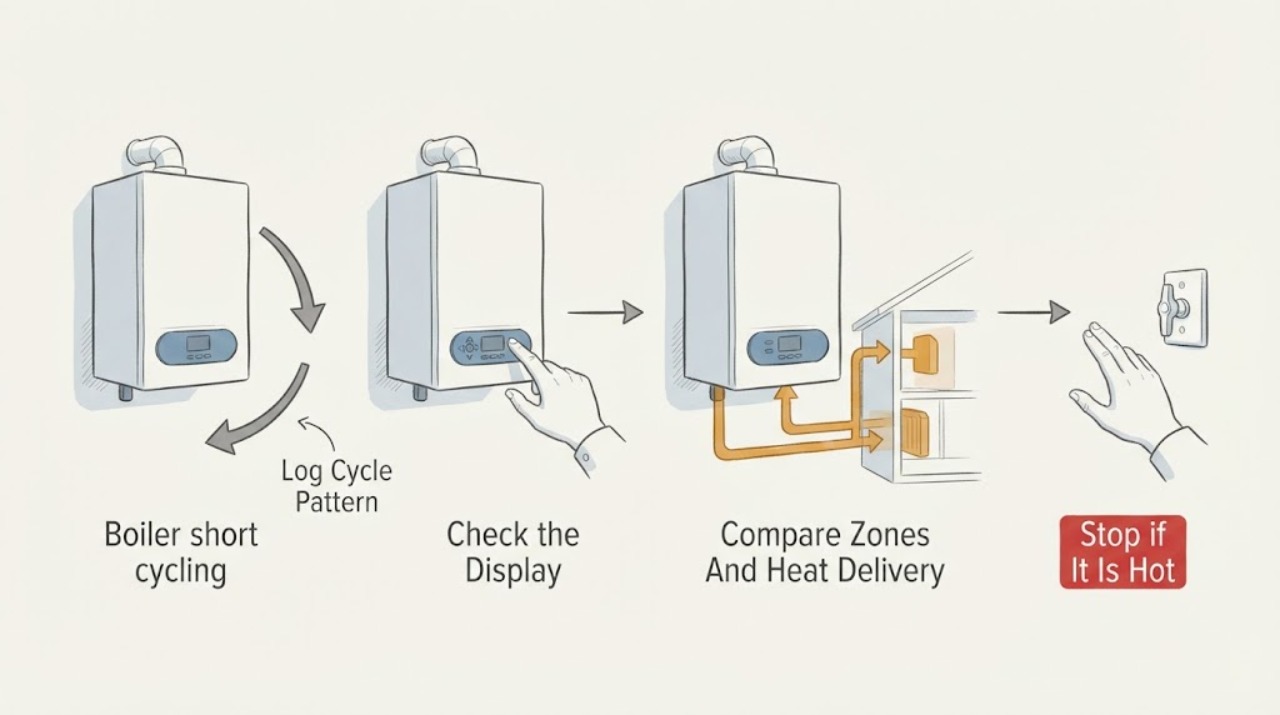
A Rheem boiler is short cycling when it starts and stops repeatedly before the space or active zone has met its demand. First record how long each run lasts, whether the thermostat or zone is still calling for heat, and whether the pattern affects every zone or only one. Use the boiler's display to note alerts and visible operating status; Rheem FT Series controls include diagnostics, pump control, outdoor reset, and safety monitoring. From safe access, inspect only what is visible outside the cabinet: vent and combustion-air terminations, condensate discharge, signs of leaks, and corrosion. Do not open the combustion side, change gas or wiring settings, bypass a safety, or adjust an unknown control. If there is a gas odor, carbon-monoxide alarm, smoke, scorching, an active water leak, hot discharge, repeated lockout, or unsafe venting, stop using the boiler and call qualified heating service or emergency help as appropriate.
Work through in order
Diagnostic checks
Use only checks that match the exact appliance or system and its official guide.
-
Check 1
For several heating calls, record the time the Rheem boiler starts, the time it stops, the off interval, the thermostat or zone calling for heat, and the room-temperature response; do not change the setpoint repeatedly to provoke cycles.
Expected result: Classify the pattern as short runs while a zone still calls, normal shutdown after the call ends, repeated starts only in mild weather or with one small zone, or an immediate restart after a fault or limit event.
Next step: Keep the log and continue with display and zone observations; arrange qualified heating service if the room remains cold, cycles are frequent, or the boiler repeatedly stops before demand is met.
Stop if: Stop operating the boiler and seek urgent help for gas odor, a carbon-monoxide alarm, smoke, scorching, an active leak, hot discharge, or a dangerous flue condition.
Why this matters
Why: Short runs with a continuing call support a cycling problem. A shutdown after the call ends may be normal zone satisfaction. A pattern tied to one small load or mild weather makes load, sizing, outdoor-reset, or control behavior more likely, while an immediate restart after a limit or fault makes safety or flow diagnosis more urgent.
-
Check 2
From normal user access, photograph the Rheem display and note the thermostat and zone-control status before using any reset; leave installer and service settings unchanged.
Expected result: Record whether the display shows normal operation, a diagnostic alert, lockout, high-limit or low-water protection, reverse-flow indication, an absent display, or a thermostat/zone call that does not match the boiler status.
Next step: Send the display photo, exact model, alert text, and thermostat/zone state to a qualified Rheem heating technician; follow only the user-level reset instruction in the exact model manual, and do not repeatedly reset a recurring fault.
Stop if: Do not bypass a limit, jumper a thermostat, open the cabinet, alter gas settings, or continue operation when a safety alert, burning smell, smoke, or carbon-monoxide alarm is present.
Why this matters
Why: A clear normal display with a continuing call keeps load, flow, thermostat, zone, and operating-condition causes in consideration. A protection or lockout indication means the control has detected a condition that needs model-specific diagnosis. A mismatch between the call and boiler status makes control or communication evidence more useful than repeated resets.
-
Check 3
Use thermostats and room response to compare all zones during a cycle; observe whether the boiler cycles with one zone, several zones, or all zones calling, without touching hot boiler surfaces or changing valves.
Expected result: Note whether all zones warm evenly, one zone stays cold, a zone control fails to call, or the boiler stops while multiple zones still call for heat.
Next step: Give the zone pattern and any recent valve, pump, thermostat, or control changes to the service technician; do not drain, bleed, or dismantle the heating system as a first response.
Stop if: Stop if a pipe, radiator, valve, or discharge is hot enough to burn, leaking, vibrating, or producing unusual steam or noise.
Why this matters
Why: One cold zone with boiler cycling makes a zone valve, air, pump, or distribution-flow issue more likely. Cycling with all zones calling makes a system flow, limit, control, load, or boiler-capacity issue more likely. A quick stop only when one small zone calls may reflect load or control behavior and still needs model-specific assessment.
-
Check 4
From safe floor-level access and without removing the boiler cabinet, visually inspect the exterior vent and combustion-air terminations, condensate outlet or trap area, relief discharge area, nearby surfaces, and visible pipe connections.
Expected result: Record an obvious obstruction, backed-up or abnormal condensate, moisture or active leak, corrosion, staining at a relief discharge, damaged venting, or no visible abnormality; do not probe, disassemble, or clean internal parts.
Next step: Keep the boiler off and arrange qualified service when any abnormality is found; if there is gas odor, flue-gas concern, active water release, smoke, or a CO alarm, leave the area as appropriate and contact emergency or utility help.
Stop if: Do not remove vent sections, open the combustion chamber, clean an internal condensate trap, adjust gas pressure, defeat a safety, or operate through a leak or blocked termination.
Why this matters
Why: A vent or combustion-air obstruction, condensate issue, leak, corrosion, or relief discharge can cause unsafe or protective shutdown and requires service. No visible problem does not rule out internal flow, sensor, combustion, or control causes.
-
Check 5
Record outdoor conditions, the number of active zones, whether doors or thermostats were recently changed, and any recent boiler, pump, thermostat, control, or radiator work; leave outdoor-reset and installer parameters at their documented settings.
Expected result: Identify whether cycling appears only during mild weather or a single small zone, began after a control or service change, or occurs under the same load in cold weather across multiple zones.
Next step: Include the timeline and load conditions in the service request and ask the technician to verify the system as a whole rather than swapping a part based only on the symptom.
Stop if: Do not change combustion, gas, wiring, pump, limit, or outdoor-reset settings unless a qualified technician directs the documented procedure for the exact model.
Why this matters
Why: A change-linked or low-load pattern makes configuration, thermostat, zone, outdoor-reset, or system-sizing review more useful. Cycling across multiple zones and loads makes flow, limit, sensor, combustion, or boiler-control diagnosis more important; the observation alone does not identify a failed part.
-
Check 6
Prepare the model and rating-label information, cycle log, display photos, thermostat and zone results, visible-condition photos, and recent repair history for a qualified boiler technician.
Expected result: Confirm that the technician has the exact model, the observed symptom, the conditions that trigger it, any displayed protection or fault, and whether the home is left cold or has a leak or safety concern.
Next step: Request a diagnostic visit and ask for a written explanation of the confirmed cause, safe operating condition, and any part compatibility before approving replacement work.
Stop if: Do not keep resetting, run the boiler unattended through a recurring lockout, or restart it after a gas, CO, smoke, leak, or venting hazard.
Why this matters
Why: A complete handoff separates a load or control pattern from a possible flow, venting, condensate, limit, sensor, or combustion problem and helps the technician choose the correct Rheem documentation and tests. A missing model or an unverified internal cause is not evidence for a particular replacement part.
Use your observations
Decision map
Find the observation that best matches what you see, then follow the next safe action.
-
PATH 01Next step
What you see
The boiler cycles mainly when one small zone calls or during mild outdoor conditions, the thermostat call ends quickly, and no protection alert or visible hazard is present.
Do this next
A low-load, sizing, thermostat, zoning, or outdoor-reset/control pattern becomes more likely than a proven failed burner part. Keep the cycle log and ask a qualified technician to review demand, controls, pump operation, and documented settings.
-
PATH 02Next step
What you see
One zone remains cold or a thermostat continues calling while the boiler repeatedly stops, especially when other zones behave normally.
Do this next
A zone valve, air, pump, control, or distribution-flow problem becomes more likely. Avoid opening the system; provide the zone comparison and have a technician verify flow and controls safely.
-
PATH 03Next step
What you see
The display shows a lockout, high-limit, low-water, reverse-flow, or other recurring protection/diagnostic state, or the display does not match the thermostat call.
Do this next
A safety, flow, sensor, control, or operating-condition fault is more likely than ordinary zone satisfaction. Photograph the display, stop repeated resets, and arrange model-specific qualified service.
-
PATH 04Next step
What you see
There is an obstruction or damage at a visible vent/combustion-air termination, abnormal condensate, moisture, corrosion, or relief discharge.
Do this next
Venting, condensate, relief, or water-system service is required. Keep the boiler off when the condition could affect combustion or safety, and do not disassemble the vent or internal condensate parts.
-
PATH 05Next step
What you see
There is gas odor, a carbon-monoxide alarm, smoke, scorching, suspected flue gas, a major water leak, scalding discharge, or exposed electrical damage.
Do this next
Leave the area and contact the appropriate emergency, utility, or qualified service resource; do not operate, reset, or troubleshoot the boiler until it has been declared safe.
Helpful context
Understand the symptom
Confirm that the pattern is short cycling
Normal modulation or a zone reaching its setpoint can make a burner change output or stop. Short cycling is a repeated start-stop pattern while the home or an active zone still needs heat. A stopwatch record is more useful than a guess: note the time from ignition or heat call to shutdown, the off time, the room temperature trend, and whether the thermostat still shows a call. Also record whether the boiler itself stops while the distribution system remains cold, or whether all zones are satisfied quickly. A small active zone, mild outdoor conditions, a recent thermostat change, or an oversized heat source can produce a load/control pattern that needs a technician's assessment rather than a reset loop.
Use the Rheem display and zone pattern as evidence
Rheem FT Series material identifies touchscreen troubleshooting, system monitoring, pump control, outdoor reset, and safety functions. Photograph or write down the display before resetting anything, including an alert, lockout, high-limit indication, low-water indication, reverse-flow indication, or a blank display. Compare the thermostat or zone controls with the boiler's status: a persistent heat call with frequent stops points toward a control, flow, limit, or operating-condition problem; a call that disappears as soon as one small zone warms points toward load or control sizing. Do not repeatedly clear a lockout or alter installer settings to make the boiler run longer.
Check distribution clues without opening the boiler
Observe whether every zone heats evenly, whether one zone remains cold, and whether the boiler cycles when only one zone calls. Keep hands away from hot pipes and discharge; use the thermostat and room response rather than touching the boiler's hot surfaces. One cold zone with cycling can make a flow, air, valve, or pump issue more likely. Cycling with all zones open can make a system-load, control, outdoor-reset, or boiler-capacity issue more likely. Water pressure, pump performance, venting, combustion, and internal sensor faults require model-specific diagnosis; do not drain, bleed, or dismantle components unless the exact Rheem instructions and a qualified technician make that procedure appropriate.
Inspect only visible external conditions
From the floor and without removing the cabinet, look for an obstructed vent or combustion-air termination, condensate backing up or discharging abnormally, moisture around the boiler or relief discharge, corrosion, or a new stain. Rheem's maintenance guidance specifically includes visual checks for leaks and corrosion, vent and combustion-air obstructions, relief-valve discharge, and condensate components. Do not disassemble venting, clean internal traps, open the combustion chamber, or change gas pressure or electrical wiring. An obstruction, condensate problem, leak, or corrosion is a reason to stop and arrange service, not to force a reset.
Give the technician a useful handoff
Provide the exact boiler model from its rating label, the cycle log, thermostat and zone status, display photographs, outdoor conditions, recent repairs or control changes, and the result of the external inspection. Rheem's product documentation includes model-specific installation, operating, quick-start, and use-and-care materials; the technician can use the correct document and test the system's flow, sensors, limits, venting, condensate, controls, and combustion safely. If the boiler has frequent repairs, unusual noise, low pressure, leaks, or repeated safety events, ask for a broader condition assessment instead of treating each reset as a repair.
Safety boundary
Stop conditions
- Gas odor, a carbon-monoxide alarm, smoke, scorching, or suspected flue gas.
- An active water leak, hot relief discharge, scalding surface, or visible electrical damage.
- A blocked or damaged vent/combustion-air termination, abnormal condensate, corrosion, or repeated safety lockout.
- Any step that would require opening the cabinet, combustion chamber, venting, gas train, wiring, or sealed control settings.
- A recurring cycle fault that leaves rooms cold or returns immediately after a reset.
Only after diagnosis
Potential parts
- Must match the exact Rheem boiler, control architecture, and zoning equipment; a technician should confirm compatibility.
- Pump selection depends on the system design, model, controls, and required flow; do not substitute by appearance.
- Use the exact model documentation and an approved compatible part; a recurring alert is not proof of which component failed.
- Venting and condensate parts affect safe combustion and drainage; installation must follow the exact Rheem documentation and applicable requirements.
When checks do not resolve it
Need a professional?
Call a qualified boiler or HVAC technician when short cycles continue after basic observation, the home remains cold, one zone does not heat, the display shows a recurring alert or lockout, or any venting, condensate, leak, pressure, flow, or corrosion clue appears. Use emergency or utility help for gas odor, a carbon-monoxide alarm, smoke, or suspected flue gas, and do not re-enter or restart until it is safe.
Common questions
FAQ
Why does my Rheem boiler start and stop every few minutes?
That pattern can come from a small or changing heat load, thermostat or zoning behavior, inadequate distribution flow, a limit or sensor event, venting or condensate trouble, or another control or combustion issue. Log the cycle and display state first; do not change installer settings or repeatedly reset a fault.
Is short cycling always a failed Rheem part?
No. Short cycling is a symptom, not a part diagnosis. The pattern may be related to load, zoning, thermostat demand, flow, protection limits, venting, condensate, or controls. A technician should test the system before selecting a replacement part.
Can I fix Rheem boiler short cycling by changing the thermostat or boiler settings?
Do not change gas, combustion, wiring, pump, limit, or installer settings as a trial. You can record thermostat and zone status, but a qualified technician should verify compatibility, flow, limits, and documented settings for the exact model.
When should I turn the boiler off?
Stop and seek appropriate help for gas odor, a carbon-monoxide alarm, smoke, scorching, suspected flue gas, an active leak, hot discharge, visible electrical damage, blocked or damaged venting, abnormal condensate, or recurring safety lockout. Do not restart until the condition is declared safe.
Read the exact guide
Official sources
- Rheem BoilersRheem · Rheem boilers, including FT Series controls and zone-related features
- FT Series Combi BoilerRheem · Rheem FT Series Combi Boiler
- FT Series Boiler Related DocumentsRheem · Rheem FT Series boiler model-specific documentation
- Rheem FT Series Super High Efficiency Condensing Gas BoilersRheem · Rheem FT Series condensing gas boiler product features
- Winter Prep Tips for Water Heating SystemsRheem · Rheem FT and ThermaForce boiler homeowner maintenance checks
- Comfort Starts Here: Key Signs Your Boiler Is Due for ReplacementRheem · Rheem boiler replacement and professional-assessment guidance
Community feedback
Share a repair observation
Share a plain-text repair observation. Accepted observations are published automatically; this page may take a moment to update.