
On this page
Start here
Quick answer
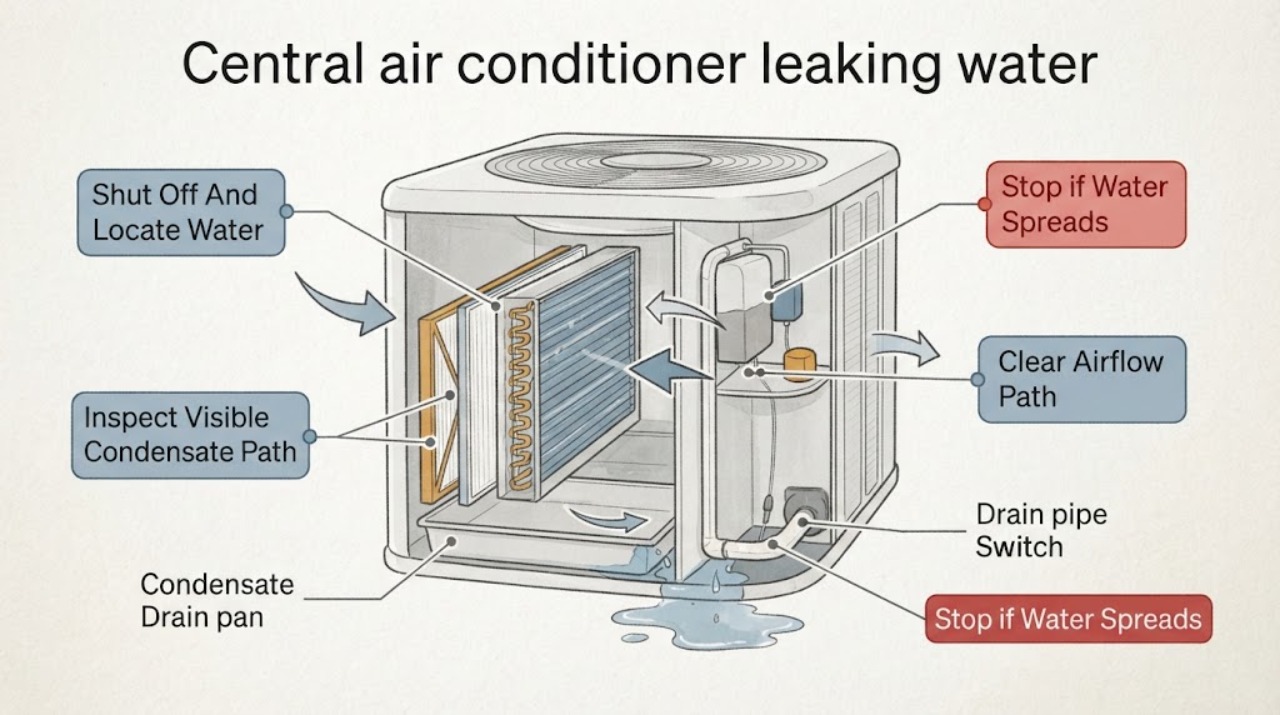
If a Rheem central air conditioner is leaking water, turn cooling off first and find the first wet point: the indoor unit or pan, a visible drain line or outlet, a wet ceiling or wall, or the outdoor unit. Water during cooling can come from a restricted drain, damaged or misconfigured pan, or ice on the indoor coil that is melting; a dirty filter or blocked return can contribute to icing. Protect nearby surfaces, inspect only the ordinary-access filter, returns, supplies, visible drain path, and outdoor area, and keep panels closed. Rheem guidance calls for correctly draining pans and lines, hand-tight drain fittings, an installed filter, and qualified service for drain, coil, electrical, blower, or refrigerant work. Stop for active overflow, water near electrical equipment, ceiling damage, ice, repeat leakage, burning odor, or a tripped breaker.
Before you begin
Safety first
- This article supports thermostat shutoff, surface protection, ordinary-access filter and airflow checks, visible ice observation, and exterior drain or outdoor-area observation only. A qualified person must handle cabinet access, electrical testing, pan or hidden-drain work, float controls, coil and blower service, refrigerant, sealed-system work, and final startup.
Work through in order
Diagnostic checks
Use only checks that match the exact appliance or system and its official guide.
-
Check 1
Set the thermostat to stop cooling, protect the floor or ceiling below the equipment, and trace the water upward to the first wet point without opening a panel.
Expected result: Record whether water is actively dripping, pooling below the indoor unit, emerging at a visible drain outlet, coming from a ceiling or wall, appearing only after shutdown, or present around the outdoor unit.
Next step: Leave cooling off, protect materials, and use the first wet point to choose a branch below. If water is near electrical equipment or building damage is spreading, arrange urgent qualified service rather than continuing checks.
Stop if: Stop immediately for active overflow, water near wiring or controls, a sagging ceiling, smoke, burning odor, sparking, or visible refrigerant-line damage.
Why this matters
Why: An indoor puddle or ceiling stain makes condensate overflow, pan damage, drain leakage, or meltwater more likely. Water that starts after shutdown may be meltwater from a frozen coil. A wet line connection or water near electrical equipment cannot be safely classified by an exterior look.
-
Check 2
With cooling off and the area safe, inspect only the ordinary-access portion of the condensate tubing, drain outlet, secondary outlet, and visible area below the indoor unit; do not remove the cabinet or pour cleaner into the line.
Expected result: Look for a dry outlet while water collects indoors, standing water in an accessible pan, a kink or crushed section, a disconnected-looking joint, a full auxiliary pan, or water at a fitting.
Next step: Do not force the line, tighten a fitting, use a chemical, or defeat a float. Keep cooling off and request service for standing water, an overflow, a damaged pan or fitting, or a drain that does not carry water normally.
Stop if: Stop for water near electrical parts, ceiling or wall damage, active overflow, or any need to remove a panel or access a hidden drain.
Why this matters
Why: A dry outlet with indoor water makes a blocked or leaking drain path, pan issue, or safety shutdown plausible. A visibly damaged fitting or pan needs repair, and an apparent blockage cannot establish whether the restriction is deeper in the line. Rheem cautions that drain fittings can crack if overtightened and that drain routing must avoid bends and pinches.
-
Check 3
With the system off, inspect the filter at its normal user access point and look at return grilles and supply registers for blockage; keep a filter installed and keep the indoor cabinet closed.
Expected result: Classify the filter as clean, dust-loaded, wet, damaged, or wrong-sized, and note weak airflow, blocked returns, closed supplies, or a room that receives little air.
Next step: Replace a disposable filter only with the exact size and type specified for the equipment, reopen an accidentally closed register, and clear ordinary return obstructions. Keep cooling off if ice or water is present; call service when airflow remains weak or the leak returns.
Stop if: Do not run without a filter, substitute an unknown restrictive filter, open the coil cabinet, or keep cooling with water near electrical equipment.
Why this matters
Why: A dirty or restrictive filter, blocked return, or closed supply can reduce airflow and contribute to indoor-coil freezing. A wet filter may be an effect of the leak, while weak airflow with a clean correct filter suggests a blower, duct, coil, or control problem that a visual check cannot identify.
-
Check 4
Look through ordinary openings or at accessible tubing for frost or ice on the indoor coil area or refrigerant line, and check whether the leak increases as ice melts; do not touch, chip, or heat the ice.
Expected result: Record no ice, light frost, a heavily iced coil or line, water appearing after the unit has been off, or repeated ice after the filter and visible airflow path are corrected.
Next step: Leave cooling off and let ice melt naturally. Correct only an obvious filter or register issue; arrange qualified service if ice is heavy, airflow stays weak, water reaches the building, or ice returns after thawing.
Stop if: Do not chip ice, use a heat source, add refrigerant, open the evaporator section, or restart while water is overflowing or electrical equipment is wet.
Why this matters
Why: Ice followed by water makes meltwater from a frozen coil plausible, but it does not prove that the filter caused the freeze. Rheem also lists dirty coil, blower motor or capacitor, low charge, mismatched components, and low outdoor temperature among possible contributors.
-
Check 5
From outside the cabinet, note the outdoor unit's condition and the surrounding ground without reaching through the grille or washing the unit; remove only loose debris that is safely outside the cabinet and only with power left off.
Expected result: Record normal outdoor condensate, a puddle with no obvious drain source, leaves or grass obstructing airflow, a non-running fan, persistent hum, vibration, burnt odor, or visible line or cabinet damage.
Next step: Clear only loose exterior debris without contact with the unit, then keep cooling off until the indoor leak pattern is understood. Arrange service for abnormal sounds, a non-running fan, damage, odor, or an unexplained outdoor leak.
Stop if: Do not open the condenser, push the fan, spray water into the cabinet, bend fins, or operate with damaged wiring or refrigerant tubing.
Why this matters
Why: Outdoor water may be unrelated to an indoor condensate leak, but a damaged line, cabinet leak, non-running fan, hum, odor, or vibration points to a qualified electrical, motor, compressor, or refrigerant check. Outdoor debris can affect performance but does not explain every indoor leak.
-
Check 6
Only after the leak has stopped, all visible ice has melted, the filter is installed, nearby surfaces are dry, and no stop condition is present, make one normal cooling call and watch the first return of water, ice, or abnormal sound; do not repeatedly cycle the system.
Expected result: Record steady airflow, cool supply air, a dry drain outlet, water returning during the call, water returning after shutdown, renewed ice, a safety interruption, or a breaker trip.
Next step: Turn cooling off at the first return of water, ice, abnormal sound, odor, or protection operation. Give the technician the timing, first wet point, filter condition, airflow, drain observations, ice history, and outdoor response.
Stop if: Stop the retest for active dripping, water near electrical equipment, smoke, burning odor, sparking, repeated breaker action, heavy ice, or loud mechanical noise.
Why this matters
Why: A dry run after correcting an obvious filter or register obstruction supports that obstruction as a contributor but does not rule out a damaged pan, hidden drain restriction, dirty coil, blower fault, or sealed-system issue. Recurrence under the same timing is useful evidence for service, not a reason to keep testing.
Use your observations
Decision map
Find the observation that best matches what you see, then follow the next safe action.
-
PATH 01Safety boundary
What you see
Water is actively overflowing, reaching wiring or controls, staining or damaging a ceiling or wall, or collecting below the indoor unit.
Do this next
Turn cooling off, protect the area without opening equipment, and arrange qualified HVAC service. If water is near energized equipment or building damage is progressing, treat the visit as urgent and avoid the area if unsafe.
Why this path and its safety boundary
Why it matters: A condensate pan, drain, auxiliary pan, float safety, or meltwater event is more likely than a harmless outdoor drip, and continued cooling can spread building or electrical damage.
Safety stop: Do not reset a float, run the unit to move water, remove panels, or use a wet vacuum at electrical equipment unless a qualified person has made the area safe.
-
PATH 02Safety boundary
What you see
The visible drain outlet is dry while water collects indoors, the pan appears full, a line is kinked, or water is at a visible drain fitting or pan edge, with no clear ice.
Do this next
Keep cooling off and have a qualified technician trace the primary and secondary drainage, pan condition, trap, float, and leak path. Do not infer that a chemical flush or tightening a fitting is safe for this model.
Why this path and its safety boundary
Why it matters: A restricted drain, poor routing, cracked pan, loose or damaged fitting, or overflow protection issue is more likely. Rheem's drain guidance requires suitable routing and warns that overtightening a fitting can crack the pan.
Safety stop: Stop for active overflow, ceiling damage, water near electrical equipment, or any hidden drain or cabinet access requirement.
-
PATH 03Safety boundary
What you see
Ice is visible and airflow is weak, the filter is loaded, a return or supply is blocked, or the leak grows as the ice melts.
Do this next
Turn cooling off, let the ice melt naturally, correct only an obvious filter or register obstruction, and call service if airflow stays weak, water persists, or ice returns.
Why this path and its safety boundary
Why it matters: Restricted airflow is plausible, but the leak can be the downstream meltwater of a frozen coil rather than a simple drain failure. A dirty coil or blower issue can remain even after a filter change.
Safety stop: Do not chip ice, heat the coil, run without a filter, open the indoor cabinet, or add refrigerant.
-
PATH 04Safety boundary
What you see
Ice or frost appears even though the filter, visible returns, supplies, and airflow seem normal, or ice returns after thawing.
Do this next
Leave cooling off and arrange qualified diagnosis of airflow measurements, coil condition, blower, refrigerant circuit, metering, and operating conditions. Provide the recurrence timing and weather or recent service details.
Why this path and its safety boundary
Why it matters: A dirty indoor coil, blower performance issue not visible from outside, low charge, metering issue, component mismatch, or low ambient condition is more likely than an obvious filter obstruction.
Safety stop: Do not adjust charge, open refrigerant or electrical sections, or continue cooling to see whether more ice forms.
-
PATH 05Safety boundary
What you see
The water is only at the outdoor unit, no indoor drain or pan is wet, or no water source can be found while the unit makes an abnormal sound or does not run normally.
Do this next
Keep cooling off if the source is unexplained or any abnormal behavior is present; arrange service and report the weather, location, timing, sounds, and visible condition.
Why this path and its safety boundary
Why it matters: Outdoor condensate or weather may be separate from an indoor leak, but unexplained water, line damage, a silent fan, hum, vibration, or odor needs equipment-specific diagnosis.
Safety stop: Do not open the outdoor cabinet, reach through the grille, spray water inside, push the fan, or repeatedly cycle an abnormal unit.
Helpful context
Understand the symptom
Find where the water starts before guessing at a part
Trace the water to its highest visible wet point, rather than assuming the puddle is the source. Check whether it appears only while cooling, after the system stops, after ice melts, or after rain. Water below an indoor air handler, at a drain termination, or from a ceiling points to different paths; a little water at an outdoor unit can be normal condensate in some installations, while water from a line connection or cabinet is not something to diagnose by sight alone. Keep the equipment panels closed while you record the pattern.
Drainage, airflow, and ice can produce the same puddle
Rheem's air-handler material describes a primary drain, a secondary or auxiliary route where appropriate, a trap, and a pan that must be level or directed toward its drains. A restriction, kink, loose or cracked fitting, poor pan setup, or overflow protection can leave water indoors. Separately, Rheem lists a dirty or restrictive filter, blocked return or supply, dirty coil, blower issue, low charge, and other faults as possible contributors to a frozen indoor coil. When that ice melts, the result can look like a drain leak.
Limit owner checks to dry, ordinary-access observations
You can turn off cooling, protect flooring, inspect a filter and visible airflow path, note ice, and look at an accessible drain outlet or outdoor obstruction. Do not remove access panels, test live wiring, pour an unknown chemical into a drain, add refrigerant, chip ice, force a fan, or bypass a float switch. A recurring leak needs qualified diagnosis of the pan, drain, coil, blower, controls, and sealed system rather than repeated resets.
Safety boundary
Stop conditions
- Turn cooling off for active overflow, water near electrical equipment, a wet ceiling or wall, smoke, burning odor, sparking, exposed or damaged wiring, refrigerant-line damage, or a breaker that trips again.
- Stop for visible ice, a full or overflowing pan, recurring water, or a float or other condensate safety interruption; protect materials and let ice melt naturally.
- Do not open electrical, refrigerant, coil, or blower panels, add refrigerant, alter wiring, force a fan, chip ice, pour chemicals into an unknown drain, or bypass a float or safety switch.
- Do not run the system without the correct filter or keep cycling it after water, ice, abnormal sound, odor, or protection operation returns.
Only after diagnosis
Potential parts
- condensate drain pan, drain fitting, or drain component
Consider this category only when service confirms a cracked pan, damaged fitting, poor drain component, or other condensate-path fault at the identified wet point.
Confirm the exact Rheem air-handler or coil model, pan orientation, drain size, fitting arrangement, and installation requirements before selecting a component; do not infer fit from a puddle. - condensate float switch or auxiliary pan safety
Consider this category only if qualified inspection confirms a failed float, auxiliary-pan safety, or related control after the drainage condition is identified.
Match the exact safety arrangement, switch behavior, wiring, pan geometry, and local installation requirements; never select a replacement to bypass protection. - air filter
Consider this category only when the installed filter is loaded, wet, damaged, or due for replacement and the exact size and type are confirmed from the unit or its manual.
Use the exact specified size and type and keep the filter installed; a filter change does not establish or repair a coil, blower, drain, or refrigerant fault. - indoor blower motor, capacitor, or refrigerant-circuit component
Consider this category only after qualified measurements identify a blower, capacitor, charge, metering, or sealed-system fault associated with recurring ice or water.
Confirm exact model, motor and capacitor characteristics, refrigerant designation, metering arrangement, and required service procedure; do not select or install from symptoms alone.
When checks do not resolve it
Need a professional?
Arrange qualified Rheem HVAC service for any active or recurring indoor leak, a full or overflowing pan, a dry drain outlet with indoor water, a float interruption, visible ice, weak airflow after a correct filter and visible-path check, an outdoor unit that is silent or only hums, water near electrical equipment, or any unexplained leak. Drain and pan access, coil and blower diagnosis, electrical testing, refrigerant, metering, and sealed-system work require equipment-specific service.
Safety scope: This article supports thermostat shutoff, surface protection, ordinary-access filter and airflow checks, visible ice observation, and exterior drain or outdoor-area observation only. A qualified person must handle cabinet access, electrical testing, pan or hidden-drain work, float controls, coil and blower service, refrigerant, sealed-system work, and final startup.
Common questions
FAQ
Why is my Rheem central air conditioner leaking water inside?
The first possibilities are a restricted or damaged condensate drain or pan, or meltwater from an indoor coil that froze. A dirty filter or blocked airflow can contribute to icing, but a recurring leak may also involve the coil, blower, pan setup, float safety, or sealed system. Turn cooling off and trace the first wet point without opening panels.
Should I keep running the Rheem unit if it is dripping water?
No. Turn cooling off when water is active, the pan is full, ice is visible, or water is near electrical equipment. Protect the area and let any ice melt naturally. One short observation is reasonable only after the leak and ice are gone, surfaces are dry, and no stop condition is present; recurring water needs service.
Can a dirty filter cause a Rheem air conditioner water leak?
It can contribute indirectly. Rheem identifies dirty or restrictive filters and other airflow problems as possible contributors to a frozen indoor coil; meltwater can then overwhelm the normal drainage path. Replace a filter only with the specified size and type, and call service if ice or water returns after the visible airflow correction.
Can I unclog or tighten the Rheem condensate drain myself?
Do not assume that a hidden drain or fitting is safe to service without model-specific access. Rheem's coil manual warns that overtightening a drain fitting can crack the pan, and its air-handler guidance depends on the installed drain routing, trap, pan, and safety arrangement. Keep cooling off and have a qualified technician trace the leak path.
What should I tell an HVAC technician about a Rheem water leak?
Report the first wet point, when water appears relative to cooling and shutdown, whether the drain outlet is dry or flowing, filter condition, airflow strength, ice or frost, outdoor-unit response, unusual sounds or odors, breaker behavior, and any ceiling or wall damage. Model and serial information is useful when it can be read safely without panel removal.
Read the exact guide
Official sources
- Freezing Indoor CoilRheem Manufacturing Company · Rheem technical tip for HVAC professionals; it supports cause categories and does not authorize owner-side sealed-system or electrical work.
- 708710-0 B5VM PAH2V 23 SEER AH II.inddRheem Manufacturing Company · Official Rheem air-handler installation manual; drain arrangement and access vary by exact model and installation orientation.
- 708635-0 C(3,5)Q-D Indoor Coil II.inddRheem Manufacturing Company · Official Rheem indoor-coil installation manual; fitting and pan details are model and orientation dependent.
- Rheem Renaissance Line Classic Series Packaged Air ConditionerRheem Manufacturing Company · Official Rheem packaged-air-conditioner manual; packaged and split systems differ, so use the exact installed-unit manual for access and maintenance details.
- Evaporator Coil SymptomsRheem Manufacturing Company · Rheem technical tip; use it to frame diagnostic possibilities, not as a substitute for model-specific measurements.
Community feedback
Share a repair observation
Share a plain-text repair observation. Accepted observations are published automatically; this page may take a moment to update.