
On this page
Start here
Quick answer
A Rheem central air conditioner is short cycling when cooling starts and stops repeatedly before the home reaches the thermostat setting, especially when the compressor runs only briefly and then tries again. First record whether the thermostat call, indoor blower, and outdoor unit stop together, and check only the thermostat mode, accessible filter, open returns and supply vents, and clear space around the outdoor unit. A dirty filter or blocked airflow can strain the system, while ice, warm air, water, a tripped breaker, unusual noise, or repeated brief compressor cycles can indicate a coil, pressure, control, capacitor, or compressor problem. Do not open panels, test wiring or capacitors, adjust refrigerant, bypass a safety control, or keep restarting the unit; stop cooling and arrange qualified HVAC service when the pattern persists or a warning sign appears.
Before you begin
Safety first
- This article supports ordinary thermostat observation, user-accessible filter and vent checks, and exterior clearance checks only. Do not open the equipment, handle refrigerant, test electrical parts, bypass controls, or continue operating a system with a warning sign.
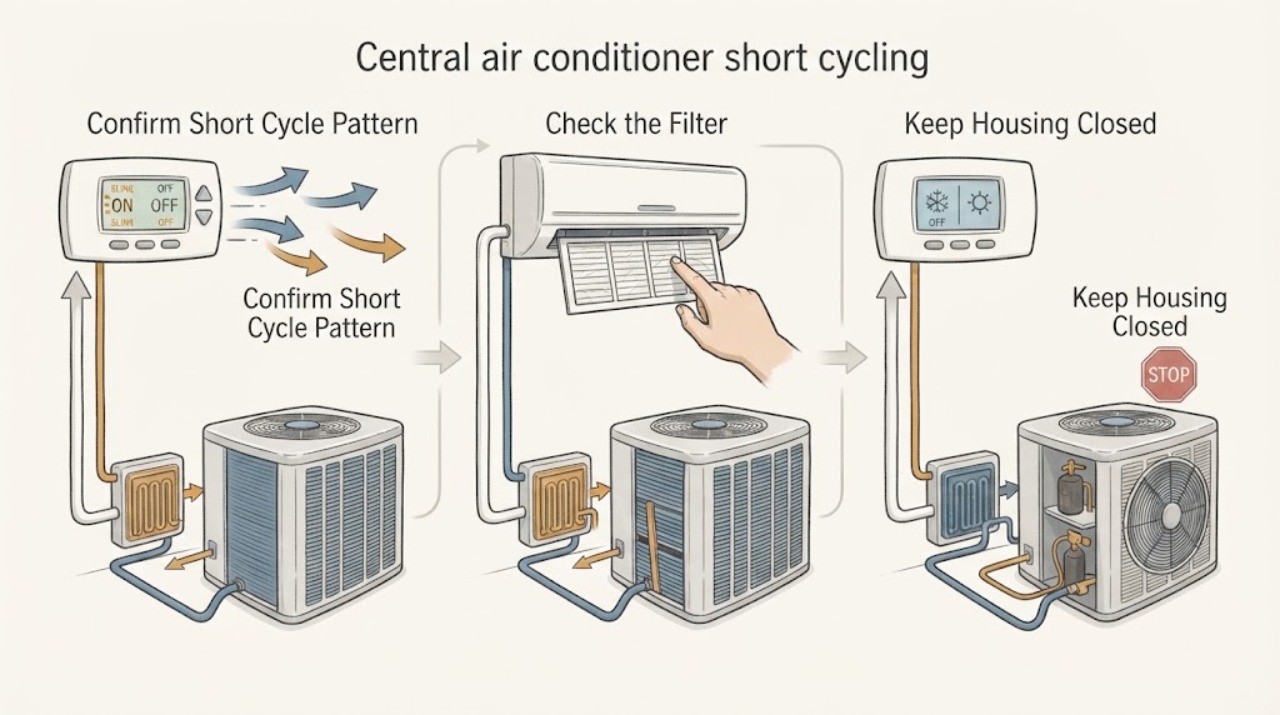
Work through in order
Diagnostic checks
Use only checks that match the exact appliance or system and its official guide.
-
Check 1
Set the thermostat to its normal cooling mode and observe from a safe position without repeatedly changing the setting. Record whether the indoor blower and outdoor unit start, whether the compressor stops before the thermostat is satisfied, and whether the cycle repeats.
Expected result: The system completes a normal cooling cycle, the compressor runs only briefly and restarts while there is still a cooling call, only the blower continues, or the entire system stops.
Next step: Write down the thermostat setting, room comfort, start-stop sequence, and approximate relative timing without forcing another cycle. Continue with safe checks only if no warning sign is present.
Stop if: Stop cooling for smoke, burning odor, sparking, a tripped breaker, loud mechanical noise, severe vibration, ice, water damage, or a rapidly worsening start-stop pattern.
Why this matters
Why: A single stop after the setpoint is reached is not the same as repeated short compressor cycles. A compressor that starts and stops before demand is satisfied supports a short-cycling pattern; a blower-only period may be a normal fan delay or a separate control or airflow clue.
-
Check 2
From the thermostat's normal user interface, confirm that the mode is COOL, the fan selection is appropriate for the installation, and no schedule, remote setting, or accidental adjustment is repeatedly ending the cooling call. Do not remove the thermostat cover or touch wiring.
Expected result: The mode or schedule is wrong, the setpoint changes unexpectedly, the display is unstable, or the thermostat continues a steady cooling call while the outdoor unit repeatedly stops.
Next step: Correct only an obvious user-setting error and observe one ordinary cycle. If the thermostat call remains steady while the compressor short cycles, arrange HVAC diagnosis rather than repeatedly changing settings.
Stop if: Do not jumper terminals, open the thermostat, alter wiring, bypass a control, or keep forcing cooling when the system trips a breaker or shows a hazard.
Why this matters
Why: An incorrect or intermittent demand can mimic short cycling. A steady call with repeated brief compressor stops makes a time-delay, pressure, control, airflow, or compressor issue more likely than a simple setting error.
-
Check 3
With cooling stopped, inspect the accessible air filter and return and supply openings. Replace a visibly loaded filter only with the exact type specified for the installation, and open vents or returns that someone intentionally closed; do not remove an equipment panel.
Expected result: The filter is dirty or damaged, a return or supply opening is blocked, airflow is weak, or the filter and accessible openings are clear.
Next step: After a correct filter change or vent opening, observe only one normal cycle if there is no ice, water, noise, or electrical warning. Arrange service if the compressor still stops briefly or airflow remains weak.
Stop if: Do not run without the required filter, block returns to change the sound, remove the blower door, thaw ice with tools or heat, or continue if airflow collapses.
Why this matters
Why: Rheem says dirty filters restrict airflow and strain components, and that clear ductwork and vents support proper circulation. If these checks are clear but short cycling continues, the cause may be a frozen or dirty coil, control, pressure, refrigerant, or compressor condition.
-
Check 4
With the outdoor unit stopped, look around the exterior cabinet for crowded vegetation, leaves, grass, or loose objects that block airflow. Remove only loose material fully outside the cabinet and keep hands away from the grille, fan, fins, disconnect, and wiring.
Expected result: The outdoor unit is crowded or obstructed, the cabinet or coil appears damaged, the fan appears abnormal, or the surrounding area is clear.
Next step: Restore only clear exterior space without opening the unit, then arrange professional diagnosis if short cycling persists or the fan, coil, cabinet, or pad appears damaged.
Stop if: Do not remove the grille, touch the fan or fins, straighten fins, hose the coil, open the electrical compartment, or reset a protection device.
Why this matters
Why: Rheem says blocked outdoor airflow can make the unit work harder and reduce performance. A clear exterior with persistent short cycling keeps pressure, coil, fan, electrical, control, and compressor causes in consideration.
-
Check 5
Record whether short cycling coincides with weak airflow, warm supply air, visible frost or ice, water, rising humidity, unusual noise, a burning odor, or a breaker that trips. Observe only from ordinary safe access and do not touch refrigerant lines.
Expected result: Cooling and airflow are normal, or one or more performance, moisture, mechanical, or electrical warning signs accompany the repeated starts and stops.
Next step: Keep cooling off for ice, water damage, severe performance loss, smoke, burning odor, sparking, loud mechanical noise, or a tripping breaker, and arrange qualified HVAC service with the observation record.
Stop if: Do not handle refrigerant, thaw ice with heat or tools, open panels, reset a breaker repeatedly, or continue operation to collect more evidence.
Why this matters
Why: Short cycling with ice, poor cooling, water, or weak airflow can involve airflow restriction, frozen or dirty coils, refrigerant or pressure conditions, or compressor protection. Noise, smoke, odor, or breaker trips add a mechanical or electrical safety concern.
-
Check 6
Collect the Rheem model and serial information from paperwork or an already accessible label, the thermostat setting and schedule history, start-stop sequence, filter and airflow observations, outdoor clearance, cooling result, visible ice or water, and any diagnostic display viewed without opening equipment.
Expected result: The compressor still runs only briefly, the problem returns after a settings or filter check, or a protection, pressure, control, coil, refrigerant, electrical, or compressor warning is present.
Next step: Leave the system off when a warning sign is present and arrange qualified HVAC service. Provide the complete sequence so the technician can diagnose the cause without repeated homeowner restarts.
Stop if: Do not order a capacitor, control board, pressure switch, refrigerant, or compressor part from the symptom alone, and do not open the cabinet to inspect it.
Why this matters
Why: The remaining possibilities include an intermittent thermostat demand, time-delay or control-board fault, pressure or airflow condition, refrigerant issue, capacitor, or compressor problem. These require model-specific measurements and qualified access.
Use your observations
Decision map
Find the observation that best matches what you see, then follow the next safe action.
-
PATH 01Safety boundary
What you see
The system stops after the thermostat is satisfied or changes capacity and run time in a way that matches the exact model's normal two-stage or variable-capacity operation, without repeated brief compressor restarts or warning signs.
Do this next
Document the baseline and use the model owner manual to interpret the operating mode; arrange service if the pattern changes or cooling becomes inadequate.
Why this path and its safety boundary
Why it matters: This pattern is not established as short cycling. A staged system can operate differently from a single-capacity system, and a normal fan delay can outlast the compressor.
Safety stop: Do not dismiss repeated brief compressor starts, ice, water, breaker trips, loud noise, or a sudden change as a normal stage transition.
-
PATH 02Safety boundary
What you see
The thermostat mode, schedule, setpoint, or demand appears to change unexpectedly, or the outdoor unit stops when the cooling call is not steady.
Do this next
Correct only an obvious setting or schedule error and observe one ordinary cycle. If demand remains unstable, arrange thermostat and control diagnosis without opening the thermostat.
Why this path and its safety boundary
Why it matters: An intermittent demand or user-setting issue can mimic short cycling, although unstable display behavior or wiring can still require professional diagnosis.
Safety stop: Do not jumper terminals, alter wiring, bypass controls, or keep restarting the system to prove the demand signal.
-
PATH 03Safety boundary
What you see
The filter or returns are restricted, airflow is weak, or frost or ice appears with the repeated starts and stops.
Do this next
Replace only a clearly loaded accessible filter with the specified type, keep returns open, stop cooling for ice, and arrange HVAC service if airflow or short cycling persists.
Why this path and its safety boundary
Why it matters: Airflow restriction or a frozen evaporator coil is more likely than a simple thermostat setting and can cause additional system stress; Rheem also lists blower, coil, duct, and refrigerant checks in this pattern.
Safety stop: Do not operate without a filter, thaw ice with tools or heat, remove panels, or diagnose refrigerant charge as a homeowner.
-
PATH 04Safety boundary
What you see
The outdoor area is crowded or obstructed, the condenser fan or cabinet looks abnormal, or short cycling occurs with poor cooling, high humidity, or a pressure-protection indication.
Do this next
Remove only loose exterior obstructions that are safely outside the cabinet, keep cooling off for persistent short cycling or performance loss, and arrange qualified service.
Why this path and its safety boundary
Why it matters: Blocked outdoor airflow, dirty or damaged coils, fan trouble, high or low pressure, or compressor protection is more likely than a problem confined to the thermostat.
Safety stop: Do not hose the unit, touch the fan, open the electrical compartment, reset a pressure device, or adjust refrigerant.
-
PATH 05Safety boundary
What you see
The thermostat call is steady, airflow and exterior clearance are reasonable, but the compressor still starts and stops briefly, or the system has loud noise, electrical odor, breaker trips, or severe vibration.
Do this next
Keep the system off and arrange qualified HVAC diagnosis; provide the start-stop record, display information, and any electrical or mechanical warning signs.
Why this path and its safety boundary
Why it matters: A time-delay relay, control board, capacitor, contactor, wiring, compressor protection, or compressor fault is more likely than a user-serviceable filter issue.
Safety stop: Do not open the equipment, test live terminals or capacitors, reset the breaker repeatedly, replace a control part by guesswork, or add refrigerant.
Helpful context
Understand the symptom
Confirm a real short-cycle pattern before guessing at a part
Short cycling is a pattern, not simply a system turning off once. Note whether the compressor and outdoor fan start, run briefly, stop, and restart while the thermostat is still calling for cooling. A two-stage or variable-capacity Rheem system can change capacity and run time as the load changes, so compare the behavior with the exact owner manual rather than assuming every change in sound or run time is a fault. Repeatedly toggling the thermostat can create its own misleading pattern.
Start with airflow and outdoor-clearance checks
Rheem says dirty or clogged filters restrict airflow and strain system components, and that blocked ducts, vents, or outdoor-unit airflow can reduce performance. With the system stopped from its normal controls, replace a visibly loaded, user-accessible filter only with the specified type, keep returns and supply vents open, and remove loose vegetation or objects outside the outdoor cabinet. Do not hose an energized unit, bend coil fins, remove panels, or treat an accessible check as proof of a refrigerant or coil diagnosis.
Ice, pressure clues, and poor cooling change the urgency
A short-cycle complaint accompanied by ice, weak airflow, warm air, water, high humidity, or a blocked outdoor coil is a performance fault rather than a thermostat nuisance. Rheem's technical diagnostic material connects abnormal pressure, frozen or dirty coils, airflow restrictions, refrigerant charge, and compressor protection with service investigation. Keep cooling off when ice or water damage is present and let a qualified technician determine whether the underlying issue is airflow, refrigerant, pressure, control, or compressor related.
Electrical and refrigerant work stays professional
A short cycle can involve a time-delay control, circuit board, pressure switch, capacitor, contactor, wiring, or compressor. Rheem's service documentation warns that refrigerant is under pressure and that homeowners should not install or service the split-system equipment. Record the display or diagnostic indication only from ordinary safe access; do not open the cabinet, measure live terminals, reset a tripping breaker repeatedly, or add refrigerant as a test.
Safety boundary
Stop conditions
- Stop cooling for repeated brief compressor cycles with ice, water damage, severe loss of cooling, weak airflow, smoke, burning odor, sparking, loud mechanical noise, severe vibration, or a tripping breaker.
- Do not open panels, touch wiring, test capacitors or live terminals, jumper thermostat controls, reset protection devices, or repeatedly reset a breaker.
- Do not thaw ice with tools or heat, handle refrigerant, adjust refrigerant charge, or bypass a pressure or time-delay safety control.
- Do not operate without the required filter, block returns or vents, hose an energized unit, touch the outdoor fan, or use a replacement part as a diagnostic test.
- Arrange qualified HVAC service when the thermostat call is steady but the compressor continues to short cycle after safe filter, vent, and exterior-clearance checks.
Only after diagnosis
Potential parts
- air filter
Consider this category only when the existing user-accessible filter is visibly loaded or damaged and the installation specifies a replaceable filter of that size and type.
Confirm the filter dimensions, airflow rating, and installation requirements from the existing filter or system documentation; do not remove the filter as a test. - thermostat or control board
Consider this category only when a qualified diagnosis confirms an intermittent demand, time-delay, thermostat, or control-board fault after airflow and exterior checks.
Confirm the exact Rheem model, control configuration, staging, wiring, and manufacturer fit information before ordering; do not jumper or rewire controls. - run capacitor or contactor
Consider this category only when a qualified HVAC technician identifies a failed capacitor or contactor as the cause of the short-cycle or compressor-start symptom.
Confirm exact electrical ratings, model, and manufacturer fit information with the technician; capacitors and contactors are not homeowner test parts. - compressor or refrigerant-circuit component
Consider this category only after qualified pressure, airflow, electrical, and compressor diagnosis establishes a refrigerant-circuit or compressor fault.
Confirm the exact model, refrigerant designation, system design, and professional replacement requirements; do not buy or add refrigerant from short cycling alone.
When checks do not resolve it
Need a professional?
Arrange qualified HVAC service when a Rheem central air conditioner repeatedly starts and stops before satisfying the thermostat, especially after an obvious setting or accessible filter issue has been corrected. Keep cooling off and seek prompt service for ice, water damage, warm air, weak airflow, unusual noise, smoke, burning odor, sparking, a breaker trip, or a pressure or control indication. Refrigerant, electrical, control, capacitor, compressor, coil, and pressure diagnosis are not homeowner repairs.
Safety scope: This article supports ordinary thermostat observation, user-accessible filter and vent checks, and exterior clearance checks only. Do not open the equipment, handle refrigerant, test electrical parts, bypass controls, or continue operating a system with a warning sign.
Common questions
FAQ
What counts as short cycling on a Rheem central air conditioner?
It is a repeated pattern in which the compressor starts and stops before the thermostat is satisfied, especially when it runs only briefly and then tries again. A normal stop after reaching the setpoint, a normal blower delay, or a staged change in capacity is not automatically short cycling.
Can a dirty filter cause a Rheem AC to short cycle?
A dirty filter can restrict airflow and strain the system, and Rheem lists airflow, coil, and duct conditions among related diagnostic clues. Replace a visibly loaded user-accessible filter only with the specified type while cooling is stopped. If short cycling or weak airflow continues, arrange professional diagnosis.
Should I keep resetting the thermostat or breaker when my Rheem AC short cycles?
No. Confirm only obvious mode or schedule settings and avoid repeatedly forcing the compressor to restart. A breaker trip, unstable demand, or returning short-cycle pattern needs qualified diagnosis; do not open wiring or reset protection devices as a test.
What should I do if my Rheem AC short cycles with ice or warm air?
Stop cooling and arrange qualified HVAC service. Ice, warm air, weak airflow, water, or rising humidity can indicate airflow, coil, pressure, refrigerant, blower, or compressor-related trouble. Do not thaw ice with tools or heat, handle refrigerant, or continue operating to collect more evidence.
Read the exact guide
Official sources
- Split System Cooling/Package Units Cooling ModeRheem Manufacturing Company · Rheem diagnostic index used to frame short cycling with related cooling, pressure, coil, compressor, and refrigerant symptoms.
- 7 Summer Air Conditioning Tips for Your HomeRheem Manufacturing Company · Rheem homeowner guidance used for low-risk airflow and exterior checks that can contribute to abnormal cycling or system strain.
- 708350ARheem Manufacturing Company · Rheem technical diagnostic document used for the definition of short cycling, possible fault categories, and the prohibition on homeowner refrigerant or equipment service.
- Air ConditioningRheem Manufacturing Company · Rheem technical FAQ used to distinguish staged operation from an assumed single-capacity cycle pattern.
Community feedback
Share a repair observation
Share a plain-text repair observation. Accepted observations are published automatically; this page may take a moment to update.