
On this page
Start here
Quick answer
First decide whether the air is cold only because the Rheem thermostat fan is set to On, or because a heat call is failing. Set the thermostat to Heat and Fan Auto, then observe one call from a safe location: a short room-temperature period before warm air can be normal, but air that stays cold, becomes cold after ignition, or follows a repeated shutdown is a fault pattern. Check only the accessible filter, registers, returns, and visible outdoor combustion-air or exhaust termination. Rheem's own gas-furnace guidance connects a blower running without ignition to an open limit circuit, and connects limit trips with low airflow or an overheating heat exchanger; its diagnostic material also identifies pressure, vent, flame-sensing, ignition, drain, and control causes. Do not remove furnace panels, bypass a safety control, adjust gas or electrical parts, or keep restarting it. Stop immediately for gas odor, soot, smoke, a carbon-monoxide alarm, sparking, or a damaged or blocked combustion vent.
Before you begin
Safety first
- This article permits observation from normal living areas, thermostat changes, an accessible filter and register/return check, and a safe visual check of an accessible external termination. Do not open furnace compartments, touch gas or electrical components, handle ignition wiring, bypass controls, modify venting, or perform combustion work.
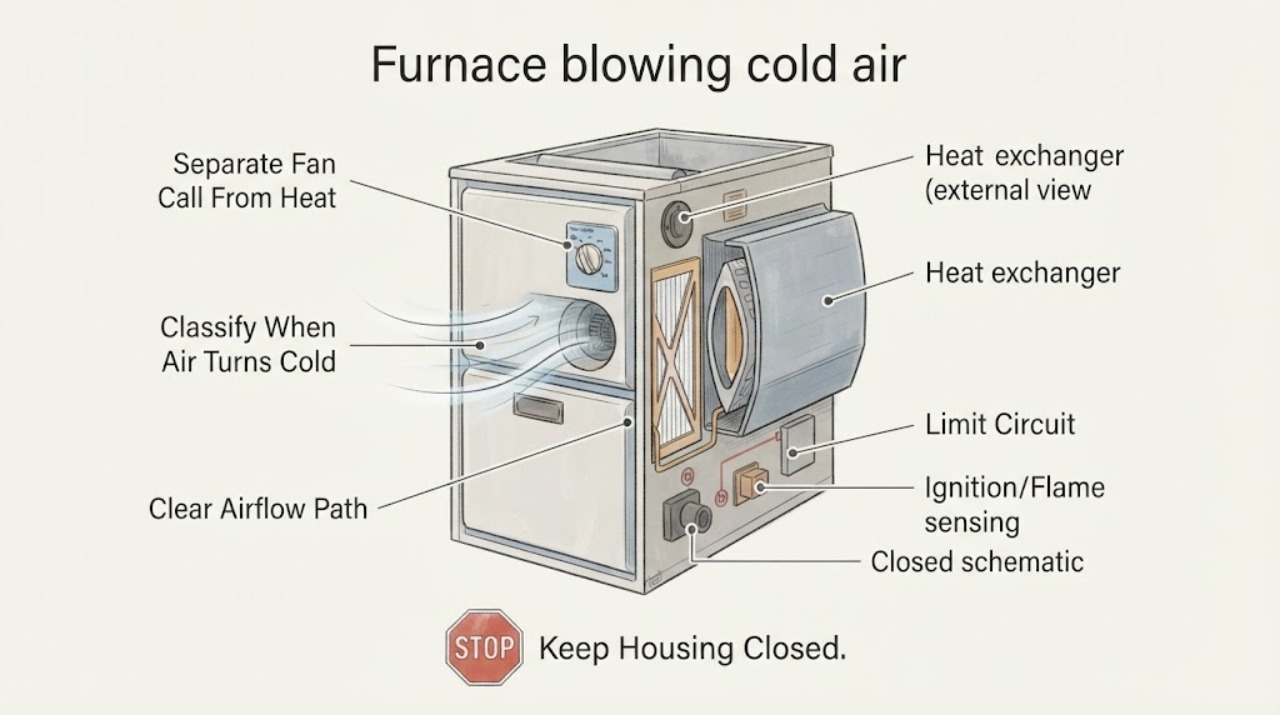
Work through in order
Diagnostic checks
Use only checks that match the exact appliance or system and its official guide.
-
Check 1
From the thermostat's normal controls, confirm Heat is selected, the setpoint is above room temperature, and Fan is Auto. Check whether the cold air occurs only when someone manually runs the fan or when no heat call is active; do not remove the thermostat cover.
Expected result: Cold air appears only with Fan On or between heat calls, the thermostat is not requesting heat, or cold air also continues during a genuine Heat call.
Next step: Use Heat and Fan Auto for one ordinary call when no hazard is present. If the air remains cold during that call, continue with the timing and airflow observations rather than repeatedly changing settings.
Stop if: Do not jumper thermostat terminals, alter low-voltage wiring, or test further when there is gas odor, smoke, soot, a carbon-monoxide alarm, sparking, or unusual combustion noise.
Why this matters
Why: Fan On can circulate room air without burner heat. If cold air continues during a steady Heat call after the settings are correct, the thermostat setting is less likely and the furnace sequence needs attention.
-
Check 2
During one heat call, stay at a register and listen from the living area. Note whether the blower starts before any warmth, warm air follows a short startup, the air never warms, or warm air becomes cold after the furnace has been heating; stop the call if a warning sign appears.
Expected result: The air is cool only briefly and then warms, remains room-temperature throughout, or becomes cold after a period of warm air.
Next step: Compare the pattern with the exact Rheem model instructions. Keep the furnace off and arrange qualified HVAC diagnosis if the air stays cold, turns cold repeatedly, or the startup sequence is abnormal.
Stop if: Do not remove an access door to watch ignition, repeatedly cycle the furnace, or treat banging, delayed ignition, gas smell, soot, smoke, or a carbon-monoxide alarm as normal warm-up.
Why this matters
Why: A brief startup or post-cycle blower period can be normal. No warmth at all suggests the burners never established heat; warm-then-cold suggests the heat sequence was interrupted, such as a limit, flame-sensing, pressure, vent, fuel, or control problem.
-
Check 3
With the furnace not operating, inspect the filter, supply registers, and return grilles from ordinary access. Replace a visibly loaded or damaged filter only with the specified type, and reopen intentional register or return closures; do not remove the blower door or furnace cabinet.
Expected result: The filter is loaded or damaged, several air openings are blocked, airflow is weak, or the accessible air path is clear.
Next step: If a correct filter change or opening a register resolves the symptom for a complete normal call, monitor it. If cold air, weak airflow, or repeated cycling remains, stop using the furnace and request diagnosis.
Stop if: Never run without the required filter, block returns to force a test, bypass a limit, clean internal burners, or reach into the blower compartment.
Why this matters
Why: Rheem identifies low airflow as a way the heat exchanger can overheat and open the main limit, leaving the blower on while heat is removed. A clear filter and room-side path make an airflow restriction less likely, but do not rule out duct, blower, heat-exchanger, or control faults.
-
Check 4
Without opening the cabinet, record any status light or display pattern visible through the normal viewing area after the cold-air event. Use the exact model manual to identify the pattern, and note whether you heard the inducer, ignition, burners, and circulating blower in that order.
Expected result: A status indication returns, the inducer or blower runs without ignition, ignition occurs and stops, or the sequence never reaches a stable heating period.
Next step: Write down the model, code pattern, sounds, and timing and give them to a qualified HVAC technician. Keep the furnace off when the abnormal pattern repeats.
Stop if: Do not reset a recurring lockout repeatedly, clean or reposition a flame sensor, adjust a gas valve, measure live voltage, or bypass a pressure, rollout, flame, or limit control.
Why this matters
Why: Rheem's published diagnostic material associates different indications with flame failure or soft lockout, pressure-switch conditions, and an open limit circuit. The same cold-air symptom can therefore arise at different points in the sequence; a code is a clue for the technician, not permission to work on the control circuit.
-
Check 5
From a safe, reachable location outside, look—not reach—for an obvious snow, leaf, nest, ice, corrosion, or impact blockage at the combustion-air intake or exhaust termination. Keep clear of exhaust and do not open, move, or modify vent piping.
Expected result: A termination is visibly blocked or damaged, or the accessible termination looks clear while cold air persists.
Next step: For a blocked or damaged termination, stop the furnace and arrange qualified HVAC inspection rather than restarting it. If it looks clear but the sequence is abnormal, provide that negative finding with the code and timing record.
Stop if: Do not climb, enter a crawlspace, disconnect vent joints, clear an internal obstruction, touch gas piping, or operate the furnace when combustion products may enter the home.
Why this matters
Why: Rheem identifies blocked venting, inadequate combustion air, and damaged heat-exchanger or vent conditions as causes of pressure or rollout protection. A clear termination does not rule out a concealed restriction or internal safety fault.
Use your observations
Decision map
Find the observation that best matches what you see, then follow the next safe action.
-
PATH 01Safety boundary
What you see
Cold air is present only with Fan On or between calls, or it lasts briefly before the register becomes warm and the furnace completes a normal heating cycle.
Do this next
Leave Fan Auto selected for normal heating and confirm the behavior against the exact Rheem manual. Escalate if the delay lengthens, warmth never arrives, or the pattern changes.
Why this path and its safety boundary
Why it matters: The observed behavior fits fan circulation or a model-specific startup/post-cycle delay more than a confirmed heating failure.
Safety stop: Do not dismiss persistent cold air, a repeated restart, unusual combustion sound, soot, smoke, gas odor, or a carbon-monoxide alarm as normal timing.
-
PATH 02Safety boundary
What you see
Warm air begins, then turns cold while airflow is weak, the filter or returns are restricted, or the furnace cycles off before satisfying the thermostat.
Do this next
Correct only an obvious accessible filter or register problem, then allow at most one normal call if no warning sign exists. Arrange service if the symptom returns or airflow remains weak.
Why this path and its safety boundary
Why it matters: An airflow-related temperature rise and limit interruption are more plausible than a thermostat-only issue. The evidence does not identify whether the restriction, blower, limit circuit, heat exchanger, or another cause is primary.
Safety stop: Do not bypass the limit, run without a filter, change blower wiring, or continue operation through repeated limit events.
-
PATH 03Safety boundary
What you see
The blower or inducer runs but ignition never establishes, or ignition occurs and the flame drops out before warm air is sustained; a Rheem status pattern may also return.
Do this next
Keep the furnace off if the pattern repeats and provide the sequence and exact code to a qualified HVAC technician. Do not substitute a flame sensor, igniter, control, or gas component based only on this symptom.
Why this path and its safety boundary
Why it matters: The interruption is downstream of the thermostat call and may involve flame sensing, ignition, pressure proving, venting, fuel, condensate, or the integrated furnace control. Rheem's flame-sensing notes show why wiring, grounding, polarity, and sensor condition can matter, but none can be safely inferred from the register temperature alone.
Safety stop: Do not open the burner compartment, handle ignition wiring, adjust manifold pressure, bypass a pressure or flame control, or repeatedly reset a soft lockout.
-
PATH 04Safety boundary
What you see
Gas odor, soot, smoke, a carbon-monoxide alarm, sparking, delayed or rough ignition, a damaged or blocked combustion termination, or another combustion warning accompanies the cold air.
Do this next
Leave the area when appropriate, avoid flames and electrical switches, and contact emergency or utility help from a safe location. Arrange qualified HVAC inspection before using the furnace again.
Why this path and its safety boundary
Why it matters: This is a combustion, venting, electrical, or safety event—not a filter experiment. Continued operation could expose occupants to combustion products or worsen equipment damage.
Safety stop: Do not operate, relight, open, probe, or attempt to clear the furnace or vent system while a hazard is suspected.
Helpful context
Understand the symptom
Use the timing of the cold air as the first Rheem clue
Cold air from a register does not identify a failed part by itself. Rheem says the thermostat fan setting is preferably Auto; On can circulate room-temperature air when there is no heat call. During a real Heat call, note whether air warms after a brief startup, never warms, or warms and then turns cold. The last pattern is especially useful: it points toward a heating sequence that started and was then interrupted, rather than simply a fan setting. Compare the observation with the exact model's owner or installation instructions because Rheem furnace families do not all use the same controls or timing.
A blower-only pattern can be a protection response
Rheem's technical FAQ describes the induced-draft and main blowers running without entering ignition when the limit circuit is open. It also lists low airflow or an over-fired heat exchanger as reasons a main limit may open. A loaded filter or blocked return can therefore change the sequence: burners stop while the blower moves unheated air. If the filter and room-side openings are clear but the pattern repeats, the observation has done its job; it does not prove that the limit switch, blower, heat exchanger, or control board itself is the failed part.
Treat Rheem flash codes as model-specific evidence
A visible status light can narrow the handoff, but it is not a universal Rheem code chart. Rheem's technical FAQ gives examples such as a soft lockout after repeated flame failures, pressure-switch indications, and a limit-control indication; the exact meaning and reset procedure must come from the manual for the furnace model. Record the number or pattern without opening the cabinet. Rheem's flame-sensing tip also lists grounding, polarity, wiring, contamination, and sensor faults, which is why a flame that starts and disappears is a professional diagnostic branch rather than a reason to clean or rewire parts yourself.
Safety boundary
Stop conditions
- Stop the furnace for gas odor, soot, smoke, a carbon-monoxide alarm, sparking, delayed or rough ignition, unusual combustion noise, repeated safety shutdowns, or a blocked or damaged combustion vent.
- Do not open the burner or blower compartments, touch gas or electrical components, handle ignition wiring, adjust gas pressure, or test live circuits.
- Do not bypass a limit, rollout, pressure, flame, door, or other safety control, and do not repeatedly reset a recurring lockout.
- Do not run without the required filter, block returns to force a test, modify venting, or clear an internal combustion restriction as a homeowner experiment.
- Do not order an igniter, flame sensor, limit control, integrated control, blower, gas valve, vent, or heat exchanger from the cold-air symptom alone.
Only after diagnosis
Potential parts
- furnace air filter
Consider this category only when the user-accessible filter is visibly loaded or damaged and the installation calls for a replaceable filter of that size and type.
Confirm the dimensions, airflow rating, and installation requirements from the existing filter or the exact Rheem documentation; a filter is not a remedy for a recurring safety shutdown. - flame sensor or igniter
Consider this category only after a qualified technician confirms a flame-sensing or ignition fault from the observed sequence and model-specific tests.
Confirm the exact furnace model, ignition system, wiring, and manufacturer fit information before ordering; this is not a homeowner test or universal Rheem part. - limit control or integrated furnace control
Consider this category only when professional diagnosis confirms the control itself failed after airflow, heat-exchanger, ignition, pressure, vent, and fuel causes have been evaluated.
Match the exact model, staging, safety ratings, wiring, and manufacturer specification; never bypass or substitute a safety control by symptom.
When checks do not resolve it
Need a professional?
Arrange qualified HVAC service when cold air persists during a Rheem Heat call, returns after a filter and accessible airflow check, follows warm air, occurs with blower-only operation or flame dropout, or coincides with a status indication or abnormal sequence. Stop using the furnace immediately for gas odor, soot, smoke, a carbon-monoxide alarm, sparking, delayed or rough ignition, unusual combustion noise, repeated safety shutdowns, or a blocked or damaged combustion vent.
Safety scope: This article permits observation from normal living areas, thermostat changes, an accessible filter and register/return check, and a safe visual check of an accessible external termination. Do not open furnace compartments, touch gas or electrical components, handle ignition wiring, bypass controls, modify venting, or perform combustion work.
Common questions
FAQ
Why does my Rheem furnace blow cold air when the fan is on?
Rheem says Fan On can circulate room-temperature air even when there is no heat call. Set Fan Auto and Heat, then watch one call. If air stays cold during Heat or turns cold after warming, the furnace sequence—not just the fan setting—needs attention.
What does it mean if a Rheem furnace blower runs but there is no heat?
Rheem's gas-furnace FAQ says the blowers can run when the limit circuit is open and lists low airflow, a tripped rollout, or an open high limit among possible conditions. Record the timing and any visible status indication, but do not open the cabinet or bypass a safety control.
What if my Rheem furnace warms up and then blows cold air?
Warm-then-cold air suggests that the heating sequence started and was interrupted. A restricted airflow condition can open a limit, while flame sensing, ignition, pressure, venting, fuel, condensate, or control faults can also interrupt heat. Check only the accessible filter and openings; recurring events need qualified diagnosis.
Can I use a Rheem flash code to replace a part?
No. Rheem publishes diagnostic indications, but the code meaning and procedure are model-specific and may identify a circuit or condition rather than a failed replaceable part. Match the pattern to the exact manual and let a qualified technician test the underlying cause.
When is a Rheem furnace blowing cold air an emergency?
Stop using it for gas odor, soot, smoke, a carbon-monoxide alarm, sparking, delayed or rough ignition, unusual combustion noise, or a blocked or damaged combustion vent. Leave the area when appropriate and contact emergency or utility help from a safe location.
Read the exact guide
Official sources
- Gas Furnace SymptomsRheem Manufacturing Company · Used only to identify the professional diagnostic categories associated with ignition, pressure, limit, flame, blower, and control symptoms.
- 708337-A L1RA Furn ii.pmdRheem Manufacturing Company · Used for safe external vent and combustion-air boundaries, required filter and airflow context, and the need to use model-specific installation information.
- Does Not Sense FlameRheem Manufacturing Company · Used to explain why a flame that starts and disappears can involve grounding, polarity, wiring, contamination, or the sensor itself and therefore needs model-specific professional diagnosis.
- FAQsRheem Manufacturing Company · Used only to explain why Fan On can circulate air continuously and why Rheem prefers Auto for ordinary operation.
- Product EducationRheem Manufacturing Company · Used to explain the role of the heat exchanger between furnace burners and the blower without claiming a particular model's failure.
- Gas Furnace Technical Frequently Asked QuestionsRheem Manufacturing Company · Used for the distinction between blower operation and ignition, the relationship between low airflow and an open limit, example status indications, and professional boundaries around flame, pressure, and rollout controls.
Community feedback
Share a repair observation
Share a plain-text repair observation. Accepted observations are published automatically; this page may take a moment to update.