
On this page
Start here
Quick answer
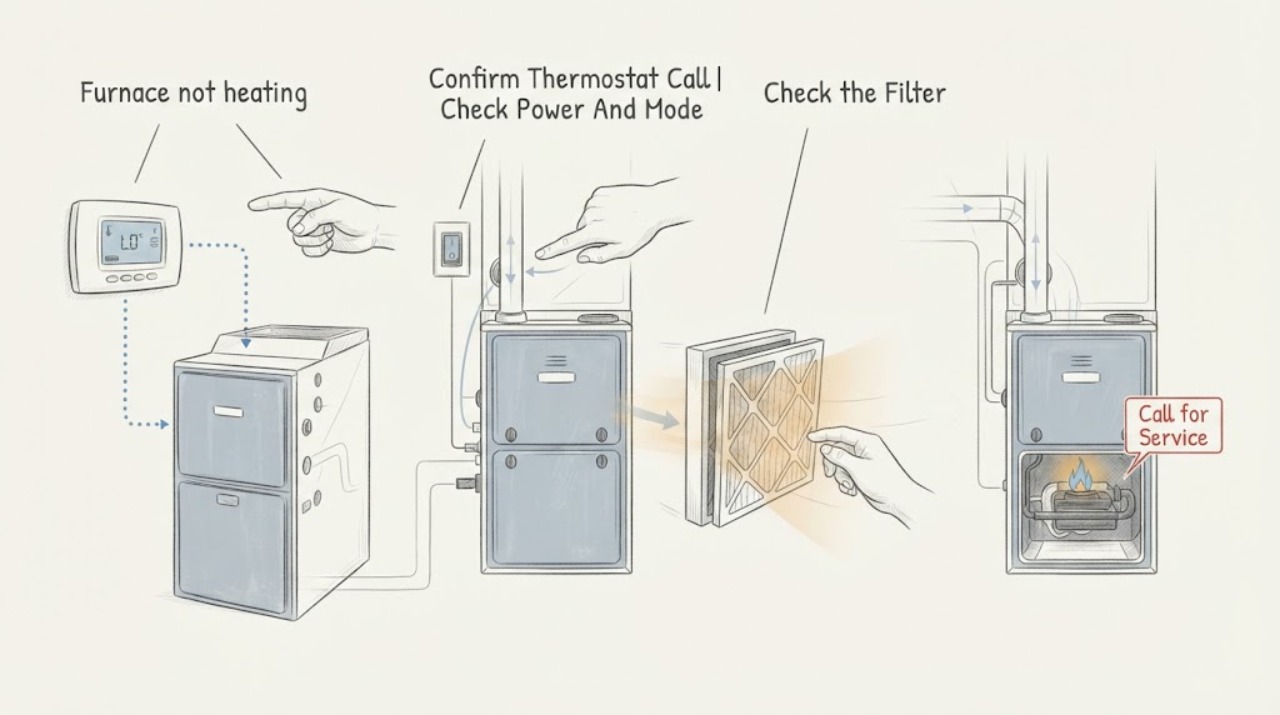
Start with observations that do not require opening the Rheem furnace: confirm the thermostat is actually calling for heat, check that the system has power and the correct mode, inspect the filter and visible registers, and note what the furnace does next. If nothing starts, the control call, power, or low-voltage path may be missing. If an inducer or blower runs but there is no ignition, the pressure-switch, vent, limit, ignitor, gas, or control path needs qualified diagnosis. If burners light and then stop, flame proving or a safety limit may be involved. Do not remove panels, test live voltage, adjust gas pressure, bypass a safety switch, clean or reposition a burner or flame sensor, or repeatedly reset a lockout. Stop for gas odor, a carbon-monoxide alarm, smoke, flame outside the burner area, scorching, unusual combustion, or an unsafe electrical or vent condition.
Before you begin
Safety first
- Owner checks are limited to normal thermostat controls, safe external power/status observation, user-accessible filter and register inspection, visible exterior vent observation, and documentation. A qualified professional must handle cabinet access, live electrical or gas measurements, combustion and vent testing, ignitor or flame-sensor work, pressure and limit diagnosis, wiring, safety controls, and part replacement.
Work through in order
Diagnostic checks
Use only checks that match the exact appliance or system and its official guide.
-
Check 1
From a normal operating position, set the thermostat to Heat, use its normal fan setting, and request a temperature a few degrees above the room reading. Confirm that the display is awake, the schedule or hold is not preventing a call, and any separate furnace service switch is not visibly off; do not remove the thermostat or furnace cover.
Expected result: Record a clear heat call and a normal display, a display that is blank or rebooting, a mode or schedule that is not calling for heat, or a call that produces no furnace response.
Next step: If the display is blank, mode is wrong, or the call cannot be maintained, address only the user-accessible thermostat setting or battery guidance for that thermostat and arrange HVAC service if it remains unresolved. If the call is clear, continue with external observations; do not jumper terminals or open the furnace.
Stop if: Stop if the thermostat, wiring, furnace switch, or control area is damaged, wet, scorched, or requires cover removal or electrical testing.
Why this matters
Why: A missing or unstable thermostat call keeps the thermostat, low-voltage power, or control wiring in consideration. A confirmed call with no response moves attention to furnace power, control status, or a lockout rather than to the filter or supply registers.
-
Check 2
Without opening the furnace, check whether the home's HVAC breaker appears tripped and whether the furnace's clearly labeled service switch is in its normal position. Check the thermostat mode once more after any safe reset of a tripped breaker only if there is no odor, smoke, moisture, or visible damage; do not repeatedly reset a breaker or lockout.
Expected result: Record normal power indications, a breaker or switch that is off, a breaker that trips again, a blank control display, or a visible alarm or lockout indication.
Next step: If a breaker trips again, leave it off and call a qualified HVAC or electrical professional. If the switch or breaker is normal but the furnace remains unresponsive, photograph the visible status indication and arrange service; do not test voltage or remove an access door.
Stop if: Stop immediately for burning odor, smoke, arcing, water near electrical equipment, a hot panel, a damaged switch, or a breaker that will not remain on.
Why this matters
Why: No power can prevent the entire heat sequence. A repeated trip, a lockout, or a display that remains dead suggests an electrical or control fault and is not evidence that the breaker should be reset again.
-
Check 3
From outside the cabinet, inspect the user-accessible air filter and visible supply and return openings. Confirm that registers are not deliberately closed or blocked and that the filter is not visibly loaded with dust; on a gas furnace, look only at the exterior termination or visible vent route for leaves, nests, ice, or other obvious obstruction, without touching or disassembling the vent.
Expected result: Record a clean filter and open registers, a heavily loaded filter, several closed or blocked registers, a restricted-looking exterior vent, or no safe view of the filter or vent.
Next step: If the filter is designed for homeowner replacement, replace it only with the exact size and type specified for the system, with power left off if the manual requires it; do not wash a disposable filter or run the furnace without one. Remove only loose debris well away from the appliance, and call service for any vent obstruction, inaccessible filter, repeated overheating, or uncertainty.
Stop if: Stop for a blocked or damaged vent, exhaust entering the home, ice that cannot be safely cleared from the ground, soot, water, a missing filter, or any need to enter the cabinet or climb near the termination.
Why this matters
Why: Rheem says closed vents can cause overheating and a dirty filter can limit airflow, while a restricted gas-furnace vent can interfere with safe operation. These findings can explain weak heat or a limit-related shutdown, but they do not prove a failed motor, limit, or vent switch.
-
Check 4
With the cabinet closed and from a safe position, request heat once and listen or look only for the external result: no sound, an inducer or draft sound without ignition, ignition followed by immediate shutdown, burners that remain lit but no warm airflow, or a normal warm-air run. Do not look into the burner compartment, touch a sight glass or vent, or attempt to relight, clean, or adjust anything.
Expected result: Record the last stage that occurs and whether the thermostat call ends normally, the furnace locks out, or the blower runs with cool air.
Next step: Use the observed stage and exact model documentation for the service call. Do not repeat failed ignition attempts, bypass a pressure or limit switch, measure gas pressure, or replace a component based only on sound.
Stop if: Stop for delayed or rough ignition, flame rollout, flame outside the burner area, unusual combustion noise, soot, gas odor, smoke, or any unsafe temperature or vent condition.
Why this matters
Why: No sound keeps the thermostat, power, and control call in consideration. Inducer operation without ignition can fit pressure-switch, vent, inducer, ignitor, gas, or control branches. Brief flame followed by shutdown can fit flame proving or a safety limit. Warm airflow that stops early points toward airflow, limit, or control behavior.
-
Check 5
Read the status light or display only through the normal viewing window or exterior panel, and record the exact blink count, color, text, timing, and whether it changes after the heat call. Photograph the model and serial label if it is safely visible; do not remove the panel to reach a board or press an unlabeled reset.
Expected result: Record no light, a steady indication, a repeatable flash pattern, a displayed fault, or a pattern that changes between attempts.
Next step: Give the exact pattern, model, serial number, and the last observed startup stage to a qualified technician. Use only the exact Rheem manual for that model; do not interpret a generic flash chart as permission to change wiring or a safety device.
Stop if: Stop if reading the code requires opening a panel, touching wiring, resetting repeatedly, or approaching a hot, smoking, wet, or combustion-unsafe cabinet.
Why this matters
Why: A repeatable code can direct a technician toward a control, pressure, limit, twinning, flame-sense, or ignition branch, but Rheem's standard codes do not apply to every furnace family. No light or a changing pattern keeps power, control, and board issues in consideration.
-
Check 6
After one safe call for heat, compare the symptom across rooms without blocking any register: no airflow, weak airflow, cool airflow, warm airflow that stops, or normal airflow with the room still below the setpoint. Note outdoor conditions, recent filter or thermostat changes, and whether other HVAC modes work; do not change blower wiring, gas settings, or limit controls.
Expected result: Record whether the problem is whole-home or limited to airflow at a register, whether the blower continues after the call, and whether the furnace attempts heat then stops.
Next step: Stop owner troubleshooting and schedule qualified HVAC service when the furnace fails to heat after the external checks, cycles off unexpectedly, or has any diagnostic indication. Provide the symptom pattern, photos, model, filter details, and code rather than ordering a part first.
Stop if: Stop for repeated lockout, short cycling, hot or burning odor, carbon-monoxide alarm, smoke, water, unusual noise, or any request to access live or combustion components.
Why this matters
Why: Whole-home no airflow with no startup suggests a call, power, or control issue. Weak or cool airflow keeps filter, blower, duct, fuel, ignition, and limit branches open. Warm air that stops early can indicate a safety or airflow response, while normal airflow with poor recovery can require sizing, duct, fuel, or heat-output diagnosis.
Use your observations
Decision map
Find the observation that best matches what you see, then follow the next safe action.
-
PATH 01Next step
What you see
There is gas odor, a carbon-monoxide alarm, smoke, flame outside the burner area, scorching, delayed or rough ignition, water near electrical equipment, or a dangerous vent condition.
Do this next
Leave the area as appropriate and contact emergency services, the gas utility, or qualified urgent HVAC help from a safe location. Do not operate switches in a suspected gas leak, touch wet electrical equipment, or restart the furnace to reproduce the symptom.
-
PATH 02Next step
What you see
The thermostat is not making a stable heat call, the display is blank, the breaker or service switch is off, or the furnace has no response while visible power indications are abnormal.
Do this next
Use only the thermostat's normal user controls and the exact system instructions. A breaker that trips again, a dead display, damaged wiring, or an unresolved no-start condition needs qualified HVAC or electrical diagnosis; do not jumper the thermostat or test live voltage.
-
PATH 03Next step
What you see
A call for heat starts an inducer or draft sound, but ignition does not occur, or the furnace reports a pressure-related indication.
Do this next
Keep the cabinet closed and provide the model, status code, vent observation, and startup timing to a qualified technician. Rheem lists vent restriction, water or damage in pressure-switch tubing, inducer problems, and the pressure switch itself as possibilities; do not manipulate the switch or vent.
-
PATH 04Next step
What you see
The furnace attempts ignition but the burners do not remain lit, or the status indication points to ignitor or flame sensing.
Do this next
Stop repeated attempts and arrange qualified service. Rheem lists a heat-surface ignitor with no power or damage and flame-sense or grounding issues as separate possibilities; do not clean, bend, replace, or test those components as an owner step.
-
PATH 05Next step
What you see
The furnace produces warm air briefly, then the blower runs cool or the heat stops; airflow is weak; the filter is loaded; or several registers are closed.
Do this next
Correct only an obvious user-accessible filter or register issue according to the exact system instructions, then stop if the symptom returns. Recurrence can involve airflow, blower, duct, limit, heat-exchanger, or control conditions and needs qualified diagnosis rather than a limit reset or bypass.
-
PATH 06Next step
What you see
The furnace runs with apparently normal airflow but the home does not reach setpoint, or the symptom is whole-home with no clear external restriction.
Do this next
Document run duration, outdoor conditions, filter status, thermostat setting, model, and code, and schedule HVAC service. Rheem's insufficient-heat reference includes equipment sizing, manifold-pressure, and return-air considerations; those are professional measurements and diagnosis, not homeowner adjustments.
Helpful context
Understand the symptom
Use the operating sequence as a symptom map
A Rheem furnace that is not heating can fail at different points. A thermostat call should be followed by the inducer, a proving or pressure check, pre-purge, ignition, flame proving, and then the indoor blower; the exact sequence varies by model. The useful clue is the last stage you can safely observe from outside the cabinet, not a guess at a replacement part. Do not remove an access panel to watch the sequence, and do not defeat a door interlock or safety control.
Separate no heat from low delivered heat
If the furnace never starts, the thermostat call, power, low-voltage control, or ignition sequence is the first branch. If it runs but the air is cool, weak, or short-lived, airflow, filter restriction, venting, fuel, flame proving, or a limit opening becomes more relevant. Rheem warns that closed vents and a dirty filter can contribute to overheating, and its gas-furnace references identify pressure-switch and flame-sense symptoms as separate diagnostic paths.
A status light is evidence, not a universal code
Record the exact Rheem model, the status-light pattern or displayed message, and whether the pattern repeats. Rheem publishes standard flash-code information with exclusions for some modulating, LXE, and two-stage furnaces, so a blink count cannot be safely interpreted without the exact control and model documentation. Do not jump to a board, ignitor, gas valve, or sensor replacement based on a generic code list.
Know when the safe boundary has been reached
Rheem's operating material directs qualified service for furnace diagnostics and repairs and warns that electrical power must be disconnected before maintenance. A homeowner can report visible, external observations and make the area safe, but gas-valve, combustion, pressure-switch, flame-sense, live-electrical, heat-exchanger, and safety-control work belongs with a qualified HVAC professional. If a combustion or electrical hazard is present, leave the area as appropriate and obtain emergency help from a safe location.
Safety boundary
Stop conditions
- Do not open the Rheem furnace cabinet, test live voltage or gas pressure, jumper thermostat terminals, bypass a pressure or limit switch, alter wiring, or adjust combustion controls as a homeowner troubleshooting step.
- Do not clean, bend, reposition, or replace an ignitor, flame sensor, burner, gas valve, inducer, capacitor, pressure switch, or control board based on a generic symptom or flash code.
- Stop repeated reset or ignition attempts. Leave the furnace off and arrange qualified service when a breaker trips, the furnace locks out, the vent is restricted, or warm air stops unexpectedly.
- For gas odor, a carbon-monoxide alarm, smoke, fire, flame outside the burner area, scorching, severe combustion noise, water near electricity, or unsafe venting, leave as appropriate and contact emergency help or the gas utility from a safe location.
Only after diagnosis
Potential parts
- air filter
Consider this only if the existing filter is visibly loaded and the exact Rheem or system instructions identify it as user-replaceable; a dirty filter can restrict airflow but does not prove it caused the no-heat symptom.
Confirm the exact filter dimensions, type, airflow orientation, and system requirements before replacement; do not run the furnace without the required filter. - hot-surface ignitor
Consider this only after a qualified technician confirms an ignition-stage failure and the exact model-specific ignitor is damaged or lacks the required circuit conditions; no ignition alone does not identify the ignitor.
Verify the exact Rheem model, ignitor design, connector, mounting, and installation procedure with qualified service; do not touch or test the ignitor as a generic owner repair. - flame sensor
Consider this only when qualified diagnosis shows burners ignite but flame proving fails and the sensor or its wiring is actually defective after grounding and combustion checks.
Confirm exact model fit, sensor geometry, wiring, grounding, and the approved service procedure; a dirty-sensor symptom is not proof that replacement is needed. - pressure switch or inducer assembly
Consider this only when the vent and tubing are clear and a qualified technician confirms the pressure circuit or inducer is outside the exact model's required operation.
Verify the exact Rheem model, switch setting, inducer configuration, vent design, and safety requirements; never substitute, bypass, or adjust a pressure switch. - limit or control component
Consider this only after qualified diagnosis identifies a failed limit or control component and rules out airflow, venting, combustion, wiring, and thermostat causes.
Confirm exact model, electrical ratings, safety function, approved replacement, and required testing; do not reset, bypass, or replace a safety control from a code alone.
When checks do not resolve it
Need a professional?
Call a qualified HVAC technician when the Rheem furnace does not respond to a confirmed heat call, a breaker trips, the display or status light is abnormal, the inducer runs without ignition, burners fail to stay lit, the blower runs cool or the furnace short-cycles, heat remains insufficient after a safe filter and register check, or any vent, airflow, ignition, flame-sense, pressure, limit, gas, or control issue is suspected. Seek urgent or emergency help for gas odor, a carbon-monoxide alarm, smoke, flame rollout, scorching, delayed or rough ignition, water near electrical equipment, or an unsafe vent condition.
Safety scope: Owner checks are limited to normal thermostat controls, safe external power/status observation, user-accessible filter and register inspection, visible exterior vent observation, and documentation. A qualified professional must handle cabinet access, live electrical or gas measurements, combustion and vent testing, ignitor or flame-sensor work, pressure and limit diagnosis, wiring, safety controls, and part replacement.
Have this ready
- Provide the Rheem model and serial number, furnace type if known, thermostat setting and display state, breaker or switch behavior, filter and register observations, last visible startup stage, status-light or display pattern, vent observations, recent service or changes, and any gas, combustion, carbon-monoxide, electrical, or water warning.
Common questions
FAQ
Why is my Rheem furnace not heating at all?
A missing thermostat call, power or control problem, ignition failure, pressure or vent issue, gas or fuel issue, flame-proving failure, or safety limit can all stop heat. Confirm only the normal thermostat setting, visible power/status, filter, registers, and external vent condition; then use the last observed startup stage to guide qualified service.
What should I check first on a Rheem furnace?
Confirm the thermostat is calling for Heat, check visible power indications without opening the cabinet, inspect the user-accessible filter and registers, and note the status light or display. Do not jumper terminals, test live voltage, or remove the furnace panel.
The inducer runs but my Rheem furnace does not light. What does that mean?
That symptom can involve the pressure switch, vent or tubing, inducer performance, ignitor, gas or control path. Rheem lists these as separate possibilities. Keep the cabinet closed, stop repeated ignition attempts, record the code and vent observation, and call a qualified HVAC technician.
My Rheem furnace lights and then shuts off. Is the flame sensor bad?
Flame proving is one possibility, but a limit opening, airflow problem, grounding or wiring issue, combustion condition, or control fault can look similar. Do not clean, bend, or replace a flame sensor based on the symptom alone; have the full sequence diagnosed.
Can a dirty filter make a Rheem furnace stop heating?
A loaded filter can restrict airflow and contribute to overheating or a limit-related shutdown. Replace it only when it is a user-accessible filter and the exact system instructions identify the correct size and type. If heat still stops or airflow is weak, call for diagnosis.
Should I reset my Rheem furnace when it is not heating?
Do not repeatedly reset a breaker, lockout, or safety device. A single normal thermostat or power-control check may be appropriate only when the exact model instructions allow it and there is no hazard; recurrence means the underlying fault needs qualified service.
What does a Rheem furnace blinking light mean?
The meaning depends on the exact furnace family and control. Rheem publishes standard diagnostic references with model exclusions, so record the exact blink count, color, timing, model, and startup stage instead of relying on a generic chart or changing a part.
Can I replace the Rheem furnace ignitor or flame sensor myself?
Do not treat either component as a generic DIY replacement. Ignition and flame proving involve combustion, electrical, grounding, and safety checks; a qualified technician should confirm the failed component and exact fit before replacement.
Why does my Rheem furnace blow cold air?
The blower may be moving unheated air because ignition did not complete, flame was not proven, a limit opened, airflow is restricted, or the thermostat or control ended the call. Note whether the air is always cool or becomes cool after warm air, then arrange service if the pattern repeats.
When is a Rheem furnace problem an emergency?
Treat gas odor, a carbon-monoxide alarm, smoke, fire, flame outside the burner area, scorching, delayed or rough ignition, severe combustion noise, water near electrical equipment, or unsafe venting as urgent. Leave as appropriate and contact emergency help, the gas utility, or qualified HVAC service from a safe location.
Read the exact guide
Official sources
- Gas Furnace Symptoms ElectricalRheem Manufacturing Company · Rheem technical symptom index used to distinguish no-operation, inducer, pressure-switch, ignitor, flame-sense, and limit branches; it is not an owner repair procedure.
- urgent helpRheem Manufacturing Company · Rheem urgent-help page supplies general heating and cooling safety context; furnace-specific isolation and repairs must follow the exact model manual and qualified service direction.
- Sequence of OperationsRheem Manufacturing Company · Rheem packaged-unit manual used to explain the general heating sequence and service boundary; exact furnace model instructions take precedence.
- Nothing Runs/ Unit Will Not FireRheem Manufacturing Company · Rheem technical tip used to frame no-response causes such as thermostat call, line or low voltage, pressure-switch state, inducer power, and inducer failure; diagnosis is for qualified service.
- Your Home Heating ChecklistRheem Manufacturing Company · Rheem homeowner guidance used for safe external checks; exact furnace instructions and qualified service govern model-specific diagnosis.
- Pressure Switch Not ClosingRheem Manufacturing Company · Rheem technical tip used for the pressure-switch branch; it identifies vent, tubing, inducer, and heat-exchanger possibilities without providing an owner bypass or adjustment procedure.
- Gas Furnace Technical Frequently Asked QuestionsRheem Manufacturing Company · Rheem technical FAQ used for symptom interpretation and escalation boundaries; it is not universal to every Rheem furnace family and does not authorize owner safety-control work.
- Gas Furnace Symptoms Heating ModeRheem Manufacturing Company · Rheem technical index used to identify separate heating symptoms such as burners not lighting, short cycling, insufficient heat, pressure switch, flame sense, and ignition; exact model service data governs.
- HSI Not HeatingRheem Manufacturing Company · Rheem technical tip used only to identify the ignitor branch; electrical diagnosis and replacement require qualified service.
- Does Not Sense FlameRheem Manufacturing Company · Rheem technical tip used for flame-proving context; it does not authorize owner cleaning, rewiring, grounding, or sensor replacement.
Community feedback
Share a repair observation
Share a plain-text repair observation. Accepted observations are published automatically; this page may take a moment to update.