
On this page
Start here
Quick answer
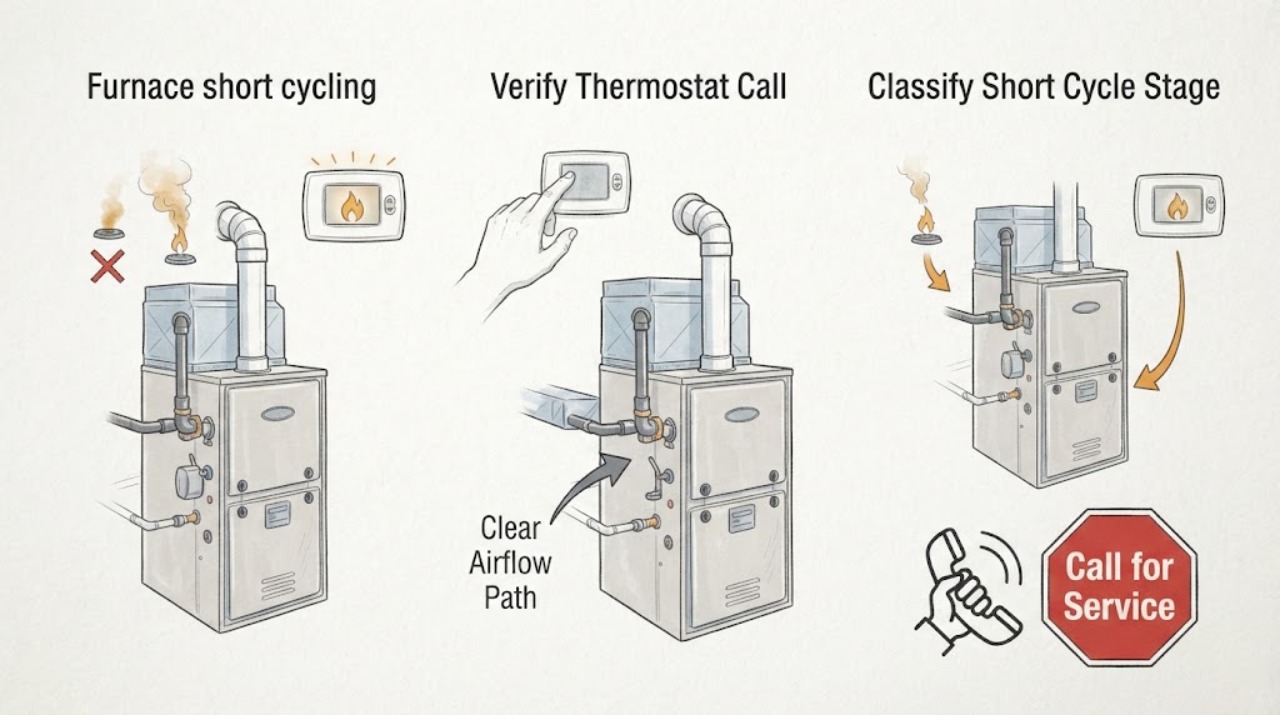
Short cycling means a Rheem furnace starts and stops repeatedly before the thermostat is satisfied. First document whether the thermostat call remains active, whether the burners light and then stop, whether the blower continues, and whether the home has weak airflow or an unusually hot supply. From a safe position, check the thermostat mode, visible filter and registers, and the exterior vent path when applicable; do not open the cabinet or manipulate a safety control. Rheem identifies thermostat conflict or short cycling, limit opening, flame-sense and pressure-switch problems, restricted airflow or venting, and control issues as different possibilities. Stop repeated resets and call a qualified HVAC technician for recurring cycles, lockouts, abnormal combustion, gas odor, a carbon-monoxide alarm, smoke, scorching, or an unsafe electrical or vent condition.
Before you begin
Safety first
- This article supports external symptom classification and ordinary user-accessible checks only. A qualified technician must handle cabinet access, combustion and vent tests, gas or live-electrical measurements, flame sensing, pressure and limit circuits, blower settings, wiring, and part replacement.
Work through in order
Diagnostic checks
Use only checks that match the exact appliance or system and its official guide.
-
Check 1
During one normal call for heat, observe from outside the cabinet whether the thermostat remains in Heat, whether the burners light, whether the indoor blower starts, and which component stops first. Do not repeat a cycle that produces unusual heat, odor, noise, or flame behavior.
Expected result: Record a burner that stops while the blower continues, a furnace that stops completely, a blower that runs with cool air, or a normal shutdown after the thermostat reaches its setting.
Next step: Record the call pattern, room temperature trend, time from start to stop without trying to reproduce it, and visible status indication. Use the matching branch below and arrange service for recurrence.
Stop if: Stop immediately for gas odor, smoke, flame outside the burner area, scorching, delayed or rough ignition, or a carbon-monoxide alarm.
Why this matters
Why: Burner-only dropout keeps flame proving, pressure, thermostat conflict, and control branches in consideration. Whole-furnace stopping keeps a limit, power, thermostat, or control branch open. A normal satisfied shutdown is not short cycling.
-
Check 2
Check the thermostat's normal user settings without opening it: confirm Heat is selected, the setpoint is above the room reading, the display is stable, and no schedule, hold, fan, or remote-control setting is ending the call. Do not jumper terminals or change installer settings.
Expected result: Record a stable heat call that remains active through the stop, a call that disappears, a blank or rebooting display, or a second thermostat or electronic control that changes the behavior.
Next step: Correct only an obvious normal user setting according to the thermostat manual. If the call is unstable, the display reboots, or the symptom returns with a stable call, arrange qualified HVAC service; do not access wiring.
Stop if: Stop for damaged or wet thermostat wiring, a hot or scorched control, or any step requiring cover removal, terminal bridging, or installer-menu changes.
Why this matters
Why: A call that ends or conflicts with another control makes thermostat, wiring, or configuration issues more likely than a furnace limit. A stable call that remains active shifts attention to the furnace sequence, airflow, venting, flame proving, or limit.
-
Check 3
With the furnace not being opened, inspect the user-accessible filter and visible supply and return openings. Confirm that registers are open and not blocked and that the filter is not visibly loaded; do not remove furnace panels or change blower wiring.
Expected result: Record a clean filter and open registers, a loaded filter, several closed or obstructed registers, weak supply airflow, or a supply that becomes unusually hot before the shutdown.
Next step: Replace only a user-accessible filter with the exact type and size specified by the system manual, then stop if short cycling returns. Have persistent weak or hot airflow, inaccessible filters, or repeated limit symptoms professionally diagnosed.
Stop if: Stop for smoke, soot, scorching, a missing filter, a damaged cabinet, an abnormally hot supply, or any need to enter the blower or burner compartment.
Why this matters
Why: Rheem identifies a dirty filter and closed vents as airflow conditions that can contribute to overheating and limit opening. Weak or hot airflow supports an airflow or duct issue, but does not prove a failed filter, blower, limit, or heat exchanger.
-
Check 4
For a gas Rheem furnace, inspect only the visible exterior vent termination and combustion-air area from a safe position for leaves, nests, ice, or other obvious blockage. Do not climb, remove vent pieces, probe tubing, or place hands near exhaust or combustion openings.
Expected result: Record a clear termination, a restricted-looking termination, water or ice, unusual exhaust, soot, or no safe view of the vent path.
Next step: Stop using the furnace and arrange qualified HVAC service for any suspected restriction, abnormal exhaust, soot, water, or recurring pressure-related cycle. Do not restart it repeatedly to see whether the vent clears.
Stop if: Stop for gas odor, exhaust entering the home, soot, flame or heat outside the termination, ice requiring a ladder, or any need to disassemble venting.
Why this matters
Why: A restricted vent or combustion-air path can contribute to pressure-switch opening, ignition failure, or a safety shutdown. Soot, abnormal exhaust, water, or an inaccessible path requires professional inspection and does not identify a pressure switch or inducer as the failed part.
-
Check 5
Read the status light or display only through the normal viewing window or exterior panel and record the exact blink count, color, text, and timing relative to the short cycle. Photograph the model and serial label if it is safely visible; do not remove a panel or press an unlabeled reset.
Expected result: Record no light, a steady indication, a repeatable pattern associated with burner dropout or limit opening, a pressure-related indication, or a pattern that changes between attempts.
Next step: Give the exact code, model, serial number, last observed sequence stage, filter and vent observations, and thermostat behavior to a qualified technician. Use the exact model manual only; do not change wiring or bypass a safety circuit.
Stop if: Stop if reading the code requires opening a panel, touching wiring, repeated resets, or approaching a hot, smoking, wet, or combustion-unsafe cabinet.
Why this matters
Why: A repeatable indication can direct a technician toward a limit, pressure, flame-sense, thermostat, or control branch. Rheem's standard diagnostic information has model limitations, so a generic blink count does not prove a part or authorize a reset.
-
Check 6
Create a service record without deliberately reproducing the fault: note whether short cycling occurs on every call or only after a long run, whether the thermostat remains active, whether the blower continues, room and outdoor conditions, recent filter or thermostat changes, and any unusual noise, odor, or display code.
Expected result: Record a repeatable pattern with the same sequence stage, a pattern linked to a thermostat or schedule, a pattern after the furnace warms, or a pattern that occurs only during very cold or high-demand conditions.
Next step: Stop owner troubleshooting and schedule qualified HVAC diagnosis for recurring short cycling. Give the technician the record and exact model; do not change safety settings, gas pressure, blower speed, or thermostat installer parameters.
Stop if: Stop for repeated lockout, abnormal combustion, carbon-monoxide alarm, smoke, gas odor, scorching, water near controls, or any request to access live or combustion components.
Why this matters
Why: The combined pattern helps separate thermostat conflict, airflow or limit response, pressure or venting, flame proving, equipment sizing, and control issues. Timing alone cannot establish a failed limit, board, sensor, inducer, or gas component.
Use your observations
Decision map
Find the observation that best matches what you see, then follow the next safe action.
-
PATH 01Next step
What you see
The thermostat call ends because the room reaches the setting, the blower completes its normal post-run, and the furnace does not restart repeatedly.
Do this next
Monitor only. Arrange service if the room is not satisfied, the furnace restarts unusually often, or a new noise, odor, code, or airflow change appears.
Why this path and its safety boundary
Why it matters: This is normal cycling rather than short cycling.
-
PATH 02Next step
What you see
The thermostat call disappears, the display reboots, a schedule or electronic control conflicts, or short cycling changes when normal thermostat settings change.
Do this next
Leave installer settings and wiring untouched and arrange qualified HVAC service to evaluate the call and controls. Do not jumper terminals or repeatedly alter the setpoint to force a longer run.
Why this path and its safety boundary
Why it matters: Thermostat, low-voltage wiring, configuration, or control conflict is more likely than a furnace limit opening.
-
PATH 03Next step
What you see
Warm air becomes weak or unusually hot, a filter is loaded, registers or return air are blocked, or the furnace stops after heating while the thermostat still calls.
Do this next
Correct only an obvious accessible filter or register issue according to the manual, then stop if the pattern returns. Have recurring limit behavior and airflow measured and diagnosed by a qualified technician.
Why this path and its safety boundary
Why it matters: Restricted airflow or a limit response is more likely, but a blower, duct, heat-exchanger, gas, or control issue can look similar.
-
PATH 04Next step
What you see
The inducer or burner starts, then the flame drops out; a pressure-related indication appears; the vent is restricted-looking; or the furnace locks out after repeated ignition or flame-proving attempts.
Do this next
Stop repeated attempts and request qualified gas-furnace service. Do not clean or adjust the flame sensor, measure gas or live electrical values, reset rollout protection, or bypass the pressure or limit circuit.
Why this path and its safety boundary
Why it matters: Pressure-switch, vent, inducer, flame-sense, grounding, ignition, gas, or control branches remain possible; the observed sequence does not identify one component.
-
PATH 05Next step
What you see
The furnace has apparently normal airflow and completes heating stages but the home remains below setpoint, or short cycling occurs only under unusual high-demand conditions without a clear code or hazard.
Do this next
Document room and outdoor conditions, run pattern, filter state, and setpoint and schedule qualified HVAC assessment. Do not raise gas pressure, change blower settings, or replace a control based on cycle timing alone.
Why this path and its safety boundary
Why it matters: Equipment sizing, duct distribution, thermostat location or control, fuel, heat-output, or building-load issues may be involved rather than a single safety part.
-
PATH 06Next step
What you see
There is gas odor, a carbon-monoxide alarm, smoke, flame outside the burner area, scorching, delayed or rough ignition, severe combustion noise, or unsafe exhaust.
Do this next
Leave the area as appropriate and contact emergency services, the gas utility, or urgent qualified HVAC help from a safe location. Do not operate switches in a suspected gas leak, restart the furnace, or inspect inside the cabinet.
Why this path and its safety boundary
Why it matters: This is an immediate gas, combustion, or fire safety event, not a normal short-cycle diagnostic.
Helpful context
Understand the symptom
Define the cycle before choosing a cause
A normal call for heat can end when the thermostat is satisfied, but a furnace that repeatedly stops while the room remains below the setpoint is a different pattern. Note whether only the burner stops, the whole furnace stops, or the blower continues; also note the thermostat display and any status indication. The last stage that occurs is more useful than assuming the limit, thermostat, or flame sensor is at fault.
Airflow and venting can create a safety response
Rheem says closed vents and a dirty filter can restrict airflow and cause the indoor unit to overheat, and it advises checking gas-furnace vent pipes for restrictions. A pressure-switch or limit response can therefore be downstream of airflow, venting, combustion, or heat-exchanger conditions. Inspect only accessible external areas with the unit off and cool; do not block, bypass, or adjust a safety device.
Burner short cycling is not the same as blower cycling
If burners ignite and drop out while the blower continues, flame proving, a pressure-switch opening, thermostat conflict, or a control path may be involved. If the blower also stops and restarts, the thermostat call, limit, power, control, or airflow path deserves attention. Rheem publishes separate symptom paths for these patterns, so the observation should be given to the technician rather than used to select a part.
The safety boundary is deliberately narrow
Rheem's technical material includes flame sensing, pressure switches, limit controls, polarity, grounding, gas pressure, and control wiring. These are combustion and electrical service tasks. A homeowner can record external symptoms, filter and register condition, model information, and a visible status code, but should not open the cabinet, probe energized wiring, change a gas setting, reset a rollout device, or defeat a limit or pressure switch.
Safety boundary
Stop conditions
- Stop using the furnace for gas odor, a carbon-monoxide alarm, smoke, flame outside the burner area, scorching, delayed or rough ignition, or severe combustion noise; leave as appropriate and obtain emergency or gas-utility help from a safe location.
- Do not open the furnace cabinet, test live voltage or gas pressure, jumper thermostat terminals, change blower or combustion settings, or alter wiring as a homeowner diagnostic.
- Never bypass, hold closed, reset repeatedly, or substitute a limit, rollout, pressure, door, or other safety control; repeated short cycling is a service symptom.
- Do not repeatedly restart the furnace to reproduce a short cycle, especially when airflow is weak, the supply is unusually hot, the vent is restricted, or a lockout occurs.
- Owner checks are limited to normal thermostat controls, safe external status observation, user-accessible filter and register inspection, visible exterior vent observation, and documentation; cabinet, combustion, electrical, and safety-component work requires qualified service.
Only after diagnosis
Potential parts
- air filter
Consider this only when the existing user-accessible filter is visibly loaded and the exact system instructions identify the correct replacement; a dirty filter may contribute to airflow or limit symptoms but does not prove the cause of short cycling.
Confirm exact dimensions, type, airflow orientation, and system requirements before replacement; do not run the furnace without the required filter. - thermostat or control component
Consider this category only after qualified diagnosis confirms an unstable heat call, control conflict, or failed control and rules out airflow, venting, ignition, and limit causes.
Verify exact Rheem system, thermostat compatibility, wiring, configuration, and installer requirements; do not change terminals or settings by symptom alone. - limit or rollout safety control
Consider this only when qualified testing confirms the specific safety control is defective after airflow, combustion, venting, and heat-exchanger causes are evaluated.
Confirm exact model, safety function, electrical and temperature ratings, approved replacement, and required cause investigation; never bypass or substitute a safety control. - pressure switch or inducer assembly
Consider this only when a qualified technician confirms the pressure circuit or inducer is outside the exact model's required operation after the vent and tubing path is assessed.
Verify exact model, switch setting, inducer configuration, vent design, and safety requirements; never bypass, adjust, or substitute a pressure switch. - flame sensor or ignitor
Consider this only when the observed burner stage and qualified testing confirm a flame-proving or ignition component fault rather than a grounding, gas, pressure, airflow, or control issue.
Confirm exact model, sensor or ignitor design, wiring, mounting, and approved service procedure; do not clean, bend, test, or replace these combustion components as a generic owner repair.
When checks do not resolve it
Need a professional?
Call a qualified HVAC technician for recurring Rheem furnace short cycling, a burner that drops out, a blower that continues with no heat, a limit or pressure indication, weak or unusually hot airflow, a restricted-looking vent, a thermostat call that conflicts or disappears, repeated lockout, or any symptom that returns after a safe filter and register check. Seek urgent or emergency help for gas odor, carbon-monoxide alarm, smoke, flame rollout, scorching, severe combustion noise, or unsafe exhaust.
Safety scope: This article supports external symptom classification and ordinary user-accessible checks only. A qualified technician must handle cabinet access, combustion and vent tests, gas or live-electrical measurements, flame sensing, pressure and limit circuits, blower settings, wiring, and part replacement.
Common questions
FAQ
What is short cycling on a Rheem furnace?
It is repeated starting and stopping before the thermostat is satisfied. A normal shutdown after reaching the setpoint is different. Record whether the burner, blower, or whole furnace stops first and whether the thermostat call remains active.
Why does my Rheem furnace start and stop every few minutes?
Possible paths include thermostat conflict, restricted airflow or a limit response, vent or pressure-switch conditions, flame proving, ignition, gas, control, sizing, or duct problems. The cycle timing alone cannot identify a part; stop repeated tests and arrange qualified diagnosis.
Can a dirty filter cause Rheem furnace short cycling?
Rheem says a dirty filter can limit airflow and cause the indoor unit to overheat, while closed vents can also reduce heat discharge. Replace only a user-accessible filter of the exact specified type, and call service if short cycling returns or airflow is weak or hot.
Why does the Rheem burner shut off but the blower keeps running?
Flame proving, a pressure-switch opening, thermostat conflict, a limit response, or a control issue may be involved. Rheem lists these as separate diagnostic paths. Do not clean or adjust combustion parts; give the sequence and status code to a qualified technician.
Should I reset my Rheem furnace when it short cycles?
Do not repeatedly reset a lockout, breaker, rollout device, limit, or pressure control. Repeated cycling can indicate an unresolved safety or airflow condition. Stop use and arrange service when the pattern returns.
What does a Rheem furnace blinking light mean during short cycling?
It depends on the exact furnace family and control. Record the exact pattern, model, sequence stage, and timing. Rheem's standard diagnostic information has model limitations, so a generic blink chart is not permission to replace or bypass a part.
Can a thermostat cause a Rheem furnace to short cycle?
Yes. Rheem identifies thermostat short cycling and electronic thermostat conflict as possible burner short-cycle causes. Check only normal user settings; do not change installer settings or jumper wiring, and arrange HVAC service for an unstable call.
Can a blocked vent cause short cycling?
A restricted gas-furnace vent can affect the pressure and combustion path and lead to a safety shutdown. Observe only the external termination from a safe position. Stop use for a suspected restriction, soot, abnormal exhaust, or gas odor and request qualified service.
Is short cycling an emergency?
Recurring short cycling needs prompt HVAC diagnosis, but gas odor, a carbon-monoxide alarm, smoke, flame outside the burner area, scorching, delayed or rough ignition, or severe combustion noise is an urgent safety event. Leave as appropriate and get emergency, gas-utility, or qualified help from a safe location.
What should I tell the Rheem furnace technician?
Provide the model and serial number, fuel type, thermostat behavior, which stage stops first, airflow and filter observations, visible vent condition, status-light pattern, cycle timing, outdoor conditions, recent changes, and any odor, noise, lockout, or carbon-monoxide warning.
Read the exact guide
Official sources
- urgent helpRheem Manufacturing Company · Rheem urgent-help guidance supplies general heating and cooling safety context; furnace-specific isolation and repairs must follow the exact model manual and qualified service direction.
- Burner Short Cycling / No Amber LightRheem Manufacturing Company · Rheem technical tip used to distinguish polarity, grounding, flame-sense, vent-pressure, thermostat, wiring, and control branches; it is not an owner repair procedure.
- Your Home Heating ChecklistRheem Manufacturing Company · Rheem homeowner guidance used for safe external checks; exact furnace instructions and qualified service govern model-specific diagnosis.
- Sequence of OperationsRheem Manufacturing Company · Rheem packaged-unit manual used to explain the general order of thermostat call, inducer, proving, ignition, flame sensing, blower, and shutdown; exact model instructions take precedence.
- Gas Furnace Technical Frequently Asked QuestionsRheem Manufacturing Company · Rheem technical FAQ used for symptom interpretation and escalation boundaries; it is not universal to every Rheem furnace family and does not authorize owner safety-control work.
- Burner Short Cycling / Amber Light GlowsRheem Manufacturing Company · Rheem technical tip used for the distinction between thermostat conflict and limit opening; exact model diagnostics and qualified service govern.
Community feedback
Share a repair observation
Share a plain-text repair observation. Accepted observations are published automatically; this page may take a moment to update.