
On this page
Start here
Quick answer
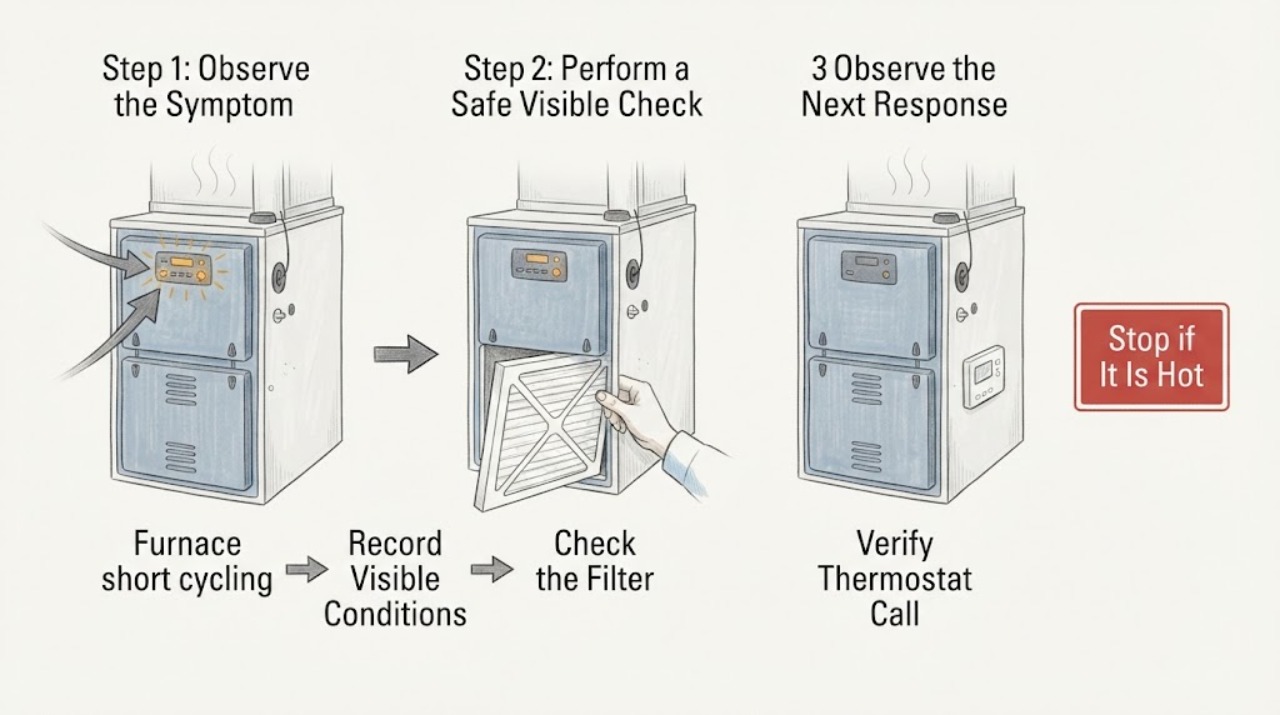
A Rheem furnace is short cycling when it stops before the thermostat is satisfied and then starts again. With the furnace left closed and no gas, smoke, soot, abnormal flame, loud ignition, or CO warning, record whether the thermostat is still calling for heat, then turn the thermostat off and inspect the external filter and return path. Confirm the filter is the exact approved size and type, is not collapsed or heavily loaded, and has its airflow arrow pointing toward the unit's fan. Clear only accessible return grilles and supply registers. A restricted, mis-sized, reversed, or unusually resistant filter can reduce airflow and contribute to heat-limit shutdown; if the filter and accessible airflow are normal or the furnace still short cycles, stop using it and arrange qualified Rheem HVAC service. Never bypass a limit, door, or pressure switch, adjust gas or fuel pressure, open combustion controls, or test energized wiring. A gas odor, combustion warning, suspected CO, smoke, soot, abnormal flame, or loud or delayed ignition is an immediate stop-use condition.
Work through in order
Diagnostic checks
Use only checks that match the exact appliance or system and its official guide.
-
Check 1
From outside the Rheem furnace cabinet, observe one normal call for heat without removing a panel. Record the thermostat setting and room temperature, when the burners or heat start, when heat stops, the restart delay, whether the blower continues, airflow at several registers, any LED or display pattern, and any noise or odor.
Expected result: The thermostat is still calling when heat stops, the thermostat reaches its setting, the blower continues after burner shutdown, airflow is weak, the same code repeats, or there is gas odor, smoke, soot, abnormal flame, loud ignition, or a CO alarm.
Next step: Stop immediately for a gas odor, smoke, soot, abnormal flame, loud or delayed ignition, suspected combustion products, or a CO alarm; leave and obtain emergency help as appropriate. If no hazard is present, turn the thermostat off normally before inspecting the external filter and return path, and do not keep restarting the furnace to collect data.
Why this matters
Why: A thermostat-satisfied cycle is different from a furnace that shuts down while the call continues. Early shutdown with continued blower operation can fit an airflow or temperature-limit event, but the observation cannot safely distinguish the limit, flame, vent, pressure, fuel, and control causes. Any combustion or CO warning overrides all routine checks.
-
Check 2
Check only normal thermostat controls: heat mode, set point, schedule, fan setting, and battery indication if the thermostat uses batteries. Keep the thermostat away from direct sunlight, a supply register, cooking heat, lamps, or a draft. Do not remove thermostat wiring or open the furnace control compartment.
Expected result: The thermostat is not calling for heat, reaches or falsely senses the set point near a local heat source, shows a low-battery indication, or continues calling while the furnace stops.
Next step: Correct only a clearly wrong mode, schedule, battery, or placement issue and observe one cycle. If the thermostat continues calling and heat stops early, leave wiring untouched and continue with the external filter check; arrange service if the symptom persists.
Why this matters
Why: A satisfied or misreading thermostat can end a normal cycle, while a continuing heat call with early furnace shutdown makes airflow, the supply-air limit, flame proving, venting, pressure, fuel, or controls more likely. This separates thermostat behavior from the filter branch but does not prove an internal fault.
-
Check 3
With the thermostat turned off normally and the blower stopped, inspect only the accessible external filter. Compare its printed dimensions and type with the filter rack, door label, and model instructions; look for a heavy dust layer, collapsed media, wetness, an unsealed or loose fit, more than one filter, or an airflow arrow pointing away from the Rheem unit's fan. Replace a damaged or loaded filter only with the exact approved size and type.
Expected result: The filter is loaded, damaged, too small or too large, unusually restrictive, installed backward, missing, doubled, or clean and correctly seated.
Next step: Correct only the visible filter issue, keep one filter in the designated location, and point Rheem's filter arrow toward the unit fan. Never operate the furnace without a filter. Observe no more than one subsequent call; if short cycling continues, stop use and arrange service instead of trying a different unapproved restriction or opening the cabinet.
Why this matters
Why: A loaded, damaged, wrong-fit, reversed, doubled, or overly resistant filter can restrict return airflow and make a temperature-limit shutdown more plausible. A clean, correctly seated filter makes this particular cause less likely but does not rule out a dirty blower or coil, duct restriction, furnace sizing, limit, flame, vent, or control issue.
-
Check 4
Check accessible return grilles and supply registers after the filter is correctly seated. Make sure they are open and not blocked by furniture, rugs, storage, dust, or construction material, and note whether airflow is weak throughout the home, weak at one branch, noisy or whistling, or normal. Do not remove duct panels or alter dampers.
Expected result: Several returns or registers are blocked, one branch is restricted, airflow is weak throughout, visible ductwork is crushed or separated, or accessible airflow appears normal.
Next step: Open and clear only accessible grilles and returns, then observe one call if no hazard is present. Arrange qualified service for separated or crushed ductwork, persistent weak airflow, or any short cycling that remains after the filter and grilles are clear.
Why this matters
Why: A filter is only one part of the airflow path. Blocked returns or supplies and damaged or restricted ducts can preserve the same heat-buildup symptom even after a new filter is installed. Weak airflow throughout makes a blower, coil, duct, filter-resistance, or system-capacity issue more likely; normal accessible airflow shifts attention toward thermostat, limits, flame proving, venting, pressure, fuel, or controls.
-
Check 5
From a safe external position, confirm the accessible furnace door is seated and look only for obvious corrosion, gaps, damage, snow, leaves, or debris at visible exhaust, combustion-air terminations, and vent connections. Do not remove covers, reach into the furnace, disturb vent joints, or attempt to clear an internal passage.
Expected result: The door is displaced, a termination or visible vent is blocked or damaged, combustion products may be present, or the exterior appears normal.
Next step: Restore only a clearly displaced external door if it can be seated without tools and no hazard exists. Stop using the furnace and arrange qualified service for a questionable vent, blocked termination, corrosion, repeated safety shutdown, or any condition requiring cabinet access.
Why this matters
Why: A door safety switch or vent and combustion-air problem can interrupt safe operation and is not explained by the filter alone. Rheem warns that blocked or corroded venting must be corrected before operation and that combustion products must not enter the living space; a normal exterior view does not clear internal venting or safety circuits.
-
Check 6
After at most one filter or accessible-airflow correction, compare one later call with the first record. Write down the Rheem model and fuel type, filter size and orientation, cycle runtimes, thermostat behavior, airflow pattern, LED or code sequence, vent observations, and any recent installation or repair.
Expected result: The furnace completes a normal cycle, short cycling returns, the thermostat still calls when heat stops, a code or limit-like pattern repeats, or the furnace recovers only temporarily.
Next step: Turn the furnace off and arrange qualified HVAC service for persistent or recurring short cycling. Do not bypass a high-limit, rollout, door, or pressure switch; do not adjust gas or fuel pressure, troubleshoot a high-pressure control, open combustion controls, or test energized wiring.
Why this matters
Why: A stable cycle after correcting a visibly wrong filter or airflow restriction makes that restriction more likely. Persistent or recurring short cycling with a correct filter requires diagnosis of the limit and flame safeguards, blower, coil or duct system, venting, sizing, pressure, fuel, thermostat, or controls; the symptom does not identify a replacement part.
Use your observations
Decision map
Find the observation that best matches what you see, then follow the next safe action.
-
PATH 01Next step
What you see
Do this next
Correct only the ordinary thermostat issue and observe one cycle. If the furnace stops while the thermostat still calls, move to the filter and airflow branch and seek service if it persists.
-
PATH 02Next step
What you see
Do this next
Install one exact approved filter with the arrow toward the unit fan, clear accessible returns and supplies, and observe one call. If it still short cycles, turn the furnace off and arrange qualified service rather than bypassing the limit or trying a less suitable filter.
-
PATH 03Next step
What you see
Do this next
Stop using the furnace and arrange qualified HVAC service. Do not bypass a limit, rollout, door, or pressure switch; do not adjust fuel pressure or open burner and control compartments.
-
PATH 04Next step
What you see
Do this next
Stop using the furnace and arrange qualified service. Do not disturb venting, relight burners outside the exact model procedure, adjust gas or fuel pressure, or test combustion controls.
-
PATH 05Next step
What you see
Do this next
Leave immediately for fresh air, call emergency services from outside, and do not re-enter or operate the furnace until responders and trained personnel say it is safe. Do not silence an alarm by removing its battery.
Helpful context
Understand the symptom
Why the filter is an independent first branch
The filter changes the amount of return-air resistance, not just the appearance of the furnace. A filter that is dirty, collapsed, installed in the wrong direction, the wrong size, or more restrictive than the model allows can reduce airflow and raise furnace temperature. That makes a filter correction worth testing once, but it does not identify whether a limit switch, blower, coil, duct, vent, thermostat, or control is actually shutting the heat off. Rheem's own technical material lists short-cycling, thermostat, limit-opening, and thermostat-conflict checks separately.
Use the filter label and airflow arrow, not a guess
Read the size and type printed on the old filter, filter rack, door label, or model-specific Rheem instructions. A replacement that fits loosely, bows, seals the wrong opening, or has an airflow arrow pointing away from the unit fan can make the result misleading. Rheem's public filter guidance says to point that arrow toward the unit's fan and notes that homes with pets, smokers, heavy traffic, or construction dust may need more frequent changes. Do not run the furnace without a filter or stack filters to compensate for a fit problem.
A persistent cycle is not permission to reset a safety
Rheem's furnace documentation describes a supply-air limit, flame sensor, rollout switch, gas valve, and inducer pressure switch as functional or safety-related components. A filter can contribute to a temperature-limit event, but a clean filter does not clear those controls, the blower, the heat exchanger, or venting. If the furnace stops while the thermostat still calls, or an indicator repeats, stop repeated restarts and arrange qualified service rather than bypassing a switch or changing gas pressure.
Combustion and CO warnings override filter checks
Do not continue a filter diagnosis when there is gas or sulfur odor, smoke, soot, an abnormal flame, loud or delayed ignition, a blocked or damaged vent, or a CO alarm. Leave for fresh air and call emergency services from outside for a sounding CO alarm or suspected exposure. Do not reuse the furnace until trained personnel inspect it; a homeowner should not test fuel pressure, an inducer pressure switch, a high-limit circuit, or other energized or combustion controls.
When checks do not resolve it
Need a professional?
Arrange qualified HVAC service for persistent or recurring Rheem furnace short cycling, weak airflow after a correctly sized and oriented filter, any repeated status or limit-like indication, abnormal ignition or flame, venting or combustion-air concerns, suspected blower, coil, duct, pressure, fuel, sizing, thermostat, or control faults, or any diagnosis beyond the thermostat, external filter, return, and register checks. For a CO alarm or suspected gas leak, leave immediately and call emergency services or the gas supplier from outside; do not operate or reuse the furnace until trained personnel clear it.
Common questions
FAQ
Can a dirty filter make a Rheem furnace short cycle?
It can restrict return airflow and make a heat-limit shutdown more plausible, but it does not prove the filter is the failed part. Confirm the exact approved size and type, install one filter with the arrow toward the unit fan, and arrange service if the furnace still stops while the thermostat calls.
Which way should the arrow on a Rheem furnace filter point?
Rheem's filter instructions say the arrows on the cardboard should point toward the unit's fan. Confirm the filter location and size against the filter rack, door label, and model instructions; do not guess from cabinet dimensions.
What if the new Rheem filter is clean but the furnace still short cycles?
A clean, correctly fitted filter makes that particular restriction less likely, not impossible to diagnose other causes. Check only accessible returns and registers, then stop repeated restarts and arrange qualified service for a blower, coil, duct, limit, flame, vent, pressure, fuel, sizing, thermostat, or control diagnosis.
Should I use a thinner filter to stop Rheem furnace short cycling?
Do not choose a filter solely because it feels less restrictive or install more than one. Use the exact size and type specified for the furnace and rack; if airflow remains weak or the symptom continues, have a qualified technician evaluate the complete airflow system.
Could the thermostat be causing Rheem furnace short cycling?
Yes. A thermostat can end a normal cycle if it reaches or falsely senses the set point, has a setting or battery issue, or is exposed to local heat or drafts. If it still calls for heat when the furnace stops, the problem shifts toward airflow, a safety, combustion, pressure, or control diagnosis.
Is it safe to bypass a Rheem furnace limit or pressure switch?
No. Rheem identifies the supply-air limit, rollout switch, flame sensor, and inducer pressure switch as functional or safety-related components. Do not bypass them, adjust gas or fuel pressure, or test energized controls; arrange qualified HVAC service.
What should I do if the Rheem furnace has a loud bang, soot, or a gas smell?
Stop using the furnace and do not continue filter checks. Leave immediately for a gas odor or suspected combustion danger and call the gas supplier or emergency services from outside. Loud or delayed ignition, soot, and abnormal flame require qualified service before reuse.
When is Rheem furnace short cycling an emergency?
Treat a sounding CO alarm, suspected combustion products, gas odor, smoke, soot, abnormal flame, loud ignition, or blocked or damaged vent as an immediate stop-use condition. Leave for fresh air when CO is suspected, call emergency services from outside, and do not operate the furnace until responders and trained personnel say it is safe.
Read the exact guide
Official sources
- Carbon Monoxide Fact SheetUnited States Consumer Product Safety Commission · Fuel-burning furnace carbon-monoxide hazards, symptoms, professional inspection, CO alarms, and emergency response
- 708337-A L1RA Furn ii.pmdRheem Manufacturing Company · Rheem L1RA gas-furnace model-family installation, component, maintenance, filter, venting, and safety guidance; model-specific instructions must control
- High Performance Air Filters - Rheem Manufacturing CompanyRheem Manufacturing Company · Rheem homeowner air-filter selection, replacement timing, filter size examples, and airflow-arrow installation direction
- Gas Furnace SymptomsRheem Manufacturing Company · Rheem gas-furnace heat-mode symptom categories including furnace short cycling, main-limit and heat-assisted-limit events, rollout, venting, flame, and pressure-switch symptoms
- FI0074Rheem Manufacturing Company · Rheem technical diagnostic categories for burner short cycling, thermostat short cycling, limit opening, and thermostat conflict
Community feedback
Share a repair observation
Share a plain-text repair observation. Accepted observations are published automatically; this page may take a moment to update.