
On this page
Start here
Quick answer
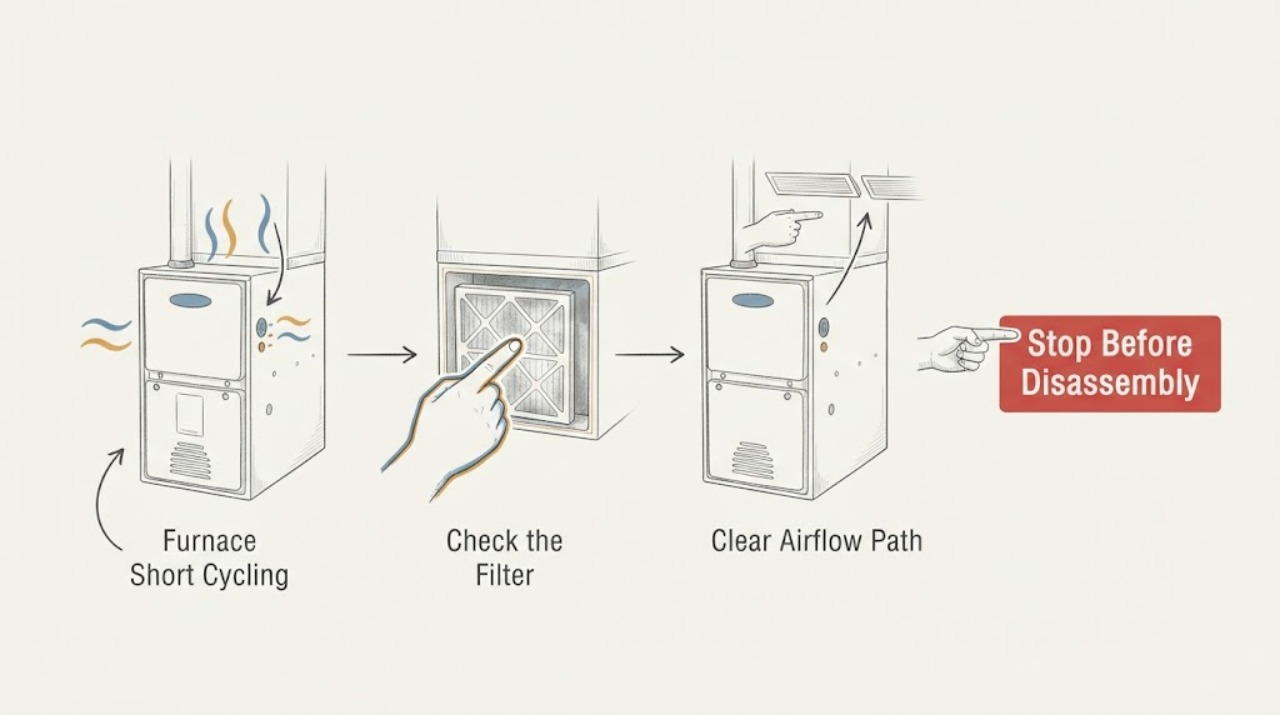
A York furnace that starts and stops before the thermostat is satisfied may be short cycling. A blocked, wrong-size, reversed, or poorly seated return filter can reduce airflow enough to make the heat section run too hot and open a protective limit, but the filter is only one possible cause. From a safe position, record how long the burners run, whether the blower continues after the burners stop, whether the filter is visibly loaded, whether supply registers and return grilles are open, and whether the filter's size and airflow arrow match the exact York manual and rack. Turn the furnace off before replacing an accessible filter, use the specified size and type, and allow the system to cool before one monitored restart. Do not bypass or reset a limit or rollout switch, open the burner cabinet, measure gas or electrical pressure, adjust gas input, or block vents. If the short cycling continues with a clean, correctly installed filter, or there is a gas odor, CO alarm, soot, flame rollout, blocked vent, damaged wiring, water damage, high-pressure concern, or repeated fault code, leave the furnace off and arrange qualified HVAC service; a gas or carbon-monoxide emergency takes priority over filter troubleshooting.
Work through in order
Diagnostic checks
Use only checks that match the exact appliance or system and its official guide.
-
Check 1
From outside the furnace cabinet, record one heating call without opening a panel. Note the thermostat call, approximate burner-on time, whether the blower starts and keeps running after the burners stop, room temperature, displayed fault indication, and whether the thermostat is satisfied before the shutdown. Stay clear of the flue, burner opening, moving blower, and hot surfaces.
Expected result: The burners stop after a short run while the blower continues, the entire furnace loses power, the thermostat is satisfied normally, a fault LED or code appears, or the unit repeatedly retries ignition.
Next step: Record the timing and exact code for the technician. Do not enter diagnostics or open the furnace; continue only with safe external filter and airflow checks if there is no gas odor, smoke, water damage, or other hazard.
Why this matters
Why: Burner-off with continued blower operation can fit a protective temperature-limit response, while a satisfied thermostat points toward normal control rather than short cycling. A code, repeated ignition retry, or total power loss adds control, ignition, vent, or electrical possibilities that a filter cannot establish.
-
Check 2
Turn the thermostat to OFF and wait for the blower to stop. From the normal user-accessible filter rack or return grille, inspect the filter face for a gray dust mat, collapsed media, moisture, ice, or a filter that is bowed or difficult to remove. Do not reach into the blower compartment or remove a furnace access panel.
Expected result: The filter is visibly blocked, wet, collapsed, missing, clean, or not located where the manual says the external filter should be installed.
Next step: If the filter is wet, damaged, or inaccessible without panels, leave the furnace off and arrange service. If it is an accessible disposable filter, record its printed size and proceed to verify direction and fit before replacing it.
Why this matters
Why: A loaded, wet, collapsed, or missing filter can change airflow and filtration. A clean filter does not rule out another restriction, a blower problem, or a limit/control fault; an unknown filter location means the exact installation manual or technician is needed.
-
Check 3
Compare the replacement filter's printed dimensions and type with the old filter and the exact York model documentation. Check that the filter sits fully in its rack, that no gap or crushed edge bypasses it, and that the airflow arrow points in the direction shown by the rack or manual, normally toward the air handler or blower. Never force a different size into the slot.
Expected result: The size matches, the size is different, the arrow points opposite the documented airflow, the filter does not seat flat, or the rack and gasket are damaged or open around the filter.
Next step: Install only the documented size and orientation if the rack is accessible and undamaged. If the size or direction is uncertain, the rack is damaged, or the filter cannot seat without force, stop and ask a qualified HVAC technician to verify the installation.
Why this matters
Why: A wrong size or poor fit can bypass filtration or add resistance; a reversed arrow indicates the filter is not installed as specified. A damaged rack or gasket can create an airflow path that a new filter will not correct.
-
Check 4
With the furnace off and the filter in its correct position, look at the return grilles and supply registers from the room side. Confirm they are not blocked by furniture, rugs, closed louvers, packing material, or a temporary cover. Do not remove duct panels, alter dampers, or tape over registers as a test.
Expected result: Several return grilles or supply registers are blocked, only one register is restricted, all visible grilles are open, or airflow is weak at many registers after a clean filter is installed.
Next step: Clear only obvious room-side obstructions and keep grilles open for one monitored call. If airflow remains weak or the furnace still cycles, turn it off and arrange HVAC diagnosis; do not enter the cabinet.
Why this matters
Why: A blocked return or supply path can reduce system airflow independently of the filter. Weak airflow at many registers with open grilles keeps a duct, blower, coil, filter rack, or control issue possible and should not be solved by repeatedly changing filter ratings.
-
Check 5
After an accessible filter has been corrected or replaced with the exact documented size, let the furnace cool, restore the normal thermostat setting, and monitor one call from outside the cabinet. Do not restart if there is a gas smell, CO alarm, smoke, soot, water on the furnace, damaged wiring, or an abnormal flame or vent condition.
Expected result: The furnace completes a normal call, still shuts the burners off early while the blower runs, cycles repeatedly, or a fault indication returns.
Next step: Turn the furnace off and arrange qualified HVAC service for a continuing or returning fault. Do not reset a limit or rollout switch, increase filter openings, bypass a safety, or replace a control from the symptom alone.
Why this matters
Why: A normal cycle after the filter correction makes a filter or room-airflow contribution more likely, but does not prove the filter was the sole cause. A continuing burner-off/blower-on pattern is consistent with a limit or airflow problem; a returning code can indicate ignition, vent, control, or sensor faults.
-
Check 6
Check the area around the furnace and the outdoor vent termination from a safe distance. Look for a gas odor, CO alarm, soot, water damage, snow or debris visibly blocking the vent, flame rollout, smoke, or a furnace that has been under water. Do not use a flame, smoke source, manometer, gas-pressure gauge, or live meter test to investigate.
Expected result: There is a gas odor, CO alarm, soot, rollout, smoke, a blocked vent, water on or inside the furnace, or no visible hazard.
Next step: For gas odor or a CO alarm, leave the building and follow the gas supplier or emergency instructions without operating electrical switches. For smoke, rollout, water damage, or blocked venting, keep the furnace off and arrange qualified HVAC service; do not clear an internal vent or relight the appliance.
Why this matters
Why: These are combustion, carbon-monoxide, fire, flood, or high-pressure/air-proving concerns, not filter-maintenance symptoms. A direct-vent system still depends on correct venting and combustion air; an unsafe condition can make repeated operation dangerous.
-
Check 7
Prepare a service note with the York model and filter size, filter type and direction, installation location, burner-on and blower times, thermostat behavior, supply and return airflow observations, outdoor temperature, fault code, gas or CO symptoms, and any recent filter, duct, thermostat, or furnace work. Do not measure gas pressure, electrical voltage, temperature rise, or limit-switch continuity yourself.
Expected result: The furnace short cycles after a correctly installed filter, the limit or rollout indication returns, the blower is weak or noisy, the thermostat is satisfied unexpectedly, or the cause remains uncertain.
Next step: Keep the furnace off if the problem repeats and provide the notes to a qualified HVAC technician. If the household has a gas or CO emergency, follow emergency guidance first rather than troubleshooting.
Why this matters
Why: The remaining possibilities include duct restriction, blower or motor performance, high-limit sensing, thermostat/control logic, ignition, venting, gas input, or an unsafe combustion condition. These require equipment-specific tests and may involve gas or line-voltage hazards.
Use your observations
Decision map
Find the observation that best matches what you see, then follow the next safe action.
-
PATH 01Next step
What you see
The filter is visibly blocked or collapsed, the rack fits the documented size and direction, and the furnace completes a monitored call after correction.
Do this next
The filter or a room-side airflow restriction may have contributed to the short cycling, but the result does not prove that no other fault exists.
-
PATH 02Next step
What you see
The filter is clean, correctly sized, correctly oriented, fully seated, and visible grilles are open, but burners stop early while the blower continues.
Do this next
A high-limit response or another airflow, blower, heat-exchanger, control, or sensing issue is more likely than a simple dirty filter.
-
PATH 03Next step
What you see
The filter size does not match the York documentation, the airflow arrow is opposite the documented direction, or the filter bows and leaves gaps.
Do this next
Installation resistance or bypass is a credible contributor, and the current filter cannot be used as a valid airflow test.
-
PATH 04Next step
What you see
Many registers have weak airflow with a correct filter, or multiple returns/supplies are blocked or the duct path is visibly damaged.
Do this next
A duct, blower, coil, rack, or distribution restriction may be limiting airflow beyond the filter.
-
PATH 05Next step
What you see
There is a gas smell, CO alarm, soot, flame rollout, smoke, water damage, or a visibly blocked vent termination.
Do this next
The situation is a combustion, carbon-monoxide, fire, flood, or venting hazard and is outside homeowner filter troubleshooting.
-
PATH 06Next step
What you see
The filter and visible airflow checks are normal but the furnace still short cycles or the fault indication returns.
Do this next
Filter restriction is not established as the cause; limit sensing, blower, thermostat, ignition, gas input, venting, or control diagnosis is needed.
Helpful context
Understand the symptom
What the filter can and cannot explain
The filter sits in the return-air path and protects the blower while allowing the furnace to move the air that carries heat into the home. A dirty or blocked filter can reduce airflow. In Johnson Controls safety documentation, reduced airflow is one condition that can cause a high-temperature limit to shut off gas and then allow another ignition after the appliance cools. That makes a burner-off/blower-on repeating pattern compatible with limit cycling, but it does not identify the filter as the cause or make it safe to bypass the limit.
Size, direction, and fit matter
Use the exact filter dimensions and type specified for the York installation. A filter that is the wrong size, installed backward relative to its airflow arrow, folded, bypassed by a gap, or installed in the wrong rack can create poor filtration or excess resistance. Follow the arrow printed on the filter or the exact model manual; do not infer a replacement from a nearby filter or force a panel closed over a filter that does not fit.
Combustion and high-voltage work are not homeowner filter checks
Do not open the burner compartment, defeat a door interlock, reset a rollout or high-limit switch, adjust gas pressure, test live wiring, or inspect combustion with improvised instruments. A gas odor, CO alarm, soot, flame rollout, blocked vent, or repeated limit fault requires the furnace to remain off and qualified service. If a wet furnace or electrical equipment is involved, do not energize it until it has been inspected.
Safety boundary
Stop conditions
- Stop immediately for gas odor, a CO alarm, soot, flame rollout, smoke, a blocked combustion vent, water on or inside the furnace, damaged wiring, a repeated breaker trip, or a high-pressure or gas-control concern.
- Do not open the burner cabinet, bypass or jumper a high-limit/rollout switch, measure gas or line voltage, adjust gas input, use an open flame, clear an internal vent, or operate a furnace that has been under water.
- Stop after a correctly sized and oriented filter plus visible room-side airflow checks do not end the short cycling; arrange qualified HVAC service instead of repeated resets or guessed part replacement.
Only after diagnosis
Potential parts
- external furnace air filter
Relevant only when the existing filter is blocked, damaged, missing, or the exact York documentation confirms a different owner-replaceable filter is required.
Confirm the complete furnace model, rack dimensions, filter type, and airflow direction; do not substitute a size or resistance rating from another system. - filter rack gasket or access seal
Relevant only when the correct filter cannot seat or the rack has a visible gap, damaged gasket, or bypass path confirmed by a technician.
Verify the rack design and model-specific seal; a gap around the filter does not justify taping over a furnace access panel. - blower motor or airflow component
Consider only after a correct filter and visible airflow path are verified and qualified diagnosis isolates weak blower performance or another airflow restriction.
Do not choose a motor, wheel, capacitor, coil, or control from short-cycling symptoms alone; model, voltage, airflow, and service data must be confirmed. - high-limit or airflow-safety component
Relevant only when a qualified technician confirms a limit or airflow-safety component is faulty after the filter, duct, blower, vent, and combustion checks.
Never bypass or reset a safety device as a repair; confirm the exact York model and service procedure.
When checks do not resolve it
Need a professional?
Arrange qualified HVAC service when a York furnace continues short cycling after the exact filter is clean, correctly sized, correctly oriented, and seated, or when the blower airflow is weak, a fault code returns, a limit or rollout indication appears, the vent or combustion path is blocked, or gas input, high pressure, control, or wiring must be tested. Leave immediately for gas odor or a CO alarm and follow emergency/gas-supplier instructions. Keep a wet, flood-damaged, smoking, or flame-affected furnace off until inspected.
Common questions
FAQ
Can a dirty York furnace filter cause short cycling?
It can contribute by reducing airflow, and Johnson Controls safety documentation describes reduced airflow from blocked filters as a condition that can make a high limit cycle burners off and back on. A clean filter does not rule out a duct, blower, limit, thermostat, control, ignition, gas, or vent issue.
Which way should the York furnace filter face?
Use the airflow arrow printed on the filter and the exact York installation manual or filter-rack marking. The arrow should match the return-air direction through the rack toward the air handler or blower. If the rack direction is unclear or the filter does not fit flat, stop and have a technician verify it.
Can I use a different filter size or a higher-rated filter to stop short cycling?
Do not guess. Johnson Controls owner guidance says throwaway filters should be replaced with new filters of the same size, and the exact furnace installation determines acceptable type and resistance. Use the documented size and orientation; have a technician evaluate airflow before changing filter specifications.
Why does the York furnace burner turn off while the blower keeps running?
That pattern can be consistent with a protective high-limit response to low airflow, including a blocked filter, but it can also involve duct, blower, heat-exchanger, control, vent, or combustion faults. Do not bypass or reset the limit; stop and arrange HVAC diagnosis if it repeats.
When is York furnace short cycling an emergency?
Leave immediately for a gas odor or carbon-monoxide alarm and follow gas-supplier or emergency instructions without operating switches. Keep the furnace off for smoke, soot, flame rollout, a blocked vent, water damage, damaged wiring, repeated breaker trips, or a gas/high-pressure concern, and arrange qualified HVAC service.
Read the exact guide
Official sources
- HVAC Direct Vent EquipmentU.S. Department of Energy, Building Science Education · Combustion-air, exhaust, backdrafting, and carbon-monoxide context for fuel-burning furnaces; not a substitute for model service instructions
- HVAC Proper Installation of FiltersU.S. Department of Energy, Building Science Education · Return-side filter role, reduced airflow from dirty filters, accessible filter placement, and filter maintenance principles
- User's Information Manual: 33 in. Multi-Position Gas Furnaces, MM9E and MG9S SeriesJohnson Controls Ducted Systems / YORK · External filter placement, same-size replacement, visual airflow checks, furnace operation, diagnostic boundary, gas/CO safety, and qualified service
- HM Indirect Gas Fired Duct Furnaces Venting Application Guidelines Service Information Letter (Form SI0344)Johnson Controls · Technical safety explanation of reduced airflow, blocked filters, high-limit cycling, gas/air-proving boundaries; exact residential York model procedures may differ
Community feedback
Share a repair observation
Share a plain-text repair observation. Accepted observations are published automatically; this page may take a moment to update.