
On this page
Start here
Quick answer
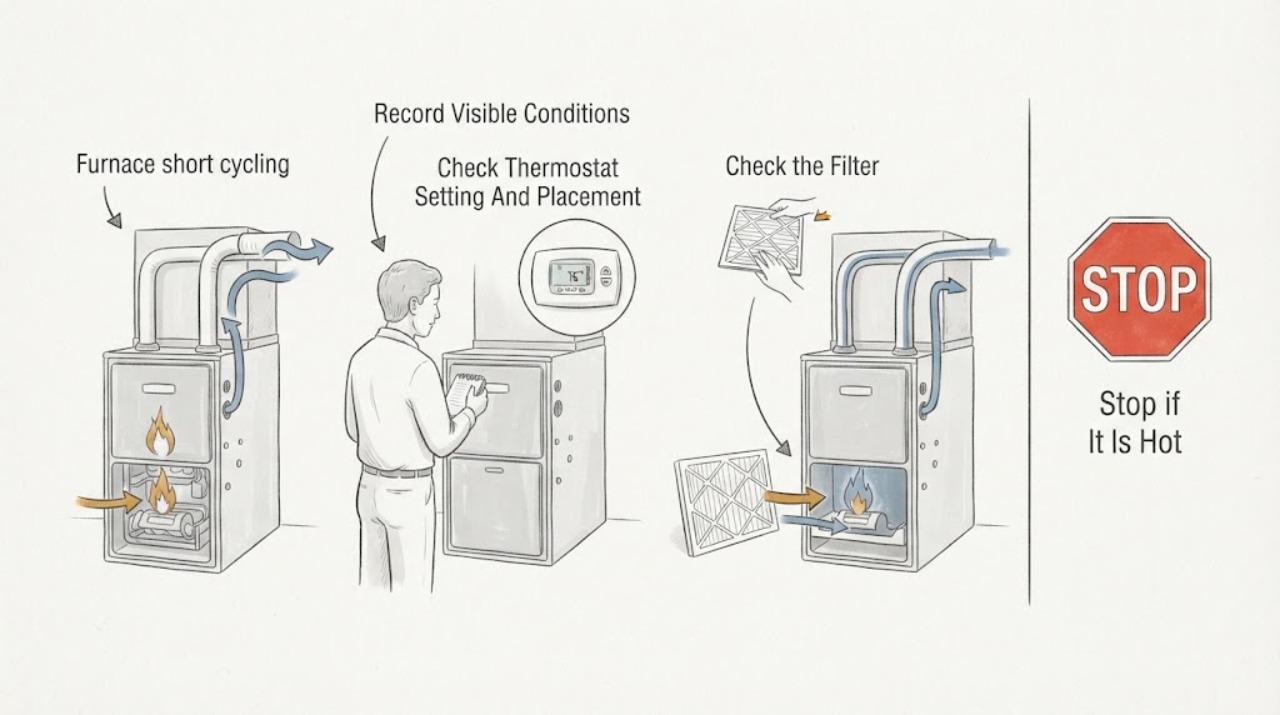
If a York furnace starts and stops before the thermostat reaches its set temperature, record the cycle runtime, restart interval, thermostat call, airflow, and any code or status light. With the furnace off and no hazard present, check the thermostat mode and placement, replace a dirty external filter with the exact approved type, and clear accessible supply registers and return grilles. York identifies a furnace that shuts off before the high set point as short cycling that requires a service call, and its maintenance guidance also calls for checking airflow, the furnace-door safety switch, and visible vent connections. Do not bypass a limit or door switch, open the burner compartment, adjust gas or oil pressure, or test live controls. If you smell gas, see soot or an abnormal flame, hear loud ignition, find a blocked or damaged vent, detect carbon monoxide, or the short cycling continues after basic airflow checks, turn the furnace off and arrange qualified HVAC service; leave immediately for a sounding CO alarm or suspected gas leak.
Work through in order
Diagnostic checks
Use only checks that match the exact appliance or system and its official guide.
-
Check 1
From outside the furnace cabinet, observe one call for heat without removing a panel. Record the thermostat setting and room temperature, when ignition or heat starts, when it stops, the delay before a restart, whether the blower continues, airflow at several registers, and any code, flashing light, unusual noise, smoke, odor, or CO alarm.
Expected result: The burners stop while the thermostat still calls, the blower continues, the thermostat reaches its setting normally, the furnace restarts within a short interval, or a warning or hazard appears.
Next step: Stop for gas odor, smoke, soot, abnormal flame, loud ignition, suspected combustion products, or a CO alarm; leave and obtain emergency help as appropriate. If no hazard is present, continue with external thermostat and airflow checks and do not run repeated cycles just to collect data.
Why this matters
Why: A furnace that satisfies the thermostat normally is different from one that stops before the set point. Stopping while the call continues can fit airflow or another safety shutdown, but the observation alone cannot identify a limit, flame, vent, or control fault. Any combustion or CO warning changes the task to stop-use or emergency response.
-
Check 2
Check the thermostat's mode, heat-call setting, schedule, fan setting, battery indication if applicable, and location. Keep it away from direct sunlight, a supply register, cooking heat, lamps, drafts, or other local heat sources. Use only normal controls and do not remove thermostat wiring.
Expected result: The thermostat is not calling for heat, its reading changes quickly near a heat source or draft, a battery indication is low, or it continues calling while the furnace stops.
Next step: Correct only a clearly wrong setting, battery, schedule, or placement issue, then observe one cycle. If the thermostat continues calling and the furnace stops early, leave wiring untouched and proceed to accessible airflow checks or service.
Why this matters
Why: A satisfied or misreading thermostat can end a cycle without a furnace safety fault. A continuing call with early furnace shutdown shifts suspicion toward airflow, a temperature limit, flame proving, venting, fuel, or control problems.
-
Check 3
Turn the furnace off with the normal thermostat control and wait for moving parts to stop. Inspect only the external filter and accessible return grilles for a heavy dust layer, collapsed media, incorrect fit, or blockage. Replace or clean the filter as the exact York model instructions specify; do not place a filter inside the cabinet if the manual specifies an external location.
Expected result: The filter is loaded or damaged, the filter is clean and correctly seated, a return grille is blocked, or the filter location or replacement process is unclear.
Next step: Correct a visibly dirty or incorrectly fitted filter and clear accessible return obstructions only as the model instructions allow, then observe one subsequent call. If short cycling continues, stop using the furnace and arrange service instead of installing an unapproved filter or opening the blower compartment.
Why this matters
Why: A blocked filter or return can reduce airflow and contribute to heat buildup and a safety shutdown. A clean, correctly installed filter makes this cause less likely but does not rule out a dirty blower or coil, duct restriction, sizing issue, or control fault.
-
Check 4
Check accessible supply registers and return grilles in rooms served by the York furnace. Make sure they are open and not blocked by furniture, rugs, dust, or storage, and note weak airflow throughout the home, one restricted branch, whistling, or visibly separated or crushed ductwork. Do not remove duct panels or alter dampers.
Expected result: Several registers or returns are closed or blocked, airflow is weak throughout, one branch is restricted, visible ducts are separated, or accessible airflow appears normal.
Next step: Open and clear only accessible grilles and returns, then observe one cycle. Arrange service for separated ductwork, persistent weak airflow, or short cycling after the grilles are clear; do not keep operating an overheating furnace.
Why this matters
Why: Blocked grilles and leaking or restricted ductwork can upset airflow and contribute to early furnace shutdown. Weak airflow throughout makes a filter, blower, coil, duct, or system-capacity issue more likely; normal accessible airflow shifts attention to thermostat, limit, flame, venting, sizing, or control diagnosis.
-
Check 5
From a safe, external position, confirm that the furnace access door is closed and the accessible safety-switch area is not blocked. Look only for obvious rust, gaps, damage, snow, leaves, or debris at visible exhaust or combustion-air terminations and vent connections. Do not remove covers, reach into the furnace, or disturb venting.
Expected result: The access door is not seated, the safety-switch area is obstructed, the vent has an obvious blockage or gap, or the external door and venting appear normal.
Next step: Restore only a clearly displaced external door or remove loose debris that can be reached without tools, then observe once if no hazard exists. Stop the furnace and arrange qualified service for a blocked, damaged, or questionable vent, repeated safety shutdown, or any cabinet access requirement.
Why this matters
Why: A door safety switch or vent and combustion-air problem can interrupt safe operation and contribute to shutdowns. York's manual requires vent and combustion-air passages to be serviced and resealed by a qualified agency, so a normal exterior view does not clear the internal vent or safety circuit.
-
Check 6
After at most one observation following a thermostat, filter, or accessible-grille correction, compare the cycle pattern again. Record the York model and fuel type, cycle runtimes, thermostat behavior, filter condition, airflow pattern, vent observations, code or LED sequence, recent installation or repair, and any gas, combustion, or CO warning.
Expected result: The furnace completes a normal cycle, still stops before the thermostat reaches the set point, repeats a status code or limit-like shutdown, or recovers only temporarily.
Next step: Turn the furnace off and arrange qualified HVAC service for persistent or recurring short cycling. Do not bypass the limit or door switch, alter gas or oil settings, open the burner compartment, or continue operating a furnace with abnormal combustion or CO concerns.
Why this matters
Why: A stable cycle after an obvious airflow correction makes that restriction more likely. Persistent or recurring short cycling despite clear accessible airflow needs diagnosis of the limit and flame safeguards, blower, heat exchanger, venting, sizing, fuel, thermostat, or controls; the symptom alone cannot identify a failed part.
Use your observations
Decision map
Find the observation that best matches what you see, then follow the next safe action.
-
PATH 01Next step
What you see
Do this next
Correct only the ordinary setting, battery, schedule, or placement issue and observe one cycle. If the furnace stops while the thermostat still calls, move to airflow and professional diagnosis.
-
PATH 02Next step
What you see
Do this next
Replace or clean the filter as the York manual directs and clear accessible grilles and returns. Observe one cycle; if it still short cycles, turn the furnace off and arrange service.
-
PATH 03Next step
What you see
Do this next
Turn the furnace off and arrange qualified HVAC service. Do not bypass safety controls, open the burner compartment, adjust fuel pressure, or keep restarting the unit.
-
PATH 04Next step
What you see
Do this next
Stop using the furnace and arrange qualified service. Do not disturb venting, relight a burner outside the exact manual procedure, or attempt burner, gas-control, or pressure adjustments.
-
PATH 05Next step
What you see
Do this next
Leave immediately for fresh air, call emergency services from outside, and do not re-enter or operate the furnace until responders and trained personnel say it is safe. Do not silence the alarm by removing its battery.
Helpful context
Understand the symptom
Record what stops, and when
A normal York heating cycle ends after the thermostat is satisfied, while short cycling ends early and repeats. Note whether the thermostat is still calling for heat when the burners stop, whether the blower continues, how strong the airflow feels, and whether a status light or code changes. This separates a thermostat decision from an airflow or safety shutdown without opening the furnace.
Start with accessible airflow, not the limit switch
York directs homeowners to clear supply and return grates and replace filters according to the manufacturer's instructions. Those are user-level checks. A high-temperature limit, flame proving, blower, vent, heat exchanger, gas control, or control-board problem requires service; never defeat a safety device to keep the burners lit.
Fuel and carbon-monoxide warnings override routine checks
York's residential gas-furnace manual warns about gas, combustion air, vent obstruction, and water-damaged equipment. If you smell gas or sulfur, do not operate switches or use a phone inside; leave the building and call the gas supplier or emergency services from outside. If a CO alarm sounds or anyone has possible CO symptoms, leave for fresh air and call emergency services. Do not reuse the furnace until trained personnel inspect it.
When checks do not resolve it
Need a professional?
Arrange qualified HVAC service for persistent or recurring short cycling, weak airflow after a correct filter, a repeated status code or limit-like shutdown, abnormal ignition, flame-proving or venting concerns, suspected blower or control faults, or any diagnosis beyond accessible thermostat, filter, return, and register checks. For a CO alarm or suspected gas leak, leave immediately and call emergency services or the gas supplier from outside; do not operate or reuse the furnace until cleared by trained personnel.
Common questions
FAQ
What does short cycling mean on a York furnace?
It means the furnace shuts off before the thermostat reaches the high temperature set point and then repeats the cycle. York treats a furnace that shuts off beforehand as a service-call condition; record the runtime, restart pattern, thermostat call, airflow, and any status code.
Can a dirty filter make a York furnace short cycle?
A blocked filter can restrict airflow and contribute to overheating or a safety shutdown. Check the external filter and replace or clean it only according to the exact York model instructions; persistent short cycling needs qualified service.
Should I close vents to make my York furnace heat faster?
No. Keep accessible supply registers and return grilles clear and unobstructed. Restricting airflow can worsen short cycling; arrange service if the furnace still stops early after the grilles and filter are clear.
Can the thermostat cause a York furnace to short cycle?
Yes. A thermostat that reaches or falsely senses the set point, is near a heat source, or has a setting or battery issue can end a call early. Check ordinary settings and placement, but do not remove wiring; a furnace that stops while the thermostat still calls needs service diagnosis.
Is it safe to bypass the York furnace limit or door switch?
No. Limit and door switches are safety-related controls. Never bypass them or keep restarting the furnace to defeat a shutdown; airflow, blower, flame-proving, venting, or control faults require qualified service.
What if my York furnace has a loud bang when it starts?
Stop using it and arrange professional service. Loud or delayed ignition can indicate a burner, ignition, fuel, or combustion problem; do not open the burner compartment or adjust gas or oil controls.
What should I do if I smell gas near the York furnace?
Do not operate electrical switches or continue troubleshooting. Leave the building immediately and contact the gas supplier or emergency services from outside. Do not return or reuse the furnace until trained personnel inspect it.
When is York furnace short cycling an emergency?
Treat a sounding CO alarm, suspected combustion products, gas odor, smoke, soot, abnormal flame, loud ignition, water damage, or a blocked vent as an immediate stop-use condition. Leave for fresh air when CO is suspected, call emergency services from outside, and do not operate the furnace until cleared.
Read the exact guide
Official sources
- Carbon Monoxide Fact SheetUnited States Consumer Product Safety Commission · Fuel-burning furnace carbon-monoxide hazards, professional inspection, symptoms, CO alarms, and emergency response
- USER’S INFORMATION MANUAL: All Residential Multi-position Gas Furnaces (33 in. Models)Johnson Controls Ducted Systems / York · York residential gas-furnace safety, combustion air, venting, external filters, diagnostics, limit and flame components, and qualified-service boundary
- Home HVAC Maintenance TipsYORK / Johnson Controls · York residential furnace short-cycling recognition, thermostat set point, filters, grilles, safety switch, vent connections, and service guidance
Community feedback
Share a repair observation
Share a plain-text repair observation. Accepted observations are published automatically; this page may take a moment to update.