
On this page
Start here
Quick answer
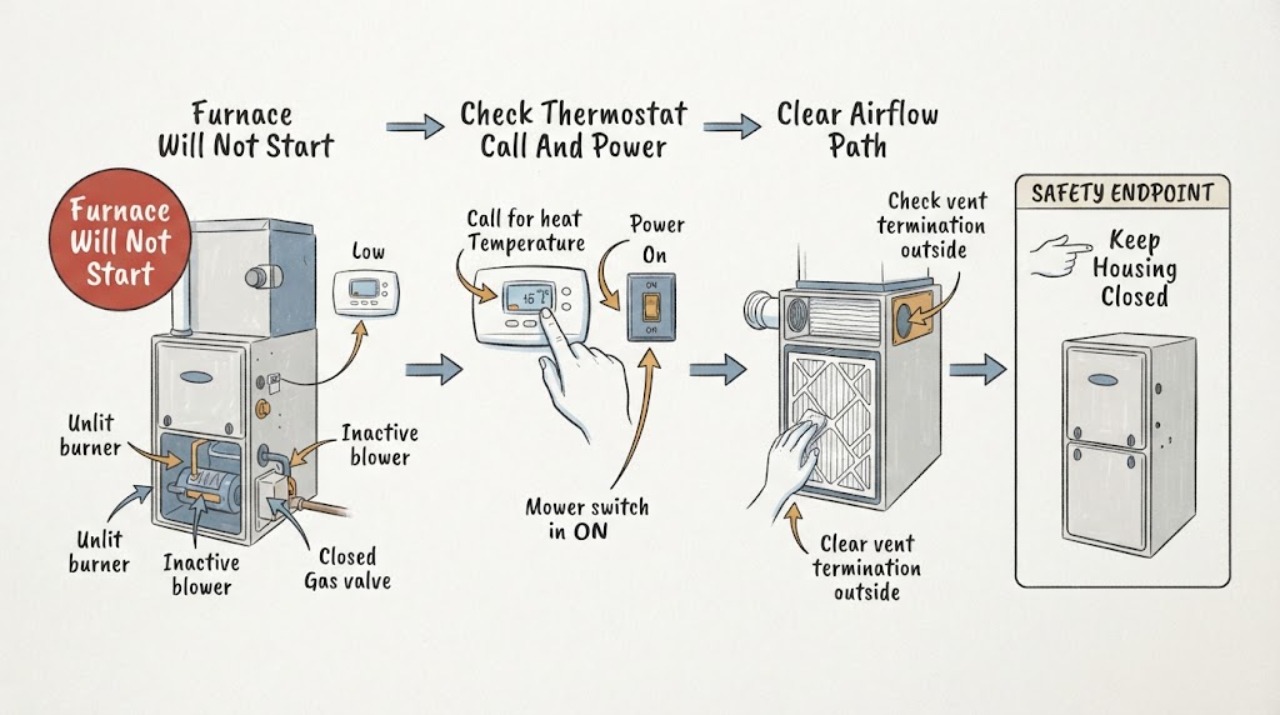
When a Rheem furnace will not start, first determine whether the thermostat is calling for heat and whether the furnace has visible power. Check the thermostat mode and setting, the furnace switch or breaker from a safe position, and that the access door is fully seated; replace or clean the filter as the model instructions direct and keep return and supply grilles clear. If the inducer or blower runs but ignition does not begin, a pressure, vent, limit, ignition, flame-sensing, condensate, or control fault may be preventing the sequence. Read any Rheem status light or display code without opening the cabinet and use the exact model manual. Stop immediately for gas odor, soot, smoke, unusual combustion, or a carbon-monoxide alarm; leave the area and contact emergency or utility support. Do not bypass a safety switch, adjust gas controls, or test live wiring.
Work through in order
Diagnostic checks
Use only checks that match the exact appliance or system and its official guide.
-
Check 1
Set the thermostat to Heat and confirm its setpoint is above the room temperature; check any user-replaceable batteries if the model uses them. From a dry, safe position, check whether the furnace switch or labeled breaker is on and whether the cabinet door is fully seated. Do not remove panels or touch wiring.
Expected result: The thermostat is not calling for heat, the display is blank, the furnace is completely silent, the switch or breaker is off, the door is not seated, or the visible controls are normal but there is still no response.
Next step: Correct only the thermostat mode, setting, battery, switch, breaker, or door position allowed by the model instructions, then make one normal heat call. If the breaker trips again, the display remains blank, or the furnace stays silent, leave it off and arrange qualified HVAC or electrical service.
Stop if: Do not repeatedly reset a tripping breaker, jumper thermostat terminals, defeat the door switch, or open the control compartment.
Why this matters
Why: No heat call, blank thermostat, lost power, or an unseated door can prevent the furnace sequence from starting. Normal visible controls with no response make an internal control, transformer, safety circuit, or wiring fault more likely.
-
Check 2
Turn the furnace off and inspect the air filter. Replace or clean it only as the Rheem model instructions specify, then check that return grilles and supply registers are not blocked by furniture, rugs, dust, or stored items. Do not remove the blower or burner door.
Expected result: The filter is visibly loaded, several return or supply openings are blocked, airflow was weak on the last call, or the filter and accessible air paths are clear.
Next step: Correct the accessible filter and grille obstruction, then allow one normal call only if there is no safety warning or combustion symptom. If the furnace still will not start or a limit-related fault returns, keep it off and arrange HVAC service.
Stop if: Do not run the furnace without its filter, use a damaged filter, block return air, or bypass a limit or rollout safety.
Why this matters
Why: Restricted airflow can cause overheating and open a limit control, which can prevent or interrupt a heating sequence. A clean accessible air path makes a thermostat, power, vent, pressure, ignition, flame-sensing, condensate, or control problem more likely.
-
Check 3
With the thermostat calling and the cabinet closed, listen from a safe position for an inducer or blower sound, ignition attempt, burner start, or a motor that runs without heat. Read the visible Rheem status light or display without opening the furnace and record the exact pattern, along with whether the furnace retries or locks out.
Expected result: Nothing runs, the inducer runs but ignition never begins, ignition starts and burners do not remain lit, the blower runs with no heat, or a status code repeats.
Next step: Write down the model, startup stage, sound, retry behavior, and code for the technician. Use only model-manual checks that do not expose wiring, gas, flame, or safety controls; arrange qualified service for any repeated no-start or lockout.
Stop if: Do not remove the burner panel, clean or adjust a flame sensor, probe a pressure switch, reset a rollout switch, or relight the furnace to force another trial.
Why this matters
Why: Each stage points to a different diagnostic path: power or control for no response; pressure, vent, limit, or control checks when the inducer runs without ignition; ignition or flame-sensing when burners fail to remain lit; and a possible limit, airflow, or heat-exchanger issue when the blower runs without heat. A recurring code identifies a safety or control event but not necessarily a replaceable part.
-
Check 4
From outside and without disturbing the equipment, look for an obviously blocked furnace vent termination, snow, leaves, nests, or damage near the accessible exhaust or combustion-air openings. Check for gas odor, soot, smoke, unusual flame noise, or a carbon-monoxide alarm; do not enter a confined area or remove a vent or cabinet panel.
Expected result: A termination is visibly blocked or damaged, the furnace has a combustion warning, gas odor or soot is present, or the accessible vent area appears clear but the furnace still will not start.
Next step: For a visible obstruction that can be removed without tools or exposure, clear only the loose external debris and leave the furnace off if the fault remains. For damage, a blocked internal path, any combustion warning, or continued no-start, arrange qualified HVAC service; leave the area for gas odor or carbon-monoxide danger.
Stop if: Do not enter a flue, disconnect venting, adjust gas valves, operate switches near gas odor, or keep restarting a furnace with soot, smoke, or a carbon-monoxide alarm.
Why this matters
Why: A blocked or damaged vent can prevent pressure proving and safe ignition. Gas odor, soot, smoke, abnormal combustion, or a carbon-monoxide alarm indicates an immediate safety boundary. A clear visible termination does not rule out a hidden vent, condensate, pressure, ignition, or control fault.
Use your observations
Decision map
Find the observation that best matches what you see, then follow the next safe action.
-
PATH 01Next step
What you see
The thermostat is not calling for heat, is blank, the furnace is silent, the switch or breaker is off, or the access door is not seated.
Do this next
Correct only the accessible setting, battery, switch, breaker, or door position allowed by the model. If power is absent, the breaker trips, or the furnace remains silent, use qualified electrical or HVAC service.
Why this path and its safety boundary
Why it matters: A call-for-heat, power, door-interlock, or basic control condition is more likely than an ignition component failure.
-
PATH 02Next step
What you see
The thermostat calls, the filter or return path is restricted, the inducer runs without ignition, or a visible vent termination is blocked or damaged.
Do this next
Correct only an accessible filter or loose external obstruction. Leave the furnace off and arrange HVAC service for hidden venting, pressure switches, limit controls, condensate, or any recurring no-start.
Why this path and its safety boundary
Why it matters: Airflow, combustion-air, exhaust, pressure-proving, or limit protection is more likely to be preventing a safe startup.
-
PATH 03Next step
What you see
The inducer or ignition sequence begins, but the burners never light, light briefly and stop, or the visible status code indicates a flame or ignition-related event.
Do this next
Stop repeated retries and arrange qualified HVAC service. Provide the code, whether ignition was visible only to the extent shown through the normal inspection window, and whether gas odor or other combustion symptoms occurred.
Why this path and its safety boundary
Why it matters: An igniter, gas supply, flame-sensing, grounding, control, or safety circuit problem is more likely; the exact cause cannot be identified by the sound alone.
-
PATH 04Next step
What you see
A status code repeats, the blower runs without heat, the furnace locks out, a switch or control may be open, or gas odor, soot, smoke, unusual combustion, or a carbon-monoxide alarm is present.
Do this next
Leave the furnace off and contact qualified HVAC service. For gas odor or a carbon-monoxide alarm, leave the area and contact emergency or utility support from a safe location; do not operate switches or attempt a reset.
Why this path and its safety boundary
Why it matters: A safety, heat-exchanger, motor, control, wiring, or combustion fault needs professional diagnosis; hazardous symptoms override ordinary troubleshooting.
Helpful context
Understand the symptom
Use the startup stage to narrow the problem
A furnace that is completely silent has a different first branch from one whose inducer, blower, igniter, or burners start and then stop. Observe from outside the cabinet whether the thermostat calls for heat and which sound or status indication appears. Do not remove the access panel to watch the burner sequence; a qualified technician can use the model-specific sequence and fault history safely.
Rheem status codes are model-dependent
Rheem technical references describe status-light conditions for lockout, pressure, limit, flame-sensing, and control faults, but the meaning and reset behavior can vary by furnace family. Record the exact blink pattern or display message and find the manual for the model on the rating label. Treat a recurring safety-related code as a service result, not an invitation to bypass the control.
Only after diagnosis
Potential parts
- Rheem furnace air filter
Only consider this category when the existing filter is loaded or damaged and the exact Rheem model and filter requirements are confirmed.
Filter type, size, and replacement interval depend on the model and installation; follow the owner's instructions. - Rheem furnace igniter or flame-sensing component
Only consider this category when the startup sequence and fault history support an ignition or flame-sensing diagnosis made by qualified service.
Ignition and sensing components are model-specific and involve combustion and electrical safety; do not select or install from a code alone. - Rheem furnace pressure or limit switch
Only consider this category when airflow and accessible vent conditions are adequate and qualified diagnosis confirms a pressure or limit control fault.
Never bypass or substitute a furnace safety switch; verify the exact model and safety specification through qualified service.
When checks do not resolve it
Need a professional?
Arrange qualified HVAC service when the Rheem furnace remains silent after the thermostat, visible power, door, filter, and grille checks; the inducer, blower, or ignition sequence starts but does not complete; a status code repeats; the furnace locks out; or a pressure, limit, flame-sensing, condensate, vent, wiring, control, or heat-exchanger fault is suspected. Stop immediately for gas odor, soot, smoke, unusual combustion, or a carbon-monoxide alarm; leave the area and contact emergency or utility support from a safe location. Do not bypass safety switches, adjust gas controls, open the burner cabinet, or test energized circuits.
Common questions
FAQ
Why will my Rheem furnace not start at all?
Start with the thermostat call, visible power, access-door position, and filter or airflow condition. If the furnace is silent, a thermostat, switch, breaker, door interlock, control, or wiring condition is more likely. If a motor or inducer runs but ignition does not complete, pressure, vent, limit, ignition, flame-sensing, condensate, or control diagnosis is needed.
What should I do if my Rheem furnace status light is blinking?
Record the exact blink pattern or display message without opening the cabinet and look it up in the manual for the exact model. Rheem references use status conditions for lockout, pressure, limit, flame-sensing, and control faults, but a code does not by itself identify a replacement part. A recurring or safety-related code needs qualified service.
Can I reset or relight a Rheem furnace that will not start?
Do not repeatedly reset a breaker, reset a rollout or limit safety, relight a burner, or bypass a control. You may correct a thermostat setting or a visibly tripped switch only when the model instructions allow it and there is no gas odor, smoke, soot, unusual combustion, or carbon-monoxide warning. Persistent no-start requires qualified HVAC service.
Read the exact guide
Official sources
- urgent helpRheem Manufacturing Company · Rheem urgent heating and cooling safety guidance for shutting off gas or electricity and getting professional help
- Gas Furnace SymptomsRheem · Rheem electrical symptom categories for a gas furnace that will not fire, including power, ignition, pressure, limit, flame, and blower paths
- Frequently Asked QuestionsRheem · Rheem gas-furnace status codes and technical causes involving flame sensing, pressure switches, limit controls, venting, airflow, and condensate
Community feedback
Share a repair observation
Share a plain-text repair observation. Accepted observations are published automatically; this page may take a moment to update.