
On this page
Start here
Quick answer
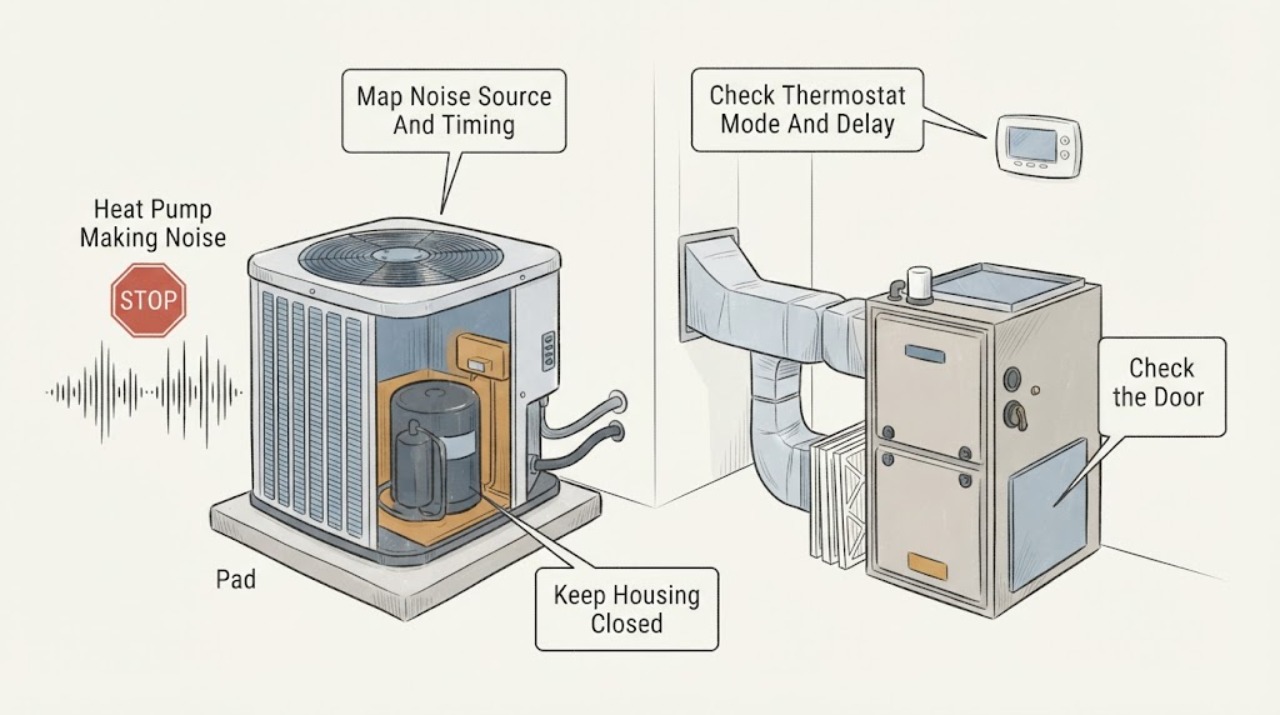
A Rheem heat pump can make normal fan, compressor, airflow, refrigerant, or defrost sounds, but a new, loud, metallic, scraping, rattling, humming, or vibration-related noise deserves a source-and-timing check. Note whether the noise comes from the outdoor unit, indoor air handler, ductwork, or thermostat, and whether it appears in heating, cooling, startup, shutdown, or defrost. From a safe distance, check for visible debris, blocked airflow, a loose panel, an unstable pad, dirty filters, and objects touching the cabinet. Disconnect power only for an owner-manual-approved external cleaning step. Do not open electrical panels, touch a fan or compressor, adjust refrigerant, or bypass a control. Arrange qualified HVAC service if the noise is persistent, worsening, accompanied by poor heating or cooling, repeated breaker trips, ice that does not clear, or any electrical or refrigerant concern.
Before you begin
Safety first
- This article covers sound localization, thermostat-mode review, visible debris and support checks, accessible filter and airflow checks, and safe observation of one operating or defrost cycle. A technician must handle electrical testing, internal panels, fan and compressor diagnosis, refrigerant, defrost and reversing controls, and structural repairs.
Work through in order
Diagnostic checks
Use only checks that match the exact appliance or system and its official guide.
-
Check 1
From a safe position, identify whether the sound starts at the outdoor cabinet, indoor air handler, a register or duct, or the thermostat. Note whether it occurs only at startup, shutdown, mode change, steady operation, defrost, or continuously, and record whether heating or cooling performance changed.
Expected result: The sound is a steady hum or airflow, a brief mode-change or defrost sound, a rattle or vibration at the outdoor cabinet, scraping or grinding, a duct or register noise, or an indoor blower noise.
Next step: Record a short description and the operating mode, then continue only with the matching external check. Stop and arrange service for scraping, grinding, electrical buzzing, rapidly worsening noise, or any sound accompanied by loss of heating or cooling.
Stop if: Do not put hands, tools, or a phone through a grille, remove a panel, or stand over the fan while the unit is operating.
Why this matters
Why: A steady operating sound or short defrost change can be normal. A cabinet rattle points toward vibration, a loose panel, debris, or fan-area contact; scraping or grinding raises concern for a moving component. Indoor or duct noise follows a different airflow or blower path, so location prevents an incorrect outdoor repair assumption.
-
Check 2
Check the thermostat's system mode and fan mode, and note whether the noise follows a heat, cool, or auxiliary-heat call. Avoid repeatedly changing the setpoint or switching modes; after a stop or power interruption, allow the model's protective delay before judging that the outdoor unit failed to restart.
Expected result: The noise occurs only in one mode, the fan is set to run continuously, the noise follows a mode change, the outdoor unit pauses after a recent stop or power interruption, or the noise remains in every mode.
Next step: Return the system and fan to the settings specified by the owner's manual and observe one normal cycle. If the unusual noise remains or comfort is reduced, provide the mode and timing pattern to an HVAC technician rather than forcing additional restarts.
Stop if: Do not bypass a delay, jumper thermostat terminals, open the thermostat, or repeatedly cycle power to test the compressor.
Why this matters
Why: Fan-only operation or one mode can make airflow, reversing, defrost, or mode-specific vibration more likely. Rheem literature describes an anti-short-cycle delay after operation or power interruption, so an immediate restart expectation can be misleading. A persistent noise in all modes is less likely to be a thermostat setting alone.
-
Check 3
With the unit off and power disconnected only as the owner's manual directs, inspect the outside of the Rheem unit for leaves, sticks, snow, ice buildup, a blocked coil or grille, a loose-looking panel, and objects touching the cabinet. Look at the pad or support for obvious rocking or contact with a wall, fence, pipe, or line cover; do not reach through the grille.
Expected result: Debris or ice blocks the airflow path, a panel or guard visibly rattles, the pad or support is unstable, the cabinet touches another object, or the exterior is clear and stable.
Next step: Remove only loose debris that is safely reachable without bending fins or opening the cabinet, and restore the clearance specified by the manual. Do not chip persistent ice or straighten internal parts; arrange service for a loose panel, unstable support, repeated ice, or noise that remains.
Stop if: Do not touch a fan blade, compressor, coil fins, refrigerant line, or electrical component, and do not use water or heat on an energized unit.
Why this matters
Why: Debris, restricted airflow, cabinet contact, and unstable support can create rattling or vibration and make the system work harder. A clear, stable exterior makes an external obstruction less likely but does not rule out an internal fan, motor, compressor, or refrigerant problem.
-
Check 4
Inspect the accessible indoor air filter with the system off and check that supply registers and return grilles are open and unobstructed. Listen from the room, not inside the air handler, for whistling, booming, rattling registers, or a blower sound that changes with airflow. Replace or clean the filter only as the system documentation permits.
Expected result: The filter is visibly dirty, a return or supply is blocked, a register or duct vibrates, the indoor blower is loud, or airflow and the filter are normal.
Next step: Restore the correct filter and visible airflow, secure only a loose grille that can be safely handled, and observe one normal cycle. If the blower, duct, or noise remains abnormal, arrange HVAC service; do not open the air-handler cabinet.
Stop if: Do not operate without a filter, reach into the blower compartment, remove duct panels, or use tools near moving parts.
Why this matters
Why: A dirty filter or blocked airflow can increase blower noise and reduce comfort. A loose register or duct can transmit vibration even when the outdoor heat pump is quiet. Normal indoor airflow with an outdoor mechanical noise shifts suspicion back to the outdoor cabinet or its service components.
-
Check 5
During one normal heating cycle, note whether outdoor frost clears on its own and whether the unusual noise is limited to the defrost transition. Check for warm air at the registers and a stable indoor temperature without opening the outdoor cabinet or changing defrost controls.
Expected result: Frost appears and clears with a brief sound or steam, the fan stops while defrost occurs, ice remains or grows, the noise continues outside defrost, or heating performance is poor.
Next step: Keep clear of the unit and record the defrost pattern. Arrange qualified service for persistent ice, poor heat, or continuing mechanical noise; do not scrape the coil, force the fan, or adjust a defrost timer.
Stop if: Do not enter the cabinet, touch a hot coil or compressor, remove ice with tools, or alter defrost or refrigerant controls.
Why this matters
Why: Rheem describes outdoor frost and automatic defrost as normal in cold-weather heating; the outdoor fan may stop while the compressor continues. Ice that does not clear, a sound that persists beyond defrost, or poor heat indicates a defrost, airflow, fan, refrigerant, or control diagnosis rather than normal defrost noise.
-
Check 6
After the external checks, document the exact noise description, location, operating mode, start and stop timing, outdoor temperature or weather, filter and debris findings, frost behavior, thermostat setting, and heating or cooling result. Do not continue testing once the pattern is persistent or unsafe.
Expected result: The sound is gone after a visible obstruction or airflow correction, remains but performance is normal, returns in one mode, worsens, or is accompanied by poor comfort, a breaker trip, burning odor, smoke, or exposed refrigerant.
Next step: Arrange qualified HVAC service for recurring or unresolved noise and provide the recorded pattern. Turn the system off at its normal control and seek prompt help for smoke, burning odor, electrical arcing, repeated breaker trips, refrigerant release, or unsafe mechanical movement.
Stop if: Do not purchase or install a fan motor, compressor, reversing valve, control, or refrigerant component from a noise description alone.
Why this matters
Why: A lasting correction supports an external obstruction or airflow cause. A recurring noise with normal performance still warrants monitoring and model-specific service if it continues; worsening noise or reduced performance makes a fan, motor, compressor, control, defrost, or refrigerant issue more likely.
Use your observations
Decision map
Find the observation that best matches what you see, then follow the next safe action.
-
PATH 01Next step
What you see
The sound is a steady fan or compressor sound, brief airflow change, or a short defrost transition, and heating or cooling remains normal.
Do this next
Keep the outdoor unit clear, maintain filters and registers, and monitor the pattern. Arrange service if the sound becomes loud, metallic, persistent, or is joined by poor performance.
Why this path and its safety boundary
Why it matters: Normal operation or automatic defrost is more likely than a failed part, especially when the sound has a consistent timing and does not worsen.
-
PATH 02Next step
What you see
The noise changes with airflow and comes from a register, duct, loose-looking panel, cabinet contact, debris, unstable support, dirty filter, or blocked grille.
Do this next
Correct only the visible obstruction or approved filter issue with power off as directed, then observe one cycle. Do not remove panels or reach into the fan; call service for persistent vibration or unstable equipment.
Why this path and its safety boundary
Why it matters: An external vibration or airflow restriction is more likely than a compressor or sealed-system fault, though continued noise after correction needs diagnosis.
-
PATH 03Next step
What you see
The noise occurs only in heating, cooling, startup, shutdown, or after a mode or setpoint change, with no visible obstruction.
Do this next
Return to the documented thermostat mode and allow the model's normal delay, then record one cycle. Arrange service if the sound is new, severe, or accompanied by weak heating or cooling.
Why this path and its safety boundary
Why it matters: Mode-specific airflow, reversing or defrost behavior, or a protective anti-short-cycle delay may be involved; the timing alone does not identify a failed part.
-
PATH 04Safety boundary
What you see
Scraping, grinding, repeated metallic rattling, strong vibration, or electrical buzzing continues in one or every mode, or the sound worsens.
Do this next
Turn the system off at the normal control if safe and arrange qualified HVAC diagnosis. Provide the location, recording, mode, weather, performance, and visible inspection results.
Why this path and its safety boundary
Why it matters: A fan, motor, cabinet, compressor, electrical control, or support problem is possible and cannot be safely distinguished from outside the unit.
Safety stop: Do not touch moving parts, remove panels, test live electrical components, or keep operating a unit with a scraping or grinding sound.
-
PATH 05Next step
What you see
Outdoor ice does not clear, heat or cooling output drops, the unit trips a breaker, there is smoke or burning odor, or refrigerant or electrical damage is suspected.
Do this next
Stop user diagnosis and arrange prompt qualified service. Leave the equipment off for smoke, burning odor, arcing, repeated breaker trips, exposed wiring, or suspected refrigerant release, and keep people away from the unit.
Why this path and its safety boundary
Why it matters: The issue has moved beyond normal noise and may involve airflow, defrost, refrigerant, electrical, or mechanical safety conditions.
Helpful context
Understand the symptom
The sound's location and timing matter more than the brand name
A low, steady sound from the outdoor unit during a heating or cooling call can be normal fan or compressor operation. Air rushing, duct movement, or a short change during a defrost cycle can also be part of normal operation. Scraping, grinding, a loose-panel rattle, strong vibration, repeated contact with the fan guard, or a sound that began with reduced capacity is a different pattern. Identify where and when it occurs before considering a part.
A heat pump may pause or change sound during protection and defrost
Rheem manuals describe a protective delay after a previous operation or power interruption, and describe the outdoor fan stopping while the compressor continues during a heating defrost cycle. Frost and some steam during defrost can be normal. Do not force an immediate restart or treat every pause, whoosh, click, or change in airflow as a failed component; persistent noise, incomplete defrost, or poor comfort changes the diagnosis.
Keep observations outside the cabinet
Homeowner checks can cover thermostat mode, filter condition, registers, visible debris, cabinet contact, and the stability of the outdoor pad. Rheem's literature warns that the equipment contains electrical systems and pressurized refrigerant, and that maintenance requires power disconnected. Internal fan, compressor, electrical, refrigerant, reversing-valve, and defrost work belongs to a qualified HVAC technician.
Safety boundary
Stop conditions
- Do not remove outdoor or indoor access panels, test live electrical components, touch a fan blade or compressor, or bypass a control.
- Do not adjust refrigerant charge, open refrigerant lines, alter a reversing or defrost control, or attempt internal motor or compressor work.
- Do not scrape or chip coil ice, use flame or improvised heat, bend coil fins, or use water on an energized unit.
- Turn the system off and arrange prompt service for scraping, grinding, strong vibration, repeated breaker trips, smoke, burning odor, arcing, exposed wiring, refrigerant release, or unsafe movement.
- Do not keep operating a heat pump with worsening noise, poor heating or cooling, ice that does not clear, or a fan that appears not to run when the system should be operating.
Only after diagnosis
Potential parts
- Outdoor fan motor or blade assembly
Consider this category only when a qualified technician confirms that a fan or motor is the source of scraping, grinding, vibration, or abnormal airflow after external debris and contact checks.
Confirm the exact Rheem model, fan assembly, motor specification, guard, and service procedure; do not reach into the outdoor unit. - Cabinet panel, vibration isolator, or support hardware
Consider this category only when inspection and service diagnosis show a loose panel, damaged isolator, cabinet contact, or unstable support is transmitting the noise.
Confirm the exact model and support configuration; do not remove panels or move an outdoor unit without qualified assistance. - Indoor air filter
Consider this category only when the accessible filter is dirty or damaged and the system documentation identifies its correct replacement type.
Confirm dimensions and approved filter type from the system documentation; never operate the air handler without the required filter. - Defrost or reversing control component
Consider this category only when a technician confirms persistent ice, abnormal defrost timing, or mode-transition noise is caused by a control or reversing component.
Confirm the exact Rheem model, control revision, refrigerant system, and service requirements before ordering. - Compressor or compressor start component
Consider this category only after a qualified technician confirms the compressor or its start/control components produce the noise or fail to operate; noise alone is not sufficient.
Confirm exact model and system compatibility; compressor and electrical work require qualified service and must not be attempted by the homeowner.
When checks do not resolve it
Need a professional?
Arrange qualified HVAC service when a Rheem heat pump has persistent or worsening scraping, grinding, metallic rattling, strong vibration, or electrical buzzing; when noise is accompanied by weak heating or cooling, abnormal cycling, persistent ice, a fan problem, a breaker trip, or an alarm; or when diagnosis would require opening panels, testing wiring, handling refrigerant, or accessing a compressor, fan motor, reversing valve, or defrost control. Seek prompt help for smoke, burning odor, arcing, exposed wiring, refrigerant release, or unsafe equipment movement.
Safety scope: This article covers sound localization, thermostat-mode review, visible debris and support checks, accessible filter and airflow checks, and safe observation of one operating or defrost cycle. A technician must handle electrical testing, internal panels, fan and compressor diagnosis, refrigerant, defrost and reversing controls, and structural repairs.
Common questions
FAQ
What noises are normal for a Rheem heat pump?
A steady fan or compressor sound, airflow, and short changes during mode transition or automatic defrost can be normal. Rheem describes outdoor frost and defrost behavior in heating. A new scraping, grinding, metallic rattle, strong vibration, or noise with poor comfort should be treated as a service clue rather than assumed normal.
Why does my Rheem heat pump pause after it stops?
Rheem manuals describe a protective anti-short-cycle delay after a previous operation or an interruption of power. Avoid repeatedly changing the setpoint or switching modes to force an immediate restart. If the unit does not resume after its model-specific delay or the noise is abnormal, arrange service.
Can debris or a loose panel make a heat pump rattle?
Yes. Leaves, sticks, blocked airflow, cabinet contact, a loose-looking panel, or an unstable support can create vibration or make the system work harder. With power off as the manual directs, remove only loose debris that is safely reachable and call service for panels, supports, fan contact, or recurring noise.
Can a dirty filter cause a noisy Rheem heat pump?
A dirty filter can restrict airflow and increase indoor blower noise or reduce comfort. Inspect it with the system off and replace or clean it only as the documentation permits. Do not operate the air handler without the required filter or open its blower compartment.
Why does my Rheem heat pump make a different sound during defrost?
During heating defrost, Rheem describes the outdoor fan stopping while the compressor continues to heat the outdoor coil; frost melts and some steam may appear. A brief, repeatable change can be normal. Ice that does not clear, a persistent grinding sound, or poor heating needs qualified diagnosis.
Should I open my Rheem heat pump to find the noise?
No. Keep the observation external. Electrical parts, moving fans, compressors, pressurized refrigerant, defrost controls, and reversing components require qualified service. Record the sound's location, timing, mode, and performance instead of removing a cover.
When should I call a technician for a noisy Rheem heat pump?
Call when the noise is persistent, worsening, scraping, grinding, metallic, strongly vibrating, or electrical; when heating or cooling is weak, ice remains, a fan does not operate, or a breaker trips; or when diagnosis needs panels, wiring, refrigerant, compressor, fan, defrost, or reversing-valve access. Seek prompt help for smoke, burning odor, arcing, exposed wiring, or suspected refrigerant release.
Read the exact guide
Official sources
- 708760-0 User Manual Q5SN Mammoth.inddRheem Manufacturing Company · Official Rheem heat-pump user manual; apply operating and maintenance concepts to the assigned Rheem heat pump and use its own model manual for final procedures.
- HVAC Quality InstallationENERGY STAR · U.S. EPA ENERGY STAR HVAC quality guidance for heat-pump systems and professional installation or service.
- 708308-A T3BC 12 SEER HP ii.pmdRheem Manufacturing Company · Official Rheem outdoor heat-pump literature; model-specific installation and service instructions control the assigned equipment.
- Rheem Heat Pumps - RP15 - RP1524BJ1NA - Rheem Manufacturing CompanyRheem Manufacturing Company · Official Rheem product page for the named RP15 model; product-specific details are not assumed to apply to every Rheem heat pump.
- Heat Pump SymptomsRheem Manufacturing Company · Official Rheem technical symptom index for heat-pump service diagnosis; it is not a homeowner internal-repair procedure.
Community feedback
Share a repair observation
Share a plain-text repair observation. Accepted observations are published automatically; this page may take a moment to update.