
On this page
Start here
Quick answer
A Rheem heat pump is short cycling when the compressor or outdoor unit starts and stops repeatedly instead of completing a normal heating or cooling call. First distinguish a brief anti-short-cycle delay after a setpoint, mode, or power change from repeated starts while the thermostat still calls. Keep the thermostat on the requested mode with the fan on AUTO, check the filter, return grilles, supply registers, and the outdoor unit for safe, visible airflow restrictions, and note whether the problem occurs in heat, cool, or during defrost. Rheem owner guidance says some equipment and thermostats can hold the compressor off for up to five minutes after a prior operation or power interruption; that delay alone is not proof of a fault. Persistent cycling can instead involve airflow, thermostat or control behavior, icing or defrost, electrical protection, refrigerant or pressure conditions, equipment matching, or sizing. Turn the system off and arrange qualified HVAC service for repeated short cycles with a tripped breaker, burning or electrical odor, smoke, severe vibration, heavy ice, a fan that does not resume, refrigerant-like hissing, or lost heating or cooling. Do not open panels, bypass a timer, adjust installer settings, test live wiring, add refrigerant, or repeatedly reset the breaker.
Before you begin
Safety first
- Homeowner checks should remain limited to recording the cycle pattern, confirming stable thermostat settings, checking a model-correct filter and accessible registers, and observing outdoor clearance or defrost from a safe distance. A qualified technician should test airflow, controls, electrical protection, coils, defrost operation, refrigerant and pressure conditions, equipment matching, and sizing as applicable.
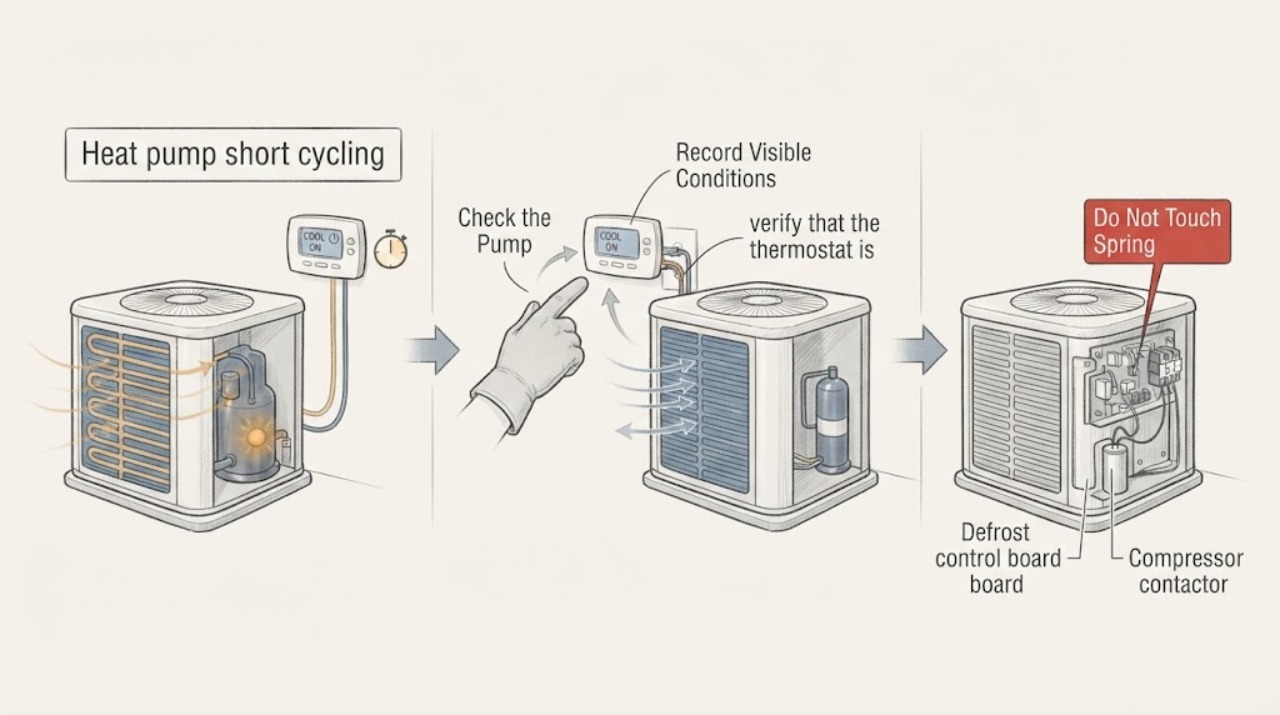
Work through in order
Diagnostic checks
Use only checks that match the exact appliance or system and its official guide.
-
Check 1
Turn the heat pump off at the thermostat and leave the area if there is smoke, a burning or electrical odor, sparks, a hot or discolored disconnect, a tripped breaker that immediately trips again, severe vibration, refrigerant-like hissing, or visible damage; do not approach moving parts.
Expected result: The unit is making ordinary operating sounds with no hazard sign, or the cycling is accompanied by an electrical, fire, refrigerant, mechanical, or visible-damage symptom.
Next step: For smoke or active fire, leave and use emergency help. Otherwise keep the system off and arrange qualified HVAC or electrical service; do not repeatedly reset the breaker.
Why this matters
Why: A repeated start-stop pattern can be a comfort or equipment issue, but hazardous signs make continued operation unsafe and can worsen damage.
-
Check 2
Record one undisturbed cycle from a safe position: note whether the compressor or outdoor unit starts, how soon it stops, whether the indoor blower continues, whether the thermostat still calls, and whether the event follows a setpoint, mode, or power change.
Expected result: There is one restart delay of up to about five minutes after a control or power change, or the unit repeatedly starts and stops while the same call remains active.
Next step: Do not keep changing the setpoint or mode to test it. If the pattern repeats after the protective delay, save the timing and arrange HVAC diagnosis.
Why this matters
Why: A short delay after an interruption can be Rheem's anti-short-cycle protection. Repeated dropouts during an unchanged call are a different pattern and can indicate airflow, control, pressure, electrical, or capacity trouble.
-
Check 3
With the system off, verify that the thermostat is in the intended HEAT or COOL mode, the fan is set to AUTO, the setpoint is stable, and no schedule or temporary hold is repeatedly changing the call; do not enter installer settings.
Expected result: The mode or schedule is changing unexpectedly, the call ends when the setpoint is reached, or the thermostat continues calling while the heat pump repeatedly stops.
Next step: Correct only an obvious user setting and observe one normal call. If the call remains active during repeated stops, keep the settings unchanged and provide the thermostat behavior to a qualified technician.
Why this matters
Why: A changing call can explain normal cycling, while an unchanged call with repeated compressor dropouts keeps thermostat wiring, controls, protection, and equipment causes in consideration.
-
Check 4
Inspect the accessible return filter, return grilles, and supply registers with the system off; replace a dirty or damaged filter only with the correct size and airflow direction, and move furniture or drapes that visibly block a grille.
Expected result: The filter is loaded, a return or supply is blocked, airflow is weak or uneven, or the filter and grilles are clear.
Next step: Correct only the obvious filter or grille restriction and allow a normal call. If short cycling continues, airflow is still weak, or comfort is poor, arrange service for measured airflow and system checks.
Why this matters
Why: Restricted indoor airflow can reduce comfort and alter heat-pump operating conditions. A clear filter does not rule out duct, blower, outdoor coil, refrigerant, or control problems.
-
Check 5
From a safe position, inspect around the outdoor unit for leaves, snow, stored objects, blocked vents, heavy ice, or water that cannot drain away; clear only loose debris that is safely reachable with the equipment off, and never reach through the guard.
Expected result: The outdoor airflow path is obstructed, the cabinet is clear, or the coil has only light frost versus a thick or persistent ice layer.
Next step: Keep the unit uncovered and clear of stored items. Do not chip ice, pour water, use flame, or remove panels; arrange service for heavy ice, recurring icing, or cycling that remains after safe clearance.
Why this matters
Why: An external obstruction can reduce heat transfer and contribute to abnormal operation. Light frost can be part of heating operation, but heavy or persistent ice can indicate a defrost, airflow, refrigerant, or control fault.
-
Check 6
If cycling occurs in heating mode, observe one defrost event from a distance without forcing a mode change: note whether the outdoor fan stops briefly, frost melts, steam dissipates, and normal heating returns.
Expected result: A brief defrost transition clears light frost and operation resumes, or the fan does not resume, ice remains or returns quickly, or indoor comfort declines.
Next step: Let a normal defrost finish. For failed recovery, heavy ice, or poor heat, turn the system off as needed and arrange qualified HVAC service; do not bypass defrost controls.
Why this matters
Why: Rheem describes temporary fan stoppage, steam, and light frost as possible defrost behavior. Failed recovery or excessive ice is not a normal explanation for repeated cycling.
-
Check 7
Prepare the model information and a service record: mode, thermostat call, start-stop timing, filter and grille condition, outdoor clearance or ice, indoor comfort, weather, recent power or repair work, fault display, and whether the issue began after installation or a system change.
Expected result: The pattern persists after safe checks, occurs in both modes or regardless of thermostat call, follows a recent installation or change, or is paired with a fault, ice, breaker event, or reduced comfort.
Next step: Give the record to a qualified HVAC technician and request inspection of thermostat controls, airflow and duct condition, indoor and outdoor coils, defrost operation, electrical protection, refrigerant circuit, and equipment sizing or matching as applicable.
Why this matters
Why: This evidence helps a technician distinguish thermostat/control behavior, airflow, sizing or equipment matching, defrost, pressure or refrigerant, and electrical protection without treating cycling alone as proof of a failed part.
Use your observations
Decision map
Find the observation that best matches what you see, then follow the next safe action.
-
PATH 01Next step
What you see
The compressor waits briefly after a setpoint, mode, or power change, then completes a normal call without repeated starts or comfort loss.
Do this next
Leave the thermostat stable and monitor. Arrange service if the delay becomes a repeated start-stop pattern or the unit no longer satisfies the call.
Why this path and its safety boundary
Why it matters: Rheem's anti-short-cycle protection is more likely than a failed component, although the exact delay varies by model and thermostat.
-
PATH 02Next step
What you see
The cycle repeats while the thermostat call is unchanged and the filter, registers, returns, and outdoor clearance show an obvious restriction.
Do this next
Correct only the safe, obvious obstruction and observe one normal call. If cycling or weak airflow remains, arrange measured airflow and equipment inspection.
Why this path and its safety boundary
Why it matters: An airflow-related operating problem is more likely than a thermostat setting alone, but the restriction's effect cannot be confirmed without measurements.
-
PATH 03Next step
What you see
The pattern appears in heating with light frost, a brief outdoor-fan stop, steam, and a return to normal heating after defrost.
Do this next
Do not interrupt defrost. Arrange service if the sound or stop-start pattern continues outside defrost, the fan does not resume, ice remains, or comfort declines.
Why this path and its safety boundary
Why it matters: A normal defrost transition is more likely than short cycling, provided ice does not become heavy and the unit resumes operation.
-
PATH 04Next step
What you see
The unit repeatedly drops out after the protective delay, the thermostat still calls, and no obvious filter, grille, or outdoor obstruction explains it.
Do this next
Keep settings stable and arrange qualified HVAC diagnosis. Do not add refrigerant, bypass protection, open panels, or repeatedly reset power.
Why this path and its safety boundary
Why it matters: Thermostat or control behavior, electrical protection, pressure or refrigerant conditions, coil restriction, or equipment matching remain possible; the pattern does not identify a part.
-
PATH 05Next step
What you see
Short cycling is accompanied by a tripped breaker, burning or electrical odor, smoke, sparks, severe vibration, refrigerant-like hissing, heavy ice, a fan that does not resume, or loss of heating or cooling.
Do this next
Leave the area for smoke or fire, keep the system off, and arrange qualified HVAC or electrical service; use emergency help for active fire. Do not operate through heavy ice or bypass safety controls.
Why this path and its safety boundary
Why it matters: A potentially hazardous electrical, mechanical, refrigerant, defrost, or pressure condition outweighs ordinary homeowner troubleshooting.
Helpful context
Understand the symptom
What short cycling looks like on a Rheem heat pump
A heat pump normally cycles as the thermostat maintains the selected temperature. Short cycling is a pattern of repeated starts and stops before the call is satisfied, often accompanied by temperature swings, weak comfort, or a protection delay. Count the pattern without repeatedly forcing the unit to restart: note the mode, the approximate time between starts, whether the indoor blower continues, and whether the thermostat still shows a call. A single delayed restart after a mode or power change has a different meaning from a compressor that repeatedly drops out while a call remains active.
A five-minute restart delay can be protective
Rheem's owner guidance describes anti-short-cycle protection in the equipment and some thermostats. After a setpoint or system-switch change, or after power is interrupted, the compressor may be held off for up to five minutes. Let that delay finish rather than changing the thermostat again. If the unit then runs normally and does not repeat the start-stop pattern, record it as a protection delay. Repeated cycling after the delay needs diagnosis.
Airflow is the safest first area to inspect
A loaded filter, blocked return, closed supply register, furniture over a grille, or debris around the outdoor unit can change heat-pump airflow and operating pressures. With the system off, correct only an obvious filter or grille obstruction and keep the outdoor cabinet clear of loose leaves, snow, and stored objects. Do not remove panels, reach through a fan guard, wash coils with power connected, or infer a refrigerant problem from a filter alone.
Defrost can look like a stop-start event
In heating mode, Rheem describes light frost and automatic defrost as normal. During defrost the outdoor fan can stop while the compressor continues, and steam or hissing may briefly appear. The heat pump should return to its prior operation. Heavy ice, ice that remains or quickly returns, a fan that does not resume, or declining heat is not a normal defrost observation; leave the system alone and arrange service rather than chipping or melting the ice yourself.
Why a persistent pattern needs measurements
If safe filter, register, clearance, and thermostat observations do not change the pattern, several causes remain possible: an airflow restriction, thermostat or control issue, equipment sizing or matching, pressure or refrigerant condition, coil restriction, or electrical protection. Rheem's technical material uses airflow and pressure measurements for these distinctions. A homeowner cannot identify the correct part by listening or by repeatedly resetting power, so provide the pattern and observations to a qualified HVAC technician.
Safety boundary
Stop conditions
- Keep the system off and arrange qualified HVAC or electrical service for smoke, fire, sparks, burning or electrical odor, a hot or discolored disconnect, repeated breaker trips, severe vibration, refrigerant-like hissing, visible damage, heavy ice, or a fan that does not resume.
- Do not open indoor or outdoor panels, reach through a fan guard, touch energized wiring, bypass an anti-short-cycle or defrost control, add or recover refrigerant, measure live terminals, or replace a compressor, capacitor, contactor, motor, or control board by guesswork.
- Do not chip ice, pour water on the outdoor coil, use flame or a heater to melt frost, cover the unit, block its vents, or repeatedly change the thermostat or reset the breaker to reproduce a cycle.
- Arrange service when repeated cycling continues after safe filter, register, thermostat-setting, and clearance checks, when comfort is poor, or when the pattern started after installation or a system change and requires sizing, matching, airflow, pressure, refrigerant, control, or defrost measurements.
Only after diagnosis
Potential parts
- Rheem heat-pump thermostat or control component
Consider only when a qualified technician confirms that the thermostat call, wiring, control, or protection circuit is causing repeated dropouts; cycling alone does not identify this part.
Match the exact Rheem indoor and outdoor equipment, thermostat protocol, wiring, staging, and approved configuration; do not change installer settings by guesswork. - Rheem heat-pump air filter or airflow component
A filter is relevant only when it is dirty or damaged; blower, duct, or coil parts should be considered only after measured airflow confirms the restriction.
Confirm the exact system, filter dimensions, airflow direction, blower configuration, and manufacturer requirements before selecting a part. - Rheem heat-pump defrost sensor or control
Consider only when a technician confirms recurring heavy ice or failed defrost operation after airflow and outdoor-clearance causes are evaluated; light frost can be normal.
Match the exact Rheem model, sensor arrangement, board, wiring, and approved defrost procedure; never bypass or force the defrost circuit. - Rheem heat-pump compressor start or electrical component
Consider only after professional electrical and compressor testing confirms a start, contactor, capacitor, or compressor fault; repeated cycling can also come from airflow, controls, pressure, or sizing.
Match the exact outdoor-unit model and electrical specifications; energized components and pressurized refrigerant circuits require qualified service.
When checks do not resolve it
Need a professional?
Safety scope: Homeowner checks should remain limited to recording the cycle pattern, confirming stable thermostat settings, checking a model-correct filter and accessible registers, and observing outdoor clearance or defrost from a safe distance. A qualified technician should test airflow, controls, electrical protection, coils, defrost operation, refrigerant and pressure conditions, equipment matching, and sizing as applicable.
Common questions
FAQ
How long should a Rheem heat pump wait before restarting?
Rheem's owner manual says some equipment and thermostats can delay compressor restart for up to five minutes after a thermostat or system-switch change or a power interruption. A brief protective delay is different from repeated starts and stops during an unchanged call; persistent cycling needs diagnosis.
Can a dirty filter make a Rheem heat pump short cycle?
A dirty filter or blocked return or supply can restrict airflow and change operating conditions, so it is a safe first check. Replace or clean only the correct filter with the system off and keep registers open. If cycling continues or airflow is weak, a technician should measure the system rather than a filter being treated as the certain cause.
Is a heat-pump stop during defrost a short-cycle fault?
Not necessarily. Rheem describes light frost, a temporary outdoor-fan stop, steam, and a return to normal heating as possible defrost behavior. Heavy ice, failed recovery, a fan that does not resume, or cycling outside defrost requires qualified service.
Should I replace the capacitor or thermostat when my Rheem heat pump short cycles?
No. The same symptom can come from airflow, thermostat or controls, defrost, pressure or refrigerant conditions, equipment matching, sizing, or electrical protection. A qualified technician should test the system and identify the cause before any component is selected.
Read the exact guide
Official sources
- Heat Pump Frequently Asked QuestionsRheem · Rheem's technical FAQ is diagnostic material for trained service work; it supports why airflow, pressure, refrigerant, and coil causes cannot be confirmed by a homeowner's observation alone.
- 708760-0 User Manual Q5SN Mammoth.inddRheem · The owner manual covers a specific packaged heat-pump family; its restart-delay, defrost, filter, and safety guidance is used with model-variation caution because the assigned task does not provide a model.
- HVAC - Cold Climate Heat Pump SizingU.S. Department of Energy Building Science Education · The DOE training page explains why proper load calculations and equipment selection matter; it does not diagnose the assigned Rheem unit or establish its size.
- USE AND CARE GUIDERheem · Rheem's guide describes packaged heat-pump defrost and maintenance behavior; exact sequence and clearances remain model-specific.
- Maintenance ChecklistENERGY STAR · ENERGY STAR provides general residential HVAC maintenance guidance that supports safe filter and register checks and professional airflow, control, coil, and refrigerant evaluation.
Community feedback
Share a repair observation
Share a plain-text repair observation. Accepted observations are published automatically; this page may take a moment to update.