
On this page
Start here
Quick answer
A thermostat cannot create airflow by itself, so “thermostat low airflow” usually means the HVAC system responds to the thermostat but little air comes from the vents. First verify the thermostat mode, fan setting, schedule, and display. Then inspect the accessible air filter and make sure return grilles and supply registers are open and unobstructed. If airflow is weak at every register, the blower does not run, the system short-cycles, ice or water appears, or a breaker trips, stop changing thermostat settings and arrange qualified HVAC service. Do not remove panels, adjust thermostat wiring, handle refrigerant, or reach into a blower or coil.
Before you begin
Safety first
- The reader-level scope is visible thermostat-setting review, accessible filter and grille checks, register comparison, and external observation. Thermostat wiring, blower, coil, duct, condensate, refrigerant, electrical, and air-handler work require qualified professionals.
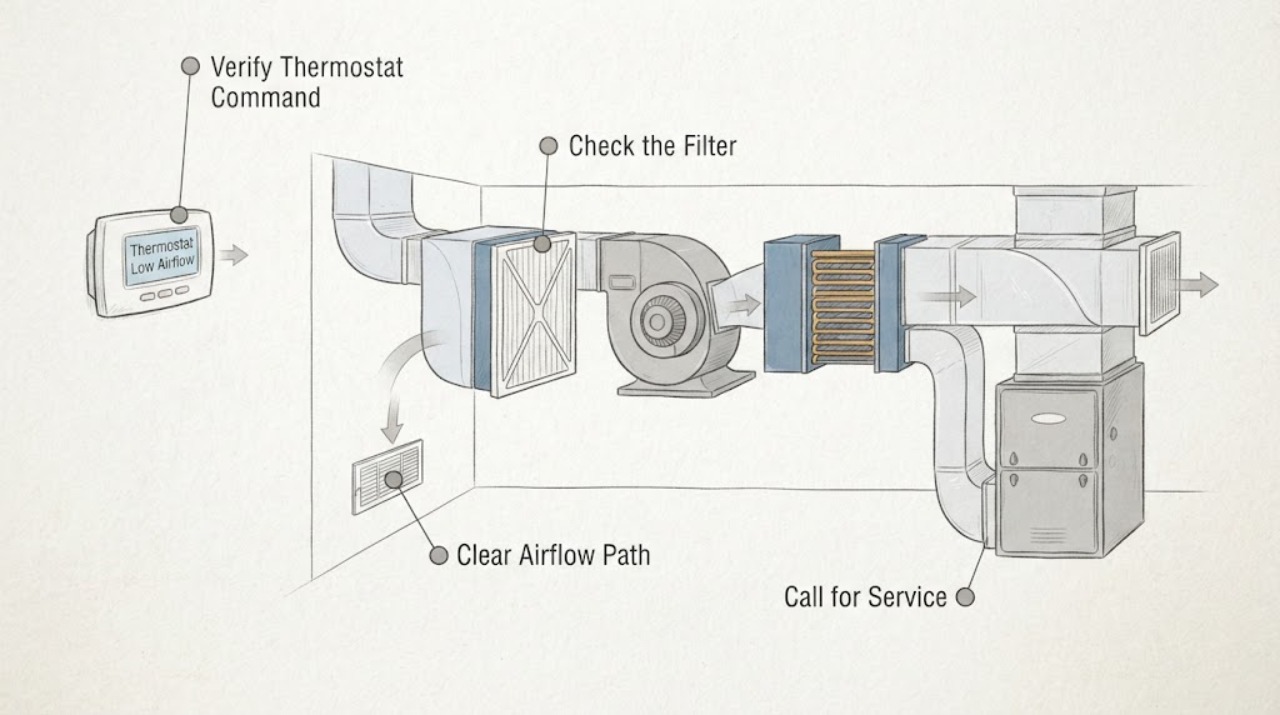
Work through in order
Diagnostic checks
Use only checks that match the exact appliance or system and its official guide.
-
Check 1
Read the thermostat display and verify the intended mode, set point, fan setting, schedule or hold status, and any filter or system alert; observe the system while a normal heating or cooling call is active.
Expected result: Record a normal call with the blower running, a fan set to OFF or an unintended schedule, a blank or unresponsive display, a call shown with no blower response, or rapid starts and stops.
Next step: Correct only the visible mode, fan, or schedule setting and observe one normal call; arrange HVAC service if the display is unresponsive, the blower does not respond, or the system cycles abnormally.
Stop if: Do not remove the thermostat faceplate, bridge terminals, change wiring, or keep resetting the system when a breaker trips or a hazard sign appears.
Why this matters
Why: An incorrect setting can suppress airflow, while a call with no blower response suggests power, control, safety, or blower trouble rather than a set-point issue. Rapid cycling also needs more than a thermostat adjustment if it persists.
-
Check 2
Inspect the accessible HVAC filter and every return grille; replace a loaded filter with the correct system type and clear furniture, curtains, dust, or other obstructions from return openings.
Expected result: Record a clean filter and open return, a visibly loaded filter, a blocked return grille, a filter that becomes dirty quickly, or weak airflow that remains after the correction.
Next step: Run one normal call after the filter is correctly installed and the returns are open; call HVAC service if airflow remains weak, the filter loads unusually fast, or the system freezes or overheats.
Stop if: Do not operate without a filter, stack filters, use an unverified restrictive filter, or reach into the blower or air-handler cabinet.
Why this matters
Why: A loaded filter or blocked return can restrict the air reaching the blower and coil. Persistent weak airflow after this external correction points toward the blower, coil, ductwork, or another equipment fault.
-
Check 3
With a normal call active, compare airflow at several supply registers and confirm each register is open; note whether one room is weak or the entire system is weak.
Expected result: Record strong airflow at some registers, weak airflow at one register or room, weak airflow everywhere, or no airflow despite the thermostat calling.
Next step: Open an accidentally closed accessible register and remove only obvious furniture or curtain blockage; arrange duct or HVAC service for a persistent room-specific or whole-home restriction.
Stop if: Do not adjust hidden dampers, cut into ducts, remove grilles that expose wiring, or force a blower to run.
Why this matters
Why: A single weak register points toward a local grille or branch restriction. Weak airflow everywhere points toward a filter, return, blower, central duct, coil, or control issue; no airflow with a call is more urgent than a single weak room.
-
Check 4
During a cooling call, observe the accessible area around the indoor unit and nearby refrigerant lines for ice, frost, water, or unusual sounds, and observe whether the indoor blower and outdoor unit respond without entering the cabinet.
Expected result: Record no ice or water with normal response, ice or frost, water around the indoor unit, weak or absent blower, an outdoor unit that does not respond, or unusual noise.
Next step: If ice is present, switch cooling OFF and let it thaw naturally; keep the system off for water, absent blower, unusual noise, or repeat ice and arrange HVAC service.
Stop if: Do not chip or heat ice, open the cabinet, touch refrigerant lines, clear a concealed drain with chemicals or pressure, or continue operation with water near electrical parts.
Why this matters
Why: Ice can reduce airflow and may involve restricted airflow, a coil, blower, or refrigerant problem. Water may be meltwater or a condensate issue. A missing blower or abnormal equipment response requires professional diagnosis.
-
Check 5
Inspect only the visible HVAC power path and thermostat display for an intact connection, a tripped breaker, repeated resets, or a warning; do not open the electrical panel or equipment.
Expected result: Record steady power and a responsive thermostat, a breaker that is off, a breaker that trips again, a blank display, a burning odor, buzzing, or a damaged connection.
Next step: If there is no hazard and you are comfortable doing so, follow the equipment instructions for one normal breaker check; if protection trips again or any warning appears, leave the system off and call a qualified electrician or HVAC technician.
Stop if: Do not reset a breaker repeatedly, touch exposed conductors, open panels, test live voltage, or continue if there is smoke, heat, odor, spark, or shock.
Why this matters
Why: A single accessible power interruption may explain no response, but a repeated trip, blank display, odor, buzzing, or damaged connection indicates an electrical or equipment fault. A responsive control with low airflow shifts attention to the air path or blower.
Use your observations
Decision map
Find the observation that best matches what you see, then follow the next safe action.
-
PATH 01Safety boundary
What you see
The thermostat is in the wrong mode, has an unintended fan or schedule setting, or does not show an active call when comfort is needed.
Do this next
Correct the visible setting and observe one normal call; service the thermostat or HVAC system if the display stays unresponsive or the command does not reach the equipment.
Why this path and its safety boundary
Why it matters: The apparent low airflow may be a command or schedule issue rather than a blocked air path.
Safety stop: Do not remove the thermostat, bridge terminals, or alter wiring.
-
PATH 02Safety boundary
What you see
The filter is loaded or a return grille is blocked, and airflow improves or remains weak after the accessible restriction is corrected.
Do this next
Install the correct clean filter and keep returns open; arrange HVAC service for persistent weak airflow, rapid filter loading, or icing.
Why this path and its safety boundary
Why it matters: Restricted return airflow can explain weak delivery and can stress the blower or coil; no improvement means the restriction may be elsewhere.
Safety stop: Do not run without a filter or access internal blower and coil parts.
-
PATH 03Safety boundary
What you see
Most registers have normal airflow but one room or register remains weak.
Do this next
Open the accessible register and remove obvious blockage; arrange duct or HVAC service if the room-specific restriction persists.
Why this path and its safety boundary
Why it matters: A local register, damper, or branch-duct restriction is more likely than a thermostat fault.
Safety stop: Do not cut, seal, or dismantle concealed ductwork.
-
PATH 04Safety boundary
What you see
Airflow is weak at every register, or the blower does not run despite an active thermostat call.
Do this next
Keep the system off if the blower is absent or abnormal and arrange qualified HVAC diagnosis with the observed pattern and filter result.
Why this path and its safety boundary
Why it matters: A central filter, return, blower, coil, duct, power, safety, or control problem is possible; the thermostat alone cannot identify it.
Safety stop: Do not bypass safety switches, open the air handler, test wiring, or keep forcing calls for heat or cooling.
-
PATH 05Safety boundary
What you see
Ice or frost appears, water collects around the indoor unit, cooling is weak, or airflow falls again after thawing and filter checks.
Do this next
Switch cooling OFF, allow natural thaw, protect the area from meltwater, and arrange qualified HVAC service; do not add refrigerant or open the sealed system.
Why this path and its safety boundary
Why it matters: A frozen coil, condensate issue, blower problem, or low-refrigerant condition may be present and needs professional diagnosis.
Safety stop: Do not chip or heat ice, touch refrigerant lines, clear a concealed drain with chemicals or pressure, or restart while water or ice remains.
Helpful context
Understand the symptom
The thermostat is the command point, not the air path
A thermostat calls for heating or cooling; the blower, filter, vents, and ductwork move the air. A wrong mode, fan setting, schedule, or unresponsive display can make the system seem weak, but low airflow at the vents can also come from a loaded filter, blocked return, blower fault, duct restriction, or an iced coil. Start by comparing the thermostat response with what the vents actually deliver.
Use the pattern at the registers to narrow the fault
If every register is weak, suspect a filter, return restriction, blower, duct, or equipment issue. If only one room or register is weak, a local register, damper, or duct branch is more plausible. If airflow falls during cooling and ice or water appears, turn cooling off and arrange service rather than forcing the blower or lowering the set point.
Keep the cabinet and refrigerant circuit out of DIY scope
User-level checks are limited to thermostat controls, accessible filters and grilles, and external observation. Do not remove an air-handler cover, clean an inaccessible coil, open ductwork, bridge thermostat terminals, or add refrigerant. A blower, wiring, coil, drain, or sealed-system diagnosis needs qualified HVAC work.
Safety boundary
Stop conditions
- Stop operation for smoke, burning odor, sparks, shock, hot or damaged electrical connections, or a breaker that trips again.
- If ice is visible, switch cooling OFF and let it thaw naturally; do not chip, scrape, or heat the ice.
- Do not remove HVAC or thermostat panels, bridge terminals, test live wiring, open ductwork, or reach into the blower or coil.
- Do not handle refrigerant, add a charge, open sealed lines, or clear a concealed condensate path with chemicals or pressure.
- Arrange qualified HVAC service for whole-system weak airflow, an absent blower, recurring ice or water, persistent short cycling, or airflow that remains low after the filter and vent checks.
When checks do not resolve it
Need a professional?
Arrange urgent HVAC or electrical help for smoke, burning odor, sparks, shock, water near electrical equipment, a hot or damaged connection, or a breaker that trips again. Arrange prompt HVAC service for weak airflow at every register, an absent or abnormal blower, recurring ice or water, short cycling, suspected refrigerant or coil trouble, or airflow that remains low after the accessible filter, grille, and thermostat checks. A homeowner-level check is limited to visible thermostat settings, accessible filter and vent care, and external observation.
Safety scope: The reader-level scope is visible thermostat-setting review, accessible filter and grille checks, register comparison, and external observation. Thermostat wiring, blower, coil, duct, condensate, refrigerant, electrical, and air-handler work require qualified professionals.
Common questions
FAQ
Can a thermostat cause low airflow?
A thermostat can suppress or misdirect a system call through its mode, fan, schedule, display, or control problem, but it does not physically move air. Check the visible settings and the blower response; if a call is active but airflow is weak, inspect the filter and returns before calling HVAC service.
What is the first thing to check for low HVAC airflow?
Verify the thermostat mode and fan setting, then inspect the accessible filter and return grilles. A loaded filter or blocked return can restrict airflow; if the filter and returns are clear but all registers remain weak, the blower, coil, duct, power, or control system needs professional diagnosis.
Why is airflow weak at every vent?
Weak airflow everywhere is more consistent with a central filter or return restriction, blower issue, duct restriction, iced coil, power or safety problem, or control fault than with one register. Note the thermostat call and blower response and arrange service if accessible filter and vent checks do not restore flow.
What should I do if low airflow comes with ice on the AC coil?
Switch cooling OFF at the thermostat and let the ice thaw naturally. Do not chip, scrape, or heat it. Check only the accessible filter and vents after the area is safe; if ice returns, water appears, or airflow stays weak, arrange qualified HVAC service.
When is low airflow an HVAC emergency?
Stop and arrange urgent help for smoke, burning odor, sparks, shock, water near electrical equipment, a hot or damaged connection, or a breaker that trips again. Prompt service is needed for an absent blower, recurring ice or water, suspected refrigerant trouble, or airflow that remains low after filter, vent, and thermostat checks.
Read the exact guide
Official sources
- Air Handler Freezing Up: Causes and SolutionsTrane · Trane air-handler guidance used for low-airflow cases involving ice or frost; system design and installed-equipment instructions control exact service.
- Thermostat Troubleshooting: Solutions for Common IssuesTrane · Trane thermostat guidance used to separate a control problem from system airflow; exact thermostat features vary by model.
- Furnace Blower Not Working: Causes and SolutionsTrane · Trane residential HVAC guidance used for general low-airflow triage; equipment type and installation manual control exact details.
- Energy Saver 101: Everything You Need to Know About Home CoolingU.S. Department of Energy · DOE home-cooling guidance used for general airflow and thermostat triage; it does not diagnose a particular installed system.
- Troubleshoot an Air Conditioner: 6 Steps to Fix an AC Not WorkingCarrier · Carrier residential HVAC guidance used for general low-airflow safety and frozen-coil escalation; it does not establish facts about a specific system.
Community feedback
Share a repair observation
Share a plain-text repair observation. Accepted observations are published automatically; this page may take a moment to update.