
On this page
Start here
Quick answer
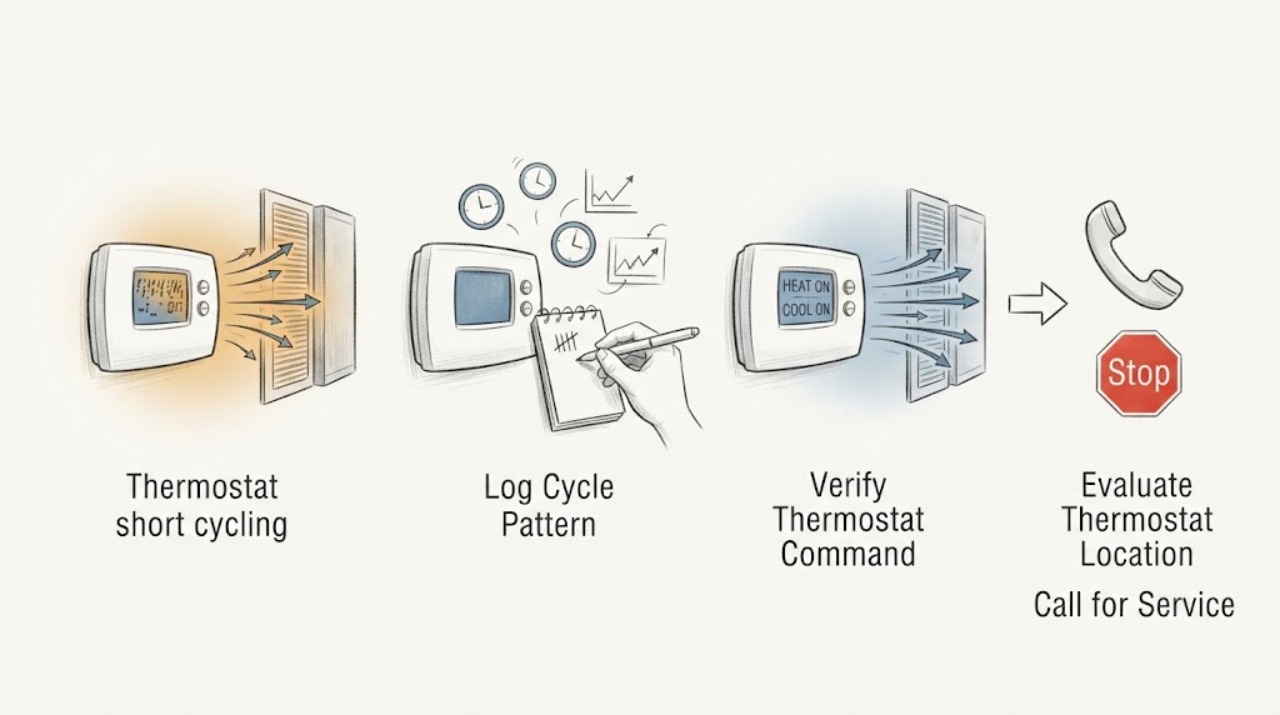
A thermostat that appears to short cycle is not automatically a failed thermostat. First record whether the system starts and stops before reaching the setpoint, then check the selected mode, schedule, batteries or display power, and whether the thermostat is in direct sun, a draft, or next to a heat source. Inspect the accessible air filter and airflow without opening equipment. If rapid cycling continues, the system never reaches the setpoint, ice appears, a breaker trips, wiring is loose, or refrigerant or equipment sizing may be involved, stop repeated restarts and have a qualified HVAC professional diagnose the system.
Work through in order
Diagnostic checks
Use only checks that match the exact appliance or system and its official guide.
-
Check 1
For one observation period, note the operating mode, approximate run and off intervals, room temperature, setpoint, whether the indoor fan continues, and whether the system stops before the setpoint is reached. Do not keep changing the setpoint to provoke a cycle.
Expected result: The system repeatedly starts and stops after only a short run, reaches the setpoint and stays off, runs continuously, or shows a thermostat call while the equipment is not operating.
Next step: Keep the log and use the matching branch. If the system is repeatedly short cycling or comfort is worsening, move to the filter and thermostat checks without repeatedly restarting the equipment.
Stop if: Stop and switch the system off if there is smoke, a burning odor, exposed or frayed wiring, water near electrical equipment, ice, or a breaker that trips again.
Why this matters
Why: Frequent starts before satisfaction support a short-cycling symptom, while normal cycles can vary with conditions. A call with no equipment response points toward power, control, safety, or equipment behavior rather than proving a bad thermostat.
-
Check 2
Check that the thermostat is in the intended heating or cooling mode, that the setpoint and programmed schedule are not being changed by another schedule or occupant, and that the fan setting is understood. If the display uses batteries, replace them only with the type specified by the thermostat manufacturer.
Expected result: The mode, setpoint, schedule, fan setting, or battery status was wrong; alternatively, the thermostat continues to call for conditioning with correct settings.
Next step: Restore the intended settings and observe one normal demand. If a modern control shows a protective delay, wait for the displayed/manual interval rather than bypassing it. Escalate if the call remains abnormal or the equipment does not respond.
Stop if: Do not remove the thermostat from its base to expose terminals or move wires unless the exact manufacturer instructions and your skills make that task appropriate; stop for loose, scorched, or exposed conductors.
Why this matters
Why: An incorrect mode or schedule can look like erratic operation, and a weak or blank display can indicate lost power or batteries. Correct settings do not prove the wall control is healthy if cycling persists.
-
Check 3
Observe the thermostat’s surroundings without opening it: direct sunlight, a nearby supply or return vent, a cooking or heating appliance, an exterior door, or a draft can distort the sensed room temperature. Keep nearby doors and windows closed during the observation.
Expected result: The thermostat is being warmed by sun or an appliance, cooled by a draft or vent, or mounted in a representative central location away from those influences.
Next step: Reduce the obvious environmental influence without blocking the thermostat. Do not relocate or rewire it as a casual fix; if the cycling continues, have placement, calibration, and system operation assessed professionally.
Stop if: Stop if relocation would require opening the wall, extending wiring, disturbing a heat-pump control, or working near line-voltage equipment.
Why this matters
Why: Trane says direct sun and poor placement can cause a thermostat to call or stop at the wrong time. A good location makes a placement-related explanation less likely, but it does not rule out sensor calibration or HVAC faults.
-
Check 4
Turn the system off at the thermostat, then inspect the accessible air filter and visible supply and return grilles. Replace a heavily loaded filter with the correct type and size, and remove only loose obstructions around grilles; do not open the air handler or furnace cabinet.
Expected result: The filter is visibly clogged, airflow is weak at several registers, or the filter and accessible grilles appear clear with normal airflow.
Next step: After the correct filter is installed, observe one demand without forcing rapid setpoint changes. If short cycling, weak airflow, or poor comfort remains, stop and arrange HVAC service.
Stop if: Stop if the filter is wet, frozen, contaminated, or inaccessible without removing equipment panels, or if there is water, ice, burning odor, or unusual noise.
Why this matters
Why: Carrier notes that a clogged filter can restrict airflow and cause protective shutdowns that mimic thermostat failure; restricted airflow can also contribute to short cycling. A clean filter does not rule out an indoor coil, blower, duct, or refrigerant problem.
-
Check 5
For cooling operation, observe from a safe distance whether the outdoor unit starts when the thermostat calls, whether its visible airflow path is blocked by leaves or objects, and whether ice is present on accessible tubing or the outdoor unit. Do not remove panels or touch the fan, coil, or refrigerant lines.
Expected result: The outdoor unit does not start, visible airflow is obstructed, frost or ice is present, or the outdoor unit runs with no visible ice.
Next step: Clear only loose debris that can be removed without approaching moving parts; otherwise leave the system off and call qualified HVAC service. Share whether ice returns and whether the indoor fan runs.
Stop if: Stop immediately for ice, water near electrical equipment, exposed wiring, a damaged disconnect, unusual electrical noise, or any need to reach through a grille or remove a panel.
Why this matters
Why: Carrier lists a non-running condenser, restricted outdoor airflow, frozen coil, and refrigerant-related conditions among causes of inadequate cooling and rapid cycling. Ice is a reason to shut the system down and obtain professional help, not to adjust the thermostat repeatedly.
-
Check 6
Compare the logged pattern with recent history: did short cycling begin after a thermostat change, installation, weather change, filter restriction, refrigerant service, or renovation? Note whether it has existed since the system was installed and whether all zones or only one area are affected.
Expected result: The symptom began with a control or placement change, has existed since installation, follows heavy load or weather, or remains after settings and airflow are correct.
Next step: Provide the timeline, model numbers, settings, filter result, cycle log, and ice or airflow observations to a qualified HVAC technician. Do not order a thermostat or refrigerant-related part solely from the symptom.
Stop if: Do not test refrigerant, compressor, capacitors, relays, low-voltage terminals, or safety switches yourself; stop for any electrical or mechanical hazard.
Why this matters
Why: A thermostat/control change suggests checking compatibility, wiring, configuration, and placement; a symptom present from installation can raise a sizing or design question; persistent cycling after basic checks can involve refrigerant, coil, compressor, safety controls, or other equipment.
Use your observations
Decision map
Find the observation that best matches what you see, then follow the next safe action.
-
PATH 01Next step
What you see
Smoke, burning odor, exposed wiring, water near electrical equipment, ice, or a breaker that trips again
Do this next
Switch the HVAC system off if safe and arrange qualified HVAC or electrical service.
Why this path and its safety boundary
Why it matters: This is no longer a routine thermostat adjustment; continued operation can worsen a safety or equipment problem.
-
PATH 02Next step
What you see
The mode, schedule, fan setting, or battery state was incorrect
Do this next
Restore the intended settings and observe one demand; escalate if the pattern returns.
Why this path and its safety boundary
Why it matters: The wall control can create an apparent cycling or comfort issue without a component failure.
-
PATH 03Next step
What you see
The thermostat is in direct sun, a draft, beside a vent, or near a heat-producing appliance
Do this next
Remove the obvious environmental influence without rewiring or relocating the control as a DIY repair, then reassess with a professional if needed.
Why this path and its safety boundary
Why it matters: The sensed temperature may not represent the room, so a placement-related control error is plausible.
-
PATH 04Next step
What you see
The filter is clogged or airflow is weak
Do this next
Install the correct filter and remove accessible obstructions; call service if airflow or cycling does not normalize.
Why this path and its safety boundary
Why it matters: Restricted airflow can trigger protective shutdowns and mimic thermostat short cycling.
-
PATH 05Next step
What you see
The outdoor unit does not run, ice is visible, or cycling persists with correct settings and airflow
Do this next
Leave the system off as appropriate and arrange qualified HVAC diagnosis.
Why this path and its safety boundary
Why it matters: A condenser, coil, refrigerant, electrical, or safety-control fault is possible and cannot be identified by the thermostat symptom alone.
-
PATH 06Next step
What you see
Short cycling has existed since installation or continues after all accessible checks
Do this next
Give the technician the cycle log and installation history; do not replace the thermostat or adjust refrigerant based only on timing.
Why this path and its safety boundary
Why it matters: System sizing, configuration, control compatibility, or an equipment fault needs professional assessment.
Helpful context
Understand the symptom
What short cycling means
Short cycling is repeated heating or cooling starts and stops before a normal cycle completes or the thermostat is satisfied. Cycle length varies with weather, load, equipment, and control settings, so a single brief cycle is not enough to diagnose a fault. A repeating pattern with poor comfort, humidity, weak airflow, ice, or a system that never reaches the setpoint deserves investigation.
Checks a homeowner can make
Keep the inspection at the wall control, accessible filter, room registers, and the visible outdoor unit area. Do not remove HVAC panels, handle low-voltage wiring, measure refrigerant, thaw a coil with heat, or bypass a safety. If a thermostat has a built-in compressor delay, follow its display or manual instead of forcing an immediate restart.
Why a thermostat replacement may not fix it
A misplaced or inaccurate thermostat can send an inappropriate call, but the equipment can also shut itself down because airflow, coil, refrigerant, electrical, or capacity conditions are wrong. A technician should test the complete control and HVAC system before a thermostat or larger component is replaced.
Safety boundary
Stop conditions
- Stop and switch the system off if safe for smoke, burning smells, exposed or frayed wiring, water near electrical equipment, ice, unusual electrical noise, or a repeated breaker trip.
- Do not remove HVAC panels, move thermostat wires, probe electrical terminals, test refrigerant, handle capacitors, bypass safety switches, or thaw a frozen coil with a heat source.
- Stop repeated restarts when short cycling continues after the accessible setting, location, filter, and airflow checks, or when the equipment never reaches the setpoint.
Only after diagnosis
Potential parts
- thermostat or room-temperature sensor
Only consider this category if testing confirms inaccurate sensing, incompatible control configuration, or a failed thermostat after placement and system causes are assessed.
Confirm the HVAC type, stages, wiring, and manufacturer compatibility before selecting a replacement; short cycling alone does not identify a thermostat. - air filter
Only replace the filter when the accessible filter is loaded or damaged and the correct filter specification is known.
Use the size and rating specified for the installed system; a filter change cannot repair a coil, duct, blower, refrigerant, or control fault. - HVAC control or safety component
Only consider this category after qualified testing identifies a failed relay, control, safety switch, or related circuit causing the cycling.
Do not choose a control component from the symptom; verify the exact equipment model and service diagnosis.
When checks do not resolve it
Need a professional?
Use qualified HVAC service for persistent short cycling, visible ice, weak airflow, a non-running outdoor unit, a recurring breaker trip, inaccurate temperature control, or a symptom that began after installation or thermostat replacement.
Common questions
FAQ
Does thermostat short cycling mean the thermostat is bad?
Not necessarily. Official HVAC guidance also lists poor thermostat placement, a clogged filter or restricted airflow, frozen coils, refrigerant problems, equipment faults, and improper sizing as possible contributors. Test the accessible basics before replacing the control.
Can a dirty air filter cause short cycling?
Yes. A heavily loaded filter can restrict airflow and cause protective shutdown behavior that resembles a thermostat problem. Replace it only with the correct specification, then call service if weak airflow or rapid cycling remains.
Should I keep restarting an HVAC system that turns off quickly?
No. Record the pattern and follow any built-in delay shown by the thermostat or manual. Repeatedly forcing starts can mask a safety shutdown; stop for ice, burning odors, electrical hazards, water, or a recurring breaker trip.
Can thermostat location cause short cycling?
It can. Direct sunlight, nearby vents, heat-producing appliances, and drafts can make the thermostat sense a temperature that does not represent the room. Reduce the obvious influence, but have wiring, calibration, and system operation checked before relocating the control.
Why does short cycling continue after I replace the thermostat?
The original cause may be airflow, a frozen or dirty coil, refrigerant, an electrical or safety shutdown, configuration, or system sizing rather than the wall control. Persistent cycling after a control change needs system-level HVAC diagnosis.
Read the exact guide
Official sources
- Troubleshoot an Air ConditionerCarrier · Air-conditioning short-cycling checks, airflow, outdoor unit, ice, refrigerant, and professional limits
- HVAC Programmable ThermostatsU.S. Department of Energy Building Science Education · Thermostat schedules and automatic setpoint behavior
- Common Thermostat Issues and How to TroubleshootCarrier · Thermostat display, short-cycling, filter, placement, delay, and professional-escalation guidance
- What Is HVAC Short Cycling?Trane · HVAC short-cycling definition, effects, thermostat placement, and sizing context
Community feedback
Share a repair observation
Share a plain-text repair observation. Accepted observations are published automatically; this page may take a moment to update.