
On this page
Start here
Quick answer
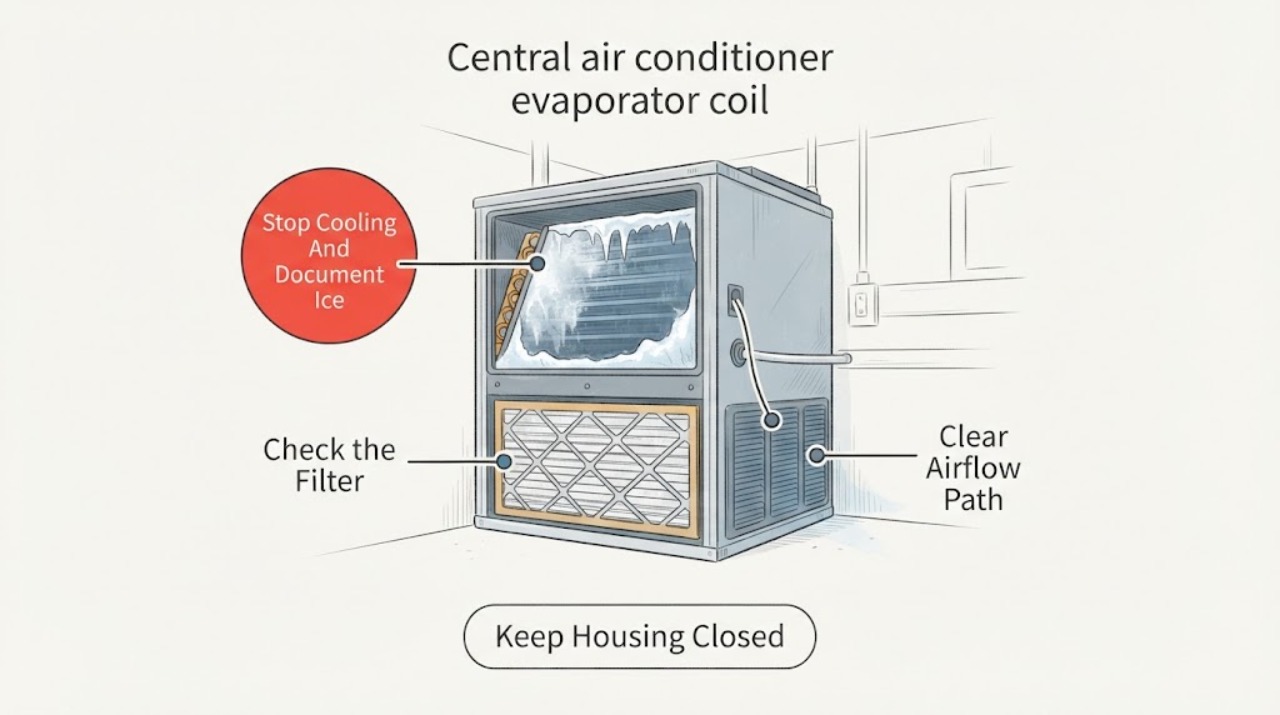
If a Trane central air conditioner's indoor evaporator coil is frozen, switch the thermostat from COOL to OFF and leave the system off while the ice thaws; do not chip at the ice or keep running the compressor. A dirty filter, blocked return air, a dirty coil, thermostat problem, low refrigerant or a refrigerant leak can all contribute, so a thawed coil does not by itself identify the cause. You can safely check the accessible filter, return grilles, thermostat mode, and visible water or icing without opening the air handler. Replace a dirty disposable filter with the exact documented type only after turning the system off, then arrange HVAC service if the coil freezes again, the filter and airflow look normal, refrigerant symptoms appear, or the coil, cabinet, drain pan, or wiring is inaccessible. Do not remove panels, handle refrigerant, use tools on the coil, or restart the system while ice remains.
Work through in order
Diagnostic checks
Use only checks that match the exact appliance or system and its official guide.
-
Check 1
From a safe position, switch the thermostat from COOL to OFF when you see ice on the indoor coil or cabinet, frost on a refrigerant line, warm air with the system running, or water near the indoor drain pan; do not chip ice or continue a cooling test.
Expected result: Ice is visible, the cabinet or line is frosted, water is present, the system is blowing warm air, or the suspected ice is not visible.
Next step: Leave the system off and let the ice thaw naturally. Protect nearby surfaces from meltwater without opening the air handler, then continue only with accessible external checks.
Why this matters
Why: Visible icing, associated water, or warm air supports a frozen-coil pattern, while no visible ice does not rule out another airflow or cooling fault. Continuing to run a frozen system can cause equipment damage and turns melting ice into a possible water event.
-
Check 2
After the system is off and only when the filter is accessible without removing an equipment panel, inspect the filter for visible loading and confirm its size and airflow-direction marking; do not reach into the air handler or run the system with a missing filter.
Expected result: The filter is visibly dirty or collapsed, the filter type or airflow direction is uncertain, or the filter looks clean and correctly seated.
Next step: If the exact replacement is documented and accessible, install it with the marked airflow direction after the system is off; if the filter is inaccessible, unusual, or the coil freezes again, leave the system off and arrange service.
Why this matters
Why: A loaded filter can restrict airflow enough to contribute to coil freezing. An uncertain filter fit should not be guessed, while a clean correctly seated filter makes blocked returns, coil dirt, thermostat behavior, refrigerant, or another fault more likely.
-
Check 3
Walk through the conditioned rooms and look at accessible return grilles for furniture, curtains, dust buildup, or other obstructions; do not dismantle grilles or enter the air handler to clean the coil.
Expected result: A return grille is blocked, several returns have weak airflow, the return path appears clear, or airflow cannot be judged safely.
Next step: Restore clear room-side return space without opening equipment. If icing recurs with a clean filter and clear returns, stop user troubleshooting and request HVAC diagnosis.
Why this matters
Why: A blocked return can reduce air across the evaporator coil and support an airflow-related freeze. Clear external furniture or loose obstruction only; a clear return path or inaccessible path keeps coil dirt, blower, duct, thermostat, and refrigerant causes in question.
-
Check 4
Read the thermostat's mode, setpoint, fan setting, schedule, and any alert after the system has been switched off; do not force an undocumented test mode or repeatedly call for COOL while the coil is still frozen.
Expected result: The thermostat was left in COOL, has an unusual schedule or alert, calls for cooling at unexpectedly low outdoor conditions, or appears correctly configured with no alert.
Next step: Keep the system OFF until the coil is fully thawed and record any thermostat alert or schedule behavior for the technician. Do not bypass controls or access wiring.
Why this matters
Why: A thermostat that fails to stop the system or has an unexpected schedule can contribute to extended operation and freezing. A normal display does not clear airflow, refrigerant, coil, or blower causes.
-
Check 5
While the system remains off, observe the indoor unit and nearby floor for meltwater, a full or overflowing drain pan, damp insulation, or a leak path; keep clear of electrical equipment and do not unclog a concealed drain or remove a panel.
Expected result: Water stays in the pan or drains normally, water reaches the floor, the pan appears full, or the water source cannot be seen.
Next step: Protect the area and arrange service for floor water, a full pan, concealed drainage, or any electrical proximity. Do not restart cooling until the ice and water issue have been assessed.
Why this matters
Why: Some condensate can occur as ice thaws, but water on the floor, a full pan, or an unknown source raises a drain or overflow risk in addition to the frozen coil. This cannot be distinguished safely by opening a powered air handler.
-
Check 6
After the coil has completely thawed, record whether icing returns, whether cooling remains weak, whether the unit runs constantly, and whether hissing or oily residue is visible from outside the equipment; do not touch refrigerant lines, gauges, or suspected residue.
Expected result: The coil freezes again, cooling remains weak with normal-looking airflow, the unit runs continuously, or hissing or oily residue is present; alternatively, the system operates normally after the documented filter change and clear returns.
Next step: Leave the system off for recurrence or leak clues and arrange HVAC service. If it remains stable, continue the manufacturer's maintenance schedule and monitor for renewed icing rather than repeatedly forcing test cycles.
Why this matters
Why: Recurrence, constant operation, weak cooling despite normal external airflow, hissing, or oily residue makes refrigerant, metering, coil, blower, thermostat, or another professional fault more likely than a one-time filter restriction. A single stable cycle after a known filter issue is encouraging but does not authorize opening equipment.
Use your observations
Decision map
Find the observation that best matches what you see, then follow the next safe action.
-
PATH 01Next step
What you see
Do this next
Keep the exact documented filter installed, maintain clear returns, and arrange service if icing returns or airflow remains weak. Do not clean an inaccessible coil as a user repair.
-
PATH 02Next step
What you see
Do this next
Leave COOL off and have a qualified HVAC technician measure airflow and refrigeration performance and inspect the coil, controls, drain, and blower.
-
PATH 03Next step
What you see
Do this next
Keep the system off and arrange qualified HVAC service. Do not add refrigerant, connect gauges, open the sealed circuit, or treat a recharge as a root-cause repair.
-
PATH 04Next step
What you see
Do this next
Keep cooling off, protect the area without opening equipment, and arrange HVAC service for the pan, drain, coil, and nearby electrical safety.
-
PATH 05Next step
What you see
Do this next
Keep clear, disconnect power only from a safe dry location if it can be reached without contact with damaged equipment, and contact qualified emergency service; use emergency services for active smoke or fire.
Helpful context
Understand the symptom
Why a frozen indoor coil matters
The evaporator coil is the cold indoor coil inside the air handler or in a coil case beside the furnace. When ice covers it, air cannot exchange heat normally, so the system may run without cooling, blow warmer air, or leave water as the ice later melts. The same visible symptom can come from more than one fault, so thawing is a safe first response, not proof that a dirty filter was the only cause.
Airflow is the first external path
Restricted airflow is a common pattern: a loaded filter, blocked return grille, closed or obstructed return path, or dirt on the coil can reduce air across the coil. Filter and grille checks are reasonable external observations. Coil cleaning, blower work, electrical diagnosis, refrigerant measurement, leak repair, and panel access belong with an HVAC professional.
Do not diagnose refrigerant by sight alone
Frost on the coil or refrigerant line can be consistent with low refrigerant, but it is not a user-level charge test. A hissing sound, oily residue, constant running, repeated icing, or normal airflow with renewed freezing makes a refrigerant or control fault more important to report. Leave the system off and provide those observations to the technician.
Only after diagnosis
Potential parts
- air filter
Consider a replacement filter only when the accessible filter is visibly loaded, damaged, or the wrong documented type and the exact system specification identifies a replacement.
Match the exact filter dimensions, type, airflow direction, and equipment instructions; a generic filter is not automatically suitable. - evaporator coil
Consider an evaporator-coil repair or replacement only after a qualified technician confirms coil damage, a leak, or a condition that cannot be corrected by airflow or control service.
Coils are model- and system-specific and involve refrigerant and sealed-circuit work; do not order or install one from the icing symptom alone. - blower motor or airflow component
Consider this category only if professional airflow testing finds a failed blower, motor, control, or related component after external filter and return checks are clear.
Confirm the exact air-handler model and electrical specifications; internal access and testing belong with qualified HVAC service. - thermostat or control component
Consider a thermostat or control component only when documented settings are correct but professional testing shows it is failing to control cooling or a defrost or limit sequence as designed.
Confirm system type, wiring, control features, and exact model compatibility before replacement; do not bypass controls.
When checks do not resolve it
Need a professional?
Keep the Trane system off and arrange HVAC service if the evaporator coil refreezes, cooling stays weak after the documented filter and accessible return checks, airflow is normal but ice returns, the unit runs constantly, hissing or oily residue appears, the coil or drain is inaccessible, or water reaches the floor or equipment. Stop immediately for smoke, burning odor, arcing, exposed or wet electrical equipment, repeated breaker trips, or water near energized components; disconnect power only from a safe dry location and do not open panels.
Common questions
FAQ
What should I do first when my Trane evaporator coil is frozen?
Switch the thermostat from COOL to OFF and leave the system off while the coil thaws. Do not chip at the ice or keep running the compressor. Once it is safe and thawed, check only the accessible filter, return-air path, and thermostat information, then arrange service if the cause is not clear or the icing returns.
Can a dirty air filter freeze a Trane AC evaporator coil?
Yes. Trane explains that a clogged or dirty filter can restrict airflow and contribute to a frozen evaporator coil. Replace an accessible filter only with the exact documented type and airflow direction after switching the system off; recurring ice needs professional diagnosis because a filter is not the only possible cause.
Why does the coil freeze again after I change the filter?
A blocked return, dirty coil, blower or duct problem, thermostat issue, low refrigerant or leak, or refrigerant-flow problem may remain. Trane recommends technician troubleshooting when filter or accessible drain checks do not prevent recurrence, so leave the system off rather than repeatedly restarting it.
Does ice on the Trane refrigerant line prove that refrigerant is low?
No. Frost can accompany low refrigerant or a leak, but restricted airflow, a dirty coil, thermostat behavior, and refrigerant-flow or metering problems can also freeze the indoor coil. A technician must test the system; do not add refrigerant or open the sealed circuit yourself.
Is water near the furnace normal when a frozen coil thaws?
Meltwater can appear as ice thaws, but water on the floor, a full pan, or an unknown path can indicate a drainage or overflow problem. Keep cooling off, protect the area, avoid opening the air handler, and arrange service when water reaches equipment or electrical components.
Read the exact guide
Official sources
- Air Handler Freezing Up: Causes and SolutionsTrane · Trane residential air-handler guidance; exact model and installation documentation control.
- AC Expansion ValveTrane · Trane residential cooling-system guidance; expansion-valve service is professional work.
- What Is a Home AC Recharge and Do I Need One?Trane · Trane residential air-conditioner refrigerant guidance; do not use as a DIY charging procedure.
- Home Air Conditioner Filter Replacement 101Trane · Trane ducted central-air filter guidance; use the exact equipment documentation for filter access and specification.
- Top 5 Causes of Frozen AC Coils and How to Fix ThemTrane · Trane residential guidance for central air conditioners and heat pumps; exact equipment instructions control.
Community feedback
Share a repair observation
Share a plain-text repair observation. Accepted observations are published automatically; this page may take a moment to update.