
On this page
Start here
Quick answer
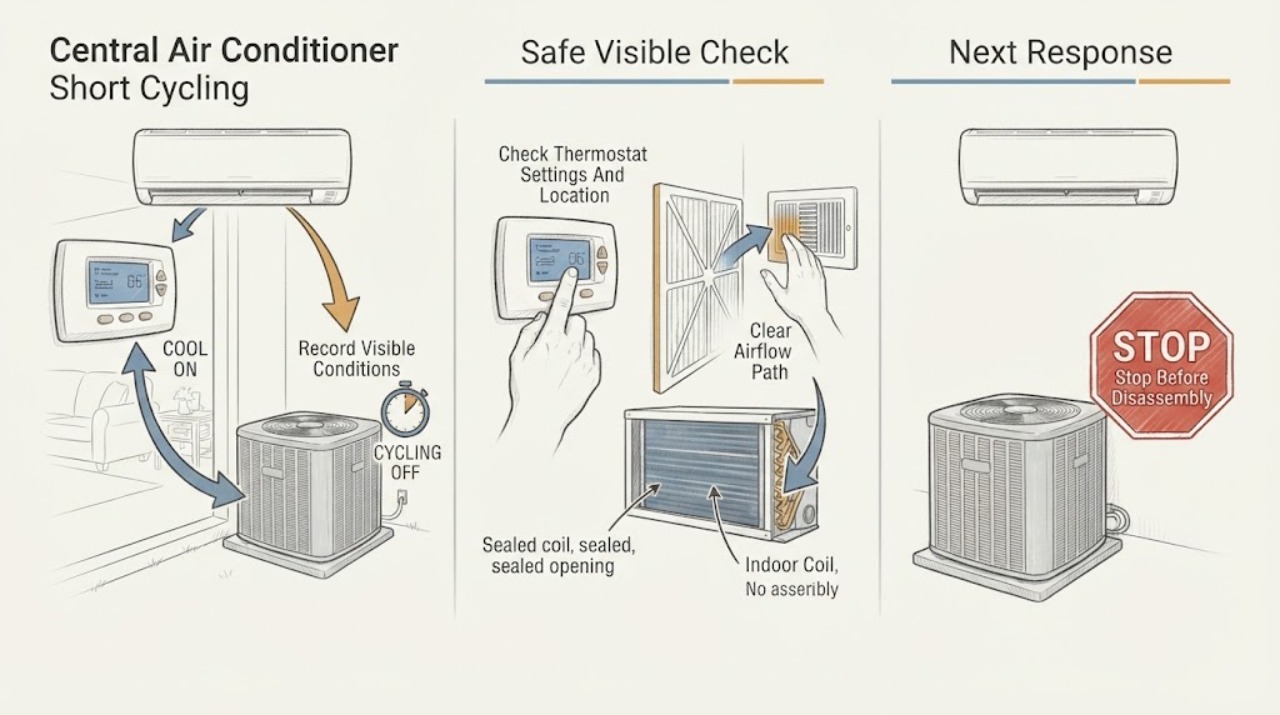
Short cycling means the Trane central air conditioner starts and stops repeatedly before comfort is reached, rather than completing a normal cooling cycle. First confirm that the behavior is abnormal and note whether the thermostat, indoor airflow, and outdoor unit change with each start. Check the thermostat mode, schedule, placement, and dust, then inspect or replace the air filter according to the model instructions and keep supply and return grilles clear. Look for ice, weak airflow, or a breaker that trips, but do not open the equipment, test wiring, or handle refrigerant. If short cycling continues with a clean filter and correct thermostat, begins after installation, or occurs with ice, low cooling, unusual noises, electrical symptoms, or repeated breaker trips, turn the system off as appropriate and arrange qualified HVAC service. Possible causes include thermostat signaling, restricted airflow, low refrigerant, a frozen coil, equipment sizing, or electrical and compressor faults, which require different professional tests.
Work through in order
Diagnostic checks
Use only checks that match the exact appliance or system and its official guide.
-
Check 1
From a safe position, note the thermostat call for cooling, indoor airflow, outdoor-unit operation, and each stop and restart during normal supervised operation; do not open either HVAC cabinet. Record whether the home reaches the set temperature and whether the behavior changes with outdoor temperature or a schedule change.
Expected result: The system repeatedly starts and stops before comfort is reached, runs continuously, reaches the set point and stays off, or stops with a fault indication, unusual noise, ice, weak airflow, or a tripped breaker.
Next step: Keep a brief cycle and symptom log for the technician. If ice, smoke, burning odor, unusual electrical noise, water damage, or repeated breaker trips is present, stop operating the system and arrange prompt qualified HVAC service.
Stop if: Do not continue cycling the equipment to collect more data when a breaker trips, ice is growing, wiring is damaged, or an electrical or refrigerant-related hazard is suspected.
Why this matters
Why: Repeated starts before comfort support a short-cycling complaint, while a completed cycle followed by a long off period may be normal for the operating conditions. Ice, weak airflow, electrical symptoms, or a fault indication change the issue from a simple thermostat check to an HVAC safety and service decision.
-
Check 2
Check the Trane thermostat display and settings without removing its cover: confirm cooling mode, the intended set point, fan mode, schedule or hold, and any delay or alert. From outside the thermostat, note whether it is in direct sun, beside a supply register, above a heat-producing appliance, or in an unusually drafty location.
Expected result: The thermostat mode, set point, schedule, or fan setting was changed; the display temperature differs noticeably from the room; dust is visible; or the settings and location appear normal.
Next step: Restore only the intended setting from the user instructions and observe one normal call. If the display remains inaccurate, the behavior returns, or wiring would need to be inspected, leave the thermostat intact and arrange HVAC service.
Stop if: Do not remove thermostat wiring, jumper terminals, bypass a delay or safety control, or relocate the thermostat yourself when relocation would disturb wiring.
Why this matters
Why: A wrong schedule, set point, fan mode, inaccurate reading, or poor location can send unwanted cooling calls or make the system appear to short cycle. If the controls and location are normal, the thermostat is not ruled out, but airflow, refrigeration, sizing, and equipment controls become more important.
-
Check 3
Turn the system off at the thermostat and inspect the accessible air filter and supply and return grilles. Replace a visibly loaded filter only with the size and type specified by the Trane equipment instructions, and clear furniture or loose items that block grilles without opening the air handler.
Expected result: The filter is dirty or collapsed, airflow is weak at several registers, a return or supply is blocked, or the filter and accessible airflow path are clear; note any frost or ice visible at the indoor unit or refrigerant tubing.
Next step: With a clean, correctly installed filter and clear grilles, make one supervised cooling call only if there is no ice, active leak, or electrical hazard. If airflow stays weak, ice appears, or short cycling continues, turn the system off as appropriate and arrange qualified service.
Stop if: Do not wash or remove an internal coil, open the blower cabinet, use a sharp tool in ductwork, or operate through an iced coil to force a diagnosis.
Why this matters
Why: Restricted airflow can contribute to poor cooling and short cycles and may allow an evaporator coil to freeze. A clear filter does not rule out a dirty internal coil, blower, duct restriction, refrigerant issue, or control fault. Ice is a stop-and-service signal rather than a reason to keep running the system.
-
Check 4
From outside the equipment enclosure, look for leaves, vegetation, blocked airflow, severe dirt, visible oil or refrigerant residue, damaged wiring, or unusual fan behavior while keeping clear of the fan and electrical compartment. Do not remove panels or attempt coil, refrigerant, capacitor, or compressor work.
Expected result: The outdoor unit has an obvious airflow obstruction, ice or oil-like residue, a fan that does not run normally, damaged wiring, unusual noise, or no visible issue.
Next step: Remove only loose vegetation or objects that are safely outside the equipment and do not touch the cabinet; otherwise record photos and leave the system off if a fault, ice, residue, or electrical damage is present. Arrange HVAC service for any continuing short cycle or abnormal outdoor behavior.
Stop if: Do not spray water into the unit, bend coil fins, open the disconnect or cabinet, touch refrigerant tubing to diagnose charge, or work near a moving fan.
Why this matters
Why: Blocked outdoor airflow, a frozen system, refrigerant loss, fan or compressor trouble, and electrical faults can all produce poor cooling or short cycling, but they require different tests. An unobstructed exterior does not prove that the coil, charge, controls, or compressor are healthy.
-
Check 5
Compare the cycle history with the equipment's installation history: note whether short cycling began on the first day, after a replacement or thermostat change, after a repair, or only recently. Record the Trane model and serial information, filter result, thermostat result, indoor and outdoor observations, and any ice, humidity, or temperature pattern.
Expected result: The behavior began immediately after installation, has existed since the system was installed, began after a control or filter change, or persists despite correct settings, a clean filter, clear grilles, and no visible obstruction.
Next step: Give the complete record to a qualified HVAC professional and ask for thermostat verification, airflow and coil assessment, refrigerant-leak and charge diagnosis, electrical safety checks, and a load-sizing review when the pattern dates to installation. Do not buy a thermostat or compressor part based on the symptom alone.
Stop if: Do not add refrigerant, adjust charge, change wiring, bypass a low-pressure or freeze protection, or authorize equipment replacement without a diagnosis and sizing evidence.
Why this matters
Why: A problem present from installation raises an equipment-sizing, duct, installation, or control-compatibility question; a new problem can involve airflow, thermostat, refrigerant, coil, fan, compressor, or electrical controls. Safe observations cannot distinguish these causes reliably.
Use your observations
Decision map
Find the observation that best matches what you see, then follow the next safe action.
-
PATH 01Next step
What you see
The system stops short only when a schedule, set point, fan mode, or thermostat location creates an unexpected cooling call, and the pattern changes after the intended setting is restored.
Do this next
Keep the corrected setting and monitor one normal cooling period; arrange HVAC service if the display is inaccurate, the call returns unexpectedly, or wiring or relocation is needed.
Why this path and its safety boundary
Why it matters: A control-state or thermostat-location issue is more likely than an immediate compressor or refrigerant failure.
-
PATH 02Next step
What you see
The filter is dirty or airflow is weak, or frost or ice appears on the indoor coil or refrigerant tubing while cooling is requested.
Do this next
Turn cooling off, leave the system cabinet closed, and arrange qualified HVAC service. Replace only the accessible filter if its model instructions support it and do not restart while ice remains.
Why this path and its safety boundary
Why it matters: Restricted airflow or a refrigeration problem may be affecting the coil and compressor protection; continued operation can worsen damage.
-
PATH 03Next step
What you see
Short cycling has existed since a Trane system was installed or replaced, the home cools very quickly but remains humid, or the system size and duct design were never documented.
Do this next
Ask a qualified HVAC professional to review the installation, measured airflow, thermostat operation, and a home load calculation; do not choose a replacement size by square footage or by copying the old unit.
Why this path and its safety boundary
Why it matters: Oversizing, duct or airflow design, installation, or control matching becomes more likely than a dirty filter alone.
-
PATH 04Next step
What you see
Correct thermostat settings, a clean filter, clear grilles, and an unobstructed outdoor unit do not change repeated starts and stops, or the system shows low cooling, residue, abnormal fan behavior, or an error.
Do this next
Stop repeated testing and arrange qualified HVAC diagnosis. Provide the cycle log and observations; do not handle refrigerant, capacitors, wiring, or internal controls.
Why this path and its safety boundary
Why it matters: A refrigerant leak, frozen coil, compressor or fan control, electrical fault, or another internal equipment problem is more likely.
-
PATH 05Next step
What you see
A breaker trips repeatedly, smoke or burning odor appears, wiring is damaged, the outdoor fan behaves dangerously, water is entering electrical equipment, or the coil is heavily iced.
Do this next
Keep people away, switch the system off from a safe control point, and obtain prompt qualified HVAC service or emergency help when there is fire or immediate electrical danger.
Why this path and its safety boundary
Why it matters: The issue has crossed into an electrical, mechanical, refrigerant, or equipment-damage hazard rather than a homeowner thermostat check.
Helpful context
Understand the symptom
Confirm a real short-cycle pattern
A variable-speed Trane system may change output instead of behaving like a simple on-and-off unit, and a conventional system can stop after satisfying a mild cooling demand. The useful pattern is repeated starts and stops before the home is comfortable, often with uneven cooling, clammy air, or rising energy use. Record the thermostat call, indoor airflow, outdoor-unit behavior, and whether the pattern began after a filter change, thermostat change, installation, or weather shift.
Separate homeowner checks from HVAC diagnosis
Thermostat settings and a dirty filter are reasonable first checks. Refrigerant charge, frozen evaporator coils, capacitors, compressor controls, wiring, and load sizing are not safe trial-and-error repairs. Do not add refrigerant, bypass a safety switch, open the condenser or air handler, or keep resetting a breaker that trips. Give the technician the cycle log and the result of the safe checks.
Only after diagnosis
Potential parts
- HVAC air filter
Only consider this category when the accessible filter is visibly loaded or damaged and the equipment instructions identify a user-replaceable filter.
Confirm the exact Trane equipment and filter dimensions and follow the manufacturer's airflow direction and installation instructions. - thermostat
Only consider a thermostat after a professional or model-specific diagnosis confirms inaccurate control, failed sensing, or incompatibility rather than a system or airflow fault.
Thermostat compatibility, wiring, staging, and configuration are system-specific; do not replace it from short cycling alone. - airflow or refrigeration service component
Only consider internal coil, airflow, or refrigeration parts after a qualified technician confirms the failed component through measured diagnosis.
Do not select refrigerant, coil, compressor, capacitor, or control parts by symptom; exact model and licensed service requirements apply.
When checks do not resolve it
Need a professional?
Arrange qualified HVAC service when short cycling continues after the intended thermostat settings and a correct clean filter are confirmed; when the pattern began at installation; when airflow remains weak; when ice, low cooling, high humidity, oil-like residue, unusual noise, or error indications appear; or when refrigerant, coil, fan, compressor, electrical, sizing, duct, or wiring work may be required. Stop operating the system for repeated breaker trips, smoke, burning odor, damaged wiring, dangerous fan behavior, heavy ice, or water near electrical equipment. Do not add refrigerant, open cabinets, test live voltage, bypass safety controls, or adjust equipment sizing yourself.
Common questions
FAQ
What does short cycling mean on a Trane central air conditioner?
It means the cooling system starts and stops repeatedly before the home is comfortable or a normal cycle is complete. Note the thermostat call, airflow, outdoor-unit behavior, and any ice or fault indication, then check only the thermostat settings and accessible filter before arranging service.
Can a dirty air filter cause my Trane AC to short cycle?
Restricted airflow from a dirty filter can contribute to short cycling and frozen-coil symptoms. Replace the filter only with the exact model-approved type, keep grilles clear, and arrange service if airflow stays weak, ice appears, or the cycling continues with a clean filter.
Why would a Trane AC short cycle from the day it was installed?
A problem present from installation raises questions about equipment sizing, duct and airflow design, thermostat or staging compatibility, or installation. Ask a qualified HVAC professional for measured airflow and a home load calculation rather than choosing a replacement size by square footage or copying the old unit.
Read the exact guide
Official sources
- Thermostat Troubleshooting: Solutions for Common IssuesTrane · Trane thermostat settings, placement, filter checks, short-cycling troubleshooting, and professional boundaries
- HVAC Quality InstallationENERGY STAR · ENERGY STAR HVAC sizing, airflow, refrigerant, and duct-quality installation guidance
- Air ConditionersTrane · Trane central air conditioner system types, sizing, load calculations, and homeowner resources
- Air Conditioning ServiceCarrier · Air conditioner professional service, short-cycling causes, coil and refrigerant diagnosis, and filter checks
- Troubleshooting an AC Not WorkingCarrier · Central air conditioner filter, airflow, refrigerant, frozen-coil, electrical, condenser, and short-cycling service boundaries
Community feedback
Share a repair observation
Share a plain-text repair observation. Accepted observations are published automatically; this page may take a moment to update.