
On this page
Start here
Quick answer
A Trane furnace can blow cool air when the thermostat is set to Fan On, is in the wrong mode, or is misreading the room; when a dirty filter restricts airflow and trips an overheat limit; when a high-efficiency furnace’s condensate drain blocks ignition; or when fuel, ignition, burner, flame-sensing, blower, duct, or control trouble prevents sustained heat. First check the thermostat mode, fan setting, call for heat, accessible filter, and unobstructed registers, then observe one normal startup from a safe position: does the burner ignite and stay on, and does the air become warm after the startup sequence? Replace only a correctly specified filter with the furnace off. Do not open the cabinet, clean burners or flame sensors, test gas or live electrical parts, repeatedly reset a breaker or safety lockout, or keep operating if you smell gas, see rollout or abnormal flame, or a carbon-monoxide alarm sounds. If the furnace continues blowing cold air, cycles without heat, shows a code, or needs ignition, limit-switch, condensate, blower, gas, or control diagnosis, arrange qualified HVAC service.
Before you begin
Safety first
- A qualified technician should test the thermostat and control call, airflow, filter and duct restrictions, igniter, burners, flame sensor, gas supply, high-limit and other safeties, condensate drain or pump, blower, wiring, and combustion. Homeowner checks should remain limited to thermostat settings, documented batteries, an accessible filter, clear registers, safe exterior observations, and information gathering.
Work through in order
Diagnostic checks
Use only checks that match the exact appliance or system and its official guide.
-
Check 1
Turn the thermostat out of heat and leave the area immediately if you smell persistent gas, hear gas escaping, see smoke or rollout, see damaged wiring, or a carbon-monoxide alarm sounds; do not operate switches or create flames in the affected area.
Expected result: There is no gas odor or alarm, or there is persistent gas odor, a CO alarm, smoke, soot, visible flame abnormality, or another immediate hazard.
Next step: For gas odor, leave the home and contact the gas utility or emergency services from a safe location; for a CO alarm, leave and follow emergency guidance. For other hazards, keep the furnace off and arrange qualified HVAC service. Do not re-enter or restart until the hazard is cleared.
Why this matters
Why: The absence of a warning permits limited, visual thermostat and filter checks. Gas or combustion warnings can indicate fire, explosion, or poisoning risk and cannot be diagnosed by repeated furnace starts.
-
Check 2
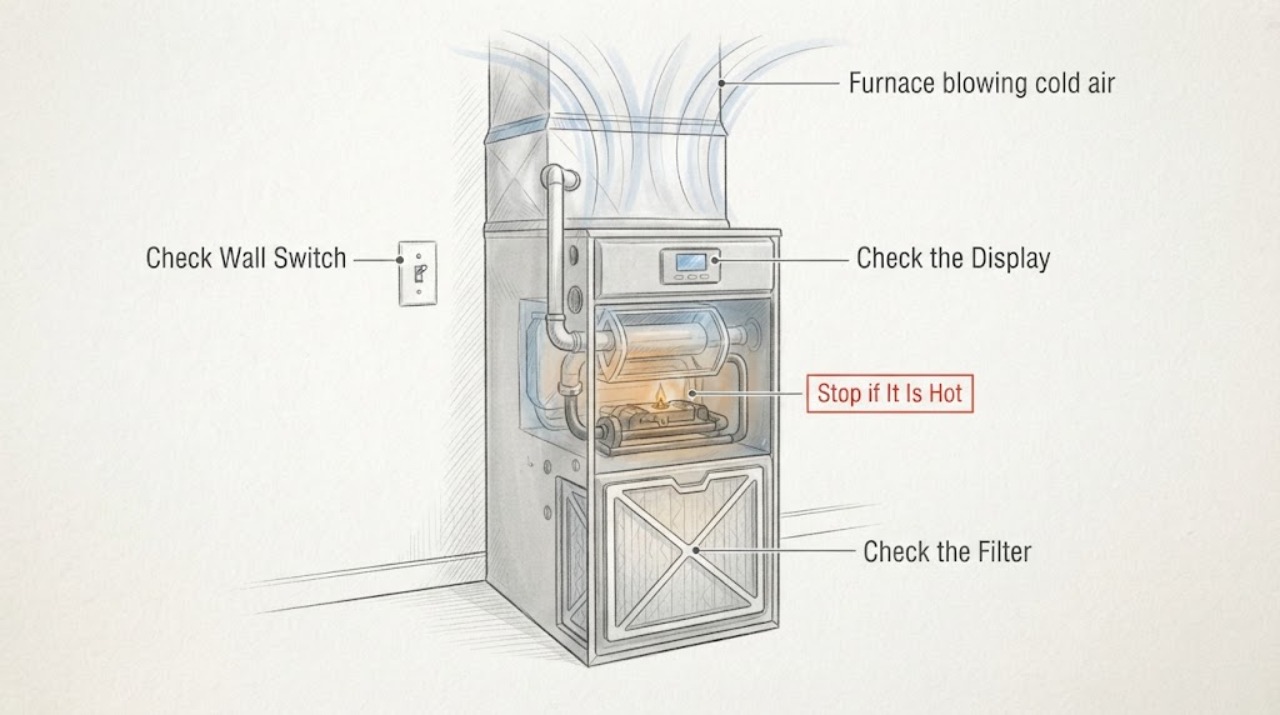
Check the thermostat display and settings without opening its base: confirm Heat is selected, the setpoint is above the room temperature, and the fan is Auto rather than On; replace batteries only when the thermostat instructions call for it.
Expected result: The thermostat is in Cool or Off, the fan is On, the setpoint is not calling, the display is weak, the room reading seems wrong, or settings and display appear normal.
Next step: Correct only an obvious setting or documented battery issue and observe one normal call. If the thermostat calls for heat but the air remains cool, do not change wiring or installer settings; continue with the filter and register checks and prepare for service.
Why this matters
Why: Cool or Off mode, Fan On, a low setpoint, weak batteries, or a misleading location can make the blower circulate cool room air without active furnace heat. Normal settings make airflow, ignition, fuel, safety, or control causes more likely.
-
Check 3
With the furnace turned off, inspect the accessible filter and return and supply registers; replace a dirty disposable filter or clean a documented permanent filter only as the Trane manual specifies, and keep the filter installed.
Expected result: The filter is loaded, wet, damaged, missing, or incorrectly seated; registers are blocked; airflow is weak; or the filter and registers appear clear.
Next step: Install only the exact documented filter with the furnace off and clear obvious register obstructions. If cool air continues, the filter is normal, or the furnace repeatedly shuts down, leave the furnace off and arrange professional diagnosis; never operate without a filter.
Why this matters
Why: A restricted filter or blocked airflow can reduce warm-air delivery and cause the furnace to overheat and shut off the burners while the blower continues. A normal accessible filter does not rule out a hidden airflow or limit problem.
-
Check 4
From a safe position, observe one heating call through the furnace’s normal exterior indicators or sight window if provided; note whether the blower starts, burners ignite, the flame stays on, and the air becomes warm, without removing any panel or touching the gas valve.
Expected result: The blower runs with no ignition, ignition occurs then stops, no startup occurs, or a stable flame and warm air are present only briefly or at some registers.
Next step: Do not retry a furnace that locks out, makes abnormal flame, or repeatedly ignites and drops out. Record any status light or code without opening the cabinet and arrange qualified HVAC service for ignition, flame, safety, and airflow testing.
Why this matters
Why: No ignition keeps fuel, igniter, control, door interlock, or safety causes in consideration. Ignition followed by shutdown keeps flame sensing, airflow, high-limit, condensate, burner, or gas-control causes in consideration. A stable furnace with cool air in only some rooms keeps duct leakage, damper, or register problems in consideration.
-
Check 5
Look only at accessible exterior conditions around the furnace and, if applicable, the visible condensate drain or pump area for water, a full pan, a blocked termination, or an alert; do not open the cabinet or disconnect a drain line.
Expected result: Water or a condensate alert is present, the furnace is a high-efficiency condensing model with a drain path, or no accessible moisture or alert is present.
Next step: Keep the furnace off for an overflow, water near controls, or condensate alert and arrange HVAC service to inspect the drain, pan, pump, and safety circuit. Do not pour chemicals, blow into a hidden line, or bypass a float or pressure switch.
Why this matters
Why: On condensing furnaces, a blocked drain can trigger a safety that prevents burners from igniting while the blower circulates cool air. No visible water does not rule out an internal drain, sensor, or safety fault.
-
Check 6
Check the furnace switch and breaker only from a dry, safe location and note any status code, repeated reset, or recent electrical or thermostat work; do not repeatedly reset a tripped breaker or remove the blower door.
Expected result: The furnace switch is off, the breaker is tripped, it trips again, the blower-door indicator is not seated, a code is displayed, or power appears normal.
Next step: Correct only an obvious switch position or fully closed access door when it can be done without opening equipment. If a breaker trips again, a code persists, or the furnace remains cold, leave power as found and arrange qualified HVAC service; do not bypass an interlock.
Why this matters
Why: An off switch or ajar access door can interrupt operation. A repeated breaker trip points to an electrical or equipment fault, and a code or lockout may indicate a safety condition rather than a setting error.
-
Check 7
Gather the Trane model and serial information from paperwork or an exterior label, furnace type, filter details, thermostat settings, startup sequence, flame or blower observations, codes, gas or CO symptoms, recent work, and the rooms affected.
Expected result: The issue began after thermostat, filter, duct, or electrical work; it affects every register; it affects only some rooms; it is intermittent; or it occurs after the burners light.
Next step: Give the record to a qualified HVAC professional and request checks of thermostat call, airflow, filters, burners, igniter, flame sensor, gas supply, high-limit and other safeties, condensate system, blower, ducts, and controls. Do not order a sensor, igniter, board, or valve from the symptom alone.
Why this matters
Why: Recent work raises configuration, filter seating, access-door, wiring, or duct-routing issues. Whole-home cool air after ignition raises furnace heat-generation or safety causes; room-specific cool air raises duct or register distribution. Intermittent shutdown after ignition keeps a sensor, limit, condensate, or control issue in consideration.
Use your observations
Decision map
Find the observation that best matches what you see, then follow the next safe action.
-
PATH 01Next step
What you see
The thermostat is set to Heat but the fan is On, and cool air flows even when the furnace is not making a heat call.
Do this next
Set the fan to Auto and observe one normal heating call. If the fan still runs cool during an active call, continue with the filter and startup observations and arrange service if heat is not produced.
Why this path and its safety boundary
Why it matters: Fan-only operation is more likely than a failed furnace heat source.
-
PATH 02Next step
What you see
The filter is loaded or airflow is weak, and the burners ignite briefly before cool air returns.
Do this next
With the furnace off, install the exact documented filter and clear registers. If the burners still drop out or the blower remains cool, stop operation and arrange professional airflow, limit, combustion, and control diagnosis.
Why this path and its safety boundary
Why it matters: Restricted airflow and an overheat limit or related safety shutdown are more likely, though a flame-sensing, burner, gas, or control issue can look similar.
-
PATH 03Next step
What you see
There is no ignition during a heat call, the furnace shows a lockout or code, or an ignition attempt is followed by immediate shutdown.
Do this next
Keep the furnace off if the condition repeats and arrange qualified HVAC service. Do not clean burners or flame sensors, alter gas controls, bypass safeties, or repeatedly reset the furnace.
Why this path and its safety boundary
Why it matters: Igniter, pilot, flame sensor, burner, gas supply, door interlock, condensate safety, wiring, or control faults remain possible and cannot be distinguished safely by air temperature alone.
-
PATH 04Next step
What you see
The furnace produces warm air at some registers but cool air or weak airflow in only certain rooms, while the heat call and burner operation are stable.
Do this next
Check only accessible registers and visible duct sections for closure or obvious disconnection. Arrange HVAC service for hidden duct, damper, blower, or airflow testing; do not open the furnace cabinet.
Why this path and its safety boundary
Why it matters: Duct leakage, a disconnected or restricted branch, blocked register, damper, insulation, or distribution issue is more likely than a furnace-wide ignition failure.
-
PATH 05Next step
What you see
Cool air persists after the thermostat, filter, register, and safe startup checks, or the furnace has water, repeated breaker trips, abnormal flame, gas odor, CO alarm, or recurring lockout.
Do this next
Keep the furnace off and arrange prompt qualified HVAC service, with gas or CO emergency action as applicable. Provide the startup sequence, codes, filter and airflow history, and any recent work rather than repeatedly restarting the unit.
Why this path and its safety boundary
Why it matters: An unresolved ignition, gas, combustion, limit, condensate, blower, electrical, control, duct, or safety fault remains; continued operation can create property or life-safety risk.
Helpful context
Understand the symptom
Cool air does not always mean the furnace failed
A blower can circulate room-temperature air when the thermostat fan is set to On, when the heat call has ended, or during a normal startup or shutdown delay. The useful question is whether the thermostat is calling for heat and whether the burners ignite and remain lit. Cool air throughout the call, repeated ignition attempts, or a furnace that lights and then shuts down points toward a heating, airflow, safety, or control problem rather than a fan setting alone.
Airflow is an early, accessible clue
A loaded filter or blocked return or supply register can reduce airflow and contribute to overheating, causing a safety limit to stop the burners while the blower continues. Filter location and construction vary by installation, so use the Trane manual or existing filter labeling. A clean filter does not rule out a dirty internal coil, blower issue, duct restriction, or limit-switch fault.
Ignition and flame sensing are not homeowner adjustments
A furnace may blow cool air when an igniter, pilot, burner, flame sensor, gas supply, or condensate safety prevents sustained combustion. Seeing a brief ignition followed by cool airflow is a clue, not proof of a failed sensor. Leave burners, flame sensors, gas controls, cabinet panels, and wiring to a qualified technician unless the exact owner manual provides a limited, safe observation.
Treat safety symptoms as a stop signal
Gas odor, an abnormal or yellow flame, soot, rollout, repeated breaker trips, damaged wiring, water near controls, a carbon-monoxide alarm, or a furnace that locks out changes the task from comfort troubleshooting to safety response. Do not keep resetting or cycling the furnace to obtain more information.
Safety boundary
Stop conditions
- Leave the home and contact the gas utility or emergency services from a safe location for persistent gas odor; leave and follow emergency guidance for a carbon-monoxide alarm. Do not operate switches or relight anything in the affected area.
- Turn the furnace off and arrange qualified service for abnormal flame, smoke, soot, rollout, water near controls, damaged wiring, repeated breaker trips, repeated lockout, or burners that ignite and immediately go out.
- Do not open the furnace cabinet, clean burners or flame sensors, test live voltage, alter gas valves, bypass a limit, pressure, condensate, or door safety, or repeatedly reset a breaker or lockout.
- Arrange HVAC diagnosis when cool air continues after the documented thermostat, filter, register, and safe visual checks, or when the correct Trane model procedure is uncertain.
Only after diagnosis
Potential parts
- furnace air filter
Consider this only when the accessible filter is loaded, damaged, missing, or the Trane documentation specifies replacement; a filter cannot repair an ignition, limit, duct, or control fault.
Confirm the exact Trane furnace or filter-rack model, dimensions, airflow direction, and documented filter type before replacement. - furnace igniter or flame-sensing component
Consider this only after a technician confirms an igniter or flame-sensing fault during the startup sequence; cool air alone cannot distinguish it from burners, gas, airflow, condensate, or controls.
Match the exact furnace model, ignition system, connector, mounting, and manufacturer procedure; combustion and ignition work is professional service. - furnace limit switch or condensate safety component
Consider this only when professional testing confirms an overheat or condensate safety component is faulty after airflow, filter, drain, and combustion causes are assessed.
Verify the exact Trane furnace, switch function and rating, drain or pressure arrangement, wiring, and safety setup; never bypass a safety control. - furnace blower motor or control board
Consider this only after testing confirms inadequate blower operation, an incorrect control signal, or a failed board; register temperature alone does not identify a component.
Confirm the exact indoor-unit model, motor type, control protocol, connector, airflow setup, and approved installation procedure. - furnace condensate drain or pump component
Consider this only when a qualified technician confirms a blocked, leaking, or failed condensate component is preventing safe ignition on a condensing furnace.
Match the exact furnace, drain or pump arrangement, tubing, trap, overflow protection, and manufacturer installation requirements.
When checks do not resolve it
Need a professional?
Safety scope: A qualified technician should test the thermostat and control call, airflow, filter and duct restrictions, igniter, burners, flame sensor, gas supply, high-limit and other safeties, condensate drain or pump, blower, wiring, and combustion. Homeowner checks should remain limited to thermostat settings, documented batteries, an accessible filter, clear registers, safe exterior observations, and information gathering.
Common questions
FAQ
Why is my Trane furnace blowing cold air?
The fan may be set to On, or the furnace may not be producing or sustaining heat because of a thermostat, filter or airflow, high-limit, condensate, ignition, burner, flame-sensor, fuel, blower, control, or duct issue. Confirm the thermostat and accessible filter, observe whether ignition occurs, and arrange service for persistent cool air or any safety symptom.
Can the Fan On setting make a Trane furnace blow cold air?
Yes. With Fan On, the blower can circulate room-temperature air even when the furnace is not actively heating. Set the fan to Auto and observe one normal heat call. If cool air continues while the thermostat calls for heat, the furnace may have an airflow, ignition, safety, fuel, or control problem.
Can a dirty filter cause a Trane furnace to blow cold air?
A dirty filter can restrict airflow and contribute to overheating, which may shut off the burners while the blower continues. Turn the furnace off and replace the filter only with the exact documented type; never run the furnace without one. If cool air or repeated shutdown remains, arrange professional airflow and safety diagnosis.
Why does my Trane furnace light and then blow cold air?
Ignition followed by cool airflow can occur when the flame is not sensed, airflow causes an overheat limit, a burner or gas issue interrupts combustion, a condensate safety prevents operation, or a control fault is present. Do not clean sensors, adjust gas controls, or bypass safeties; record the sequence and arrange qualified service.
Should I reset my Trane furnace if it is blowing cold air?
Do not repeatedly reset a breaker, lockout, or safety control. A single documented thermostat or switch correction can be observed, but recurring lockout, ignition failure, abnormal flame, water, or electrical symptoms require the furnace to remain off and a qualified technician to diagnose the cause.
When should I stop using a Trane furnace that blows cold air?
Stop and arrange service for abnormal flame, smoke, soot, rollout, water near controls, repeated breaker trips, repeated lockout, burners that light and go out, or persistent cool air after the documented thermostat, filter, register, and safe visual checks. Leave the home for persistent gas odor or a CO alarm and contact emergency support from a safe location.
Read the exact guide
Official sources
- Furnace Not Turning On? Try These Troubleshooting TipsTrane · Trane provides checks for thermostat, furnace switch and breaker, filter and registers, ignition, gas odor, and professional service boundaries.
- Furnace Not Blowing Hot Air? Get Help NowTrane · Trane directly addresses a furnace blowing cold air and identifies Fan On, thermostat, filter, high-limit, condensate, ignition, burner, flame-sensor, and duct possibilities.
- Furnace Troubleshooting: Gas Furnace SolutionsTrane · Trane warns against DIY gas and electrical repairs, provides safe thermostat, register, filter, power, and observation checks, and gives emergency guidance for gas odor and CO concerns.
- Proper Maintenance – Gas FurnacesTrane · The Trane manual describes model-dependent filter locations, requires power disconnection before blower-door access, and lists thermostat, power, filter, airflow, burner, gas, and lockout clues.
- Furnace Not Igniting? Find Out Why and What to DoTrane · Trane explains how thermostat, power, filter, gas, igniter, flame-sensor, pilot, and burner conditions affect ignition and directs professional repair for modern ignition and flame-sensor faults.
Community feedback
Share a repair observation
Share a plain-text repair observation. Accepted observations are published automatically; this page may take a moment to update.