
On this page
Start here
Quick answer
If a Trane furnace is not heating, verify that the thermostat is calling for heat and the fan is set appropriately, then check the accessible furnace switch, breaker, filter, return, and supply vents. Note whether the furnace is silent, starts but does not ignite, ignites and shuts back down, or runs the blower with cool air. Trane identifies airflow restriction, power, thermostat, fuel, ignition, condensate, burner, flame-sensor, and duct issues as different possibilities; only the filter, grille, and obvious control-setting checks are ordinary homeowner checks. Do not open the burner or blower compartment, adjust gas controls, bypass a limit or safety switch, or repeatedly reset a tripped breaker. Keep the furnace off and arrange qualified HVAC service for failed ignition, repeated lockout, persistent cool air, weak airflow, or any internal or venting concern. Leave immediately for a suspected gas leak or carbon-monoxide alarm.
Before you begin
Safety first
- This article supports thermostat-setting verification, safe accessible switch and filter checks, clearing blocked grilles, observing one start sequence from outside the cabinet, and looking at safely visible vent or condensate conditions. It does not authorize panel removal, live electrical work, gas or combustion adjustment, ignition or burner service, safety-control bypass, or blower, sensor, heat-exchanger, or vent repair.
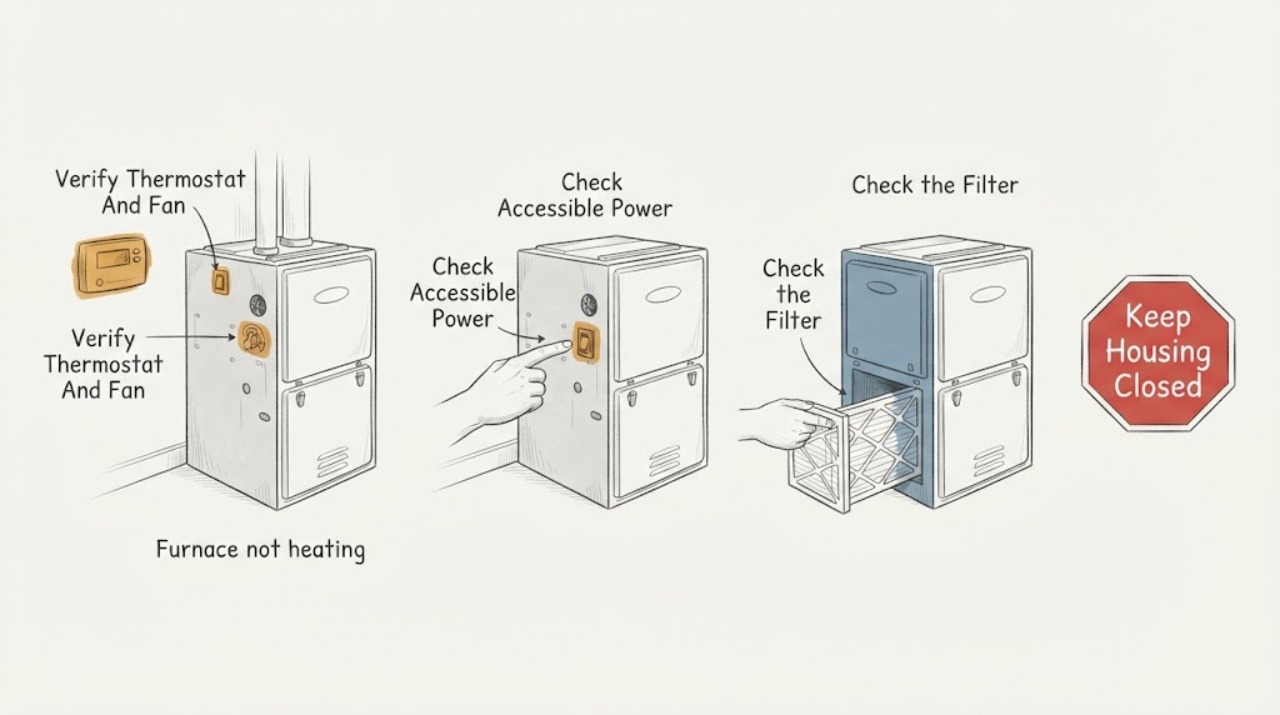
Work through in order
Diagnostic checks
Use only checks that match the exact appliance or system and its official guide.
-
Check 1
Set the thermostat to Heat with the target above the room temperature and check whether the display shows an active heat call; set the fan to Auto when the goal is furnace-heated air, and replace thermostat batteries only if the thermostat instructions allow it.
Expected result: The display is blank, the system is in Cool or Off, the fan is set to On, no heat call appears, or a valid heat call is present but the furnace does not respond.
Next step: Correct only an obvious thermostat setting or battery issue. If the display remains blank or the furnace still does not respond to a valid call, leave wiring untouched and arrange qualified HVAC service.
Stop if: Do not remove or bridge thermostat wires, change control wiring, or keep cycling the thermostat to force ignition.
Why this matters
Why: A setting, battery, or fan-mode issue can make the home feel cold or circulate unheated air. A valid heat call with no furnace response points toward power, wiring, control, or furnace-side trouble rather than a setting alone.
-
Check 2
With no gas odor, smoke, unusual heat, or electrical damage present, check the accessible furnace service switch and the breaker labeled for the furnace; if a breaker is tripped, do not touch exposed wiring and do not reset it repeatedly.
Expected result: The service switch is off, a breaker is tripped, the breaker trips again, or power appears on while the furnace remains unresponsive.
Next step: Restore an accidentally switched-off control only when it is safe and permitted by the equipment instructions. If the breaker trips again or the furnace does not start, leave it off and arrange qualified HVAC service.
Stop if: Do not increase fuse or breaker capacity, remove electrical covers, test live voltage, or repeatedly reset a breaker or furnace safety.
Why this matters
Why: An accidentally switched-off unit can be silent. A breaker that trips again signals an electrical or equipment fault, while power with no response makes control, ignition, motor, or safety diagnosis more likely.
-
Check 3
Turn the furnace off, inspect the accessible air filter for dust loading, and check that return grilles and supply registers are open and not blocked by furniture, drapes, or stored items; replace or clean the filter only as its instructions specify.
Expected result: The filter is dirty, a return or supply path is blocked, airflow is weak, the filter and grilles are clear, or the furnace still does not heat after an allowed filter correction.
Next step: Correct the accessible filter or grille issue and refit all covers before any permitted operation. If heat or airflow does not return, keep the furnace off and arrange qualified HVAC diagnosis.
Stop if: Never operate the furnace without the required filter, with an access door removed, or with hands inside the blower compartment.
Why this matters
Why: Restricted airflow can reduce warm-air delivery and may cause overheating or a safety shutdown. A clear filter and open grilles with continued no heat point toward ignition, fuel, condensate, controls, blower, or another fault requiring service.
-
Check 4
From outside the cabinet, observe one normal call for heat only when there is no gas odor, smoke, safety alarm, unusual heat, or abnormal flame sign; note whether the furnace is silent, starts a draft, ignites, keeps the flame, and then sends warm air through the registers.
Expected result: Nothing starts, a draft or inducer starts but ignition does not follow, ignition starts and stops, the blower runs with cool air, or the unit produces warm air briefly and then shuts down.
Next step: Record the sequence, display code, and sound for a qualified HVAC technician. Keep the furnace off for failed ignition, repeated starts and stops, blower-only cool air, or a sequence that does not complete.
Stop if: Do not open the burner compartment, touch flame or wiring, relight or reset a pilot without exact model instructions, or bypass an ignition, limit, flame, rollout, or pressure safety.
Why this matters
Why: The stopping point narrows the service area: no response suggests power or controls; failed or lost ignition suggests fuel, igniter, pilot, burner, flame-sensing, condensate, vent, or safety issues; blower-only cool air can reflect fan mode, airflow, or failed heat production; brief heat followed by shutdown needs safety and operating diagnosis.
-
Check 5
From a safe position, inspect any visible flue or intake termination and the area around the furnace for obvious blockage, damage, water, or a condensate overflow; do not climb, insert objects, open panels, or disconnect a drain line.
Expected result: A vent or intake is blocked or damaged, water is present around a high-efficiency furnace or drain pan, the area is clear, or the no-heat condition persists without an obvious exterior cause.
Next step: Keep the furnace off for questionable venting, water intrusion, or condensate overflow and arrange qualified HVAC inspection. Provide photographs only from a safe position and do not attempt to clear an internal drain or vent yourself.
Stop if: Do not climb to a roof termination, seal or reroute venting, pour chemicals into a condensate line, open the furnace, or operate with water near electrical components.
Why this matters
Why: Trane notes that blocked condensate drainage can prevent burners from igniting on condensing furnaces and that gas-furnace venting and combustion systems require safe operation. A clear exterior does not rule out an internal blockage, ignition, burner, sensor, or control fault.
-
Check 6
Before returning the Trane furnace to normal use, review the thermostat call, power, filter and vent observations, operating sequence, airflow, and any code or alarm; leave the unit off when the no-heat cause is unresolved.
Expected result: Heat returns after a permitted thermostat, filter, grille, or accidental switch correction with no safety sign, or no heat persists, the unit repeatedly locks out, a breaker trips, or service access would be required.
Next step: Arrange qualified HVAC service and provide the model, fuel type, symptom sequence, filter and airflow findings, vent or condensate observations, and any code or alarm. Do not restore operation merely to see if it eventually heats.
Stop if: Do not remove panels, service burners or flame sensors, test gas pressure, replace igniters or motors, clear internal drains, or bypass or reset a safety without qualified diagnosis.
Why this matters
Why: An accessible setting or airflow issue may have been corrected, but persistent no heat can involve the gas supply, ignition, flame sensor, burner, condensate, blower, limit switch, controls, ductwork, or another internal condition.
Use your observations
Decision map
Find the observation that best matches what you see, then follow the next safe action.
-
PATH 01Next step
What you see
The thermostat is blank or not calling for heat, or it calls for heat but the Trane furnace remains silent after the accessible switch and breaker check.
Do this next
Correct only an obvious thermostat setting or battery issue. If a valid heat call still produces no response or a breaker trips again, leave the furnace off and arrange qualified HVAC service.
Why this path and its safety boundary
Why it matters: A thermostat setting, battery, service switch, breaker, wiring, or control issue may be stopping the sequence; a recurring trip is an electrical fault, not a reset opportunity.
-
PATH 02Next step
What you see
The blower runs but the registers deliver cool or barely warm air, especially with a fan setting of On, weak airflow, a dirty filter, or blocked grilles.
Do this next
Set the fan to Auto, inspect the filter and grilles with the furnace off, and correct only an allowed filter issue. If cool air or weak airflow remains, keep the unit off and call an HVAC professional.
Why this path and its safety boundary
Why it matters: Fan mode or restricted airflow may explain the symptom, but the heat-producing sequence may also have failed due to ignition, flame sensing, fuel, condensate, burner, or control trouble.
-
PATH 03Safety boundary
What you see
A draft or ignition sequence begins but no sustained flame or warm air follows, or the furnace starts and stops repeatedly before heating the home.
Do this next
Keep the furnace off, record any code and sequence, and arrange qualified HVAC diagnosis. Do not relight, open the burner compartment, alter gas settings, or bypass a safety.
Why this path and its safety boundary
Why it matters: Fuel, pilot or electronic ignition, flame sensor, burner, condensate, venting, or a safety control may be preventing the cycle from completing; the exact cause needs model-specific testing.
Safety stop: Do not repeat failed ignition cycles or reset a hard lockout to keep the furnace running temporarily.
-
PATH 04Next step
What you see
The filter is loaded, return or supply grilles are blocked, airflow is weak, or a high-efficiency furnace has visible condensate water while the burners do not provide heat.
Do this next
Correct only the accessible filter or grille condition as directed by the manual. Keep the unit off for condensate overflow, persistent weak airflow, or continuing no heat and arrange HVAC service.
Why this path and its safety boundary
Why it matters: Airflow restriction can reduce heat delivery or trigger an overheating shutdown, while a clogged condensate path can prevent ignition on a condensing furnace. A visible water issue needs service rather than a restart.
-
PATH 05Safety boundary
What you see
There is a strong or lingering gas odor, carbon-monoxide alarm, smoke, soot, flame rollout, sparking, unusual heat, water near electrical parts, or damaged or blocked venting.
Do this next
Leave the home or area as appropriate, avoid ignition sources and electrical switches in a suspected gas leak, and contact emergency services or the gas utility from a safe location. Arrange HVAC service only after the immediate danger is addressed.
Why this path and its safety boundary
Why it matters: This is an immediate combustion, fire, electrical, or carbon-monoxide safety concern, not a routine no-heat adjustment.
Safety stop: Do not operate the furnace, relight a pilot, reset a safety control, open the cabinet, or return indoors until the appropriate emergency authority says it is safe.
Helpful context
Understand the symptom
Identify where the heating sequence stops
A furnace can fail before any blower starts, during ignition, after a brief flame, or after the blower starts. Those patterns point to different next checks. A fan set to On can circulate room-temperature air even when the furnace is not heating; a blower that runs while the furnace will not ignite can instead reflect ignition, flame-sensing, thermostat, fuel, or safety trouble. Use one safe observation and record it rather than repeatedly cycling the equipment.
Begin with filter, vents, and accessible controls
Trane lists a dirty filter, blocked return or supply vents, an off furnace switch, and a tripped breaker among checks a homeowner can make. Turn the furnace off before inspecting the filter, use the correct replacement or cleaning method for that filter, and never operate the unit without its filter. If the breaker trips again, stop resetting it and call for service.
Fuel, ignition, and safety faults belong to a technician
A gas furnace may not heat if fuel does not reach the igniter, the electronic ignition or pilot sequence fails, a burner or flame sensor does not operate, or a safety control prevents ignition. A high-efficiency furnace may also stop the burners when condensate cannot drain. These components require model-specific diagnosis; do not open the furnace, alter gas settings, or bypass a safety.
Safety boundary
Stop conditions
- Do not operate a Trane furnace with strong or lingering gas odor, carbon-monoxide alarm, smoke, soot, flame rollout, sparking, unusual heat, water near electrical parts, or damaged or blocked venting.
- Do not repeatedly reset a tripped breaker or hard lockout, increase fuse or breaker capacity, bridge thermostat terminals, or bypass a limit, flame, rollout, pressure, or door safety.
- Do not open burner or blower compartments, touch live wiring or flames, adjust gas pressure, clear internal condensate or venting, or replace ignition, sensor, blower, or motor parts as a homeowner no-heat check.
- Never operate the furnace without its required filter, doors, or covers in place, and do not climb or insert objects into an outdoor vent or intake.
- Keep the furnace off and arrange qualified HVAC service when no heat persists after ordinary thermostat, switch, filter, grille, and safe exterior checks or when the sequence repeatedly starts and stops.
Only after diagnosis
Potential parts
- Trane furnace ignition component
Consider this category only after qualified testing shows that ignition fails or drops out and thermostat, power, fuel, venting, condensate, and safety conditions have been evaluated.
Confirm the exact Trane model and technician diagnosis before ordering; ignition work requires correct installation and combustion-safety testing. - Trane furnace flame sensor
Consider this category only when qualified diagnosis identifies flame-sensing failure as the reason the burners do not remain lit after ignition.
Confirm the exact model and diagnostic result before ordering; do not clean, reposition, or replace a sensor inside the burner compartment without appropriate training. - Trane furnace blower motor or capacitor
Consider this category only when service identifies a blower motor or capacitor fault after the filter, grilles, duct airflow, and heat-producing sequence have been evaluated.
Confirm the exact model, motor, capacitor rating, and mounting details before ordering; electrical components can retain hazardous energy.
When checks do not resolve it
Need a professional?
Arrange qualified HVAC service when the thermostat calls for heat but the Trane furnace is silent, the draft or ignition sequence fails, the blower runs with cool air, the unit repeatedly locks out, the filter and grilles are clear but no heat persists, condensate or venting is questionable, or any internal gas, electrical, burner, blower, ignition, sensor, or safety access would be required. Leave immediately and use emergency or gas-utility help for a suspected gas leak or carbon-monoxide alarm.
Safety scope: This article supports thermostat-setting verification, safe accessible switch and filter checks, clearing blocked grilles, observing one start sequence from outside the cabinet, and looking at safely visible vent or condensate conditions. It does not authorize panel removal, live electrical work, gas or combustion adjustment, ignition or burner service, safety-control bypass, or blower, sensor, heat-exchanger, or vent repair.
Common questions
FAQ
Why is my Trane furnace running but not heating?
Check whether the fan is set to On instead of Auto, then inspect the accessible filter and return and supply grilles with the furnace off. If the blower runs but the furnace does not ignite or warm air does not return, the issue may involve ignition, flame sensing, fuel, condensate, burners, controls, or another internal fault that needs HVAC service.
What should I check first when my Trane furnace will not turn on?
Verify that the thermostat is in Heat and calling above room temperature, then check the accessible furnace switch, breaker, filter, and blocked grilles. Do not bridge thermostat wires or repeatedly reset a breaker; if a valid call still produces no response, arrange qualified service.
Can a dirty filter cause a Trane furnace to stop heating?
A dirty filter can restrict airflow, reduce warm-air delivery, and contribute to an overheating safety shutdown. Turn the furnace off before checking it, use the correct filter method and orientation, and never operate without the required filter. Persistent no heat or weak airflow requires professional diagnosis.
Should I relight the pilot on a Trane furnace that is not heating?
Only follow a pilot-light procedure if the exact model's owner manual explicitly provides it and there is no gas odor or other hazard. Newer furnaces may use electronic ignition, and a failed ignition sequence can involve fuel, venting, flame sensing, condensate, or a safety control. Do not open the burner compartment or bypass a safety; call an HVAC professional when ignition fails.
Read the exact guide
Official sources
- Furnace Not Blowing Hot Air? Get Help NowTrane · Used for the no-heat symptom branches; gas-furnace content applies conditionally, and the installed model manual controls.
- Furnace Troubleshooting: Gas Furnace SolutionsTrane · Used for gas-furnace safety and homeowner boundaries; electric-furnace users should follow their own model documentation.
- Furnace Blower Not Working: Causes and SolutionsTrane · Used to distinguish blower-only cool air from a blower motor fault and to set the service boundary.
- Furnace Not Turning On? Try These Troubleshooting TipsTrane · Used for silent-furnace and startup checks; gas and ignition work remains professional.
- Furnace Filter Guide: Everything You Need to KnowTrane · Used for the ordinary filter check; exact filter type, size, and access depend on the installed system.
Community feedback
Share a repair observation
Share a plain-text repair observation. Accepted observations are published automatically; this page may take a moment to update.